





























Traditional Shawl or Modern Stole? What Should Pakistani Men Choose for a More Contemporary Eastern Look?
Traditional shawl or modern stole? See which option gives Pakistani men a cleaner contemporary Eastern look for winter, weddings and formal wear.
In Islampur, Swat, shawl making is still a living skill rather than something kept only for display. A 2024 report by The National documented young workers who had learned handloom skills from older family members and continued working in the local shawl trade.
One young worker, Shehzad, had considered leaving the area for further education. He eventually stayed and continued the craft that had been passed down through his family. His experience reflects something important about shawls in Pakistan. They are connected not only with winter clothing, but also with family skills, regional identity and livelihoods.
At the same time, Pakistani menswear has become cleaner and more structured. Straight-cut kurtas, fitted waistcoats, simple sherwanis and narrow trousers are now common choices for weddings and formal gatherings.
That creates a very practical style question.
Should a Pakistani man wear a traditional full shawl with these clothes, or does a narrower modern stole create a more contemporary Eastern look?
There is no need to reject one in favour of the other. The better choice depends on four things: the shape of your outfit, the weather, the occasion and the amount of fabric you actually need.
Traditional Shawl and Modern Stole: What Is the Main Difference?
A traditional shawl and a modern stole may look similar when they are folded, but they create very different shapes once worn.
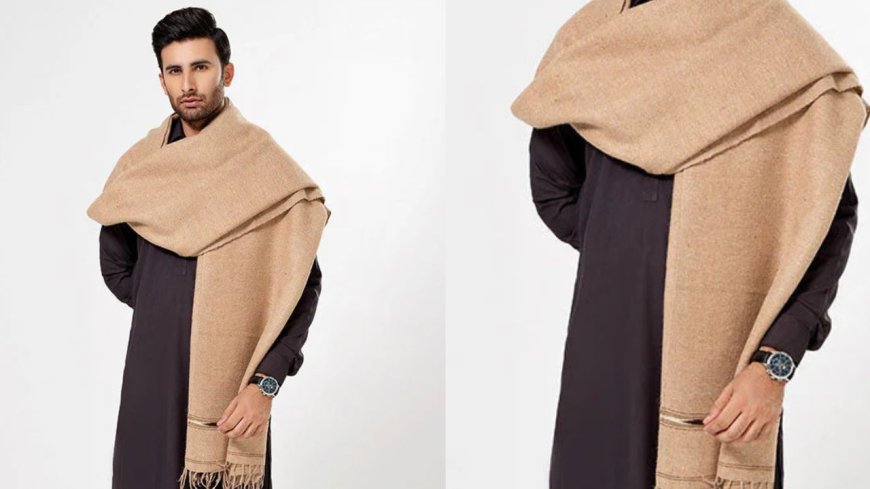
A traditional men’s shawl is generally wider and provides more coverage. It can sit across both shoulders or wrap around the chest and arms when the temperature drops. This makes it both a clothing layer and a style element.
A stole is normally narrower. It usually falls around the neck or from the shoulders without covering much of the upper body. Because less fabric is involved, more of the kurta, waistcoat or sherwani remains visible.
That difference matters more than the name written on the label.
A full shawl adds width and visual presence. A stole produces a longer and cleaner line.
If your clothes are loose and traditional, a shawl may create better balance. If your clothes are fitted and structured, a stole may allow their shape to show more clearly.
Traditional Shawl vs Modern Stole for Pakistani Men
|
Feature |
Traditional Shawl |
Modern Stole |
|
Overall appearance |
Fuller and more traditional |
Cleaner and more minimal |
|
Coverage |
Covers shoulders, chest and often the arms |
Mainly covers the neck and shoulders |
|
Warmth |
Better for cold winter conditions |
Better for mild weather or indoor use |
|
Best with |
Shalwar kameez, kurta pajama and traditional formal wear |
Straight-cut kurta, fitted trousers and waistcoat |
|
Best occasions |
Winter weddings, outdoor gatherings and formal family events |
Engagements, dinners, Eid events and indoor functions |
|
Visual effect |
Adds width and presence |
Creates a vertical and lighter shape |
|
Ease of wearing |
Requires more attention to draping |
Easier to manage |
|
Best fabric approach |
Wool, fine wool and heavier traditional weaves |
Fine wool and lighter fabrics |
|
Cold-weather practicality |
High |
Moderate to low |
|
If buying only one |
Usually more versatile in Pakistan |
Better as an additional style option |
The table gives the quick difference, but the right choice becomes clearer when you look at how each option works with Pakistani Eastern clothing.
Why a Traditional Shawl Can Still Look Contemporary
A traditional shawl does not automatically make a man look old fashioned.
Usually, the problem is not the shawl. It is the number of details competing around it.
Imagine a kurta with noticeable embroidery, a patterned waistcoat and a shawl with another strong design. Each item may look attractive on its own. Together, they can make the outfit feel crowded.
Now replace the decorative shawl with a plain charcoal or dark brown wool piece. Suddenly the kurta and waistcoat have room to breathe.
That is one of the simplest ways to make traditional clothing feel current.
Contemporary Eastern dressing often works best when one piece provides texture and the others stay quiet.
For example, a charcoal shawl over an off-white shalwar kameez gives clear contrast without looking loud. Brown or camel can soften a black kurta. Grey works naturally with navy, white and deep winter shades.
The key is restraint.
You do not need to remove traditional clothing to create a modern appearance. You simply need to control the colour, texture and amount of fabric.
When a Traditional Shawl Is the Better Choice
A full shawl becomes the stronger option when warmth and traditional proportion are both important.
Pakistani winter events often move between indoor and outdoor spaces. At a wedding, you may stand outside while guests arrive. You may walk across an open lawn for photographs. Later, you may sit inside a marquee or hall before stepping outside again.
A proper shawl can handle those changes easily.
When you feel cold, you can wrap it around the upper body. Once you move indoors, you can open it and let it sit naturally across the shoulders.
There is also a visual reason why shawls work so well with shalwar kameez.
A traditional shalwar creates more volume below the waist than narrow trousers. A wider shawl often balances that shape better than a very narrow stole.
A traditional shawl is usually the better option for four common situations.
-
Cold winter weddings: A proper wool layer gives warmth without forcing you to put a Western coat over formal Eastern clothes.
-
Traditional shalwar kameez: The wider proportions of the shawl sit naturally with the relaxed shape of the outfit.
-
Formal family gatherings: A simple shawl can make plain clothing look more complete without adding heavy embroidery.
-
Long outdoor events: When you know you will spend real time outside, coverage becomes more important than following a light layering trend.
If you want to compare the variety of fabrics and traditional designs available, looking through different mens shawls can help you understand how wool weight, weave and styling vary before deciding what suits your own clothes.
The useful approach is to choose according to your wardrobe and weather rather than buying the most decorative option.
When a Modern Stole Creates the Better Contemporary Look
A stole becomes more useful when the clothes underneath already have a sharp shape.
Take a straight-cut kurta with fitted trousers. The outfit naturally creates long vertical lines. If you place a thick shawl across most of the chest and shoulders, those lines can disappear.
A narrower stole keeps them visible.
The same principle applies to waistcoats.
A fitted waistcoat is designed to create structure around the chest and waist. Covering most of it with a wide shawl can hide the feature that makes the outfit look neat in the first place.
For that reason, a stole works especially well for indoor functions, engagement dinners, Eid gatherings and wedding events where strong winter protection is not necessary.
It can also be easier for men who are not used to managing a shawl.
A full shawl sometimes needs adjustment when you sit, stand or move through a crowded event. A stole contains less fabric, so it is easier to keep in place.
The important limitation is warmth.
A lighter accessory may look cleaner indoors, but it cannot always replace a proper wool shawl on a cold evening.
Pakistan’s Shawl Culture Has a Real Economic Side
A few hours of research into Pakistan’s textile sector and regional wool craft show that shawls sit inside a much larger economic and cultural story.
According to the latest Pakistan Economic Survey 2025-26, the textile sector accounted for about 59.6 percent of Pakistan’s total exports during July to March FY2026. The official survey describes textiles as the backbone of Pakistan’s export performance.
The broader textile figures should not be confused with shawl exports alone. They simply show how central fabric and clothing remain to Pakistan’s economy.
The connection becomes much more specific when we look at Swat.
According to The National, the Islampur Cottage Industry Association reported that shawl making employed about 70 percent of Islampur’s population. The same 2024 report said more than 50,000 people from Swat and surrounding districts, including Dir, Bajaur, Shangla, Buner and Chitral, worked in the wider shawl industry.
These numbers are local industry estimates, not an official population census. That distinction matters.
Even so, they give a useful picture of how strongly shawl production is connected with livelihoods in parts of northern Pakistan.
The report also shows that producing a shawl is not only about the person sitting at the loom. Wool preparation, spinning, weaving, design and finishing can involve different workers before a finished piece reaches the market.
That is one reason traditional shawls deserve to be judged as real textiles with practical and cultural value, not simply as old-fashioned accessories.
Chitral Research Shows Why Fabric Matters
Some of the strongest recent documentation of traditional Pakistani wool comes from the Endangered Material Knowledge Programme.
Its Chitrali shu project was based in Chitral District and hosted by National Museums Scotland. Researchers documented shu as a handwoven woollen cloth closely connected with local dress, trade and identity.
The scale of the research was substantial.
The project produced more than 21 hours of raw video footage, over 400 photographs and more than 50 audiovisual interviews. Researchers documented the journey from raw fleece to finished fabric, including washing, dyeing, carding, spinning, weaving, felting and drying.
The research also describes Chitrali shu as a climate-adapted and windproof textile.
That detail is especially relevant when comparing a traditional shawl with a modern stole.
Traditional wool clothing developed around real weather conditions. Heavy fabric was not added only for appearance. It served a practical purpose in mountain regions where protection from cold and wind mattered.
A modern buyer should still think in the same practical way.
Choose the fabric for the conditions in which you will actually wear it.
Fabric Should Come Before Colour
Most people notice colour first when shopping for a shawl or stole.
Fabric should probably come first.
A thick black wool shawl and a thin black stole may look similar in a photograph. Once worn, they will behave completely differently.
A heavier wool shawl gives more insulation and creates more volume around the shoulders. This makes it useful for cold weather, but it can feel too heavy with an already layered outfit.
Fine wool sits closer to the body. It can provide warmth without covering the entire shape of a formal kurta.
Lighter, softer fabrics work better when the main purpose is styling rather than insulation.
Traditional heavier weaves make more sense when the weather is cold or when you want the shawl to become a clear part of the Eastern look.
Before choosing a colour, ask yourself one question.
Am I buying this mainly because I need warmth, or because I want to finish the outfit?
If warmth is the priority, a traditional shawl is usually the better choice.
If the event is indoors and appearance matters more than coverage, a stole can be enough.
How to Make a Traditional Shawl Look More Contemporary
You do not need a complicated drape.
In fact, the simpler approach normally looks better.
Place the shawl naturally across both shoulders and allow the ends to fall without creating too many folds. If you want more of your kurta to remain visible, move one side slightly behind the shoulder.
Another clean option is to place most of the shawl over one shoulder. This works particularly well when the kurta has a neat collar or when you want to show a waistcoat.
Avoid wrapping thick fabric repeatedly around the neck unless you genuinely need the extra warmth.
Too much material around the chest and face can make a formal outfit look heavy.
Colour also needs some control.
If your kurta already has embroidery, choose a simple shawl.
If the outfit is plain, a subtle woven texture or restrained border can give it more character.
The colours do not need to match exactly.
White with charcoal feels crisp. Cream with brown feels warmer. Navy with grey is understated. Black with camel creates a stronger contrast without looking overly decorative.
How to Wear a Stole Without Making It Look Like an Extra Piece
A stole should look connected to the clothes beneath it.
With a straight kurta, letting both ends fall vertically creates a clean shape and keeps the front visible.
With a waistcoat, place the stole so that the buttons and front panels are not hidden.
A sherwani or achkan already has strong structure, so the stole should be kept even simpler. Too much fabric around the chest can cover details that are meant to be seen.
This is where many outfits go wrong.
The stole is added because the wearer feels the outfit needs something more, but there is no connection between the two.
Instead of adding it automatically, ask whether the outfit genuinely needs another texture or vertical line.
Sometimes the most contemporary choice is wearing less.
Does Body Frame Affect the Choice?
It can, although there are no strict rules that apply to every man.
A thick shawl adds visual width.
On a shorter frame, wrapping a large amount of fabric around the shoulders can make the upper body look crowded. A lighter shawl or narrow stole may create better proportions.
Taller men can often carry wider fabric without losing the shape of the clothes underneath.
Broad-shouldered men should pay attention to thickness. A heavy shawl wrapped tightly across an already broad upper body can create unnecessary bulk.
The easiest check does not require any fashion theory.
Put on the complete outfit and look at yourself from a few steps away.
If the shawl hides almost everything underneath or makes the upper half look much heavier than the lower half, adjust the drape or use a lighter piece.
The full outfit should look balanced before any single item looks impressive.
Modern Eastern Style Does Not Mean Dressing Less Traditionally
This is where the shawl versus stole debate is often misunderstood.
Modern Eastern dressing does not mean replacing traditional Pakistani pieces with Western ones.
A contemporary look is usually created through proportion, fit and restraint.
A plain wool shawl can look current when worn over a clean, well-fitted kurta.
A narrow stole can look dated if it clashes with the colour, pattern or cut of the clothes underneath.
So the real difference is not traditional versus modern.
It is balanced versus overloaded.
Keep one strong texture instead of several.
Let embroidery breathe.
Avoid adding a patterned shawl simply because the kurta is formal.
Choose footwear and accessories that support the outfit rather than competing with it.
When these details are handled properly, a traditional shawl can feel just as contemporary as a stole.
Which One Should Pakistani Men Choose?
If you are buying only one winter layer, the traditional shawl is usually the more useful choice for a Pakistani wardrobe.
It works with shalwar kameez, kurta pajama and formal Eastern clothing. It can protect you during cold outdoor events and still be worn lightly when you move indoors.
A modern stole becomes more useful when your wardrobe already includes straight-cut kurtas, fitted trousers, tailored waistcoats and clothes with a cleaner silhouette.
Think about the decision in simple terms.
Choose a traditional shawl when warmth, coverage and traditional balance matter most.
Choose a modern stole when light layering, a slimmer outline and visible tailoring matter more.
If the weather is genuinely cold, function should win.
If the event is indoors and the outfit already has enough structure, the stole may produce the cleaner result.
The Best Contemporary Eastern Look Is About Balance, Not Trends
The most contemporary choice is not automatically the newest one.
Pakistan’s shawl tradition has real depth. Research in Chitral shows how wool cloth is tied to climate, local knowledge and regional identity. Reporting from Islampur in Swat shows that shawl making also remains connected with working communities and family skills.
None of that means a Pakistani man has to dress exactly as previous generations did.
Tradition can change with the way clothes are cut and worn.
A full shawl works best when you need warmth and when the outfit has enough simplicity to carry the extra fabric.
A modern stole works best when the clothing is already fitted and you want a lighter finishing layer without covering its shape.
That is really the whole decision.
Look at the weather first. Then look at the clothes. Check the fabric weight, colour and proportion. Make sure each piece has a reason to be there.
A traditional shawl does not make an Eastern outfit look outdated.
A stole does not automatically make it modern.
The better choice is the one that feels natural with the outfit, suits the occasion and gives you the right balance between Pakistani tradition and contemporary style.
What's Your Reaction?