





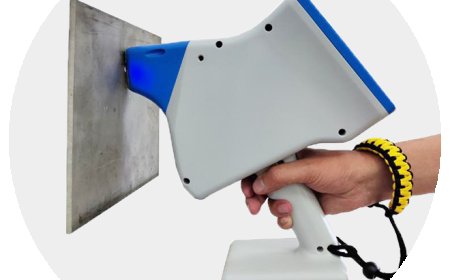





















Portable LIBS Spectrometer LIS-02, Carbon detection spectrometer
Portable LIBS Spectrometer LIS-02 deducts the carbon without use of argon gas in one second. It is Fast, precise metal analyzer.

Portable LIBS Spectrometer LIS-02: Working Principles,
Applications, and Practical Considerations
Introduction
A Portable LIBS Spectrometer LIS-02 is a relevant topic for professionals who need rapid elemental analysis in industrial and commercial environments. Portable Laser-Induced Breakdown Spectroscopy (LIBS) instruments help identify elements in metals, alloys, minerals, and other suitable materials.
Unlike conventional laboratory methods, a portable LIBS spectrometer can perform measurements close to the sample location. Therefore, it can support material verification, incoming quality inspection, scrap sorting, and field investigations.
However, measurement quality depends on several factors. These include sample preparation, surface condition, calibration, measurement settings, and the elements being analyzed.
This article explains how a Portable LIBS Spectrometer works, where technicians can use it, and what they should consider when evaluating the LIS-02 model. It focuses on technical information and practical decision-making rather than promotional claims.
What Is a Portable LIBS Spectrometer?
A portable LIBS spectrometer uses laser-induced plasma to determine the elemental composition of a sample. LIBS stands for Laser-Induced Breakdown Spectroscopy.
The instrument directs a short, high-energy laser pulse onto the sample surface. This pulse removes a tiny amount of material and creates a hot plasma. As the plasma cools, excited atoms and ions emit light at characteristic wavelengths.
An optical system collects this light. A spectrometer separates it into wavelengths, and software analyzes the resulting emission spectrum to identify elements.
Depending on the instrument configuration, LIBS can identify elements such as iron, aluminum, copper, magnesium, chromium, nickel, manganese, and silicon.
The exact detection capability varies by element, concentration, instrument design, calibration, and sample matrix. Users should verify these capabilities against the manufacturer's technical documentation.
How Does a Portable LIBS Spectrometer Work?
A Portable LIBS Spectrometer follows a series of measurement steps.
1. Sample positioning
The operator places the instrument against, or positions it toward, a suitable sample surface. The operator must follow the instrument's working-distance and safety requirements.
2. Laser pulse generation
The instrument delivers a focused laser pulse to a small area of the sample. The laser produces localized heating and material ablation.
3. Plasma formation
The ablated material forms a plasma containing excited atoms, ions, and electrons. The plasma emits light as its particles return to lower energy states.
4. Optical emission collection
The instrument collects the emitted light and directs it into an optical spectrometer. The spectrometer separates the light into its component wavelengths.
5. Element identification
The instrument compares the measured emission lines with known atomic spectral lines. This process helps identify the elements present in the sample.
6. Concentration estimation
Where suitable calibration and analytical models exist, the instrument estimates the concentration of selected elements. It may then compare the results with predefined material grades or specifications.
Important distinction: Element identification and quantitative composition analysis are not the same. Identifying chromium in a sample does not automatically establish its exact chromium concentration.
Key Technical Components
A portable LIBS system generally contains the following components.
| Component | Function | Practical consideration |
|---|---|---|
| Pulsed laser | Creates plasma from the sample | Pulse energy, stability, and repetition rate affect performance |
| Optical collection system | Collects plasma emission | Alignment and collection efficiency influence signal quality |
| Spectrometer | Separates emitted light by wavelength | Spectral resolution and wavelength coverage affect element detection |
| Detector | Converts light into electrical signals | Sensitivity and dynamic range influence measurement quality |
| Processing software | Identifies elements and calculates results | Algorithms and calibration determine reporting reliability |
| Power supply | Powers the instrument | Battery capacity affects field operating time |
| User interface | Displays measurements and material classifications | Clear results and suitable data export improve workflow |
The precise component specifications of the LIS-02 should be confirmed using its official datasheet or manufacturer documentation.
What's Your Reaction?