






























What Is Portable Hardness Tester - UCI & LEEB Portable Hardness Tester
A portable hardness tester is used to measure the hardness of small & heavy jobs in field. Leeb & UCI is also portable hardness testers.

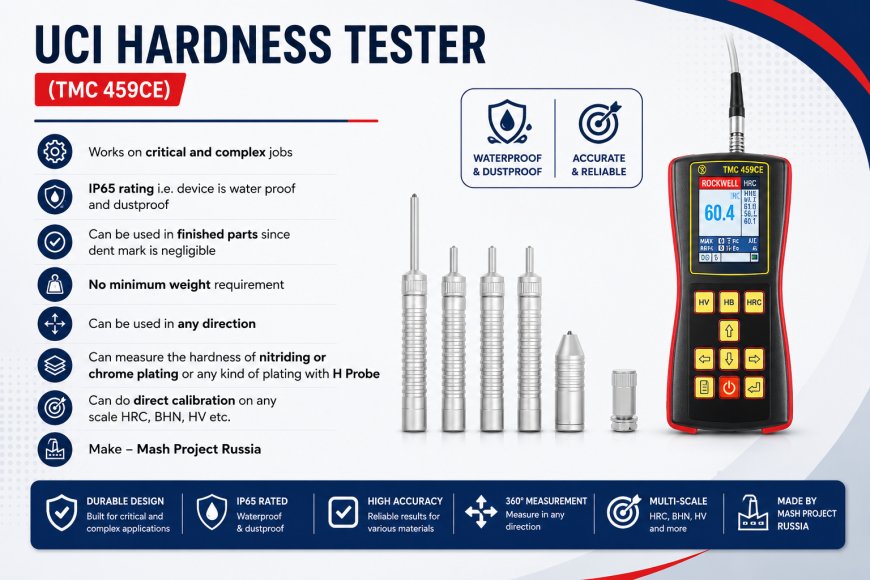
Portable Hardness Tester Buying Guide: Choosing the Right
UCI Probe Load
A portable hardness tester using UCI technology isn't a one-size-fits-all instrument — the probe load you select has a direct impact on accuracy, and getting it wrong is one of the most common reasons UCI results end up inconsistent. For a portable UCI hardness tester, load selection deserves the same attention buyers typically give to overall device specs, yet it's often the last thing evaluated before purchase.
This guide focuses specifically on UCI probe load options — what they mean, how to match them to your components, and the buying mistakes that lead to underperforming equipment even when the base device itself is perfectly capable.
Why Probe Load Selection Matters So Much in UCI Testing
UCI testing works by pressing a vibrating probe into the test surface under a defined load and measuring the resulting frequency shift. That load directly determines the size of the indentation created — too light a load on a rough or coarse-grained material can produce unstable readings, while too heavy a load on a thin or delicate component can distort results or even damage the part.
Matching load to material and component thickness isn't a minor technical detail — it's central to getting UCI testing to perform the way it's supposed to.
Common UCI Probe Load Options and What They're For
Higher Load Probes (Around 50N–98N)
Higher load probes create a larger, more stable indentation, which works well on components with coarser microstructures or slightly rougher surfaces, where a very light load might produce inconsistent contact.
Best for: Larger machined components, coarser-grained materials, and general industrial parts where surface finish is reasonably good but not mirror-polished.
Medium Load Probes (Around 10N)
Medium load probes balance indentation size with surface sensitivity, making them a common default choice for a wide range of standard precision components.
Best for: General precision manufacturing parts, moderately thin components, and typical automotive or metal fabrication applications.
Lower Load Probes (Around 1N–3N)
Lower load probes create a much smaller indentation, ideal for very thin materials, delicate coatings, or components where even minimal surface marking must be avoided.
Best for: Thin sheet metal, plated or coated finishes, and small precision parts where preserving surface integrity is a strict requirement.
Matching Load Selection to Your Components
Material Thickness
Thinner materials generally require lighter loads to avoid over-penetration, which can distort the reading or, in extreme cases, deform the component itself. As a general principle, the thinner and more delicate the part, the lighter the load should be.
Surface Finish Requirements
If preserving a polished, plated, or cosmetically sensitive surface is a priority, lighter loads that leave minimal visible marking are usually the right choice, even if it means slightly longer testing time per reading.
Material Hardness and Grain Structure
Coarser-grained materials or those with more surface irregularity often benefit from higher loads, since a larger indentation averages out local variation better than a very small, light-load indentation would.
Testing Environment Consistency
Facilities testing a wide range of component types often benefit from a device supporting multiple interchangeable probe loads, rather than committing to a single fixed-load unit that only performs well on part of their production mix.
Buying Mistakes to Avoid With UCI Load Selection
Assuming one load setting covers everything. A single fixed-load probe might work well for one product line but produce unreliable results on a different component range within the same facility.
Choosing load based on price rather than application fit. A cheaper single-load device might seem like good value initially but can lead to inaccurate results — and additional purchases later — if it doesn't match your actual components.
Overlooking load-specific calibration requirements. Different load settings typically require matching calibration reference blocks, an ongoing cost that's easy to miss when comparing initial purchase prices.
Skipping operator training on load selection. Even with the right probe options available, technicians need to understand which load to select for which component — a gap that structured training closes quickly.
Building the Right UCI Testing Setup
Before finalizing a purchase, it helps to map out:
- The thickness range of components you test most often
- Surface finish sensitivity across your product range
- Whether your facility handles a narrow or wide variety of materials and geometries
- Whether interchangeable load options or a single fixed setting better fits your operation
Facilities with a narrow, consistent component range may do well with a single well-matched load setting, while those handling varied precision work typically benefit from a device supporting multiple interchangeable loads.
How RiM LaS Helps You Choose the Right UCI Configuration
RiM LaS Private Limited supplies portable UCI hardness testers, including the TKM-459CE, with probe load options suited to different component types and industries. Rather than defaulting to a standard configuration, our team works with metal, aerospace, and automotive companies across India to match probe load selection to your actual production needs — avoiding both underperformance on delicate parts and unnecessary complexity for straightforward applications.
Every purchase is backed by certification-based training, ensuring your technical team understands not just how to operate the device, but which load setting to select and why, based on the component in front of them.
Conclusion
Choosing the right portable UCI hardness tester setup goes beyond the base device — probe load selection plays a direct role in whether your results are accurate and repeatable. Matching load to material thickness, surface sensitivity, and grain structure is what separates a UCI testing program that performs consistently from one that produces unreliable data on certain components.
Not sure which UCI probe load fits your components? Contact RiM LaS Private Limited for expert guidance and certification-based training tailored to your production environment.
Frequently Asked Questions
1. Why does probe load matter in UCI hardness testing? The load determines the size of the indentation created during testing, and mismatched load selection relative to material thickness or surface finish can lead to unstable or inaccurate readings.
2. What UCI probe load should I use for thin or plated components? Lower load probes, typically in the 1N to 3N range, are generally better suited to thin materials or plated finishes where minimal surface marking is required.
3. Can one UCI probe load work for all my components? Not reliably if your facility tests a wide range of thicknesses or surface finishes. Devices supporting multiple interchangeable loads generally perform better across varied component types.
4. Do different UCI probe loads require different calibration references? Yes, typically. Different load settings often need matching calibration reference blocks, which is an important ongoing cost to factor into your purchase decision.
5. Does RiM LaS help determine the right UCI probe load for specific applications? Yes. RiM LaS works with customers to match probe load selection to their actual components, backed by certification-based training on correct load selection and technique.
What's Your Reaction?