

































Philippines Computer-Aided Design (CAD) Market Share, Trends & Forecast 2034
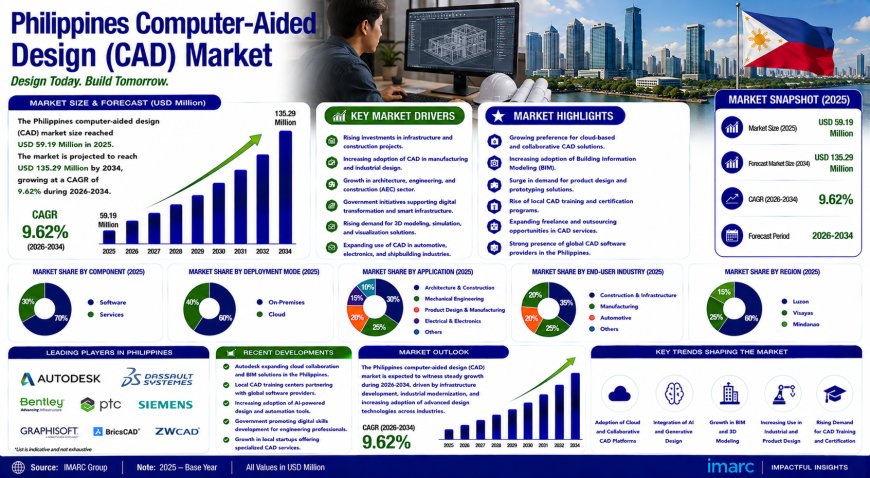
The Philippines computer-aided design (CAD) market size reached USD 59.19 Million in 2025. The market is projected to reach USD 135.29 Million by 2034, growing at a CAGR of 9.62% during 2026-2034.

Market Overview
The Philippines computer-aided design (CAD) market is witnessing strong growth driven by accelerating digital transformation across manufacturing and construction sectors, robust government infrastructure investments supporting Industry 4.0 initiatives, and the expanding integration of Building Information Modeling (BIM) and cloud-based design technologies. According to IMARC Group, the market size reached USD 59.19 Million in 2025 and is projected to reach USD 135.29 Million by 2034, exhibiting a compound annual growth rate (CAGR) of 9.62% during 2026‑2034. The growing emphasis on smart city development and sustainable building practices is expanding the market share. This market is strategically important to the Philippines' economy as it directly supports the nation's digital transformation objectives, infrastructure modernisation priorities, and industrial competitiveness enhancement.
The Philippines computer-aided design (CAD) market is poised for robust expansion, fueled by the construction industry's projected growth rate and the government's ambitious Build Better More infrastructure program. With a projected CAGR of 9.62% through 2034, the market presents significant opportunities for software vendors, service providers, and system integrators focused on cloud-based solutions, AI integration, and educational partnerships to address the growing demand for advanced design tools.
Philippines Computer-Aided Design (CAD) Market Summary
- The Philippines computer-aided design (CAD) market encompasses a wide range of software and services used for creating precise 2D and 3D models, technical drawings, and design simulations across multiple industries.
- The ecosystem includes international software vendors, local distributors, value-added resellers, system integrators, educational institutions, and end‑use consumers spanning electrical and electronics, automotive, civil and construction, energy and materials, industrial equipment, and media and entertainment sectors.
- Major segments identified in the market include component (software and services), development model (cloud and on-premises), application (3D printing, surface modelling, reverse engineering, drafting detailing, assembly, and others), technology (2D and 3D), and end user (electrical and electronics, automotive, civil and construction, energy and materials, industrial equipment, media and entertainment, and others).
- The market is driven by accelerating digital transformation across manufacturing and construction sectors, robust government infrastructure investments, the expanding integration of BIM and cloud-based design technologies, and the growing emphasis on smart city development.
- The accelerating adoption of cloud-based CAD platforms among small and medium enterprises, driven by cost efficiency and enhanced collaboration capabilities, is democratising access to advanced design tools throughout the forecast period.
PORTER'S FIVE FORCES ANALYSIS – PHILIPPINES COMPUTER-AIDED DESIGN (CAD) MARKET
Bargaining Power of Suppliers – Moderate
- Global CAD software leaders dominate the market through comprehensive product portfolios, strong brand recognition, and established distribution networks. These multinational corporations leverage technological superiority, continuous innovation in cloud computing and artificial intelligence, and extensive global support infrastructure to maintain market leadership.
- The growing adoption of cloud-based SaaS CAD platforms is lowering entry barriers while enabling existing vendors to reach small and medium-sized enterprises more effectively, helping to balance supplier influence over pricing and availability.
Bargaining Power of Buyers – Moderate
- Buyers in the Philippines CAD market include electrical and electronics manufacturers, automotive companies, civil and construction firms, and industrial equipment producers. The availability of CAD products across different development models (cloud and on-premises) and price points provides buyers with choice.
- The shift to subscription-based SaaS models reduces upfront capital expenditure while providing predictable operational costs, making advanced CAD capabilities financially accessible to a broader range of companies.
Threat of New Entrants – Moderate
- Capital requirements for software development, quality certifications, and distribution networks create barriers for new entrants. However, the growing demand from construction, manufacturing, and electronics sectors attracts new players.
- Cloud-based SaaS platforms are lowering entry barriers for new players while enabling existing vendors to reach small and medium-sized enterprises more effectively. Local distributors and value-added resellers play critical roles in market penetration by providing localised technical support, training services, and customised implementation assistance.
Threat of Substitutes – Low
- CAD software possesses unique design and modelling capabilities essential for manufacturing, construction, and engineering applications. Alternative design methods cannot fully replicate the precision, efficiency, and innovation capabilities that modern CAD systems offer for improving design quality, reducing errors, accelerating project timelines, and enhancing collaboration.
- The integration of AI-powered tools, generative design capabilities, and cloud collaboration features represents product evolution rather than substitution, creating new growth opportunities within the CAD category.
Competitive Rivalry – Moderate
- The Philippines CAD market exhibits a moderately competitive landscape characterised by the presence of established international software vendors alongside emerging local service providers and system integrators. Competition revolves primarily around product functionality, pricing strategies, technical support quality, and the ability to provide localised solutions tailored to Philippine business requirements.
- Strategic partnerships between software vendors and educational institutions are becoming increasingly important as companies recognise that building a skilled user base through academic programs creates long-term customer loyalty and market expansion opportunities.
Request for Sample Report: [No sample request link available on the source page]
MARKET GROWTH DRIVERS
Accelerating Digital Transformation and Cloud-Based CAD Adoption Across Industries
Several key factors are propelling the expansion of the Philippines computer-aided design (CAD) market. The Philippines is experiencing a fundamental shift toward digitalisation across its industrial landscape, with technology adoption becoming a strategic imperative for businesses seeking competitive advantage. In 2025, the Philippines officially moved toward e-governance after the signing of the E-Governance Act on September 5 by President Ferdinand Marcos Jr., which will expedite the country's digital transformation by simplifying government procedures and increasing transparency via a national framework for a cohesive digital government system. This digital transformation momentum is being propelled by comprehensive government initiatives, most notably the e-Government Master Plan, which aims to modernise public services and encourage private sector technology adoption. Cloud-based CAD platforms are gaining significant traction as they eliminate the need for expensive hardware investments, enable real-time collaboration among geographically dispersed teams, and provide automatic software updates without disrupting workflows. For Philippine enterprises, particularly small and medium-sized businesses that historically faced barriers to adopting expensive on-premises CAD systems, cloud solutions democratise access to world-class design tools. The shift to subscription-based SaaS models reduces upfront capital expenditure while providing predictable operational costs, making advanced CAD capabilities financially accessible to a broader range of companies. This trend is further accelerated by improving internet infrastructure, with the National Telecommunications Commission and the Department of Information and Communications Technology aggressively expanding 5G network coverage to support bandwidth-intensive applications like cloud CAD and real-time design collaboration.
Government Infrastructure Investment and Industry 4.0 Initiatives Creating Unprecedented Demand
The Philippines computer-aided design (CAD) market is also benefiting from the Philippine government's massive infrastructure development programs, which are creating unprecedented demand for CAD software across construction, transportation, and utilities sectors. The construction market in the Philippines is projected to grow significantly, as per IMARC Group. These large-scale developments, including road networks, rail systems, airports, and urban development projects, require sophisticated CAD tools for planning, design coordination, and construction management. Aside from construction, the manufacturing industry is adopting Industry 4.0 concepts, as businesses invest in digital technologies to boost their competitiveness in global value chains. The Philippines Manufacturing Digitalisation Summit has become a focal platform for industry leaders to discuss the application of digital technologies including IT/OT convergence, artificial intelligence, machine learning, IoT, 5G, digital twins, automation, and advanced analytics. Major manufacturers in sectors ranging from automotive components to electronics assembly are recognising that CAD software is fundamental to achieving the precision, efficiency, and innovation required in modern production environments. Public-private partnerships are emerging as powerful vehicles for accelerating digital transformation, combining resources, expertise, and technology from both sectors to address complex infrastructure and manufacturing challenges while ensuring solutions are practical, innovative, and sustainable.
MARKET GROWTH DRIVERS
Growing Integration of Building Information Modeling and Advanced Design Technologies in Construction
The Philippines computer-aided design (CAD) market is experiencing transformative growth through the gradual but steady adoption of Building Information Modeling (BIM) and advanced CAD technologies to improve project outcomes, reduce costs, and enhance collaboration among stakeholders. BIM technology enables construction professionals to create intelligent 3D models enriched with data that facilitates planning, designing, constructing, and managing buildings and infrastructure more efficiently. The benefits include improved collaboration among architects, engineers, and contractors, enhanced accuracy in project planning, reduced errors and rework, better cost management, and efficient facility maintenance throughout a building's lifecycle. In November 2024, the Department of Trade and Industry's Construction Industry Authority of the Philippines, in collaboration with the Philippine Constructors Association, convened the 5th Philippine Construction Congress to promote sustainable and innovative building practices. Leading Philippine developers are pioneering BIM adoption, with companies like DMCI Homes investing in the technology to enhance aesthetics, quality, and cost-efficiency of their offerings. DMCI Homes started adopting BIM technology with Fairlane Residences in Pasig City as its first project using the innovation, creating a team of 18 in-house trained BIM modelers to develop design models for upcoming projects. The company aims to develop project models that create seamless coordination of project design, with clashes or conflicts being detected even prior to the start of construction, enabling cost-efficient operations and accelerated construction timelines without affecting quality.
Artificial Intelligence Revolutionising CAD Workflows
Artificial intelligence is revolutionising CAD workflows in the Philippines through generative design capabilities that automatically create multiple optimised design alternatives based on user-defined constraints. AI-powered tools enable automated error detection, predictive analytics for simulations, and intelligent design assistants that streamline repetitive tasks, allowing Filipino engineers to focus on creativity and innovation. As AI integration accelerates, Philippine-based design firms can leverage cloud-based AI-driven CAD platforms to enhance productivity and compete globally. The expanding electronics manufacturing sector, particularly in semiconductor assembly and consumer electronics production, coupled with increasing foreign direct investments in manufacturing facilities, will sustain strong demand for sophisticated CAD software throughout the forecast period.
Philippines Computer-Aided Design (CAD) Market Segmentation
Segmentation analysis provides a detailed view of the Philippines computer-aided design (CAD) market by category:
- Component Insights: Software, Services.
- Development Model Insights: Cloud, On-premises.
- Application Insights: 3D Printing, Surface Modelling, Reverse Engineering, Drafting Detailing, Assembly, Others.
- Technology Insights: 2D, 3D.
- End User Insights: Electrical and Electronics, Automotive, Civil and Construction, Energy and Materials, Industrial Equipment, Media and Entertainment, Others.
- Regional Insights: Luzon, Visayas, Mindanao.
Competitive Landscape
The competitive landscape of the Philippines computer-aided design (CAD) market exhibits a moderately competitive structure characterised by the presence of established international software vendors alongside emerging local service providers and system integrators. Global CAD software leaders dominate the market through comprehensive product portfolios, strong brand recognition, and established distribution networks. These multinational corporations leverage their technological superiority, continuous innovation in areas like cloud computing and artificial intelligence, and extensive global support infrastructure to maintain market leadership. However, local distributors and value-added resellers play critical roles in market penetration by providing localised technical support, training services, and customised implementation assistance that address the specific needs of Philippine businesses. The growing adoption of cloud-based SaaS CAD platforms is intensifying competition by lowering entry barriers for new players while enabling existing vendors to reach small and medium-sized enterprises more effectively. Strategic partnerships between software vendors and educational institutions are becoming increasingly important as companies recognise that building a skilled user base through academic programs creates long-term customer loyalty and market expansion opportunities.
Regional Analysis
Regional dynamics within the Philippines computer-aided design (CAD) market are shaped by varying levels of industrial activity, construction development, and technology adoption across the archipelago.
- Luzon emerges as the largest demand centre, driven by the National Capital Region's high concentration of construction projects, manufacturing facilities, and electronics assembly operations. The region benefits from extensive distribution networks, proximity to major technology hubs, and significant government infrastructure investments under the Build Better More program.
- Visayas sees demand from construction projects, tourism-related infrastructure development, and growing industrial activities supporting the adoption of CAD solutions across architectural and engineering firms.
- Mindanao represents a significant growth market, driven by infrastructure development, agricultural processing industries, and emerging industrial zones that increasingly require sophisticated design tools for project planning and execution.
Recent Industry Developments
- September 2025: President Ferdinand Marcos Jr. signed the E-Governance Act (Republic Act No. 12254), which will expedite the country's digital transformation by simplifying government procedures and increasing transparency via a national framework for a cohesive digital government system, creating significant momentum for CAD software adoption across public and private sectors.
- November 2024: The Department of Trade and Industry's Construction Industry Authority of the Philippines, in collaboration with the Philippine Constructors Association, convened the 5th Philippine Construction Congress to promote sustainable and innovative building practices, emphasising smart building systems adoption and green building standards compliance.
- 2024 (Throughout): The Philippines Manufacturing Digitalisation Summit continued to serve as a focal platform for industry leaders to discuss the application of digital technologies including IT/OT convergence, artificial intelligence, machine learning, IoT, 5G, digital twins, automation, and advanced analytics, supporting CAD adoption across manufacturing sectors.
- 2025 (Throughout): DMCI Homes continued pioneering BIM adoption, with its team of 18 in-house trained BIM modelers developing design models for upcoming projects, demonstrating the growing commitment to advanced design technologies among leading Philippine developers.
Browse Full Report with TOC & List of Figures for In‑Depth Market Insights: https://www.imarcgroup.com/philippines-computer-aided-design-market
Note: If you need any specific information that is not covered currently within the scope of the report, we will provide the same as a part of customisation.
About Us
IMARC Group is a global management consulting firm that helps the world's most ambitious changemakers to create a lasting impact. The company provides a comprehensive suite of market entry and expansion services. IMARC offerings include thorough market assessment, feasibility studies, company incorporation assistance, factory setup support, regulatory approvals and licensing navigation, branding, marketing and sales strategies, competitive landscape and benchmarking analyses, pricing and cost research, and procurement research.
Contact Us
IMARC Group
134 N 4th St., Brooklyn, NY 11249, USA
Email: sales@imarcgroup.com
Tel No.: (D) +91 120 433 0800
United States: +1-201-971-6302
What's Your Reaction?