





























A Simpler Way to Manage Family Health Information
Learn how a personal health record app can help families organize medications, vitals, doctor visits, and important health documents.

Think about the last time you needed an old prescription, a child's vaccination detail, a parent’s medication list, or a lab report. Was it easy to find? For many families, health information ends up scattered across paper folders, phone photos, email attachments, and different apps.
That is where a personal health record app can make everyday health organization much simpler. Instead of searching through different places, families can keep important information organized by person and access it when needed.
For families managing children, parents, spouses, or aging relatives, having one organized system can also make appointments and routine health tracking less stressful.
What Is a Personal Health Record App?
A personal health record app is a digital place where you can organize your own health information. Depending on the app, this can include medications, allergies, vital readings, doctor visits, prescriptions, lab reports, and other medical documents.
The main benefit is organization. Rather than keeping a prescription in one drawer and a lab report somewhere else, you can keep the information together and update it over time.
The Office of the National Coordinator for Health Information Technology notes that health apps can help people organize and access health information and may also make it easier to share records with healthcare providers and caregivers.
Why Family Records Need Extra Organization
Managing health information for one person can be difficult enough. Managing it for several people is a different challenge.
Imagine a parent looking after two children and an older parent. One child has regular appointments, the other has a medication schedule, and the older parent takes several prescriptions. Remembering every detail is not realistic.
A health tracking app for family members can give each person a separate profile, making it easier to keep information from getting mixed together.
For example, a child's vaccination information can stay in their profile while a parent's blood pressure readings and medication history remain in theirs.
What Should You Keep in a Family Health Record?
A useful record does not have to contain every piece of information imaginable. Start with details that are actually useful during appointments and everyday care.
Medications and Allergies
Medication information is one of the first things worth organizing. Keep the medicine name, dosage, schedule, prescribing doctor, and relevant dates together.
Allergies are also important, especially when visiting a new doctor or dealing with an urgent situation.
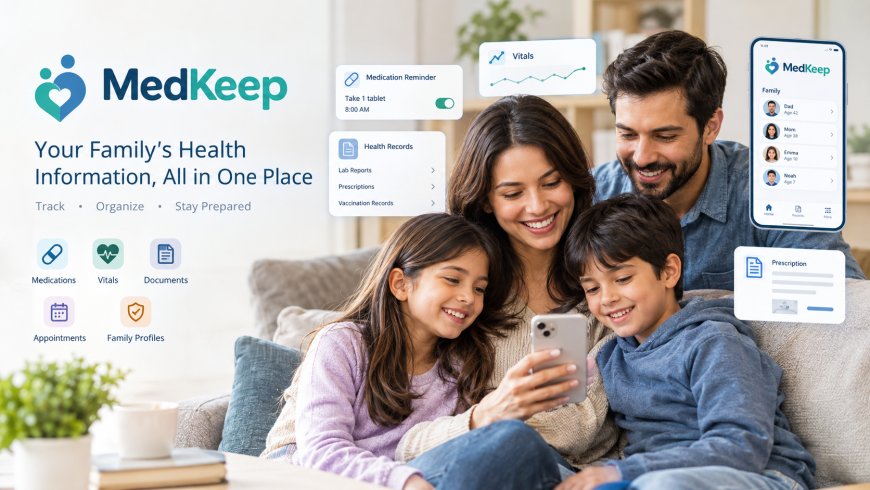
MedKeep lets users create separate profiles for family members and keep individual medication lists, allergies, and other health details within those profiles.
Vitals and Health Readings
Some families regularly record blood pressure, blood glucose, weight, temperature, heart rate, or other readings.
Keeping these numbers together can make it easier to review a history rather than relying on memory. MedKeep supports seven types of vital readings and keeps the history separated by family member.
For instance, someone monitoring blood pressure at home can record readings over several days and have that information available during their next appointment.
Of course, tracking an unusual reading does not replace professional medical advice. The purpose is to keep a clear record that can be discussed with a healthcare professional.
Keep Doctor Visits and Documents Together
Medical records are more than medications and numbers. Appointment notes and documents can become valuable later.
A visit from six months ago may include a diagnosis, treatment plan, or follow-up instruction that you need to remember. Writing those details down at the time can save you from trying to reconstruct the appointment later.
MedKeep includes separate doctor visit histories, follow-up reminders, and document storage for items such as lab reports, prescriptions, and scans.
A Simple Real-Life Example
Suppose your father has a specialist appointment next week. Instead of looking through old messages and paper files, you can review his medication list, recent readings, previous visits, and relevant documents in his profile.
You can then create a health summary for the appointment. MedKeep supports PDF health summaries containing selected information from a family member's record.
That small amount of preparation can make an appointment easier to manage.
Privacy Matters When Storing Health Information
Health records contain personal information, so privacy should be considered before choosing any health app.
Look at how the app stores information, whether records are encrypted, what happens when you are offline, and whether you can export your data.
MedKeep states that records are encrypted on the device using AES-256 before storage or syncing, and its privacy policy says it does not access the content of users' health records.
It also supports offline use, which can be useful when you need to check information somewhere with limited connectivity.
Keep the Record Updated
Even the most organized health record becomes less useful if it is outdated.
After a doctor's appointment, update any medication changes or new information. When a prescription ends, mark it appropriately rather than leaving an old schedule active. Add new reports soon after receiving them while the details are still fresh.
A quick review every few months can also help you spot outdated information.
Make Health Organization Part of the Routine
A personal health record app is not meant to replace a doctor or provide a diagnosis. Its real value is much simpler: keeping information organized and available when you need it.
For families, separate profiles can make a particularly big difference. Parents can organize children's records, caregivers can keep track of an older relative's information, and individuals can maintain their own health history without mixing everything together.
What's Your Reaction?