





























Australia Office Furniture Market Projected to Reach USD 2.6 Billion by 2034
Australia office furniture market size reached USD 1.9 Billion in 2025. Looking forward, IMARC Group expects the market to reach USD 2.6 Billion by 2034, exhibiting a growth rate (CAGR) of 3.21% during 2026-2034.

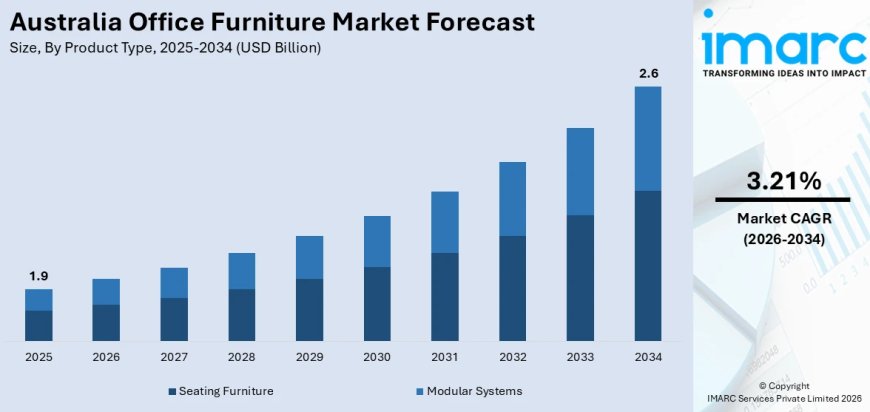
The Australia office furniture market size reached USD 1.9 Billion in 2025. Looking forward, IMARC Group expects the market to reach USD 2.6 Billion by 2034, exhibiting a growth rate (CAGR) of 3.21% during 2026-2034. The market is shaped by the structural shift toward hybrid work models—with four-in-one-out and three-in-two-out becoming dominant workplace configurations—driving demand for modular, reconfigurable furniture systems that flex with fluctuating daily occupancy. The seating segment commands 44.3% market share as employers prioritize employee comfort and ergonomic wellness, while government entities wielding over USD 46.7 billion (AUD 75 billion) in annual purchasing power are mandating circular-economy credentials and AFRDI certification as minimum procurement requirements. The convergence of commercial fit-out activity, sustainability mandates addressing 30,000 tonnes of annual commercial furniture waste, and the integration of smart, AI-powered ergonomic solutions is collectively driving measured but sustained market expansion.
How AI is Reshaping the Future of the Australia Office Furniture Market
Artificial intelligence is transforming office furniture from passive workplace fixtures into responsive, health-promoting systems that adapt to individual user needs in real time. AI-powered tools now assess workstation setups using cameras and sensors to provide personalized feedback on posture, desk height, and seating adjustments, while smart desks with integrated IoT connectivity track usage patterns and automatically optimize ergonomic settings. The 2025 launch of the ErgoConnect protocol has established an interoperability standard enabling chairs, desks, and building management systems to communicate seamlessly, creating intelligent workspace ecosystems that enhance employee wellbeing and productivity across Australian offices.
• Kokuyo debuted the ingCloud chair at Orgatec Tokyo 2025 featuring a proprietary 3D Ultra Auto Fit mechanism that uses AI-driven sensors to automatically adapt support and resistance to user movement in real time—representing the next generation of intelligent seating now entering the Australian market.
• 9am Home launched the Dora Pro Smart Electric Standing Desk in Australia in January 2025, equipped with millimeter-wave sensors that track standing time and calories burned, using AI algorithms to deliver personalized sit-stand scheduling recommendations that improve workplace health outcomes.
• AI-integrated dynamic lumbar support systems using mechanical sensors and pneumatic chambers are being incorporated into premium ergonomic chairs, adjusting in real time to maintain consistent lower back contact as users change position—reducing musculoskeletal complaints and workplace injury claims across Australian corporate environments.
• AI-powered space planning platforms are enabling Australian workplace designers to analyze occupancy data, movement patterns, and collaboration frequency to optimize furniture layouts for hybrid offices—ensuring that modular systems, hot-desking stations, and collaborative zones are configured for maximum space utilization and employee satisfaction.
• AI is advancing sustainability in furniture manufacturing by identifying eco-friendly material alternatives, optimizing production processes to minimize waste, and enabling predictive demand forecasting that reduces overproduction—helping Australian manufacturers like Koskela achieve their target of 90% recycled materials in products by 2026.
Request a Business Sample Report for Procurement & Investment Evaluation:
https://www.imarcgroup.com/australia-office-furniture-market/requestsample
Australia Office Furniture Market Trends
Hybrid Work Transformation and Modular Furniture Demand
The hybrid work revolution is fundamentally reshaping office furniture requirements across Australia, with organizations transitioning from fixed, individual workstation layouts to flexible, modular systems that accommodate fluctuating daily occupancy. The four-in-one-out and three-in-two-out attendance models have become dominant configurations, requiring furniture that can be rapidly reconfigured between individual focused work, collaborative team sessions, and open social spaces. The Victorian Government’s foreshadowed legislation in January 2026—granting employees a statutory right to work from home up to two days per week from September 2026—is accelerating corporate investments in adaptable furniture systems that maximize the utility of reduced office footprints. Height-adjustable desks and sit-stand workstations have surged in popularity as employers recognize the health benefits of movement, while hot-desking solutions with personal storage lockers are replacing traditional assigned desk setups, driving demand for furniture that delivers ergonomic consistency regardless of which employee occupies the station.
Sustainability Mandates and Circular Economy Adoption
Sustainability has transitioned from a marketing differentiator to a procurement prerequisite in Australia’s office furniture market, driven by the staggering reality of 8.5 million tonnes of total furniture waste generated annually, with 30,000 tonnes of commercial furniture waste—95% of which ends up in landfills. Government procurement entities, commanding over AUD 75 billion in annual purchasing power, now insist on circular-economy credentials, extended warranties, and AFRDI (Australasian Furnishing Research and Development Institute) certification as minimum entry requirements for suppliers. Koskela, Australia’s first B Corp certified furniture company, is advancing its Circularity Action Plan targeting 90% recycled materials in products by 2026 and full product circularity by 2027, establishing benchmarks for the industry. Manufacturers are responding with take-back programs, modular designs that enable component replacement rather than full product disposal, and sustainably sourced timber and recycled plastics that meet both environmental standards and premium aesthetic expectations.
Australia Office Furniture Market Summary
• Market Size & Forecast: The Australia office furniture market reached USD 1.9 Billion in 2025 and is projected to grow to USD 2.6 Billion by 2034, registering a CAGR of 3.21% during the forecast period 2026-2034.
• Seating Dominance: Seating furniture commands 44.3% of the market in 2025, driven by employer investment in ergonomic wellness solutions including AI-powered adaptive chairs and height-adjustable sit-stand desks that address employee health and productivity requirements.
• Sustainability Imperative: Australia generates 8.5 million tonnes of furniture waste annually with 30,000 tonnes of commercial furniture waste, 95% landfilled, driving government mandates for circular-economy procurement and AFRDI certification across public sector purchasing.
• Hybrid Work Impact: Victoria’s foreshadowed right-to-work-from-home legislation (September 2026) and dominant four-in-one-out attendance models are driving demand for modular, reconfigurable furniture systems that accommodate fluctuating occupancy across Australian offices.
• Industry Consolidation: HNI Corporation’s USD 2.2 billion acquisition of Steelcase in August 2025 created a combined entity with USD 5.8 billion in annual revenue, intensifying competition in Australia’s premium office furniture segment.
Australia Office Furniture Market Growth Drivers
Commercial Construction Activity and Premium Fit-Out Demand
High levels of commercial construction activity across Australia’s major metropolitan centers are generating sustained demand for office furniture through new building fit-outs and refurbishment programs. Developers and tenants are investing in premium workplace interiors to attract and retain talent in competitive labor markets, with prime office spaces requiring high-standard furnishing that includes ergonomic seating, collaborative furniture zones, and technology-integrated workstations. The growing emphasis on workplace experience as a tool for employee attraction—particularly in hybrid environments where offices must offer compelling reasons for workers to commute—is elevating fit-out specifications and driving bulk furniture procurement. Commercial fit-out specialists are working closely with furniture manufacturers to deliver turnkey workplace solutions that integrate acoustic management, flexible partitioning, and branded environments, creating multi-product procurement opportunities that extend beyond traditional desks and chairs.
Government Procurement and Institutional Demand
Government entities represent a major structural demand driver for Australia’s office furniture market, wielding over AUD 75 billion in annual purchasing power across federal, state, and local procurement programs. Public sector procurement increasingly mandates sustainability credentials, circular-economy compliance, and AFRDI certification as non-negotiable requirements, creating a quality floor that benefits established manufacturers with certified product portfolios. The ongoing modernization of government offices—driven by hybrid work adoption across public service agencies, workplace health and safety regulations, and aging furniture replacement cycles—generates consistent procurement volumes. Educational institutions, healthcare facilities, and defense establishments represent additional institutional demand channels, with universities and hospitals investing in ergonomic furniture that meets stringent occupational health standards. These government and institutional procurement programs provide stable, recurring revenue streams that underpin market growth independent of private sector commercial construction cycles.
Australia Office Furniture Market Segments
The Australia office furniture market is segmented by product type, material type, distribution channel, price range, and region, reflecting the diverse procurement requirements across commercial, government, and institutional workplaces:
• By Product Type: The market is divided into seating furniture and modular systems. Seating furniture commands 44.3% market share in 2025, driven by ergonomic demand including AI-powered adaptive chairs and height-adjustable solutions. Modular systems are experiencing accelerated adoption as hybrid work models require reconfigurable workspace layouts.
• By Material Type: The market encompasses wood, metal, plastic and fiber, glass, and other materials. Wood maintains premium positioning for executive furniture, metal dominates structural components and storage, while recycled plastics and sustainable fibers are gaining share through circular-economy procurement mandates.
• By Distribution Channel: The market is served through direct sales, specialist stores, non-specialist stores, online platforms, and other channels. Direct sales dominate for large corporate and government procurement, while online channels represent the fastest-growing segment driven by remote workers and small business buyers seeking ergonomic home office solutions.
• By Price Range: The market spans low, medium, and high price segments. The medium segment captures the largest volume driven by corporate standardization programs, while the high-end segment is growing through premiumization of ergonomic and smart furniture products with AI-powered features and sustainability certifications.
• By Region: The market spans Australia Capital Territory & New South Wales, Victoria & Tasmania, Queensland, Northern Territory & Southern Australia, and Western Australia. NSW and Victoria dominate market share driven by Sydney and Melbourne’s large commercial office stocks and premium fit-out activity, while Queensland benefits from growing commercial construction in Brisbane and the Gold Coast.
Australia Office Furniture Market Competitive Landscape
The Australia office furniture market features a competitive landscape comprising global furniture corporations, specialized domestic manufacturers, and emerging smart furniture innovators. The competitive dynamics were reshaped in August 2025 when HNI Corporation finalized its USD 2.2 billion acquisition of Steelcase, creating a combined entity with USD 5.8 billion in annual revenue that strengthens premium market positioning in Australia. Danny’s Desks and Chairs has expanded its product range in 2025, focusing on ergonomic solutions designed specifically for remote and hybrid work arrangements across the Australian market. Value Office Furniture serves the cost-effective segment with functional solutions for small and medium enterprises. Koskela, Australia’s first B Corp certified furniture company, is differentiating through its Circularity Action Plan targeting 90% recycled materials by 2026 and full product circularity by 2027. International innovators are entering the market, with Kokuyo’s ingCloud AI-adaptive chair and 9am Home’s Dora Pro Smart Standing Desk bringing technology-integrated solutions to Australian workplaces. The competitive intensity is driven by sustainability certification requirements for government contracts, the growing importance of ergonomic wellness credentials, and the integration of smart technology features that command premium pricing.
Latest News & Development in the Australia Office Furniture Market
• January 2026: The Victorian Government foreshadowed legislation granting employees a statutory right to work from home up to two days per week from September 2026, accelerating corporate investments in flexible and modular office furniture systems across the state.
• August 2025: HNI Corporation finalized its USD 2.2 billion acquisition of Steelcase, creating a combined entity with USD 5.8 billion in annual revenue and significantly strengthening its competitive position in Australia’s premium commercial office furniture segment.
• May 2025: Kokuyo debuted the ingCloud chair at Orgatec Tokyo 2025, featuring a proprietary 3D Ultra Auto Fit mechanism that automatically adapts to user movement using AI-driven sensors, with the product entering Australian distribution channels for corporate and premium commercial applications.
• January 2025: 9am Home launched the Dora Pro Smart Electric Standing Desk in Australia, featuring millimeter-wave sensors that track standing time and calories burned, delivering personalized sit-stand recommendations through AI algorithms for improved workplace health outcomes.
• 2025: Koskela advanced its Circularity Action Plan targeting 90% recycled materials in products by 2026 and full product circularity by 2027, establishing Australia’s first B Corp certified furniture company as a sustainability benchmark for the commercial office furniture industry.
Note: If you require any specific information not currently covered within the scope of the report, IMARC Group will provide it as part of customization.
Speak to an analyst:
https://www.imarcgroup.com/request?type=report&id=31662&flag=E
What's Your Reaction?