






















Infinity Mart vs Circle K Franchise: Which Is the Better Investment in Canada in 2026?
Comparing Infinity Mart vs Circle K franchise costs in Canada for 2026? See real investment ranges, royalties, and which suits your budget better.

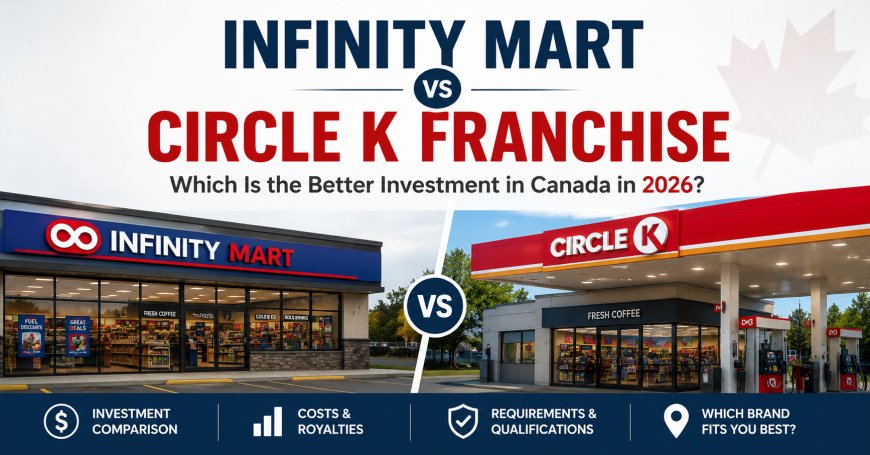
DIRECT ANSWER
Circle K requires $268,500 to $3,029,500 CAD to convert an existing site into a Canadian franchise, with a $500,000 minimum net worth. Infinity Mart starts at $185,000, with no franchise-wide net worth figure published. The better investment depends almost entirely on the capital an investor has available and how much operational support they want from day one.
Introduction
This comparison breaks down real cost data, royalty structures, qualification requirements, and territory access for both brands operating in Canada in 2026, using figures published directly by each franchisor and verified through independent franchise research platforms.
Circle K Franchise Cost in Canada: What the Numbers Actually Show
Circle K's official franchise disclosure puts the total investment for a Canadian conversion site between $268,500 and $3,029,500, while a newly constructed store runs $1,383,500 to $4,846,500, according to Circle K's own franchise FAQ page.
The franchise fee is $25,000. Royalty runs 3.7 percent of gross sales for franchisees who self-fund, or 4.5 percent for those using Circle K financing, based on data published by FranchiseHelp. A separate 1.5 percent advertising fee applies in most markets.
Qualification requires a minimum net worth of $500,000 and at least $100,000 in liquid capital, according to Circle K franchise disclosure data compiled by SharpSheets. Circle K is owned by Alimentation Couche-Tard, the Canadian multinational behind one of the largest convenience store networks globally.
Reality check: Even the lowest published Circle K conversion figure of $268,500 sits well above what most first-time franchise buyers in Canada can access without institutional financing or an existing retail portfolio.
Infinity Mart Franchise Investment: The Numbers
Infinity Mart's published total investment ranges from $185,000 to $485,500 CAD, according to the brand's own franchise opportunities page, with a $30,000 franchise fee included in that range.
The royalty structure is flat: $500 per month plus 5 percent of retail sales, with lottery, tobacco, beer, and wine excluded from that calculation. Infinity Mart does not publish a separate net worth requirement on its public franchise materials, though applicants go through a documented due diligence and financial review stage before approval.
Infinity Mart franchises across eight Canadian provinces: Ontario, Alberta, British Columbia, Quebec, Manitoba, Nova Scotia, Prince Edward Island, and Newfoundland and Labrador. The brand also offers a standalone Infinity Vape format starting from $39,000 plus inventory, for investors wanting a smaller entry point than a full convenience store.
Side-by-Side Comparison: Infinity Mart vs Circle K
|
Factor |
Infinity Mart |
Circle K |
|---|---|---|
|
Total Investment (CAD) |
$185,000 - $485,500 |
$268,500 - $3,029,500 (conversion); up to $4.8M new build |
|
Franchise Fee |
$30,000 |
$25,000 |
|
Royalty |
$500/mo + 5% retail (excl. lottery, tobacco, beer, wine) |
3.7% - 4.5% of gross sales + 1.5% ad fee |
|
Minimum Net Worth |
Not publicly published |
$500,000 |
|
Minimum Liquid Capital |
Not publicly published |
$100,000 |
|
Canadian Provinces |
8 (ON, AB, BC, QC, MB, NS, PEI, NL) |
National, via Couche-Tard network |
|
Standalone Smaller Format |
Yes, Infinity Vape from $39,000 |
No published equivalent |
|
Process Steps |
9-step documented process |
FDD review, typically under 6 months to open |
The gap in total investment is the headline difference. Circle K's lowest published figure is roughly 45 percent higher than Infinity Mart's upper range, and that is before accounting for the new-build pricing tier that exceeds $4.8 million.
Which Brand Fits Which Type of Investor?
Circle K Makes Sense If:
-
You have $500,000 or more in net worth and at least $100,000 in liquid capital, as required by Circle K's published qualification standards.
-
You want the backing of an established global brand with decades of operating history and a fuel-integrated business model.
-
You are scaling an existing portfolio of retail or fuel locations rather than opening a first store.
Infinity Mart Makes Sense If:
-
Your available capital sits in the $185,000 to $485,500 range without a $500,000 net worth requirement to clear first.
-
You want a smaller-footprint format, including the option to start with the $39,000 Infinity Vape concept before committing to a full store.
-
You are a first-time franchise investor looking for a documented onboarding process across a growing, multi-province Canadian network.
What Neither Brand's Marketing Tells You
Headline investment figures rarely include everything. Circle K's range already spans an enormous gap, from $268,500 to nearly $5 million, which signals how much site-specific factors like new construction versus conversion change the real number.
Infinity Mart's published breakdown explicitly notes that applicable taxes, POS systems, and security costs are additional to the $185,000 to $485,500 range. Any investor comparing the two brands should request the full Franchise Disclosure Document from each before treating either headline figure as final.
Due diligence step: Both Circle K and Infinity Mart are required to provide a Franchise Disclosure Document under Ontario's Arthur Wishart Act (Franchise Disclosure), 2000 if operating in that province, at least 14 days before any agreement is signed. Review it with a franchise lawyer regardless of which brand you are considering.
Financing Either Brand: What Canadian Investors Should Know
Regardless of which brand fits your budget, financing options are similar across both. The Canada Small Business Financing Program (CSBFP) provides government-backed loan guarantees of up to $1,000,000 for leasehold improvements and equipment, commonly used for franchise acquisitions at both investment tiers. The Business Development Bank of Canada (BDC) also offers dedicated franchise financing products, and major chartered banks including RBC, TD, and Scotiabank maintain franchise lending desks familiar with convenience retail specifically.
Infinity Mart: The Lower-Capital Entry Point in This Comparison
For investors who have read through both brands' qualification requirements and recognize that Circle K's $500,000 net worth threshold puts it out of reach, Infinity Mart represents the accessible side of this comparison. The brand's published range starts at $185,000 with no separate net worth requirement, and its turnkey support model is designed specifically around first-time franchise buyers.
Investors who want to review Infinity Mart's full Franchise Disclosure Document or discuss available territories across the eight provinces can apply through infinitymart.co/franchise-opportunities/ or by contacting franchising@infinitymart.ca.
Frequently Asked Questions
How much does a Circle K franchise cost in Canada in 2026?
Circle K's total investment for a Canadian conversion site ranges from $268,500 to $3,029,500, based on the brand's official franchise FAQ. A newly constructed store runs $1,383,500 to $4,846,500. The franchise fee is $25,000, with royalties between 3.7 and 4.5 percent of gross sales.
How much does an Infinity Mart franchise cost?
Infinity Mart's published total investment ranges from $185,000 to $485,500 CAD, including a $30,000 franchise fee. Royalties are a flat $500 per month plus 5 percent of retail sales, excluding lottery, tobacco, beer, and wine.
Which is the better convenience store franchise to invest in Canada?
It depends on available capital. Circle K suits investors with $500,000 or more in net worth and at least $100,000 in liquid capital who want a globally established brand. Infinity Mart suits investors working with $185,000 to $485,500 who want a lower entry point and a smaller-footprint option.
Does Circle K or Infinity Mart have lower ongoing royalty costs?
Infinity Mart's flat $500 monthly fee plus 5 percent on retail sales, excluding lottery and tobacco, can work out lower for stores with significant lottery or tobacco volume, since those categories are excluded from the calculation. Circle K's 3.7 to 4.5 percent royalty applies to total gross sales, plus a 1.5 percent advertising fee in most markets. The better deal depends on a specific store's sales mix.
Can I start smaller than a full convenience store with either brand?
Infinity Mart offers a standalone Infinity Vape format starting from $39,000 plus inventory, designed for investors who want a smaller initial commitment. Circle K does not publish an equivalent smaller-format franchise option in its standard disclosure materials.
What provinces can I franchise Infinity Mart or Circle K in?
Infinity Mart franchises across eight provinces: Ontario, Alberta, British Columbia, Quebec, Manitoba, Nova Scotia, Prince Edward Island, and Newfoundland and Labrador. Circle K operates nationally across Canada as part of the Alimentation Couche-Tard network, with availability depending on specific territory and site approval.
Do both franchises require a Franchise Disclosure Document in Canada?
Yes, in provinces with franchise disclosure legislation, including Ontario under the Arthur Wishart Act. Both Circle K and Infinity Mart are required to provide an FDD at least 14 days before any agreement is signed in those provinces. Always have it reviewed by a franchise lawyer before committing.
Final Thoughts
Circle K and Infinity Mart serve different segments of the same market. Circle K's $500,000 net worth requirement and investment range reaching nearly $5 million position it for investors with significant capital or an existing retail portfolio. Infinity Mart's $185,000 to $485,500 range, with no published net worth floor, opens the category to a wider pool of first-time investors.
Neither figure should be the final word. Request the full Franchise Disclosure Document from each brand, have it reviewed by a franchise lawyer, and model the royalty structure against realistic sales projections for your specific market before deciding. The right answer depends on your capital, not on which brand has the bigger national footprint.
What's Your Reaction?