
































How to Assess Manufacturing Capability Before Selecting a Partner
Learn how to assess manufacturing capability before selecting a partner by evaluating process fit, production capacity, quality systems, compliance, maintenance and delivery performance.

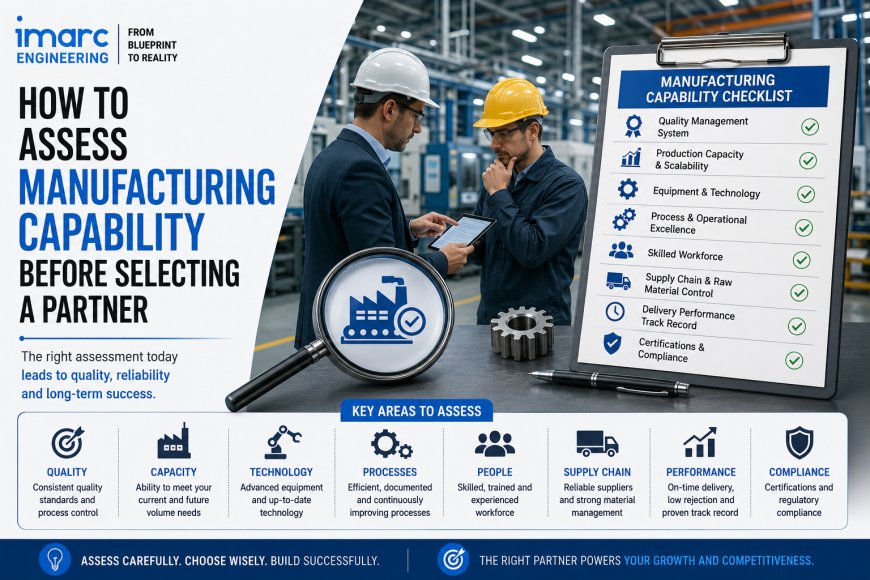
Introduction
Selecting a manufacturing partner is one of the highest-impact supply decisions a business can make — and one of the easiest to get wrong when the choice is based mainly on price or a plant tour.
Once orders are placed or a long-term agreement is signed, the hidden gaps surface: capacity that cannot scale, quality systems that fail under volume, delayed deliveries, weak documentation for audits, and compliance issues that block exports or customer approvals. These risks are rarely obvious in a quotation. They become clear only when manufacturing capability is assessed against process, capacity, quality, compliance and delivery evidence before the partnership is locked.
IMARC Engineering supports manufacturers and industrial buyers with operational readiness, capability assessment and project advisory across India. This article explains how to assess manufacturing capability before selecting a partner, which checks matter most, and how a structured evaluation protects both cost and supply continuity.
Why Capability Assessment Matters in India’s Manufacturing Landscape
India’s manufacturing sector continues to attract buyers and investment under policy support and rising capacity.
- Manufacturing growth is estimated at around 7% at constant prices in FY 2025-26 (MoSPI First Advance Estimates).
- FDI into manufacturing rose 18% in FY 2024-25 to US$19.04 billion (Ministry of Commerce & Industry / DPIIT).
- PLI cumulative investment has exceeded ₹2.16 lakh crore, with cumulative production and sales surpassing ₹20.41 lakh crore as of December 2025 (PIB).
- Logistics costs have improved to an estimated 7.97% of GDP (DPIIT-NCAER study).
As more companies source from or partner with Indian plants, capability assessment becomes the filter between a competitive quote and a reliable supply relationship. Price matters. Ability to deliver consistently at the required quality and compliance standard matters more over the life of the partnership.
What “Manufacturing Capability” Really Means
Capability is more than installed machines. A practical assessment covers:
- Process capability — can the plant run your product to specification, repeatedly?
- Capacity capability — can it meet volume, mix and ramp-up needs without chronic overtime or quality drift?
- Quality capability — are controls, testing and release processes strong enough for your market?
- Compliance capability — can it meet regulatory, customer and export requirements that apply to your category?
- Delivery capability — can planning, materials and logistics support reliable lead times?
- Improvement capability — can the partner stabilise issues and scale without repeated firefighting?
A partner strong on one dimension and weak on others still creates supply risk.
Step-by-Step: How to Assess Manufacturing Capability
1. Define what success looks like for your product Specify quality targets, volumes, delivery windows, documentation needs and compliance standards before visiting plants. Assessment without a clear requirement list becomes a generic tour.
2. Review process fit Check whether the partner’s process route, equipment and operating discipline match your product’s critical characteristics. Similar industry experience helps; identical product proof is better.
3. Validate capacity with evidence Ask for demonstrated output, utilisation, bottleneck constraints and how peak demand is handled. Nameplate capacity is not the same as sustainable capacity for your orders.
4. Assess quality systems in operation Look beyond certificates. Review incoming control, in-process checks, finished goods testing, non-conformance handling and traceability. Ask how recent quality failures were investigated and closed.
5. Check compliance and audit readiness Confirm licences, environmental and factory obligations, customer audit history and export documentation capability where relevant. Gaps here can stop shipments even when production is fine.
6. Evaluate materials, planning and delivery control Weak planning systems create expedites, shortages and missed dates. Review how the partner schedules, manages suppliers and communicates delays.
7. Inspect maintenance and asset condition Chronic breakdowns destroy both capacity and quality. Maintenance discipline is part of capability, not a side topic.
8. Test communication and escalation A capable plant that does not communicate early becomes an operational problem. Assess how issues are reported and resolved.
9. Run a pilot or controlled trial where risk is high For critical products, a trial order or process qualification reveals more than presentations alone.
10. Score partners against the same criteria Use a consistent scorecard so decisions are comparable and not driven by the most persuasive plant visit.
Key Capability Checks Buyers Often Miss
- Change control and how process changes are approved
- Real workforce skill and shift supervision strength
- Subcontractor dependence for critical steps
- Data integrity in production and quality records
- Ability to support volume growth without quality loss
- Business continuity for power, water or logistics disruption
These determine whether performance holds after the honeymoon period of the first orders.
Red Flags During Partner Evaluation
- Large gap between claimed capacity and recent actual output
- Certificates without matching shop-floor practice
- Incomplete batch records or weak traceability
- Frequent expedites presented as “flexibility”
- Reluctance to share process or quality metrics
- Heavy dependence on one unproven subcontractor
- No clear owner for customer issues and corrective actions
Any one red flag deserves deeper diligence. Several together usually mean higher lifecycle cost than the quotation suggests.
How Strong Capability Assessment Improves Outcomes
When manufacturing capability is assessed properly, buyers typically gain:
- Lower risk of quality escapes and customer complaints
- More reliable lead times and fewer emergency shipments
- Clearer view of true capacity for growth planning
- Stronger audit and export readiness
- Better commercial negotiation based on evidence, not assumptions
- Fewer partner changes after launch
Assessment cost is small compared with the cost of a failed production partnership.
How IMARC Engineering Supports Manufacturing Capability Assessment
IMARC Engineering helps industrial buyers and project sponsors evaluate plant capability with an operations and engineering lens.
- Process and capacity reality checks
- Quality and compliance readiness inputs
- Operational risk identification before partner selection
- Support for companies establishing or expanding manufacturing relationships in India
- Advisory across pharmaceuticals, food and beverage, chemicals, auto components, electronics, FMCG and discrete manufacturing
Looking to evaluate a manufacturing partner in India? Explore manufacturing capability assessment and partner evaluation support from IMARC Engineering:
Common Mistakes When Selecting a Manufacturing Partner
- Choosing mainly on unit price
- Accepting nameplate capacity without production evidence
- Treating certificates as proof of daily control
- Skipping pilot or trial runs on critical products
- Ignoring planning, maintenance and escalation strength
- Finalising partners before compliance and documentation needs are clear
Conclusion
Assessing manufacturing capability before selecting a partner protects supply performance by testing process fit, capacity reality, quality control, compliance readiness and delivery discipline before orders or long-term commitments are locked.
In India’s growing manufacturing economy — supported by PLI investment, rising FDI and improving logistics — more plants are available as potential partners. The buyers who evaluate capability with structured evidence build more stable supply relationships than those who select on price and first impressions alone.
Through process, capacity and operational readiness review, IMARC Engineering helps companies assess manufacturing partners with clearer eyes before commitment.
What's Your Reaction?