































Europe Positive Displacement Pumps Market 2026 | Worth USD 6.3 Billion by 2034
Europe’s positive displacement pumps market is projected to reach USD 6.3 billion by 2034, driven by rising industrial demand and technological advancements.

Market Overview
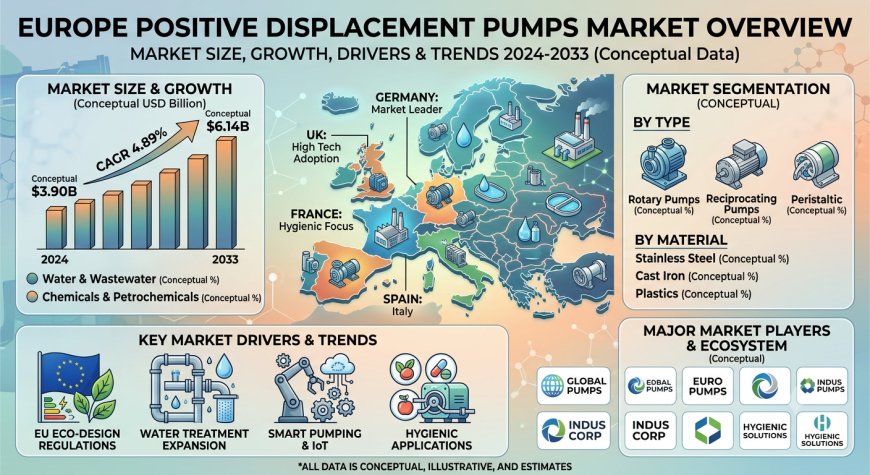
The Europe positive displacement pumps market size was valued at USD 4.1 Billion in 2025. Looking forward, IMARC Group estimates the market to reach USD 6.3 Billion by 2034, exhibiting a CAGR of 4.70% from 2026-2034. Germany currently dominates the market, driven by rising demand across water and wastewater treatment, oil and gas, food and beverage, and chemical industries due to their efficiency in handling viscous fluids and precise flow control. Growing urbanization and stricter European Union (EU) regulations on water management are slowly adopted. Additionally, the shift toward energy-efficient pumping solutions, coupled with technological advancements like smart monitoring systems, supports Europe positive displacement pumps market share. Expanding industrial automation and infrastructure investments further strengthen demand for positive displacement pumps in Europe.
Positive displacement pumps are mechanical devices that move fluids by trapping a fixed volume and forcing (displacing) that trapped volume into a discharge pipe. Unlike centrifugal pumps, they deliver a constant flow rate regardless of pressure, making them ideal for handling high-viscosity fluids, precise dosing, and shear-sensitive materials. The Europe positive displacement pumps market includes rotary pumps (vane, screw, lobe, gear, progressing cavity, and others), reciprocating pumps (piston, diaphragm, plunger, and others), peristaltic pumps, and other product types, available in low, medium, and high capacities, standard, engineered, and special purpose pump characteristics, manufactured from bronze, cast iron, polycarbonate, stainless steel, and other raw materials, serving oil and gas, water and wastewater, automotive, chemicals and petrochemicals, and other end-use industries across Germany, France, United Kingdom, Italy, Spain, and other European countries.
This market is strategically important to Europe's water security, industrial productivity, and sustainability agenda, supporting the region's environmental compliance and circular economy goals. In Europe, stringent environmental regulations and sustainability initiatives are driving heavy investments in water and wastewater treatment infrastructure. The sector is significant, with nearly 79,700 enterprises generating €290.5 billion in turnover and employing 1.6 million people in 2021. The EU's first water efficiency plan calls for a 10% reduction in water use by 2030 and highlights that only 2.4% of urban wastewater is currently reused, emphasizing the urgent need to upgrade treatment infrastructure.
The Europe positive displacement pumps market is poised for sustained expansion, underpinned by technological advancements and smart pumping solutions, expanding water and wastewater treatment sector, and growth in food, beverage, and pharmaceutical industries. With a projected CAGR of 4.70% through 2034, the market presents significant opportunities for providers focusing on IoT-enabled smart pumps, predictive maintenance, energy-efficient designs, and hygienic pumping solutions for critical industries.
EUROPE POSITIVE DISPLACEMENT PUMPS MARKET SUMMARY
The Europe positive displacement pumps market encompasses the manufacturing, distribution, and servicing of mechanical pumps that move fluids by trapping and displacing fixed volumes, delivering precise flow control and reliable performance across diverse industrial applications.
The ecosystem spans pump manufacturers, component and raw material suppliers, IoT and automation technology providers, distributors, system integrators, and end-use industries serving customers across water and wastewater, oil and gas, chemicals, food and beverage, pharmaceutical, and automotive sectors throughout Europe .
By Product Type, the market is segmented into Rotary Pumps (dominating, including Vane, Screw, Lobe, Gear, Progressing Cavity, and Others), Reciprocating Pumps (including Piston, Diaphragm, Plunger, and Others), Peristaltic, and Others.
By Capacity, the market serves Low Capacity Pumps (dominating), Medium Capacity Pumps, and High Capacity Pumps.
By Pump Characteristics, the market serves Standard Pumps (dominating), Engineered Pumps, and Special Purpose Pumps.
By Raw Material, the market serves Bronze (dominating), Cast Iron, Polycarbonate, Stainless Steel, and Others.
By End Use Industry, the market serves Water and Wastewater (dominating), Oil and Gas, Automotive, Chemicals and Petrochemicals, and Others.
By Country, the market serves Germany (dominating), France, United Kingdom, Italy, Spain, and Others.
Key trends shaping the market include technological advancements and smart pumping solutions, expanding water and wastewater treatment sector, growth in food, beverage, and pharmaceutical industries, energy efficiency requirements, and increasing industrial automation.
PORTER'S FIVE FORCES ANALYSIS – EUROPE POSITIVE DISPLACEMENT PUMPS MARKET
Competitive Rivalry: High. The market features intense rivalry among global and regional manufacturers focusing on innovation, energy efficiency, and regulatory compliance. Companies compete through advanced product designs, smart pump technologies, and integration of IoT-based monitoring solutions. Competition centres on efficiency, reliability, after-sales service, customization, and cost-effectiveness. Business implication: Companies must differentiate through technological advancement, energy efficiency, and service excellence.
Supplier Power (Component and Raw Material Providers): Moderate. Manufacturers rely on suppliers of bronze, cast iron, polycarbonate, stainless steel, motors, seals, and electronic components. Raw material prices are subject to commodity market fluctuations, while electronic components face supply chain constraints. Business implication: Strategic partnerships with raw material suppliers and diversified sourcing can reduce long-term dependency and cost volatility.
Buyer Power (Industrial End Users): Moderate to High. Major industrial buyers across water treatment, oil and gas, chemicals, and food processing leverage volume purchasing power to negotiate favourable terms. Buyers increasingly demand energy-efficient pumps, IoT-enabled monitoring, predictive maintenance, and compliance with EU environmental standards. Business implication: Providers must demonstrate energy efficiency, reliability, and alignment with buyer sustainability and operational objectives.
Threat of Substitutes: Moderate. Centrifugal pumps, peristaltic alternatives, and other pump technologies represent substitutes in certain applications. However, positive displacement pumps offer unique advantages in handling viscous fluids, precise dosing, and shear-sensitive materials that centrifugal pumps cannot match. Business implication: Demonstrating superior performance in high-viscosity and precision applications is essential.
Threat of New Entrants: Moderate. Significant capital requirements for manufacturing infrastructure, compliance with EU standards, and established buyer relationships create barriers. However, growth of IoT-enabled smart pumps, energy-efficient designs, and specialized applications has enabled new entrants focused on technology-driven and niche solutions. Business implication: Incumbents must leverage scale, engineering expertise, and service networks while monitoring emerging technology-focused competitors.
KEY ASPECTS REQUIRED FOR THE EUROPE POSITIVE DISPLACEMENT PUMPS MARKET
Market Performance: USD 4.1 Billion in 2025, projected to reach USD 6.3 Billion by 2034, driven by demand across water treatment, oil and gas, food and beverage, and chemical industries, supported by EU regulations and energy efficiency requirements.
Market Outlook: A 4.70% CAGR through 2034 reflects steady growth led by rotary pumps, low capacity pumps, standard pumps, bronze material, water and wastewater end use, and German market dominance.
Growth Drivers: Rising demand across water and wastewater treatment, oil and gas, food and beverage, and chemical industries; growing urbanization; stricter EU regulations on water management; shift toward energy-efficient pumping solutions; technological advancements like smart monitoring systems; expanding industrial automation and infrastructure investments; technological advancements and smart pumping solutions; expanding water and wastewater treatment sector; growth in food, beverage, and pharmaceutical industries.
Competitive Landscape: A highly competitive market with global and regional manufacturers. Key players invest in advanced product designs, smart pump technologies, and IoT-based monitoring solutions.
Value Chain Analysis: From raw material and component sourcing through pump manufacturing, integration of IoT and automation technologies, distribution and system integration, to end-use industries across water and wastewater, oil and gas, chemicals, food and beverage, and automotive sectors.
Industry Trends: Smart monitoring systems and IoT-enabled sensors; predictive maintenance; energy-efficient designs; industrial automation; water efficiency and circular economy; hygienic pumping for food, beverage, and pharmaceutical applications; EU energy-saving regulations; technological innovation in pump design (Hydraulic Adapter Kit, Rotary Vane technology).
Strategic Recommendations: Invest in IoT-enabled smart pump technologies and predictive maintenance; develop energy-efficient pump designs; target water and wastewater treatment infrastructure upgrades; expand hygienic pumping solutions for food, beverage, and pharmaceutical industries; pursue industrial automation integration; strengthen presence in Germany, France, and high-growth markets; pursue strategic partnerships and acquisitions; enhance after-sales services and customization capabilities.
Request for Sample Report: https://www.imarcgroup.com/europe-positive-displacement-pumps-market/requestsample
MARKET GROWTH DRIVERS
Technological Advancements and Smart Pumping Solutions
Rapid technological innovation is reshaping the Europe positive displacement pumps market trends. Modern pumps are increasingly being integrated with smart monitoring systems, Internet of Things (IoT)-enabled sensors, and predictive maintenance capabilities, which improve reliability and reduce operational costs. Energy efficiency is also a critical driver, as European industries face growing pressure to minimize energy consumption and carbon emissions. Manufacturers are introducing advanced pump designs with lower lifecycle costs, higher durability, and improved efficiency, appealing to end-users across oil and gas, chemicals, and food and beverage industries. Moreover, automation trends in European manufacturing enhance demand for digitally connected pump solutions that can deliver real-time performance data. These innovations not only align with the EU's climate and energy efficiency targets but also strengthen competitiveness for companies adopting state-of-the-art positive displacement pumps, accelerating widespread market penetration. Notably, EU energy-saving regulations have delivered tangible benefits, with water pump design standards saving 3.3 TWh of electricity in 2020, cutting pump-related use by 1.8%, and saving users about €0.5 billion.
Expanding Water and Wastewater Treatment Sector
Europe's growing focus on environmental sustainability and water resource management is a major driver for the positive displacement pumps market. The EU's first water efficiency plan calls for a 10% reduction in water use by 2030 and highlights that only 2.4% of urban wastewater is currently reused, emphasizing the urgent need to upgrade treatment infrastructure. Strict EU directives require municipalities and industries to enhance wastewater efficiency and adopt reuse practices, creating opportunities for advanced pumping solutions. Positive displacement pumps are particularly valued for their ability to handle high-viscosity fluids, slurries, and chemicals with consistent flow and precise dosing. With accelerating urbanization and rising industrial wastewater generation, demand for reliable treatment systems continues to expand. Additionally, investments in upgrading aging facilities across Germany, France, and the UK reinforce adoption. The shift toward circular economies, recycling, and eco-friendly water usage positions these pumps as essential to meeting Europe's sustainability goals.
Growth in Food, Beverage, and Pharmaceutical Industries
Europe's strong and expanding food, beverage, and pharmaceutical sectors represent a major growth driver for the positive displacement pumps market. These industries require precise, hygienic, and contamination-free pumping solutions for handling sensitive fluids, such as dairy, juices, syrups, vaccines, and liquid medicines. Positive displacement pumps are preferred because of their ability to maintain gentle fluid handling, exact dosing, and consistent flow without compromising product integrity. Stringent EU regulations on food safety and pharmaceutical manufacturing standards further increase reliance on high-quality pumps that meet sanitary requirements. Growing demand for processed foods, packaged beverages, and pharmaceutical products across Europe fuels pump adoption, particularly in countries like Germany, France, Italy, and the UK. Additionally, the rising trend of automation in production facilities enhances demand for reliable and efficient pumping systems, making positive displacement pumps integral to these critical industries.
Energy Efficiency and EU Sustainability Regulations
Energy efficiency and EU sustainability regulations are significant drivers of the Europe positive displacement pumps market. The EU's strong push toward achieving net-zero emissions and stricter clean water standards supports pump adoption, making them indispensable for sustainable wastewater management across Europe. The EU's strong push to reduce carbon footprints and boost industrial automation is driving industries to adopt pumps that lower energy consumption while ensuring high reliability. Advanced IoT-enabled pumps enable real-time monitoring, minimizing downtime and maintenance costs. EU energy-saving regulations have delivered tangible benefits, with water pump design standards saving 3.3 TWh of electricity in 2020, cutting pump-related use by 1.8%, and saving users about €0.5 billion. These advancements align with Europe's broader sustainability and efficiency goals, driving demand for energy-efficient positive displacement pumps across all industrial sectors.
EUROPE POSITIVE DISPLACEMENT PUMPS MARKET SEGMENTATION
Segmentation analysis provides a detailed view of the Europe positive displacement pumps market by category:
Product Type Insights: According to the Europe positive displacement pumps market forecast, rotary pumps account for the majority of shares driven by their versatility, efficiency, and ability to handle a wide range of fluid types, including viscous, abrasive, and shear-sensitive materials. They are widely used across industries such as chemicals, food and beverage, oil and gas, and wastewater treatment due to their smooth, continuous flow and low pulsation performance. Rotary pumps also offer high reliability, durability, and easy maintenance, making them a preferred choice for critical industrial operations. Their adaptability to varying pressure and flow requirements further strengthens demand. Additionally, growing industrial automation and the push for energy-efficient solutions in Europe support the dominance of rotary pumps in the regional market. The rotary pumps segment includes vane, screw, lobe, gear, progressing cavity (PC), and other sub-types. Reciprocating pumps (piston, diaphragm, plunger, and others), peristaltic pumps, and other product types represent significant segments with growing demand.
Capacity Insights: Low-capacity pumps dominate the market demand owing to their extensive use in applications requiring precise flow control and handling of small volumes of fluids. Industries such as pharmaceuticals, food and beverage, and specialty chemicals rely heavily on these pumps for dosing, metering, and transferring sensitive or viscous liquids with accuracy. Their compact design, cost-effectiveness, and energy efficiency make them attractive for operations where high capacity is unnecessary. Additionally, the rising demand for automation and hygienic processing across Europe further supports the use of low-capacity pumps. Their ability to deliver reliability, precision, and compliance with stringent European regulatory standards drives their widespread adoption, ensuring dominance in overall Europe positive displacement pumps market demand. Medium and high capacity pumps represent significant segments with growing demand across water treatment, oil and gas, and industrial applications.
Pump Characteristics Insights: Standard pumps hold the market growth in the Europe Positive Displacement Pumps market owing to their wide applicability, cost-effectiveness, and ease of availability across various industries. These pumps are highly versatile and meet the requirements of sectors such as water treatment, chemicals, food and beverage, and oil and gas without the need for heavy customization, making them a preferred choice for general operations. Their relatively lower initial investment and simple maintenance further drive adoption, especially among small and medium-sized enterprises. Additionally, compliance with European quality and safety standards enhances their reliability. As industries increasingly seek efficient yet affordable pumping solutions, standard pumps continue to dominate demand, supporting overall market growth across the region. Engineered pumps and special purpose pumps represent significant segments with growing demand for specialized and high-performance applications.
Raw Material Insights: Based on the Europe positive displacement pumps market analysis, bronze dominates the market demand driven by its exceptional durability, corrosion resistance, and suitability for handling a wide range of fluids. Bronze components are particularly favored in water and wastewater applications, marine environments, and industries where pumps are exposed to harsh operating conditions. Their ability to resist wear and maintain performance under high pressure and temperature makes them a reliable material choice. Additionally, bronze's antimicrobial properties make it suitable for food and beverage as well as pharmaceutical applications, where hygiene and safety are critical. The combination of strength, longevity, and adaptability across diverse sectors ensures bronze remains the preferred material, driving its significant share in the European market. Cast iron, polycarbonate, stainless steel, and other raw materials represent significant segments with growing demand across diverse applications.
End Use Industry Insights: Water and wastewater account for the majority of shares due to the region's strict environmental regulations, urbanization, and rising demand for sustainable water management. Positive displacement pumps are highly valued in this sector for their efficiency in handling sludge, slurry, chemicals, and other viscous fluids while maintaining accurate flow and dosing. The European Union's focus on improving wastewater treatment infrastructure, recycling, and achieving circular economy goals further strengthens adoption. Aging water treatment plants across several countries are also being upgraded, boosting demand for advanced pump technologies. Additionally, growing industrial activity and municipal requirements for clean water management ensure steady investments, making water and wastewater treatment the leading application segment in Europe's market. Oil and gas, automotive, chemicals and petrochemicals, and other end-use industries represent significant segments with growing demand.
Country Insights: Germany accounts for the majority of shares owing to its strong industrial base, advanced manufacturing capabilities, and high adoption of innovative technologies. The country's well-established chemical, pharmaceutical, food and beverage, and automotive sectors drive consistent demand for reliable and efficient pumping systems. Furthermore, Germany's strict environmental regulations and significant investments in water and wastewater treatment infrastructure increase reliance on positive displacement pumps due to their precision and ability to handle complex fluids. The nation's emphasis on energy efficiency and automation also accelerates adoption of smart and sustainable pump solutions. Combined with its role as a hub for engineering excellence and technological innovation, Germany continues to lead the regional market with dominant market share. France, United Kingdom, Italy, Spain, and other markets represent significant segments with growing positive displacement pump demand.
COMPETITIVE LANDSCAPE
The competitive landscape is characterized by intense rivalry among global and regional manufacturers focusing on innovation, energy efficiency, and regulatory compliance. Companies compete through advanced product designs, smart pump technologies, and integration of IoT-based monitoring solutions to address growing demand for efficiency and sustainability. The market is also influenced by strong emphasis on after-sales services, customization, and cost-effectiveness to cater to diverse end-user industries such as water treatment, chemicals, oil and gas, and food processing. Additionally, strategic partnerships, mergers, and acquisitions are common as players aim to expand their geographic presence and strengthen market share. The industry's competitive edge largely depends on technological advancement, reliability, and alignment with Europe's stringent environmental standards.
Major players include global and regional manufacturers such as Blackmer (PSG, a Dover company) and Pneumofore, among others, investing in advanced product designs, smart pump technologies, and IoT-based monitoring solutions.
Recent Developments:
August 2025: Blackmer, a part of PSG and a Dover company, has launched its new Hydraulic Adapter Kit designed to upgrade the LB080 and LB160 Series Reciprocating Gas Compressors. The patent-pending kit is specifically designed for mobile liquid petroleum gas (LPG) applications, transforming existing compressor setups into compact, chassis-mounted, hydraulically-driven systems.
August 2025: Pneumofore has launched its brand-new semi-annual magazine, offering an in-depth look into the company's latest innovations and updates from its global operations. Designed for partners, employees, customers, and anyone interested in pneumatic equipment and Rotary Vane technology, the magazine features exclusive content, including application highlights, success stories, technical insights, and updates from across Pneumofore's world.
Investment opportunities exist in IoT-enabled smart pumps, predictive maintenance, energy-efficient designs, hygienic pumping solutions, and industrial automation integration.
REGIONAL ANALYSIS
Germany accounts for the majority of shares owing to its strong industrial base, advanced manufacturing capabilities, and high adoption of innovative technologies. The country's well-established chemical, pharmaceutical, food and beverage, and automotive sectors drive consistent demand for reliable and efficient pumping systems. Furthermore, Germany's strict environmental regulations and significant investments in water and wastewater treatment infrastructure increase reliance on positive displacement pumps due to their precision and ability to handle complex fluids. The nation's emphasis on energy efficiency and automation also accelerates adoption of smart and sustainable pump solutions. Combined with its role as a hub for engineering excellence and technological innovation, Germany continues to lead the regional market with dominant market share.
France represents a key market, with strong industrial sectors including chemicals, food and beverage, and water treatment driving positive displacement pump demand. The country's commitment to environmental sustainability and investment in water infrastructure upgrades support market growth. French manufacturers and industries increasingly adopt energy-efficient and smart pump solutions, driving innovation and demand.
United Kingdom constitutes a major market, with significant investments in water and wastewater treatment infrastructure, oil and gas, and food and beverage sectors supporting demand. The country's focus on environmental compliance and industrial automation drives adoption of advanced positive displacement pumps. UK industries increasingly prioritize energy-efficient and IoT-enabled pump solutions, supporting market growth.
Italy and Spain represent growing markets, with strong food and beverage, chemical, and water treatment sectors driving positive displacement pump requirements. Italy's strong manufacturing base and export-oriented food industry support substantial pump demand. Spain's expanding industrial and water treatment sectors create growing positive displacement pump requirements.
Other European markets including Netherlands, Belgium, Poland, Nordic countries, and others collectively contribute to the Europe positive displacement pumps market. These markets maintain high environmental standards and strong industrial sectors, driving adoption of energy-efficient and smart pump solutions. Nordic countries lead in sustainability and water management innovation, supporting market growth.
RECENT INDUSTRY DEVELOPMENTS
2026 Activity: The Europe positive displacement pumps market continued its growth trajectory from USD 4.1 Billion in 2025 toward USD 6.3 Billion by 2034 at a CAGR of 4.70%.
August 2025: Blackmer, a part of PSG and a Dover company, launched its new Hydraulic Adapter Kit designed to upgrade the LB080 and LB160 Series Reciprocating Gas Compressors for mobile LPG applications.
August 2025: Pneumofore launched its brand-new semi-annual magazine, offering an in-depth look into the company's latest innovations and updates from its global operations, featuring Rotary Vane technology.
FREQUENTLY ASKED QUESTIONS
Q1: What is the current size of the Europe positive displacement pumps market?
A: The Europe positive displacement pumps market was valued at USD 4.1 Billion in 2025 and is projected to reach USD 6.3 Billion by 2034, exhibiting a CAGR of 4.70% from 2026-2034.
Q2: What are the key drivers of the Europe positive displacement pumps market?
A: The market is driven by: (i) rising demand across water and wastewater treatment, oil and gas, food and beverage, and chemical industries; (ii) growing urbanization; (iii) stricter EU regulations on water management; (iv) shift toward energy-efficient pumping solutions; (v) technological advancements like smart monitoring systems; (vi) expanding industrial automation and infrastructure investments; (vii) technological advancements and smart pumping solutions; (viii) expanding water and wastewater treatment sector; and (ix) growth in food, beverage, and pharmaceutical industries.
Q3: What are the major product types in the Europe positive displacement pumps market?
A: Major product types include Rotary Pumps (dominating, including Vane, Screw, Lobe, Gear, Progressing Cavity, and Others), Reciprocating Pumps (including Piston, Diaphragm, Plunger, and Others), Peristaltic, and Others.
Q4: What are the major capacities in the Europe positive displacement pumps market?
A: Major capacities include Low Capacity Pumps (dominating), Medium Capacity Pumps, and High Capacity Pumps.
Q5: What are the major pump characteristics in the Europe positive displacement pumps market?
A: Major pump characteristics include Standard Pumps (dominating), Engineered Pumps, and Special Purpose Pumps.
Q6: What are the major raw materials in the Europe positive displacement pumps market?
A: Major raw materials include Bronze (dominating), Cast Iron, Polycarbonate, Stainless Steel, and Others.
Q7: What are the major end use industries in the Europe positive displacement pumps market?
A: Major end use industries include Water and Wastewater (dominating), Oil and Gas, Automotive, Chemicals and Petrochemicals, and Others.
Q8: Which country leads the Europe positive displacement pumps market?
A: Germany accounts for the majority of shares owing to its strong industrial base, advanced manufacturing capabilities, high adoption of innovative technologies, strict environmental regulations, and significant investments in water and wastewater treatment infrastructure.
Q9: What are the challenges facing the Europe positive displacement pumps market?
A: Key challenges include raw material price volatility, supply chain disruptions affecting electronic components, high capital requirements for advanced smart pump technologies, competition from alternative pump technologies, and the need for continuous innovation to meet stringent EU energy efficiency and environmental standards.
Q10: What is the outlook for the Europe positive displacement pumps market?
A: The market is projected to grow at a 4.70% CAGR through 2034, with growth driven by water treatment infrastructure investment, energy efficiency requirements, and industrial automation. The shift toward IoT-enabled smart pumps, predictive maintenance, energy-efficient designs, and hygienic pumping solutions are expected to shape the market's evolution.
Q11: Who are the key players in the Europe positive displacement pumps market?
A: Key players include global and regional manufacturers such as Blackmer (PSG, a Dover company) and Pneumofore, among others, investing in advanced product designs, smart pump technologies, and IoT-based monitoring solutions.
Note: If you need any specific information that is not covered currently within the scope of the report, we will provide the same as a part of customization.
https://www.imarcgroup.com/request?type=report&id=2658&flag=E
Report Format, Delivery, and Customization Details
Report Format Mode: PPT, PDF, and Excel
Report Delivery Mode: Online Delivery, Physical Delivery
Report Delivery Time: Report Delivered Over Email within 24 to 48 hours. If requested by the client, a physical copy will be delivered within three to ten days.
Report Confirmation Mode: Yes via Email
Report Customization Mode: Yes via Email / Call
Report Table of Content: Yes
Report List of Figures: Yes
Report Methodology Mode: Yes
Request For Sample Report: Yes
What's Your Reaction?