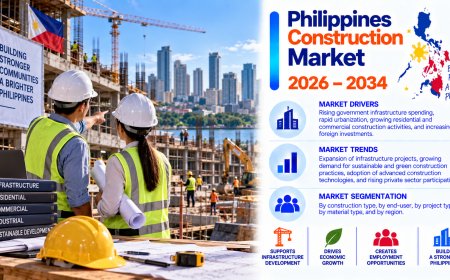































Philippines Construction Market Growth Analysis Report 2026-2034
The Philippines construction market size reached USD 41.3 Billion in 2025 and is projected to reach USD 61.7 Billion by 2034, at a CAGR of 4.56%.

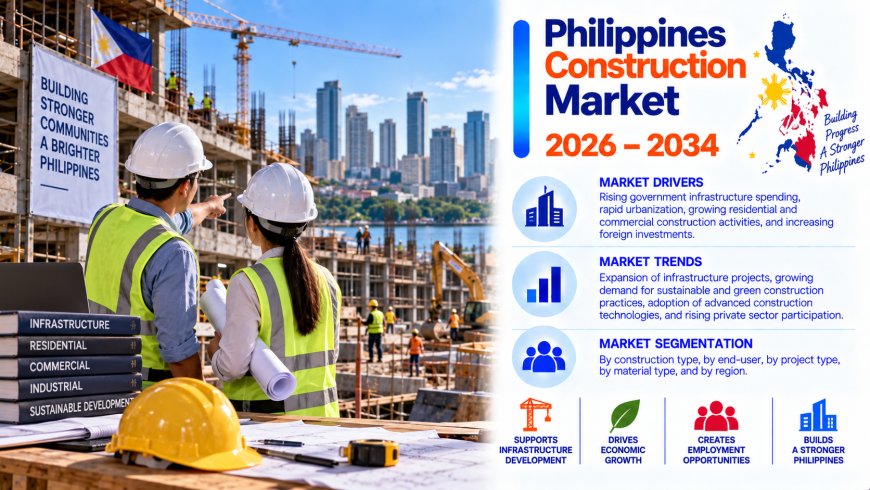
Market Overview
The Philippines construction market size reached USD 41.3 Billion in 2025 and is projected to reach USD 61.7 Billion by 2034, growing at a compound annual growth rate (CAGR) of 4.56% from 2026 to 2034. The market is driven by government infrastructure programs, sustainable building, urban housing, industrial zones, foreign investment, and public-private partnerships.
Philippines Construction Market Summary
- The Philippines construction market covers residential, commercial, industrial, infrastructure (transportation), and energy and utilities construction across Luzon, Visayas, and Mindanao.
- Construction supports housing, transport, energy, and industrial growth.
- The ecosystem includes developers, contractors, material suppliers, engineering and design firms, government agencies, financiers, and foreign investors.
- IMARC cites the PPP Center’s rollout of 173 projects worth about USD 56 billion, including 95 solicited projects (about USD 21 billion) and 78 unsolicited projects (about USD 37 billion).
- IMARC lists three challenges: high construction costs, regulatory delays, and a skilled labor shortage.
- IMARC lists opportunities in tourism infrastructure, rural development, and technology adoption such as BIM, automation, prefabrication, and modular construction. It gives no 2025 sector shares in text.
Request a Sample Report for In-Depth Market Insights: https://www.imarcgroup.com/philippines-construction-market/requestsample
Porter’s Five Forces Analysis
- Competitive Rivalry: High. Local and international contractors compete for public and private projects on price, track record, and delivery. Business implication: Build specialization and strong project delivery records.
- Supplier Power (Materials): Moderate to High. Imported steel and cement, fuel, and labor costs affect margins. Business implication: Secure supply contracts and diversify sourcing.
- Buyer Power (Government and Developers): High. Large public agencies and developers use competitive bidding. Business implication: Build credibility and pre-qualify for large tenders.
- Threat of Substitutes: Low to Moderate. Prefabrication and modular methods compete with traditional building. Business implication: Adopt modular and BIM capabilities.
- Threat of New Entrants: Moderate. Small contractors enter easily, but large projects require capital, licenses, and experience. Business implication: Partner with established firms and meet approval requirements.
Market Growth Drivers
Government Infrastructure Programs
Large programs in transport, water, energy, and digital infrastructure support construction. IMARC cites the PPP Center’s rollout of 173 projects worth about USD 56 billion, including 95 solicited projects of about USD 21 billion and 78 unsolicited projects of about USD 37 billion, and says public-private partnerships bring private expertise and financing.
Sustainable Building and Urban Housing
Developers are using green materials such as recycled concrete, bamboo, and low-carbon cement, plus smart building systems, as shown by the 5th Philippine Construction Congress on November 28, 2024. Demand for affordable housing and high-rise condominiums in cities, supported by developer programs and government subsidies, adds further volume.
Industrial Zones and Foreign Investment
Industrial and economic zone expansion drives demand for factories, warehouses, and supporting infrastructure. Foreign direct investment brings capital, expertise, and partnerships with local firms, according to IMARC. The page gives no figures for these two drivers, so the growth they support is described qualitatively in the report.
Philippines Construction Market Segmentation
Sector Insights:
- Residential Construction
- Commercial Construction
- Industrial Construction
- Infrastructure (Transportation) Construction
- Energy and Utilities Construction
Regional Insights:
- Luzon
- Visayas
- Mindanao
Competitive Landscape
The Philippines construction market includes large local contractors, international engineering firms, and many smaller builders. IMARC names no companies on the page and says detailed profiles are in the full report. Competition centers on price, technical capability, project experience, and access to financing.
Key Organizations Mentioned in the Report Context Include:
- PPP Center, the government agency that rolled out the 173 public-private partnership projects.
- DTI-CIAP and the Philippine Constructors Association, which held the 5th Philippine Construction Congress on November 28, 2024.
- Society of Construction Law Philippines, which signed an MoU with DTI-CIAP on standardized contract templates and training.
- Philippine Domestic Construction Board, which ran a contracts course in July 2024.
- These are agencies and industry bodies, not contractors. IMARC names no construction companies.
Regional Analysis
- Luzon: The largest construction base, centered on Metro Manila, with infrastructure, housing, and commercial building.
- Visayas: Growth from tourism, urban development, and regional infrastructure.
- Mindanao: Rural development, energy, and infrastructure needs. IMARC gives no regional values or narrative.
Recent Industry Developments
October 2026: Approved building permits fall to a six-year low, signalling weaker construction activity. On 22 October 2026, BusinessMirror, citing Philippine Statistics Authority data, reported that 10,968 construction activities were approved in August 2026, down 31% from 15,888 a year earlier. Approved residential construction activities fell by 40.7% to 6,355, while the estimated value of new residential buildings declined by 23.7% to ₱16.86 billion. The decline points to mounting pressure on construction demand amid higher costs, financing constraints and cautious investor sentiment.
October 2026: Government prioritises completing delayed infrastructure projects over launching new ones. On 19 October 2026, the Department of Public Works and Highways outlined a proposed infrastructure-budgeting reform that would provide multi-year funding commitments for ongoing projects. The agency manages approximately 25,000 to 30,000 projects annually, including roads, bridges and flood-control infrastructure. The proposed approach aims to reduce unfinished projects and construction delays by ensuring that projects receive sufficient funding through completion. If implemented effectively, the reform could improve project continuity and provide contractors with greater visibility over future workloads.
October 2026: Slowing private development and weaker public construction put pressure on contractors. A report published on 8 October 2026 by Construction Intelligence Asia, citing Colliers Philippines, highlighted a simultaneous slowdown in government construction spending and private property development. Government construction spending contracted by 32.4% in the second quarter of 2026, while overall construction activity declined by 14.8%. Developers also delayed some residential launches amid higher borrowing costs and weaker demand. Industrial developments serving semiconductor, food and beverage, fast-moving consumer goods, and electric vehicle manufacturers offered a potential source of demand for contractors with the relevant capabilities.
September 2026: Government strengthens building safety and climate-resilient infrastructure planning. On 9 September 2026, the Presidential Communications Office reported that President Ferdinand Marcos Jr. convened the Private Sector Advisory Council to discuss infrastructure resilience and water security. Priorities included improving structural safety, checking the quality of imported cement, strengthening flood management and accelerating water infrastructure projects. These measures highlight the importance of durable construction materials, reliable engineering and climate-resilient designs in a country exposed to typhoons, flooding and other natural hazards.
Key Aspects Required for the Philippines Construction Market
- Market Performance: USD 41.3 Billion in 2025, with a projected trajectory to USD 61.7 Billion by 2034.
- Market Outlook: A 4.56% CAGR through 2034 indicates steady growth.
- Growth Drivers: Government infrastructure programs; sustainable building and urban housing; and industrial zones and foreign investment.
- Competitive Landscape: Local and international contractors competing on price, capability, and financing.
- Value Chain Analysis: From material suppliers, through contractors and engineering firms, to developers, government agencies, and end users.
- Industry Trends: Green materials; BIM, prefabrication, and modular building; public-private partnerships; and tourism and rural infrastructure.
- Strategic Recommendations: Adopt modular and digital methods; secure materials; build skilled labor; and pursue PPP projects.
Note: If you need any specific information that is not currently covered within the scope of the report, we will provide the same as a part of customization.
Speak to an analyst: https://www.imarcgroup.com/request?type=report&id=28749&flag=C
Report Format, Delivery, and Customization Details
- Report Format Mode: PDF and Excel (Editable version in PPT/Word format available on special request)
- Report Delivery Mode: Online Delivery, Physical Delivery
- Report Delivery Time: report delivered over email within 24 to 48 hours. If requested by the client, a physical copy will be delivered within three to ten days.
- Report Confirmation Mode: Yes, via email
- Report Customization Mode: Yes, via Email / Call
- Report Table of Content: Yes
- Report List of Figures: Yes
- Report Methodology Mode: Yes
- Request For Sample Report: Yes
What's Your Reaction?