


































Australia Hearing Aids Market Projected to Reach USD 241.4 Million by 2034
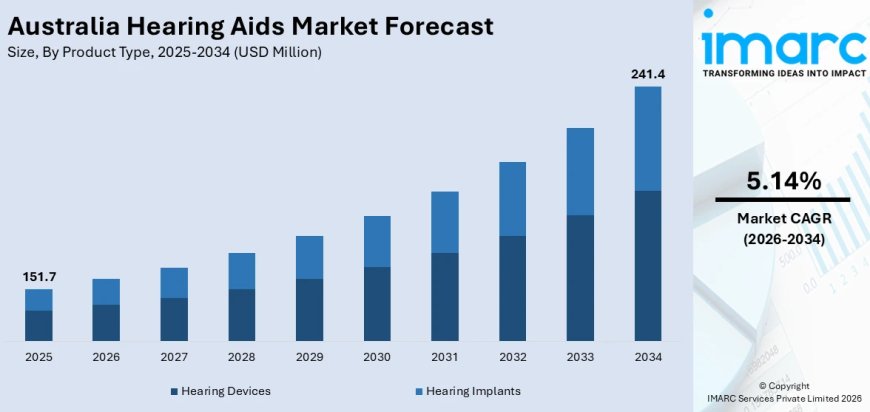
The Australia hearing aids market size reached USD 151.7 Million in 2025 and is projected to reach USD 241.4 Million by 2034, exhibiting a compound annual growth rate (CAGR) of 5.14% during 2026‑2034.

Market Overview
The Australia hearing aids market is witnessing steady growth driven by the growing population of elderly people, ongoing developments in hearing support technology, and heightened awareness about hearing health. The market size reached USD 151.7 Million in 2025 and is projected to reach USD 241.4 Million by 2034, exhibiting a compound annual growth rate (CAGR) of 5.14% during 2026‑2034. The number of Australians aged 75 and older is expected to rise by 49 per cent or an additional one million individuals in the coming decade, while life expectancy is also projected to increase.
This market is strategically important to Australia’s healthcare and aged care economy, supporting the quality of life and social engagement of the nation’s aging population. With a rise in the population of seniors, age‑related hearing loss is becoming more common, promoting the use of hearing aids among older Australians who need solutions to manage hearing deficits. Most older people are becoming aware about the necessity of wearing hearing devices to sustain their quality of life and remain active in social and work environments.
The Australia hearing aids market is poised for sustained expansion, driven by demographic aging, technological innovation, and improved healthcare access. With a projected CAGR of 5.14% through 2034, the market presents significant opportunities for manufacturers focusing on AI‑enabled devices, telehealth integration, and rechargeable solutions.
AUSTRALIA HEARING AIDS MARKET SUMMARY
-
The Australia hearing aids market encompasses a range of hearing improvement devices, including behind‑the‑ear (BTE), in‑the‑ear (ITE), and receiver‑in‑canal (RIC) devices, as well as advanced digital and AI‑powered hearing solutions.
-
The ecosystem spans global hearing aid manufacturers, audiology clinics, hospitals, telehealth service providers, and public and private health insurance schemes.
-
Major segments identified in the hearing aids industry include product type, hearing loss type, patient type, technology type, end user, and region (Australia Capital Territory & New South Wales, Victoria & Tasmania, Queensland, Northern Territory & Southern Australia, Western Australia).
-
Key trends shaping the market include technological advancements such as Bluetooth connectivity, rechargeable batteries, and artificial intelligence (AI), as well as increasing awareness and early detection of hearing loss.
PORTER'S FIVE FORCES ANALYSIS – AUSTRALIA HEARING AIDS MARKET
The competitive dynamics of the Australia hearing aids market can be analysed using Porter's Five Forces framework.
Bargaining Power of Suppliers – Moderate
-
Hearing aid manufacturers rely on suppliers of microprocessors, batteries, Bluetooth modules, and acoustic components. The technical expertise required for AI‑powered devices gives established component suppliers moderate leverage. However, the presence of multiple global suppliers and ongoing miniaturisation advances help balance supplier influence.
Bargaining Power of Buyers – Moderate
-
Australian patients benefit from a growing range of hearing aid options across audiology clinics, online platforms, and telehealth services. Public and private health insurance coverage makes devices more accessible, while the launch of telehealth services for hearing testing and fittings is making it more convenient for people to get access to hearing aids, particularly in rural regions.
Threat of New Entrants – Moderate
-
Significant capital requirements for R&D, regulatory approvals, and clinical validation create barriers. However, the shift toward direct‑to‑consumer online sales and smartphone‑compatible devices has enabled niche entrants to access the market with differentiated offerings.
Threat of Substitutes – Low
-
Personal sound amplification products (PSAPs) represent partial substitutes, but prescription hearing aids offer superior sound quality, customization, and medical validation. The aging population is actively pursuing high‑end, easy‑to‑use, and unobtrusive hearing aid solutions to tackle hearing loss more successfully.
Competitive Rivalry – High (Healthy)
-
The market features intensifying competition among global hearing aid manufacturers, with companies differentiating through digital connectivity, AI features, and smartphone app integration. In 2024, Starkey launched Genesis AI hearing aid devices in Australia and New Zealand, featuring a unique and efficient processor and a long‑lasting rechargeable battery.
Request for Sample Report: https://www.imarcgroup.com/australia-hearing-aids-market/requestsample
MARKET GROWTH DRIVERS
Aging Population Increasing Demand for Hearing Aids
The growing population of elderly people in Australia is particularly driving the demand for hearing aids. The number of Australians aged 75 and older is expected to rise in the coming decade by a staggering 49 per cent or an additional one million individuals, while life expectancy is also projected to increase. With a rise in the population of seniors, age‑related hearing loss is becoming more common. This population change is promoting the use of hearing aids among older Australians who need hearing solutions to manage hearing deficits. Most older people are becoming aware about the necessity of wearing hearing devices to sustain their quality of life and remain active in social and work environments. The aging population is actively pursuing high‑end, easy‑to‑use, and unobtrusive hearing aid solutions.
Technological Developments in Hearing Aid Devices
Ongoing developments in hearing support technology, including the inclusion of Bluetooth connectivity, rechargeable batteries, and artificial intelligence (AI), are improving the functionality and usability of hearing aids. These technological developments are improving the effectiveness of hearing aids in alleviating hearing loss and offering superior sound quality, comfort, and customization. They are shifting toward digital hearing aids that can be tailored through smartphone apps, giving more control and customization. The launch of telehealth services for hearing testing and fittings is also making it more convenient for people to get access to hearing aids, particularly in rural regions. In 2024, Starkey launched Genesis AI hearing aid devices in Australia and New Zealand.
Increasing Awareness and Early Detection of Hearing Loss
Increased awareness about hearing health is driving the market for hearing aids in Australia. Both public and private bodies are placing greater emphasis on making people aware about hearing impairment, detection at an early stage, and the benefits of timely intervention. Public health campaigns and hearing screening programs are contributing to early diagnosis, leading to higher adoption rates of hearing devices. As awareness grows, more Australians are proactively seeking hearing assessments and investing in quality hearing solutions.
AUSTRALIA HEARING AIDS MARKET SEGMENTATION
Segmentation analysis provides a detailed view of the Australia hearing aids market by category:
-
Product Type Insights: Behind‑the‑Ear (BTE), In‑the‑Ear (ITE), Receiver‑in‑Canal (RIC), Others.
-
Hearing Loss Insights: Sensorineural Hearing Loss, Conductive Hearing Loss, Mixed Hearing Loss.
-
Patient Type Insights: Adults, Pediatrics.
-
Technology Type Insights: Digital, Analog, AI‑Powered.
-
End User Insights: Hospitals, Audiology Clinics, Online, Others.
-
Regional Insights: Australia Capital Territory & New South Wales, Victoria & Tasmania, Queensland, Northern Territory & Southern Australia, Western Australia.
COMPETITIVE LANDSCAPE
The competitive landscape of the Australia hearing aids market is characterised by the presence of global hearing aid manufacturers competing across digital connectivity, AI features, and smartphone app integration. The market research report provides a comprehensive analysis of the competitive landscape, including market structure, key player positioning, top winning strategies, competitive dashboard, and company evaluation quadrant, with detailed profiles of all major companies provided in the full report. Strategic developments are shaping the competitive arena, with companies focusing on rechargeable batteries, Bluetooth connectivity, and AI integration. Investment opportunities exist in telehealth integration, AI‑powered devices, and direct‑to‑consumer distribution channels.
REGIONAL ANALYSIS
-
Australia Capital Territory & New South Wales represents a critical demand centre, anchored by Sydney's large elderly population, concentration of audiology clinics, and strong healthcare infrastructure supporting hearing aid accessibility.
-
Victoria & Tasmania benefits from Melbourne's robust healthcare research ecosystem and government investment in aged care, supporting innovation in hearing support technologies and telehealth services.
-
Queensland sees rising demand driven by the state's growing retirement communities and increasing awareness of hearing health among older residents.
-
Western Australia experiences steady growth supported by Perth's expanding healthcare network and improving access to hearing services in regional areas.
-
Northern Territory & Southern Australia, though smaller in market share, are benefiting from telehealth hearing testing and fitting services that improve access in remote and rural locations.
RECENT INDUSTRY DEVELOPMENTS
-
2024: Starkey launched Genesis AI hearing aid devices in Australia and New Zealand. The hearing aid features a unique and efficient processor, a long‑lasting rechargeable battery, along with various other aspects to improve its performance.
-
2024: The Australian Government’s Centre for Population released its 2024 Population Statement, projecting that the number of Australians aged 75 and older will rise by 49 per cent or an additional one million individuals in the coming decade.
-
2025 Activity: Telehealth services for hearing testing and fittings continued to expand, making hearing aids more accessible, particularly in rural regions.
Note: If you need any specific information that is not covered currently within the scope of the report, we will provide the same as a part of customization.
https://www.imarcgroup.com/request?type=report&id=36096&flag=C
ABOUT US
IMARC Group is a global management consulting firm that helps the world's most ambitious changemakers to create a lasting impact. The company provides a comprehensive suite of market entry and expansion services. IMARC offerings include thorough market assessment, feasibility studies, company incorporation assistance, factory setup support, regulatory approvals and licensing navigation, branding, marketing and sales strategies, competitive landscape and benchmarking analyses, pricing and cost research, and procurement research.
CONTACT US
IMARC Group
134 N 4th St., Brooklyn, NY 11249, USA
Email: sales@imarcgroup.com
Tel No: (D) +91 120 433 0800
United States: +1 201 971 6302
What's Your Reaction?