































Australia Catering Services Market Estimated to Exceed USD 4.6 Billion By 2034: IMARC Group
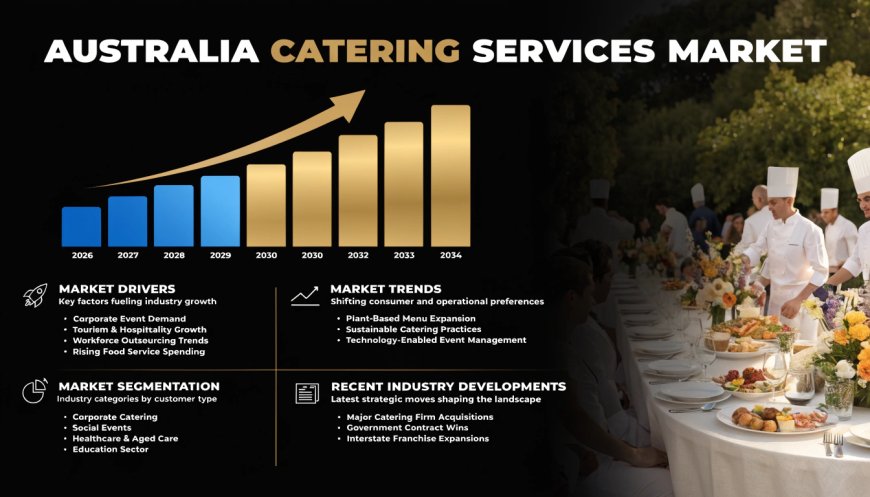
The market size reached USD 3.2 Billion in 2025 and is projected to reach USD 4.6 Billion by 2034, exhibiting a compound annual growth rate (CAGR) of 4.11% during 2026 2034.

Market Overview
The Australia catering services market is advancing steadily, driven by the adoption of flexible contractual models and a surge in event-driven, short-term food service demand across corporate and private sectors. According to IMARC Group, the market size reached USD 3.2 Billion in 2025 and is projected to reach USD 4.6 Billion by 2034, exhibiting a compound annual growth rate (CAGR) of 4.11% during 2026‑2034.
The market is propelled by heightening adoption of contractual and non-contractual models of catering, following demand for assured, adaptable, and innovative food options in different sectors. Growth is supported by customised services in healthcare, education, hospitality, and air-catering, with a view to meeting precise nutritional and operational requirements. The market is also benefitting from the broader expansion of Australia's food service industry, which reached US$90.1b ($137b AUD) in 2025 and is projected to grow to US$130.4b ($198b AUD) by 2034.
The Australia catering services market is poised for sustained expansion, driven by corporate demand for high‑quality outsourced food services and the rising popularity of event-based catering. With revenue in the corporate catering segment alone reaching $7.1 billion in 2025‑26 and a growing focus on health-conscious, sustainable offerings, the market presents significant opportunities for providers who can deliver customised, quality-driven solutions across healthcare, education, hospitality, and in-flight sectors.
Australia Catering Services Market Summary
The Australia catering services market encompasses a wide range of food service offerings including corporate catering for businesses and government departments, event catering for weddings and conferences, mobile catering and food truck services, catering for schools and educational institutions, healthcare facility catering, and in-flight and airport catering.
The market ecosystem includes international catering giants, specialised local providers, outsourced service operators, and a diverse network of chefs, logistics partners, and venue collaborators serving end-users across corporate clients, private events, educational institutions, healthcare facilities, government agencies, and non-profit organisations.
The market is driven by increased corporate outsourcing of workplace food services, growing demand for health-conscious and sustainable menu options, and the resurgence of business events, conferences, and social gatherings following the pandemic.
PORTER'S FIVE FORCES ANALYSIS – AUSTRALIA CATERING SERVICES MARKET
Bargaining Power of Suppliers – Moderate
The market relies on a diverse network of food producers, agricultural suppliers, and logistics providers. While the large number of potential suppliers limits individual influence, the increasing demand for locally sourced, organic, and specialty ingredients can give niche suppliers moderate leverage. Rising input costs for key ingredients such as meat, dairy, and fresh produce, along with packaging and logistics expenses, have placed upward pressure on supplier bargaining power.
Bargaining Power of Buyers – Moderate to High
Buyers include large corporate clients, government departments, healthcare facilities, and event organisers. With numerous catering providers competing for contracts, institutional buyers can negotiate favourable terms. The corporate catering segment alone generated $7.1 billion in revenue in 2025‑26, reflecting significant buyer expenditure. However, large integrated operators serving mining, government, and major corporate clients have secured long-term contract wins, giving established providers some protection against buyer switching.
Threat of New Entrants – Moderate
Capital requirements for establishing catering operations are moderate, with entry barriers primarily related to brand building, food safety compliance, and securing client contracts. However, niche opportunities remain for specialised entrants focusing on organic, plant-based, or dietary-specific catering, as well as cloud kitchen and on-demand delivery models. The on‑demand / cloud kitchen segment is projected to post the fastest growth rate among service types.
Threat of Substitutes – Low
While consumers can prepare meals at home or purchase from restaurants, the unique value of professional catering services for corporate events, institutional settings, and large gatherings cannot be easily replaced. The convenience, customisation, and scale offered by dedicated catering providers, combined with the return-to-office policies that have anchored predictable weekday catering demand, keep substitution pressures low.
Competitive Rivalry – High
The market is highly competitive, featuring a dynamic mix of international giants such as Compass Group Australia, Spotless Group, Delaware North Companies Australia, Aramark Australia, ISS Facility Services, and Sodexo Australia, alongside specialised local players including The Good Food Company, A La Carte Catering, and The Fresh Collective. Competition centres on quality, customisation, sustainability credentials, and pricing, with rivalry intensified by the entry of international QSR brands and aggressive store rollouts.
Request for Sample Report: https://www.imarcgroup.com/australia-catering-services-market/requestsample
MARKET GROWTH DRIVERS
Growing Corporate Outsourcing and Return-to-Office Trends Boosting Contractual Catering
The Australia catering services market is experiencing significant growth in contractual catering, driven by organisations across healthcare, education, and corporate sectors increasingly delegating their food service requirements to third-party players on long‑term agreements. The Corporate Catering Services industry has demonstrated resilient, accelerating growth, with revenue expanding at a robust 5.9% compound annual rate to reach $7.1 billion in 2025‑26, supported by a 2.8% increase in the most recent year.
Return-to-office policies have tightened, with average mandated office attendance rising to 3.64 days per week in 2025, anchoring predictable weekday catering demand. Rebounding conferences, training sessions, and corporate functions have lifted higher‑value event work, particularly in metro CBDs and major business‑event destinations. Contractual catering provides sustained quality, cost‑effectiveness, and adherence to stringent nutritional standards, making it a client favourite in institutional settings. Businesses concentrating on core operations find outsourcing catering helps them minimise overhead and increase professionalism in service.
Rising Demand for Healthy and Sustainable Food Options
Australian consumers are increasingly seeking healthier meal options, with the Australian Institute of Health and Welfare reporting that 67% of Australians are actively seeking healthier meal choices, propelling catering services to adapt their menus accordingly. The health food market is projected to reach AUD 2.5 billion, reflecting a 10% increase from the previous year.
Catering companies are also embracing environmentally friendly practices like green packaging, much in line with consumer values. Health-conscious and organic food options are increasingly influencing menus, with plant‑based dishes, gluten‑free meals, and low‑sugar alternatives becoming standard across the sector. This shift towards sustainable practices and local sourcing has further fueled market expansion.
Expansion of Non-Contractual Catering Services Driven by Event Demand
The Australia catering services market is also expanding through non-contractual catering, driven by a surge in corporate events, private parties, and conferences demanding short‑term, flexible food service arrangements. In contrast to contractual catering, these services provide flexibility and customisation in the absence of long‑term agreements. Customers are availed with extensive menus comprising dietary‑restricted and themed dishes that are tailored to event needs. Increased event‑driven activities and the quest for culinary distinction have driven innovation within the non‑contractual sector. This expansion supplements overall Australian catering services expansion by meeting varied client needs and preferences.
Australia Catering Services Market Segmentation
Segmentation analysis provides a detailed view of the Australia catering services market by category:
- Service Type Insights: Event Catering (Weddings/Corporate), Contract Catering (Institutions), Mobile Catering and Food Trucks, On‑demand / Cloud Kitchens, Schools and Institutions, Healthcare Facilities.
- End-User Insights: Corporate Clients, Private Events, Educational Institutions, Healthcare Facilities, Government Agencies, Non‑Profit Organisations.
- Regional Insights: Australia Capital Territory & New South Wales, Victoria & Tasmania, Queensland, Northern Territory & Southern Australia, Western Australia.
Competitive Landscape
The competitive landscape of the Australia catering services market is characterised by a dynamic mix of regional and international players. Leading participants include Compass Group Australia, Spotless Group, Delaware North Companies Australia, Aramark Australia, ISS Facility Services, Sodexo Australia, Civeo Corporation, The Good Food Company, Food & Desire, A La Carte Catering, The Fresh Collective, Gourmet Food Catering, The Food Co., and The Event Catering Company.
These companies contribute to innovation, geographic expansion, and service delivery. The industry has seen a wave of long‑term contract wins by major integrated operators serving mining, government, and large corporate clients, while specialised local caterers compete on customisation, quality, and regional expertise. New South Wales is the largest province with a 33% market share in the Australian catering industry (1,003 catering companies), followed by Victoria with 848 catering companies (28%) and Queensland with 463 (15%).
Regional Analysis
Regional dynamics within the Australia catering services market are shaped by varying levels of economic activity, population density, and business event concentration across states and territories.
- Australia Capital Territory & New South Wales is the largest region with a 33% market share (1,003 catering companies), driven by Sydney's high concentration of corporate offices, event venues, and a vibrant food culture. The region recorded 7.9 per cent year‑on‑year growth in the café, restaurant and catering sector.
- Victoria represents the second‑largest region with 848 catering companies (28% share), with Melbourne's strong hospitality scene, growing business events, and thriving food culture driving consistent demand for corporate and event catering.
- Queensland holds a 15% share with 463 catering companies, supported by Brisbane's growing corporate sector, tourism‑driven events, and expanding hospitality industry.
- Western Australia sees demand from resource sector catering, particularly fly‑in fly‑out (FIFO) operations in mining regions, along with corporate and event catering in Perth.
- Northern Territory & Southern Australia, while smaller in overall catering company numbers, are experiencing growth driven by infrastructure projects, tourism, and community events.
Recent Industry Developments
- April 2024: Perth Inflight Catering was rebranded as Foodfolk Australia, increased staff and production, acquired key airline contracts, and announced a new facility opening later in the year to improve operational efficiency, highlighting the growing sophistication of the in‑flight catering segment.
- April 2024: National Media bought Australian foodservice and hospitality events such as Foodservice Australia and Australian Chef of the Year, bolstering its Food and Beverage Group to serve Australia's $222 billion market, underscoring the scale of growth opportunities in the sector.
- February 2026: IBISWorld's Corporate Catering Services industry analysis reported that the industry had demonstrated resilient, accelerating growth over the five years to 2025‑26, with revenue expanding at a robust 5.9% compound annual rate to reach $7.1 billion, supported by return‑to‑office policies and rebounding business events.
- March 2026: The broader Australian foodservice market was projected to grow from US$90.1b ($137b AUD) in 2025 to US$130.4b ($198b AUD) by 2034, expanding at a CAGR of 4.07%, with tourism, urban lifestyle shifts, and digital ordering adoption identified as key growth drivers.
- 2025 (Throughout): Australia's major QSR operators – McDonald's, KFC, and Hungry Jack's – steadily increased their market share, benefiting from dense store networks, strong brand recognition, and disciplined value propositions, driving intense competition across foodservice formats.
- 2025 (Throughout): Cloud and ghost kitchen models gained traction as capital‑efficient, delivery‑focused operations, while AI‑driven personalisation and digital ordering platforms continued to reshape the sector, enhancing convenience and customer experience.
Browse Full Report with TOC & List of Figures for In‑Depth Market Insights: https://www.imarcgroup.com/australia-catering-services-market
Note: If you need any specific information that is not covered currently within the scope of the report, we will provide the same as a part of customisation.
About Us
IMARC Group is a global management consulting firm that helps the world's most ambitious changemakers to create a lasting impact. The company provides a comprehensive suite of market entry and expansion services. IMARC offerings include thorough market assessment, feasibility studies, company incorporation assistance, factory setup support, regulatory approvals and licensing navigation, branding, marketing and sales strategies, competitive landscape and benchmarking analyses, pricing and cost research, and procurement research.
Contact Us
IMARC Group
134 N 4th St., Brooklyn, NY 11249, USA
Email: sales@imarcgroup.com
Tel No.: (D) +91 120 433 0800
United States: +1-201-971-6302
What's Your Reaction?