

































Australia Agricultural Adjuvant Market Size, Share, Trends & Forecast 2026-2034
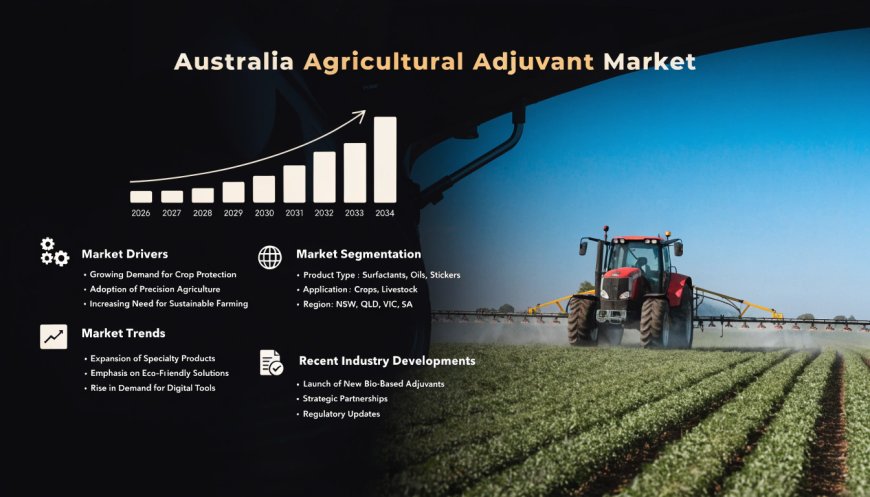
The Australia agricultural adjuvant market size reached USD 83.92 Million in 2025. The market is projected to reach USD 129.14 Million by 2034, exhibiting a growth rate (CAGR) of 4.91% during 2026-2034.

Market Overview
The Australia agricultural adjuvant market size reached USD 83.92 Million in 2025. Looking forward, IMARC Group expects the market to reach USD 129.14 Million by 2034, exhibiting a growth rate (CAGR) of 4.91% during 2026-2034. The market is experiencing steady growth driven by Australia’s record agricultural production forecasts, increasing herbicide application across no-till farming systems, rising demand for spray drift reduction technologies, expanding adoption of sustainable and biodegradable adjuvant formulations, and strong crop protection product usage that directly enables AUD 31.6 billion of Australia’s agricultural output annually.
Request for a sample report: https://www.imarcgroup.com/australia-agricultural-adjuvant-market/requestsample
Porter’s Five Forces Analysis – Australia Agricultural Adjuvant Market
The Australia agricultural adjuvant market, valued at USD 83.92 Million in 2025 and projected to reach USD 129.14 Million by 2034 (CAGR 4.91%), reflects a structurally sound and innovation-driven industry environment supported by Australia’s world-leading sustainable farming practices.
Bargaining Power of Suppliers – Moderate
• The market is served by established global specialty chemical companies including BASF, Corteva Agriscience, Evonik Industries, and Croda International, alongside Australia-headquartered Nufarm Limited (AUD 3.4 billion total revenue in FY2025) which is actively expanding its environmentally friendly adjuvant portfolio.
• SST Australia, the country’s leading specialist adjuvant supplier since 1991, operates a custom-built manufacturing facility in Melbourne (opened 2016) with over 60 commercialized products and a research partnership with Monash University, providing domestic supply stability.
• In June 2025, Evonik launched biodegradable adjuvant technologies including trisiloxane surfactants and BREAK-THRU specialty additives, expanding the supplier innovation pipeline and offering buyers more formulation options.
Bargaining Power of Buyers – Moderate
• Australia’s gross value of agricultural production is forecast to reach a record AUD 99.5 billion in 2025-26 (ABARES), with national winter crop production expected to increase 13% to 68.4 million tonnes, sustaining strong adjuvant demand from a productive farming base.
• Crop protection products directly enable AUD 31.6 billion of Australia’s agricultural output annually (Deloitte Access Economics/CropLife Australia), with 73% of the AUD 43.2 billion total crop production attributable to crop protection product access.
• Farmer consolidation from 120,000 broadacre farms in 1980-81 to approximately 60,000 by 2021-22 (ABARES) is concentrating purchasing power among larger, more commercially sophisticated operations.
Threat of New Entrants – Low to Moderate
• The APVMA requires full registration of adjuvants under Section 4 of the Agricultural and Veterinary Chemicals Code Act 1994, including comprehensive chemistry, toxicology, efficacy, and drift potential data, creating significant regulatory entry barriers.
• As of Q1 2025, only 54.9% of APVMA application assessments for new novel chemistry are being completed on time (CropLife Australia), extending time-to-market for new entrants and favoring established players with existing registrations.
Threat of Substitutes – Low to Moderate
• While precision agriculture adoption is growing (Australian smart agriculture market valued at USD 345.35 million in 2025), drone-based precision spraying technologies complement rather than replace adjuvant use by optimizing spray deposition efficiency.
• Australia records the most sustainable pesticide use among comparable exporters at 1.88 kg per hectare (CropLife Australia), and herbicides account for over 50% of total crop protection market value driven by no-till farming, sustaining adjuvant demand as essential spray performance enhancers.
Competitive Rivalry – Moderate to High (Healthy)
• Multi-tier competition spans global crop protection majors (BASF, Corteva, Nufarm with 18% crop protection EBITDA growth), specialty adjuvant manufacturers (SST Australia with 60+ products, Croda, Evonik), and regional distributors, driving innovation in biodegradable and drift-reducing formulations.
• Australia’s crop protection chemicals market, valued at USD 2.7 billion in 2024, provides a substantial addressable base, while CropLife Australia’s revised Resistance Management Strategies (July 2025) encourage adjuvant-integrated spray programs, sustaining competitive product development.
Australia Agricultural Adjuvant Market Trends
Sustainability-Driven Shift Toward Biodegradable Adjuvant Formulations
A defining trend in the Australia agricultural adjuvant market is the accelerating industry shift toward biodegradable and bio-based adjuvant formulations driven by sustainability imperatives and evolving regulatory expectations. Global suppliers including Evonik and Croda are launching next-generation adjuvants featuring sophorolipid biosurfactants, polyglycerol ester-based surfactants, and novel organosilicon technologies that deliver equivalent or superior spray performance while meeting environmental stewardship standards. Australian growers, operating within one of the world's most sustainable pesticide-use frameworks at 1.88 kg per hectare, are increasingly receptive to these innovations. SST Australia's ongoing R&D partnership with Monash University is further advancing locally developed sustainable adjuvant solutions tailored to Australian cropping conditions.
Herbicide Adjuvant Demand Growing with No-Till Farming Expansion
The continued expansion of conservation tillage and no-till farming practices across Australian broadacre cropping systems is driving sustained demand for herbicide-compatible adjuvants. Herbicides account for over 50% of Australia's total crop protection market value, reflecting the country's heavy reliance on chemical weed management in reduced-tillage systems where mechanical weed control is minimized. This structural dependence creates consistent demand for activator adjuvants including surfactants, crop oil concentrates, and drift reduction agents that optimize herbicide spray coverage, uptake, and efficacy. CropLife Australia's revised Resistance Management Strategies issued in July 2025 further emphasize the importance of adjuvant-integrated spray programs to maximize herbicide effectiveness and manage evolving weed resistance challenges.
Australia Agricultural Adjuvant Market Summary
• The Australia agricultural adjuvant market reached USD 83.92 Million in 2025 and is projected to grow at a CAGR of 4.91% to reach USD 129.14 Million by 2034, supported by record agricultural production and strong crop protection reliance.
• Activator adjuvants including surfactants and crop oil concentrates dominate the type segment, driven by their essential role in enhancing herbicide and fungicide spray performance across broadacre and horticultural applications.
• The herbicides application segment leads market demand, reflecting Australia's no-till farming dependence where chemical weed management supported by adjuvants is the primary crop protection strategy.
• Cereals and oilseeds represent the largest crop type segment, aligned with national winter crop production forecast at 68.4 million tonnes in 2025-26 (ABARES), generating substantial spray adjuvant consumption volumes.
• Biodegradable and bio-based adjuvant innovations from Evonik, Croda, and SST Australia are gaining market traction as sustainability requirements and environmental stewardship standards shape farmer purchasing decisions.
Australia Agricultural Adjuvant Market Growth Drivers
Record Agricultural Production Supporting Crop Protection Demand
Australia's agricultural sector is experiencing record-setting production levels that are directly driving adjuvant market growth. ABARES forecasts the gross value of agricultural production to reach AUD 99.5 billion in 2025-26, with combined agriculture, fisheries, and forestry exports forecast at a record AUD 83.9 billion. National winter crop production is expected to increase 13% to 68.4 million tonnes, the second-largest winter crop on record and 15% above the five-year average. This exceptional production environment generates correspondingly high demand for crop protection products and their essential adjuvant companions, as farmers apply herbicides, fungicides, and insecticides across expanded cropping areas. The Deloitte Access Economics analysis confirms that crop protection products enable AUD 31.6 billion of agricultural output annually.
Regulatory Focus on Spray Drift Reduction and Application Efficiency
Increasing regulatory attention to spray drift management and application efficiency across Australian agriculture is driving adoption of specialized adjuvant products. The APVMA requires adjuvant applicants to provide comprehensive data on drift potential effects, and drift-reducing agents face additional specific data requirements for registration. This regulatory framework encourages farmers and spray applicators to incorporate drift reduction adjuvants into their spray programs to ensure compliance and minimize off-target environmental exposure. State-level environmental protection regulations and buffer zone requirements further reinforce the need for adjuvant technologies that improve spray droplet size control and deposition accuracy, creating sustained demand for utility adjuvants designed specifically for drift mitigation applications.
Australia Agricultural Adjuvant Market Segments
The Australia agricultural adjuvant market can be segmented as follows:
By Type
• Activator Adjuvant
• Utility Adjuvant
By Crop Type
• Cereals and Oilseeds
• Fruits and Vegetables
• Others
By Application
• Herbicides
• Fungicides
• Insecticides
• Others
By Region
• Australia Capital Territory & New South Wales
• Victoria & Tasmania
• Queensland
• Northern Territory & Southern Australia
• Western Australia
Competitive Landscape
The Australia agricultural adjuvant market features a competitive landscape with global specialty chemical companies and dedicated local manufacturers. Key players include BASF, Corteva Agriscience, Nufarm Limited, Evonik Industries, Croda International, and SST Australia. SST Australia maintains a leading domestic position through its Melbourne manufacturing facility, 60+ product portfolio, and Monash University research partnership. Nufarm leverages its Australian headquarters and broad crop protection distribution network. Companies differentiate through formulation innovation, sustainability credentials, APVMA registration breadth, and agronomist recommendation networks across broadacre and horticultural cropping segments.
Latest Recent News & Development
June 2025: Evonik Industries launched a new range of biodegradable adjuvant technologies including trisiloxane surfactants and BREAK-THRU specialty additives targeting sustainable crop protection applications globally and in Australia.
July 2025: CropLife Australia issued revised Resistance Management Strategies for insecticides, fungicides, and herbicides, emphasizing adjuvant-integrated spray programs to enhance crop protection efficacy.
March 2026: Nufarm Limited reported 18% growth in crop protection EBITDA and expanded its environmentally friendly adjuvant product line designed to improve herbicide performance across Australian broadacre farming systems.
Browse the full report: https://www.imarcgroup.com/australia-agricultural-adjuvant-market
About Us
IMARC Group is a global management consulting firm that helps companies in strategy, operations, technology, and M&A. We have served over 5,000 clients across 100+ countries, providing actionable insights and strategic recommendations. Our research spans technology, healthcare, chemicals, food and agriculture, energy, logistics, and more. IMARC's information products include major market, scientific, economic and technological developments for business leaders in pharmaceutical, industrial, and high technology organizations.
Contact Us
IMARC Group
134 N 4th St. Brooklyn, NY 11249, USA
Email: sales@imarcgroup.com
Tel No: (D) +91 120 433 0800
United States: +1-631-791-1145
What's Your Reaction?