
































Australia Agricultural Adjuvant Market | Size, Share, Trends and Analysis 2026-2034
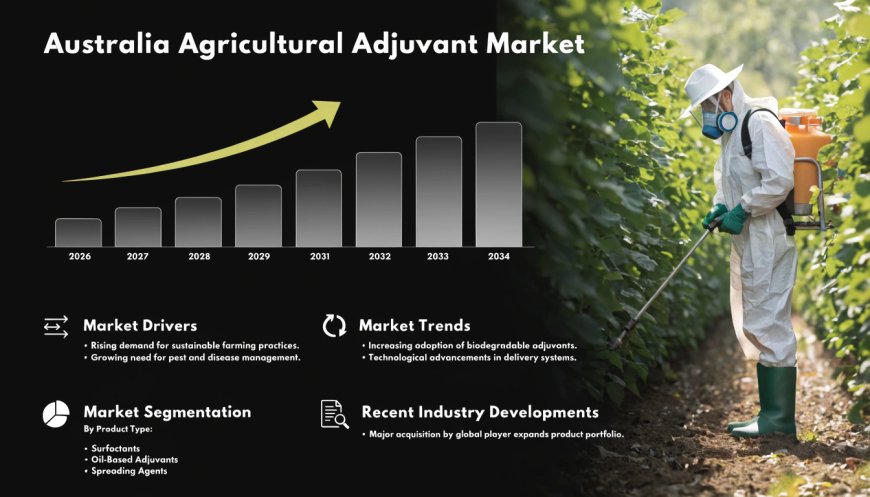
The Australia agricultural adjuvant market size reached USD 83.92 Million in 2025. The market is projected to reach USD 129.14 Million by 2034, exhibiting a growth rate (CAGR) of 4.91% during 2026-2034.

Market Overview
The Australia agricultural adjuvant market is advancing steadily as the agricultural sector embraces precision farming technologies and enhanced crop protection strategies to meet growing food production demands. According to IMARC Group, the market size reached USD 83.92 Million in 2025 and is projected to reach USD 129.14 Million by 2034, exhibiting a compound annual growth rate (CAGR) of 4.91% during 2026‑2034. The market is driven by the rapid adoption of precision agriculture technologies driving demand for optimized agrochemical application, government investment in climate-smart and sustainable agriculture practices supporting agrochemical innovation, and rising demand for enhanced crop protection solutions to combat resistant pests and weeds.
The market is strategically important to Australia's agricultural economy as adjuvants enhance the efficiency of crop protection chemicals, reduce chemical volumes required per application, and support the nation's world-best-practice standards for chemical and fertilizer use. As Australian farmers face mounting challenges from resistant weeds and labour shortages, agricultural adjuvants have become essential tools for maintaining productivity while supporting environmental stewardship goals. The market is also benefiting from the integration of Internet of Things (IoT)-connected precision application systems and the rising adoption of automated spray technologies across Australian farming operations.
*The Australia agricultural adjuvant market is poised for sustained expansion, driven by a projected CAGR of 4.91% through 2034, accelerating precision agriculture adoption, and strong government backing for climate-smart farming. With herbicides remaining the dominant application segment and increasing demand for sustainable, low-impact formulations, the market presents significant opportunities for manufacturers and technology partners focused on innovative, environmentally compatible adjuvant solutions.*
Australia Agricultural Adjuvant Market Summary
The Australia agricultural adjuvant market encompasses a range of products designed to enhance the performance of crop protection chemicals, including activator adjuvants and utility adjuvants. The ecosystem includes chemical manufacturers, agricultural technology providers, distributors, and end‑users spanning broadacre cropping, horticulture, cotton, and pastoral sectors.
Segmentation Insights:
-
By Type: Activator adjuvants enhance the biological activity of herbicides, fungicides, and insecticides by improving penetration, spreading, and absorption of active ingredients. Utility adjuvants include wetting agents, drift control agents, and compatibility agents that improve spray application characteristics.
-
By Crop Type: The market covers cereals and oilseeds, fruits and vegetables, and others. Cereals and oilseeds represent a significant segment driven by Australia's extensive broadacre cropping sector.
-
By Application: Herbicides held the dominant share in Australia's crop protection chemicals market, driven by weed biosecurity challenges and the need for effective control of resistant weed populations. Applications also include fungicides and insecticides.
-
By Region: The market covers Australia Capital Territory & New South Wales, Victoria & Tasmania, Queensland, Northern Territory & Southern Australia, and Western Australia.
The market is driven by the rapid adoption of precision agriculture technologies, substantial government investment in climate-smart agriculture, and escalating demand for enhanced crop protection solutions against resistant pests and weeds.
Porter's Five Forces Analysis – Australia Agricultural Adjuvant Market
The competitive dynamics of the Australia agricultural adjuvant market can be analysed using Porter's Five Forces framework.
Bargaining Power of Suppliers – Moderate
The market relies on a mix of domestic and international suppliers for chemical raw materials and formulation technologies. Australian manufacturers such as Vicchem produce adjuvants using locally sourced ingredients, including 100% Australian-grown natural canola oil. The presence of multiple suppliers and the increasing development of environmentally compatible adjuvant formulations help balance supplier influence.
Bargaining Power of Buyers – Moderate
Buyers include large-scale farmers, agricultural cooperatives, and crop protection chemical distributors. The availability of adjuvant products from multiple manufacturers provides buyers with choices. However, the technical nature of adjuvant formulations and the need for compatibility with specific crop protection chemicals give established suppliers with proven product performance some protection against pure price-based competition.
Threat of New Entrants – Moderate
Capital requirements for developing and registering adjuvant formulations with the Australian Pesticides and Veterinary Medicines Authority (APVMA) are significant. However, the growing demand for sustainable, low-impact adjuvant formulations is attracting new entrants focused on innovative, environmentally compatible technologies.
Threat of Substitutes – Low
There is a low threat of substitutes. While farmers could theoretically apply crop protection chemicals without adjuvants, the increasing prevalence of resistant weed biotypes and the need for efficient agrochemical application make adjuvants essential for achieving effective pest and weed control.
Competitive Rivalry – Moderate
The market is moderately competitive, featuring a mix of established chemical manufacturers, agricultural technology companies, and specialised adjuvant producers. Key players compete on product efficacy, environmental compatibility, and the ability to provide integrated crop protection solutions. The market is also seeing increased collaboration between chemical manufacturers and agricultural technology firms to develop advanced formulation technologies.
Request for Sample Report: https://www.imarcgroup.com/australia-agricultural-adjuvant-market/requestsample
Market Growth Drivers
Rapid Adoption of Precision Agriculture Technologies
The Australian agricultural sector is undergoing a significant transformation through widespread adoption of precision agriculture technologies, fundamentally reshaping how farmers apply crop protection chemicals and creating substantial demand for agricultural adjuvants. Australian farms are adopting precision farming technologies for improved crop management, utilizing GPS, satellite imagery, drones, and IoT-connected devices to optimize planting, irrigation, and agrochemical application. These advanced systems require highly efficient spray solutions to maximize the effectiveness of every application, making adjuvants indispensable for achieving optimal coverage, penetration, and absorption on target surfaces.
The integration of variable rate technology allows farmers to precisely apply inputs based on specific field conditions, necessitating adjuvants that can enhance spray characteristics and reduce waste. In February 2025, Yamaha Motor established Yamaha Agriculture, Inc., marking its strategic entry into precision agriculture utilizing AI and autonomous technologies, aiming to offer robotic solutions for spraying, weeding, and various field tasks for producers of wine grapes, apples, and other specialty crops in Australia and New Zealand. As precision agriculture technologies continue to proliferate across Australian farms, the demand for adjuvants that optimize agrochemical performance in automated and precision application systems is rising, supporting the Australia agricultural adjuvant market growth.
Government Investment in Climate-Smart and Sustainable Agriculture
The Australian Government's substantial investment in climate‑smart agriculture and sustainable farming practices is creating a favourable environment for agricultural adjuvant adoption and innovation. The establishment of the $302.1 million Climate-Smart Agriculture Program over five years from 2023‑24 to 2027‑2028 through the Natural Heritage Trust demonstrates the government's commitment to strengthening sustainable agriculture and natural resource management practices across the country. The program comprises multiple investment streams aimed at driving the development, adoption, trialling, and roll‑out of climate‑smart, sustainable, innovative tools and on‑ground farm practices that enhance the agriculture sector's productivity and profitability.
This strategic focus on sustainable agriculture is encouraging farmers to adopt technologies and products that reduce environmental impact while maintaining crop yields, where agricultural adjuvants play a crucial role by improving the efficiency of agrochemical applications and reducing the volume of chemicals required. The government's emphasis on sustainable farming practices, combined with substantial R&D investments, is accelerating the development of advanced adjuvant formulations that enhance agrochemical efficacy while supporting environmental stewardship goals.
Rising Demand for Enhanced Crop Protection Against Resistant Pests and Weeds
Australian farmers face mounting challenges from resistant pests and weeds, driving unprecedented demand for enhanced crop protection solutions where agricultural adjuvants play a vital role in maximizing herbicide and insecticide effectiveness. The evolution of herbicide‑resistant weed biotypes has intensified the need for adjuvants that can enhance penetration and absorption of active ingredients, ensuring effective control even against resistant populations.
Weeds pose a major biosecurity challenge to Australian crops, leading to reduced yields and significant financial losses for producers, which has driven herbicides to become the dominant segment in Australia's crop protection chemicals market. A notable shortage of farm labour, particularly for manual tasks like weeding, has emerged, making chemical weed control increasingly critical. In 2024, the Australian Government introduced a $4.1 million initiative to promote advanced mechanization technology in the Australian vegetable sector, targeting high input costs and labour issues affecting grower profitability. This program, executed by Hort Innovation and the Queensland Department of Agriculture and Fisheries in partnership with the Global Organization for Agricultural Robotics, reflects the growing recognition that efficient application of crop protection chemicals, enhanced by adjuvants, is essential for managing production challenges.
Market Growth Drivers
Increasing Demand for Environmentally Friendly and Sustainable Adjuvants
The Australia agricultural adjuvant market is witnessing a growing demand for environmentally friendly and sustainable adjuvants that have minimal impact on ecosystems. Australian agriculture has strong sustainability credentials, with chemical and fertilizer use at world best practice levels. Farmers are increasingly seeking adjuvants that enhance agrochemical efficacy while reducing environmental impact and supporting the transition to more sustainable farming systems. This trend is driving innovation in formulations that are non-hazardous, crop-safe, and environmentally compatible.
Integration of IoT-Connected Precision Application Systems
The integration of IoT-connected precision application systems is a key trend shaping the market. Advanced systems that combine real‑time data analytics, automated spraying technologies, and precision application equipment require adjuvants that can enhance spray characteristics and reduce waste. The rising adoption of automated spray technologies in Australian farming operations is creating demand for adjuvants that are compatible with sophisticated application equipment and can deliver consistent performance across varying field conditions.
Australia Agricultural Adjuvant Market Segmentation
Segmentation analysis provides a detailed view of the Australia agricultural adjuvant market by category:
-
Crop Type Insights: Cereals and Oilseeds, Fruits and Vegetables, Others
-
Application Insights: Herbicides, Fungicides, Insecticides, Others
-
Regional Insights: Australia Capital Territory & New South Wales, Victoria & Tasmania, Queensland, Northern Territory & Southern Australia, Western Australia
Competitive Landscape
The competitive landscape of the Australia agricultural adjuvant market features a mix of established chemical manufacturers, agricultural technology companies, and specialised adjuvant producers.
Key Companies and Strategic Developments:
-
Nufarm Australia – Announced a collaboration with KingAgroot, a Chinese agricultural biotechnology firm, in February 2025 to create a new broad-spectrum, non-selective herbicide for the Australian market as an independent knockdown solution. Nufarm aims to secure registration of the Flufenoximacil (FFO) molecule developed by KingAgroot for the Australian market.
-
BASF – Introduced its innovative insecticide, Cimegra, in Australia in May 2024, expanding the company's crop protection portfolio. This launch demonstrates BASF's commitment to providing Australian farmers with advanced pest management solutions that require optimized application technologies, creating demand for compatible adjuvants that enhance product performance, spray coverage, and uptake efficiency.
-
Vicchem – An Australian manufacturer of agricultural adjuvants, producing products including HASTEN Spray Adjuvant based on 100% Australian-grown natural canola oil, described as a non-hazardous product that is safe for users, crops, and the environment.
-
Other participants include Brandt Consolidated, Winfield Solutions, Helena Chemical Company, Clariant International Ltd., and other global and regional players.
The market research report has also provided a comprehensive analysis of the competitive landscape, including market structure, key player positioning, top winning strategies, competitive dashboard, and company evaluation quadrant.
Regional Analysis
Regional dynamics within the Australia agricultural adjuvant market are shaped by varying levels of cropping activity, agricultural technology adoption, and farm size across states and territories.
-
Australia Capital Territory & New South Wales represents a significant market, driven by the state's diverse agricultural sector including extensive broadacre cropping, horticulture, and viticulture, with high adoption of precision agriculture technologies.
-
Victoria & Tasmania is a key market, supported by the state's strong agricultural base, including grains, oilseeds, and horticulture, with growing adoption of sustainable farming practices.
-
Queensland is a growing market, driven by extensive cropping areas in the state's agricultural regions and increasing adoption of precision farming technologies.
-
Northern Territory & Southern Australia presents emerging opportunities, with expanding cropping areas in northern Australia and growing interest in precision agriculture.
-
Western Australia is a significant market, driven by the state's extensive broadacre cropping sector and strong adoption of precision farming technologies across large-scale farming operations.
Recent Industry Developments
-
February 2025: Nufarm Australia announced a collaboration with KingAgroot, a Chinese agricultural biotechnology firm, to create a new broad-spectrum, non-selective herbicide for the Australian market. Nufarm aims to secure registration of the Flufenoximacil (FFO) molecule developed by KingAgroot for the Australian market.
-
February 2025: Yamaha Motor established Yamaha Agriculture, Inc., marking its strategic entry into precision agriculture utilizing AI and autonomous technologies, aiming to offer robotic solutions for spraying, weeding, and various field tasks for producers in Australia and New Zealand.
-
May 2024: BASF introduced its innovative insecticide, Cimegra, in Australia, expanding the company's crop protection portfolio and creating demand for compatible adjuvants that enhance product performance, spray coverage, and uptake efficiency.
-
2024: The Australian Government introduced a $4.1 million initiative to promote advanced mechanization technology in the Australian vegetable sector, targeting high input costs and labour issues affecting grower profitability.
-
2025‑2026 (Throughout): The Australia agricultural adjuvant market continues its steady expansion, driven by accelerating precision agriculture adoption, strong government backing for climate‑smart farming, and increasing demand for sustainable, environmentally compatible adjuvant formulations.
Browse Full Report with TOC & List of Figures for In‑Depth Market Insights: https://www.imarcgroup.com/australia-agricultural-adjuvant-market
Note: If you need any specific information that is not covered currently within the scope of the report, we will provide the same as a part of customisation.
About Us
IMARC Group is a global management consulting firm that helps the world's most ambitious changemakers to create a lasting impact. The company provides a comprehensive suite of market entry and expansion services. IMARC offerings include thorough market assessment, feasibility studies, company incorporation assistance, factory setup support, regulatory approvals and licensing navigation, branding, marketing and sales strategies, competitive landscape and benchmarking analyses, pricing and cost research, and procurement research.
Contact Us
IMARC Group
134 N 4th St., Brooklyn, NY 11249, USA
Email: sales@imarcgroup.com
Tel No.: (D) +91 120 433 0800
United States: +1-201-971-6302
What's Your Reaction?