































India Wastewater Treatment Market 2026-2034: Size, Share, Industry Growth and Forecast Report
The India wastewater treatment market size reached USD 10.4 Billion in 2025. Looking forward, IMARC Group expects the market to reach USD 19.4 Billion by 2034, exhibiting a growth rate (CAGR) of 7.00% during 2026-2034.

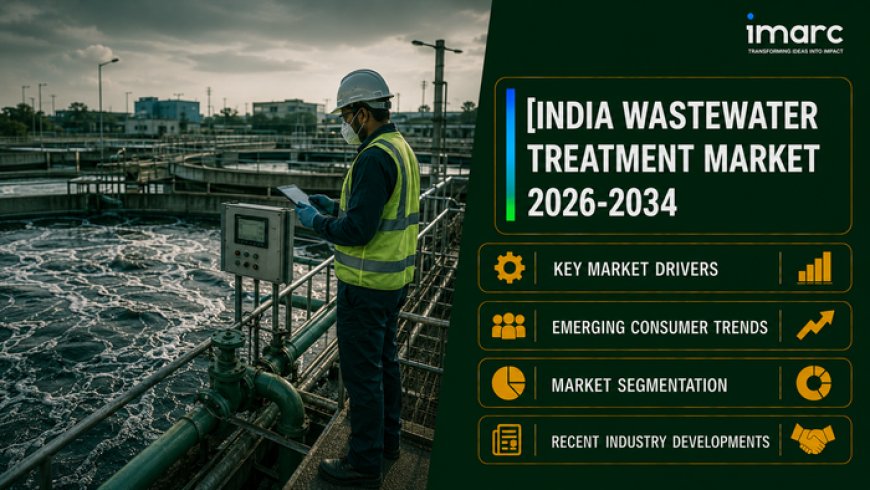
According to IMARC Group’s report titled “India Wastewater Treatment Market Size, Share, Trends and Forecast by Product Type, Technology, Application and Region, 2026-2034“, the report offers a comprehensive analysis of the industry, including market forecast, growth and regional insights.
The India wastewater treatment market size reached USD 10.4 Billion in 2025. Looking forward, IMARC Group expects the market to reach USD 19.4 Billion by 2034, exhibiting a growth rate (CAGR) of 7.00% during 2026-2034.
The chemical and process materials engineering framework in India is experiencing a massive structural realignment as rapid industrialization, absolute urban freshwater constraints, and localized water stress redefine industrial resource allocation. For chemical formulators, corporate utility providers, heavy manufacturing enterprises, and institutional infrastructure investors, this evolution elevates advanced purification agents and separation media into critical components for securing operational continuity and scaling localized circular water economies.
- Chemical and Separation Media Core: Specialty treatment chemicals (including coagulants, flocculants, and scale inhibitors) alongside modular membrane separation systems dominate the product type category, providing essential purification stages to process hazardous multi-industry effluents.
- Industrial Effluent Acceleration: While municipal utilities manage massive volumetric baseline loads, specialized industrial sectors—specifically pharmaceuticals, textiles, chemicals, and food processing—are generating high-velocity commercial demand for high-purity internal recycling loops.
- Decentralized Infrastructure Scaling: Due to mounting demographic pressure on centralized urban sewage lines, property developers and corporate office parks are aggressively scaling compact, decentralized treatment modules to recycle blackwater at its point of origin.
The Strategic Market Challenge: Navigating the Wastewater Treatment Market in India
Corporate leaders frequently overlook the intense capital expenditure friction and operating cost structures linked to achieving mandatory zero-liquid discharge (ZLD) metrics across high-fouling industrial zones. Standard biological treatment setups regularly experience sudden failure when exposed to irregular shocks of heavy chemical oxygen demand (COD) and complex organic compounds common in multi-tenant industrial estates. This operational vulnerability accelerates membrane degradation, leading to frequent plant downtime, unexpected replacement overhead, and severe legal exposures due to sudden, non-compliant effluent discharges.
➤ Access Key Market Statistics and Actionable Insights - Request Sample Report
India's Strategic Vision for the Wastewater Treatment Market:
-
Closing the National Treatment Void: National macroeconomic benchmarks are structured to aggressively address the profound domestic deficit highlighted by the Central Pollution Control Board, where cities currently treat merely 28% of the 72,368 million liters of sewage generated daily.
-
Institutionalizing the Circular Water Economy: Strategic federal roadmaps aim to transition urban areas from a baseline linear extraction model toward localized circular loops, enforcing a framework where recycled wastewater becomes an active secondary resource.
-
Massive Restoration of Major River Basins: Multi-billion dollar central programs are aligning state capital expenditures to establish high-throughput, automated treatment networks along primary river basins to eliminate uncontrolled raw industrial runoff.
Why Invest in the India Wastewater Treatment Market: Key Growth Drivers & ROI
-
Severe Freshwater Exhaustion Parameters: With domestic per capita water availability dropping steadily toward the official water stress baseline, industrial entities must secure treated recycled water to insulate manufacturing operations from municipal supply cutbacks.
-
Compounding Volumes of Industrial Effluents: Accelerated domestic output under centralized manufacturing directives ensures an expanding volume of high-density chemical waste, creating an active B2B market for specialized processing equipment and formulation chemicals.
-
Rapid Urbanization and Smart City Integration: The ongoing development of organized smart cities and mega industrial corridors requires the mandatory installation of built-in, automated recycling assets to maximize real estate lifecycle value and lower regional infrastructure overhead.
India Wastewater Treatment Market Trends & Future Outlook:
-
Pervasiveness of Advanced Membrane Bioreactors: Processing facilities are systematically replacing traditional activated sludge setups with high-efficiency Membrane Bioreactor (MBR) and Moving Bed Biofilm Reactor (MBBR) technologies to achieve space-saving, ultra-pure effluent outputs.
-
Automation of Plant Assets via Industrial IoT: Modern treatment facilities are heavily incorporating IoT-enabled sensor arrays and automated chemical dosing platforms, minimizing human error and stabilizing operating margins through real-time predictive analytics.
-
Surge in Mandatory Bulk Consumer Reuse: Driven by updated climate policies, commercial and residential bulk entities are rapidly installing on-site filtration loops to hit near-term reuse targets for non-potable facilities.
-
Co-Generation of Energy via Sewage Sludge: Large-scale municipal and industrial plants are increasingly configuring anaerobic digestion systems to convert collected sludge into biogas, allowing advanced installations to generate up to 50% of their internal operational energy needs on-site.
Regulatory Landscape & Policy Catalysts in India:
-
Rigid CPCB Zero Liquid Discharge Guidelines: According to the Central Pollution Control Board (CPCB), highly polluting industrial sectors face mandatory implementation of Zero Liquid Discharge (ZLD) configurations, requiring total internal water reclamation.
-
Enforcement of Stringent National Green Tribunal Penalties: According to the National Green Tribunal (NGT), industrial estates and municipal bodies face immediate financial penalties and closure orders if active monitoring systems detect unauthorized discharge of untreated chemical waste.
-
Substantial Infrastructure Funding under AMRUT 2.0: According to the Ministry of Housing and Urban Affairs, multi-billion dollar approvals under the Atal Mission for Rejuvenation and Urban Transformation (AMRUT 2.0) are driving large-scale municipal contract awards for advanced water recycling facilities.
-
Strategic Expansion of the Namami Gange Framework: According to the Ministry of Jal Shakti, ongoing allocations under the Namami Gange Programme have sanctioned hundreds of sewerage infrastructure projects to create thousands of million liters per day (MLD) of verified modern treatment capacity.
➤ Explore the Full Report with Charts, Table of Contents, and List of Figures
India Wastewater Treatment Market Segmentation:
The market report offers a comprehensive analysis of the segments, highlighting those with the largest India wastewater treatment market share. It includes forecasts for the period 2026-2034 and historical data from 2020-2025 for the following segments.
Product Type Insights:
- Chemicals
- Disinfection Equipment
- Filtration Equipment
- Membrane Systems
- Others
Technology Insights:
- Primary Treatment
- Secondary Treatment
- Tertiary Treatment
Application Insights:
- Municipal Wastewater
- Industrial Wastewater
Regional Insights:
- North India
- South India
- East India
- West India
By the IMARC Group, the Top Competitive Landscape & their Positioning:
Covering an in-depth analysis of the competitive landscape, market structure, key player positioning, competitive dashboards, top winning strategies, and detailed profiles of all major industry participants you will gain access to all these exclusive insights within the full research report.
Note: If you need specific information that is not currently within the scope of the report, we can provide it to you as a part of the customization.
➤ Shape the Data to Answer Your Specific Questions - Request Customization
Frequently Asked Questions (FAQs)
Q1: What is the current value and projected growth of the India Wastewater Treatment Market?
A1: According to IMARC Group, the India wastewater treatment market reached a valuation of USD 10.4 Billion in 2025. Looking forward, the market is projected to reach USD 19.4 Billion by 2034, exhibiting a compound annual growth rate (CAGR) of 7.00% during the 2026–2034 forecast period.
Q2: What are the primary product types driving revenue generation in the market?
A2: The market is dominated by treatment chemicals (such as coagulants, disinfectants, and antifoams) alongside specialized equipment, including advanced membrane systems, filtration units, and sludge dewatering machinery.
Q3: How do the updated Ministry of Environment reuse targets affect bulk water consumers?
A3: Recent regulatory frameworks mandate that bulk consumers using over 5,000 liters daily must implement dedicated wastewater treatment. These policies dictate that new users must reuse up to 50% of their generated volume by 2031, shifting the cost curve toward localized recycling setups.
Q4: Which end-user industries represent the fastest-growing commercial segments?
A4: While municipal utilities handle the largest absolute baseline volume, specialized industrial end-users—specifically pharmaceuticals, petrochemicals, textiles, and food and beverage processors—are registering the fastest growth due to rigorous regulatory compliance mandates.
Q5: What technical advantage do MBR and MBBR systems provide over conventional filtration?
A5: Membrane Bioreactor (MBR) and Moving Bed Biofilm Reactor (MBBR) systems merge advanced biological degradation with microfiltration, requiring significantly smaller physical footprints while consistently delivering high-clarity effluent suitable for immediate industrial re-entry.
Strategic Insight & Verdict:
The ongoing evolution of the water management sector from a basic municipal sanitation obligation to a critical, technology-driven industrial chemical imperative is reshaping commercial capital allocations across India. Through our continuous tracking of heavy manufacturing process cycles, we at IMARC Group have observed that institutional operators are consistently choosing advanced, automated membrane systems and zero-liquid discharge configurations to safeguard their primary production assets against rising freshwater scarcity. For corporate investors and materials conglomerates, establishing a localized footprint in advanced chemical synthesis and automated MBR engineering represents a highly resilient, high-return strategic path to capturing dominant positions in this USD 19.4 Billion sustainability economy.
Verified Data Source: India Wastewater Treatment Market Report by IMARC Group
What's Your Reaction?