




























India Textile Recycling Market: Size, Share, Growth Opportunities & Future Projections 2026-2034
The textile recycling industry in india size was valued at USD 337.56 Million in 2025 and is projected to reach USD 429.30 Million by 2034, growing at a compound annual growth rate of 2.71% from 2026-2034.

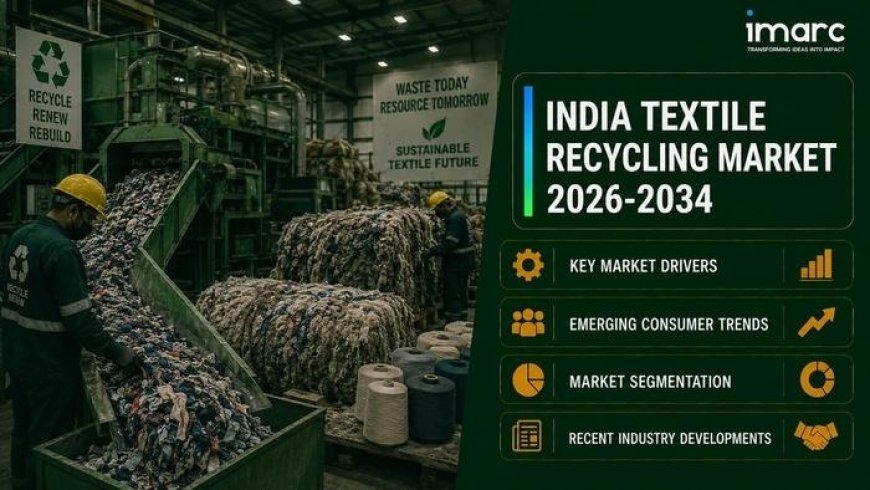
According to IMARC Group’s report titled “India Textile Recycling Market Size, Share, Trends and Forecast by Product Type, Textile Waste, Distribution Channel, End Use, and Region, 2026-2034“, the report offers a comprehensive analysis of the industry, including market share, forecast, growth and regional insights.
The textile recycling industry in india size was valued at USD 337.56 Million in 2025 and is projected to reach USD 429.30 Million by 2034, growing at a compound annual growth rate of 2.71% from 2026-2034.
- Pre-Consumer Waste Volume Capture: Pre-consumer textile waste held a dominant 55.0% market share in 2025, providing an abundant and highly homogeneous feedstock directly from manufacturing scrap mills and apparel factories.
- Established Mechanical Dominance: Cotton recycling led the product segment with a 32.0% market share in 2025, supported by widespread availability and specialized mechanical processing clusters across major industrial centers.
- Northern Industrial Cluster Leadership: North India remains the largest regional market, capturing a 30.0% share in 2025 due to world-scale recycling hubs located in Panipat and Ludhiana, which are well-positioned near raw fiber sources.
The Strategic Market Challenge: Navigating the Textile Recycling Market in India A critical, often overlooked operational bottleneck within India’s retail and manufacturing sector is the deep organizational and technological fragmentation across the post-consumer collection network. While pre-consumer industrial waste is efficiently aggregated, household textile waste mostly moves through informal channels, resulting in high levels of contamination and a lack of fiber traceability. This lack of standardized sorting processes restricts the supply of clean feedstock needed for advanced chemical recycling plants, leaving manufacturers heavily dependent on lower-value mechanical downcycling.
➤ Access Key Market Statistics and Actionable Insights - Request Sample Report
India's Strategic Vision for the Textile Recycling Market:
-
Institutionalizing the Circular Economy: In line with the National Productivity Council and NITI Aayog guidelines, the government is formalizing industrial scrap streams to systematically integrate informal waste pickers into organized recycling value chains.
-
Scaling Advanced Chemical Infrastructure: The domestic strategy focuses on moving past mechanical shredding toward advanced chemical recycling, highlighted by major private joint ventures building plants to transform discarded blended fabrics into virgin-quality polyester.
-
Mitigating Textile Landfill Pressures: Central environmental boards are working to establish zero-waste guidelines for garment manufacturing hubs, aiming to divert hundreds of thousands of tons of scrap from urban landfills annually.
Why Invest in the India Textile Recycling Market: Key Growth Drivers & ROI
-
Unrivaled Global Feedstock Security: As the world's second-largest textile producer, India's factories generate a massive, steady supply of pre-consumer scrap, providing investors with reliable, low-cost raw materials.
-
Surging Demand from Sustainable Fashion Brands: Driven by strict international environmental mandates and corporate ESG targets, global apparel brands are paying higher premiums for certified recycled fibers, ensuring strong export revenues for compliant manufacturers.
-
Strategic Growth in Retail Take-Back Networks: Retail and departmental stores held a dominant 73.0% distribution share in 2025, utilizing extensive in-store collection programs to secure stable post-consumer textile streams.
India Textile Recycling Market Trends & Future Outlook:
-
Widespread Adoption of Automated Sorting: To solve manual processing bottlenecks, advanced recycling plants are increasingly deploying automated, AI-driven optical sorting systems to separate materials accurately by fiber type and color.
-
Commercial Scaling of Chemical Recycling: The market is pivoting toward true textile-to-textile chemical recycling, allowing blended polyester and cotton fabrics to be broken down into high-quality reusable materials.
-
Expansion of Brand Take-Back Programs: Leading retail fashion brands are rapidly expanding local collection initiatives, turning physical retail networks into major procurement hubs for post-consumer garments.
Regulatory Landscape & Policy Catalysts in India
-
The Draft National Resource Efficiency Policy: Administered by the Ministry of Environment, Forest and Climate Change, this overarching framework sets the groundwork for implementing strict recycling mandates across major consumer sectors.
-
Extended Producer Responsibility (EPR) Blueprints: According to the Ministry of Textiles, upcoming EPR guidelines will require major apparel brands and retail conglomerates to fund and manage the end-of-life collection and processing of their consumer products.
-
The National Technical Textiles Mission (NTTM): This regulatory program supports research and development in transforming low-grade recycled textile waste into valuable industrial non-wovens and insulation materials.
India Textile Recycling Market Segmentation:
The market report offers a comprehensive analysis of the segments, highlighting those with the largest India textile recycling market share. It includes forecasts for the period 2026-2034 and historical data from 2020-2025 for the following segments.
Product Type Insights:
- Cotton Recycling
- Wool Recycling
- Polyester & Polyester Fiber Recycling
- Nylon & Nylon Fiber Recycling
- Others
The cotton recycling dominates with a market share of 32% of the total market in 2025.
Textile Waste Insights:
- Pre-consumer Textile
- Post-consumer Textile
The pre-consumer textile leads with a share of 55% of the total market in 2025.
Distribution Channel Insights:
- Online Channel
- Retail & Departmental Stores
The retail & departmental stores dominate with a market share of 73% of the total market in 2025.
End Use Insights:
- Apparel
- Industrial
- Home Furnishings
- Non-woven
- Others
The apparel leads with a share of 52% of the total market in 2025.
Region Insights:
- North India
- West and Central India
- South India
- East India
North India exhibits a clear dominance with a 30% share of the total market in 2025.
By the IMARC Group, the Top Competitive Landscape & their Positioning:
Covering an in-depth analysis of the competitive landscape, market structure, key player positioning, competitive dashboards, top winning strategies, and detailed profiles of all major industry participants you will gain access to all these exclusive insights within the full research report.
Note: If you need specific information that is not currently within the scope of the report, we can provide it to you as a part of the customization.
➤ Shape the Data to Answer Your Specific Questions - Request Customization
Frequently Asked Questions (FAQs)
Q1: What is the current value and projected growth of the India Textile Recycling Market?
A1: According to IMARC Group, the India textile recycling market size was valued at USD 337.56 Million in 2025. It is projected to reach USD 429.30 Million by 2034, expanding at a compound annual growth rate (CAGR) of 2.71% over the forecast period from 2026 to 2034.
Q2: Which waste segments and product categories hold the highest market share?
A2: Pre-consumer industrial waste dominated the market with a 55.0% share in 2025 due to its clean, uniform nature. Among product types, cotton recycling led with a 32.0% share, supported by the widespread availability of cotton scrap and established mechanical processing mills.
Q3: Which region is leading the textile recycling landscape in India?
A3: North India represents the leading geographic market, capturing a 30.0% share in 2025. This leadership is anchored by massive, world-class recycling clusters in Panipat and Ludhiana, which benefit from strong connections to domestic raw fiber sources.
Q4: How do retail and departmental stores influence the recycling supply chain?
A4: Retail and departmental stores comprised the largest distribution channel with a 73.0% market share in 2025. They serve as critical collection hubs by operating consumer take-back programs, securing a steady supply of post-consumer garments for processors.
Q5: What are the main operational hurdles for investors in this sector?
A5: Key structural challenges include highly fragmented post-consumer collection networks, high contamination risks in mixed urban waste streams, a general lack of digital fiber traceability, and the initial capital costs required to deploy advanced chemical recycling technologies.
Strategic Insight & Verdict
Having analyzed the trajectory of India’s textile recycling market, we observe a decisive shift toward circular value chains driven by sustainability mandates and global sourcing requirements. Demand is increasingly centered on traceability, fiber recovery efficiency, and high-quality recycled outputs. Companies that invest in advanced sorting technologies, scalable recycling infrastructure, and compliance frameworks will secure long-term advantage as ESG-driven procurement becomes a defining industry standard.
Verified Data Source: India Textile Recycling Market Report by IMARC Group
What's Your Reaction?