






























India Refrigerated Trucks Market: Size, Share, Growth Projection & Revenue Forecast 2026-2034
The India refrigerated trucks market size was valued at INR 8.51 Billion in 2025 and is projected to reach INR 28.58 Billion by 2034, growing at a compound annual growth rate of 14.41% from 2026-2034.

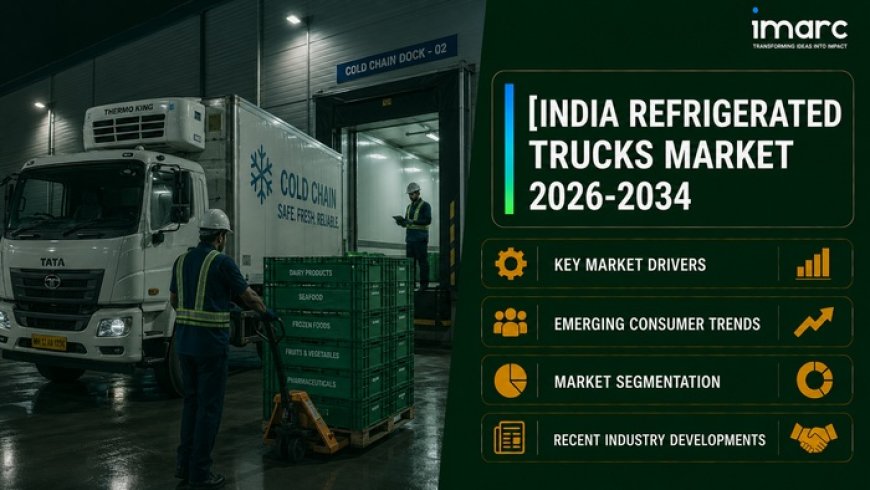
According to IMARC Group’s report titled “India Refrigerated Trucks Market Size, Share, Trends and Forecast by Vehicle Capacity GVW, Sector, Body Type, Application, and Region, 2026-2034“, the report offers a comprehensive analysis of the industry, including market share, forecast, growth and regional insights.
The India refrigerated trucks market size was valued at INR 8.51 Billion in 2025 and is projected to reach INR 28.58 Billion by 2034, growing at a compound annual growth rate of 14.41% from 2026-2034.
India’s cold chain distribution networks are undergoing a significant structural transition, moving away from fragmented, uninsulated transport toward precision-monitored, organized fleet systems. Driven by stringent pharmaceutical regulations and expanding modern grocery networks, corporate investors and CXOs must align capital deployment with this high-growth logistics sector to secure resilient market positions.
- Dominance of Organized Fleet Operators: The organized logistics sector commanded a major 65.0% market share in 2025, driven by corporate demands for standardized temperature compliance, advanced telematics, and end-to-end fleet tracking.
- Preference for Ready-to-Deploy Assets: Fully built vehicles represented the largest structural segment with a 57.0% market share in 2025, providing immediate operational efficiency through factory-integrated insulation and pre-fitted refrigeration units.
- High-Volume Urban Delivery Footprint: Light and medium commercial trucks (capacities below 12 tons) represent key growth assets, driven by expanding quick-commerce and last-mile urban logistics.
The Strategic Market Challenge: Navigating the Refrigerated Trucks Market in India
A critical, often overlooked operational bottleneck within India's transportation and logistics sector is the persistent reliance on old-generation diesel-powered cooling units during primary long-haul transits. These traditional compressor setups encounter sharp margin compression from volatile domestic diesel costs while contributing disproportionately to greenhouse gas emissions. Furthermore, continuous idling at inter-state checkpoints frequently causes deep temperature fluctuations, directly invalidating sensitive pharmaceutical.
➤ Access Key Market Statistics and Actionable Insights - Request Sample Report
India's Strategic Vision for the Refrigerated Trucks Market:
-
Minimizing National Agricultural Wastage: Through the Pradhan Mantri Kisan Sampada Yojana (PMKSY), the Ministry of Food Processing Industries is funding massive integrated cold-chain corridors to connect rural production clusters directly with large metropolitan centers.
-
Enforcing Strict Temperature Governance: The government is tightening compliance frameworks to ensure that zero-break thermal links are maintained across key food, dairy, and medical transport chains.
-
Decarbonizing Commercial Logistics Fleets: Under the National Clean Air Programme guidelines, the state is encouraging transport operators to phase out old diesel units in favor of eco-friendly and energy-efficient refrigeration technologies.
-
Bridging the Last-Mile Urban Cold Chain: National manufacturing goals prioritize the mass production of specialized reefer commercial vehicles to safely support the booming sub-city grocery and medical logistics networks.
Why Invest in the India Refrigerated Trucks Market: Key Growth Drivers & ROI
-
Unrivaled Growth in Biopharma Logistics: Triggered by Ministry of Health mandates, the pharmaceutical sector requires strict temperature-controlled transport for vaccines, biologics, and clinical trials, ensuring high-margin, stable logistics contracts.
-
Surging Shifts in Consumer Food Habits: Rapidly changing urban lifestyles have triggered a massive surge in the consumption of ready-to-eat meals, dairy products, and frozen foods, creating permanent contract volumes for specialized refrigerated carriers.
-
Substantial Yield Enhancements via Asset Modernization: Upgrading conventional fleets to modern eutectic plate technology and smart telemetry offers high capital returns by reducing fuel expenses and eliminating costly product spoilage claims.
India Refrigerated Trucks Market Trends & Future Outlook:
-
Rapid Adoption of Eutectic Plate Engineering: To bypass volatile fuel costs, fleet managers are shifting to green eutectic cooling systems that utilize stored thermal energy to maintain sub-zero temperatures for 10 to 12 hours without active engine power.
-
Widespread Integration of IoT Telematics: Modern reefer trucks are uniformly adopting advanced multi-zone temperature sensors and real-time remote telemetry to provide shippers with constant, verifiable climate updates.
-
Strong Shift toward Light Electric Reefer Trucks: Fueled by zero-emission city delivery rules, organized retail giants are progressively deploying fully electric light commercial vehicles for inner-city drop-offs.
Regulatory Landscape & Policy Catalysts in India
-
The Pradhan Mantri Kisan Sampada Yojana (PMKSY): Administered by the Ministry of Food Processing Industries, this flagship program provides direct capital subsidies to build comprehensive cold-chain infrastructure, reducing financial risks for fleet operators.
-
Stricter FSSAI Temperature Regulations: The Food Safety and Standards Authority of India enforces tight oversight on logistics providers, penalizing companies for thermal violations during the transit of perishable commercial food goods.
-
The National Logistics Policy (NLP) Blueprint: Championed by the Ministry of Commerce and Industry, the NLP directly drives digital logistics integration, simplifying paperwork and reducing transit delays for cold-chain operators at state checkpoints.
➤ Explore the Full Report with Charts, Table of Contents, and List of Figures
By the IMARC Group, the Top Competitive Landscape & their Positioning:
- Carrier Airconditioning & Refrigeration Limited (Carrier Global Corporation)
- Ice Make Refrigeration Limited
- JCBL Limited
- KOLD SEAL
- Motherson Sumi System Limited
- Subros Limited
- Surin International Private Limited
- Tata Motors Limited
- Trane Technologies India Pvt Ltd
- TransACNR
India Refrigerated Trucks Market Segmentation:
The market report offers a comprehensive analysis of the segments, highlighting those with the largest India refrigerated trucks market share. It includes forecasts for the period 2026-2034 and historical data from 2020-2025 for the following segments.
Capacity GVW Insights:
- 02 – 4.5 Tons
- 7 – 7.5 Tons
- 11-12 Tons
- 18.5 Tons
- 28.5 Tons
- 35 Tons
11-12 tons dominate with a market share of 23% of the total market in 2025.
Sector Insights:
- Organized Sector
- Unorganized Sector
Organized sector leads with a share of 65% of the total market in 2025.
Body Type Insights:
- Fully Built
- Customizable
Fully built exhibits a clear dominance with a 57% share of the total market in 2025.
Application Insights:
- Meat and Fish
- Dairy Products
- Fruits & Vegetables
- Confectionaries
- Pharmaceutical
- Others
Dairy products lead with a share of 22% of the total market in 2025.
Region Insights:
- North India
- West and Central India
- South India
- East India
North India exhibits a clear dominance with a 28% share of the total market in 2025.
Note: If you need specific information that is not currently within the scope of the report, we can provide it to you as a part of the customization.
➤ Shape the Data to Answer Your Specific Questions - Request Customization
Frequently Asked Questions (FAQs)
1. What is the current value and projected growth of the India Refrigerated Trucks Market?
According to IMARC Group, the market reached a value of INR 8.51 Billion in 2025 and is expected to reach INR 28.58 Billion by 2034, exhibiting a CAGR of 14.41% during 2026-2034.Journalism & News Industry
2. What are the dominant segments within the industry?
The organized sector leads with a commanding 65% market share. Fully built body types represent the largest segment at 57%, while 11-12 Ton GVW vehicles dominate the market due to their optimal balance for mid-haul transport.
3. What are the primary trends driving this market forward?
Key growth drivers include the rapid modernization of pharmaceutical distribution networks, the expansion of organized retail and quick-commerce, and the integration of IoT-enabled real-time temperature monitoring systems.
4. What are the major industry challenges facing operators?
High initial capital expenditure, an over-reliance on fragmented unorganized logistics networks, and the lack of robust charging infrastructure for emerging electric refrigeration solutions remain prominent bottlenecks.
5. Who are the primary consumers and end-users fueling market demand?
The demand is aggressively driven by the dairy products sector (accounting for roughly 22% of applications), followed closely by the meat and poultry industry, pharmaceutical manufacturers, and large-scale grocery retail platforms.
Strategic Insight & Verdict:
Navigating the complex modernization of the localized transport grid, we at IMARC Group have observed that the India refrigerated trucks market has evolved beyond mere transportation to become a high-stakes, data-driven supply chain ecosystem. The structural transition toward sustainable cooling, multi-temperature hauling, and IoT-backed compliance is permanent. To capture the highest margins and dominate the logistical landscape, stakeholders must urgently phase out outdated assets and aggressively invest in tech-enabled, fully-built refrigerated fleets that guarantee uncompromised, end-to-end thermal visibility.
Verified Data Source: India Refrigerated Trucks Market Report by IMARC Group
What's Your Reaction?