































India Prefabricated Buildings Market Size, Share, Industry Insights and Report 2026-2034
The India prefabricated buildings market size reached USD 8.8 Billion in 2025. Looking forward, IMARC Group expects the market to reach USD 15.9 Billion by 2034, exhibiting a growth rate (CAGR) of 6.84% during 2026-2034.

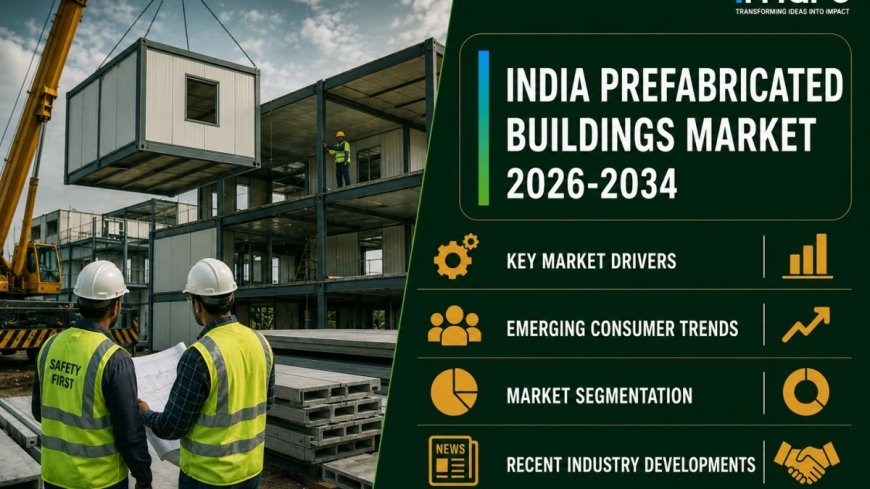
According to IMARC Group’s report titled “India Prefabricated Buildings Market Size, Share, Trends, and Forecast by Material Type, Application, and Region, 2026-2034“, the report offers a comprehensive analysis of the industry, including market forecast, growth and regional insights.
Market Outlook
The India prefabricated buildings market size reached USD 8.8 Billion in 2025. Looking forward, IMARC Group expects the market to reach USD 15.9 Billion by 2034, exhibiting a growth rate (CAGR) of 6.84% during 2026-2034. The market is expanding due to rapid urbanization, infrastructure growth, and demand for cost-effective, time-efficient construction. Moreover, developers focus on modular designs, eco-friendly materials, and advanced manufacturing to enhance efficiency and durability.
Core Market Metrics & Snapshot
A consolidated view of critical market metrics and leading segments.
- Market Valuation (2025): USD 8.8 Billion
- Forecast Valuation (2034): USD 15.9 Billion
- CAGR (2026-2034): 6.84%
What are the Key Developments and Emerging Shifts in the India Prefabricated Buildings Market?
Rising Adoption of Modular and Off-Site Construction
The ecosystem is witnessing widespread adoption of modular and off-site construction methods as developers pursue faster project completions and highly cost-effective solutions. Pre-engineered buildings (PEBs) and volumetric modular frameworks are experiencing surging demand across residential, commercial, and industrial infrastructure. Prefabrication strategically cuts down material wastage, project duration, and manual labor costs, serving as a structural upgrade over conventional on-site practices.
Growing Demand for Sustainable and Green Construction
Sustainability is driving continuous innovation within the market, with industrial developers heavily focusing on energy-efficient materials, eco-friendly designs, and overarching waste reduction. Advanced prefabrication heavily minimizes construction waste and overall energy consumption, making it the preferred choice for environmentally responsible infrastructure projects. Furthermore, advancements such as solar-integrated prefabricated structures and rainwater harvesting systems are making these buildings increasingly self-sufficient.
What Factors are Driving Growth in the India Prefabricated Buildings Market?
Government Housing and Infrastructure Initiatives
Urban expansion and the aggressive pursuit of low-cost housing schemes under central government policies are heavily contributing to the move toward modular solutions. The Pradhan Mantri Awas Yojana (PMAY) plays a critical role in this structural shift. For instance, as of June 2024, under PMAY-G, the government had successfully sanctioned 2.94 crore houses and completed 2.62 crore, significantly enhancing rural housing conditions and driving sustained volume demand for rapid construction solutions.
Technological Integration in Manufacturing
The integration of next-generation technology in prefabrication, including 3D printing and Building Information Modeling (BIM), is enabling highly precise manufacturing while heavily reducing on-site assembly complexities. Real estate developers are actively looking to streamline their operations and enhance structural integrity using these digitized workflows, securing continuous market expansion and mitigating traditional construction delays.
How will the India Prefabricated Buildings Market Evolve in the Coming Years?
The India prefabricated buildings market is projected to maintain a highly aggressive expansion trajectory, driven by the escalating demand for green buildings and rapid urban infrastructure development. As developers prioritize off-site manufacturing and strict quality control, the transition toward pre-engineered and volumetric modular structures will define the next operational phase of real estate execution. Companies that invest heavily in BIM technology, eco-friendly material sourcing, and efficient PEB deployments will remain uniquely positioned to capture dominant overall market share across both commercial and residential sectors over the forecast period.
➤ Request Sample Report (TOC & Charts): https://www.imarcgroup.com/india-prefabricated-buildings-market/requestsample
CXO Blindspot
While the shift toward modular and off-site construction guarantees accelerated project delivery, developers often underestimate the technological integration required to execute volumetric components successfully. The failure to fully integrate Building Information Modeling (BIM) and 3D printing technologies during the initial design phase can severely limit precise manufacturing, leading to unforeseen on-site assembly complexities. Decision-makers must prioritize end-to-end digital integration and streamline off-site factory operations to fully capitalize on the time and labor cost benefits of pre-engineered buildings over conventional practices.
How Is the Market Segmented?
Material Type Insights:
- Concrete
- Glass
- Metal
- Timber
- Others
Application Insights:
- Residential
- Commercial
- Others
Regional Insights:
- North India
- South India
- East India
- West India
Recent Market Developments:
- Green Building Leadership (2024): Highlighting its strong commitment to sustainable building practices, India ranked third on the U.S. Green Building Council's 2024 LEED list, certifying 370 projects spanning 8.5 Million gross square meters.
- PMAY-G Housing Execution (June 2024): The central government achieved a massive milestone by sanctioning 2.94 crore houses and completing 2.62 crore under the Pradhan Mantri Awas Yojana - Gramin, significantly propelling the adoption of rapid construction modalities.
- Golden Book of World Records Recognition: A massive 151,000 sq ft building was successfully constructed with precision, speed, and sustainability utilizing advanced prefabrication and PEB technology, earning prestigious recognition from the Golden Book of World Records.
Competitive Landscape
The market features intensely competitive activity strictly focused on rapid capacity expansion, compliance with rigid national environmental safety frameworks, and seamless integration with formalized automotive supply chains. A massive strategic focus remains on heavily leveraging advanced localized hydrometallurgical processing to cater to the rapidly evolving material requirements of newly sanctioned domestic gigafactories. According to IMARC Group, key players driving the India battery recycling market include:
➤ Shape the Data to Answer Your Specific Questions - Request Customization: https://www.imarcgroup.com/request?type=report&id=30164&flag=E
Frequently Asked Questions (FAQs):
Q1. How big is the prefabricated buildings market in India?
Ans. The prefabricated buildings market in India was valued at USD 8.8 Billion in 2025.
Q2. What is the future outlook of the prefabricated buildings market in India?
Ans. The India prefabricated buildings market is projected to exhibit a CAGR of 6.84% during 2026-2034, reaching a value of USD 15.9 Billion by 2034.
Q3. What are the key materials analyzed in the market?
Ans. The market is segmented into major materials including concrete, glass, metal, timber, and others.
Q4. Which applications drive the demand for prefabricated buildings?
Ans. The primary applications fueling overall demand include large-scale residential and commercial infrastructure developments.
Q5. What are the major factors driving the market?
Ans. The market is propelled by rapid urbanization, infrastructure growth, the urgent demand for cost-effective construction, rising on-site labor costs, and the critical need for efficient, delayed-free project delivery.
Strategic Insight & Verdict
The India prefabricated buildings sector presents a robust, high-value modernization opportunity, advancing decisively toward USD 15.9 Billion by 2034. The industry is structurally pivoting from traditional, time-intensive on-site construction toward highly precise, digitized, and off-site pre-engineered building (PEB) frameworks. Propelled by massive government housing directives like PMAY and the pressing need for sustainable, energy-efficient commercial real estate, the operating environment remains exceptionally lucrative. Corporate stakeholders and developers who prioritize the integration of BIM, green-certified eco-friendly materials, and solar-integrated structures will remain uniquely positioned to capture dominant market share and dictate the future of India's overall construction landscape over the forecast period.
What's Your Reaction?