

























Portable LIBS Spectrometer LIS-02, Carbon detection spectrometer
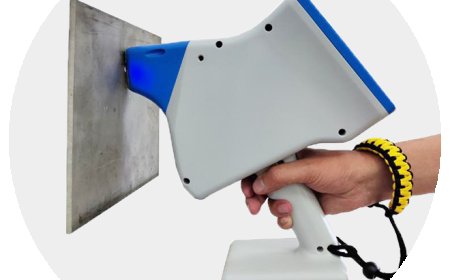
Portable LIBS Spectrometer LIS-02 deducts the carbon without use of argon gas in one second. It is Fast, precise metal analyzer.

Portable LIBS Spectrometer LIS-02: Features, Working
Principle, Specifications, and Industrial Applications
Introduction
A Portable LIBS Spectrometer LIS-02 is designed for rapid elemental analysis of metals and alloys directly at the inspection site. LIBS stands for Laser-Induced Breakdown Spectroscopy, an analytical technique that uses a laser pulse to examine the elemental composition of a material.
Unlike laboratory-based testing systems, a portable LIBS spectrometer allows operators to analyze metal components near production lines, inspection stations, warehouses, and material receiving areas. As a result, it can support faster material identification and quality control decisions.
The LIS-02 product information highlights several important features, including carbon analysis in steel without argon gas, analysis results in approximately one second, a built-in grade library, and a high-resolution camera. These features make the instrument relevant to applications where teams need rapid, on-site information about metal composition.
However, measurement accuracy depends on the material, calibration, surface condition, measurement method, and operating environment. Therefore, users should verify the instrument's performance against their specific testing requirements.
What Is a Portable LIBS Spectrometer?
A Portable LIBS Spectrometer is an analytical instrument that uses laser-induced plasma to identify elements in a sample. The instrument directs a focused laser pulse onto the material surface. This pulse removes a small amount of material and creates a high-temperature plasma.
As the plasma cools, excited atoms and ions emit light at characteristic wavelengths. The spectrometer measures this light and processes the resulting spectrum to determine which elements are present and, when properly calibrated, estimate their concentrations.
LIBS technology can analyze multiple elements during a single measurement. Its suitability for a particular element or alloy depends on the instrument's optical system, spectral range, calibration models, and detection limits.
How Does LIBS Analysis Work?
The general measurement process involves five steps:
- Laser pulse: The instrument directs a laser pulse toward the sample surface.
- Plasma formation: The pulse creates a small plasma containing material from the sample.
- Light emission: Excited atoms and ions emit light at characteristic wavelengths.
- Spectral measurement: The optical system records the emitted light.
- Result processing: Software compares the spectrum with calibration data and displays the analysis results.
This process allows the operator to assess elemental composition without sending every sample to a laboratory. Nevertheless, critical acceptance testing may still require a validated laboratory method or another approved reference technique.
Key Features of the Portable LIBS Spectrometer LIS-02
1. Carbon Analysis in Steel Without Argon Gas
Carbon measurement is important in steel identification because carbon content influences hardness, strength, weldability, and other material properties.
According to the supplied LIS-02 product information, the instrument can measure carbon concentration in steel directly in air without using argon gas. This can simplify field testing by removing the need for an argon supply during supported measurements.
However, the actual measurement range, detection limit, uncertainty, and suitability for different steel grades should be confirmed using the manufacturer's technical documentation.
2. Rapid Analysis Results
The LIS-02 product information specifies a measurement duration of approximately one second. Rapid measurements can help inspection teams assess more components within a given period.
For example, a quality inspector can use the instrument to screen incoming metal parts before they enter a production process. The complete inspection cycle may take longer because it can include surface preparation, positioning, repeat measurements, and documentation.
Therefore, users should distinguish the stated measurement time from the total time required to complete an inspection.
3. Spectral Resolution of 0.01 nm
The supplied product information lists a spectral resolution of 0.01 nm. Spectral resolution describes an instrument's ability to distinguish nearby spectral features.
This capability matters because different elements emit light at characteristic wavelengths, and some spectral lines may overlap. However, spectral resolution alone does not establish elemental detection limits or concentration accuracy. Those values require supporting performance data and suitable calibration.
4. Portable and Handheld Design
The LIS-02 has a handheld design intended for measurements at different inspection locations. Portability can reduce the need to move large or heavy components to a fixed testing laboratory.
Potential uses include receiving inspection, shop-floor verification, metal fabrication, and material sorting. Operators should follow the instrument's handling instructions and maintain stable contact with the measurement surface where required.
5. Built-In Grade Library
The product information identifies a built-in grade library that displays a steel or alloy grade based on analysis results.
A grade library can help operators compare measured compositions with stored grade definitions. Nevertheless, grade identification depends on the elements measured, the available calibration models, and the grades included in the database.
If two grades differ mainly in elements that the instrument cannot measure reliably under the selected conditions, the displayed identification may not be conclusive. Users should check critical results against the applicable material specification.
6. Carbon Equivalent Values
The LIS-02 product information lists carbon equivalent values as a feature. Carbon equivalent calculations help assess aspects of steel weldability by combining carbon content with contributions from selected alloying elements.
Different standards and applications use different formulas. Therefore, users should confirm which formula the instrument applies and whether it matches the relevant welding procedure, material specification, or industry standard.
7. High-Resolution Camera
The instrument includes a high-resolution camera intended to capture the location of analysis. Visual records can help inspectors connect a measurement result with a particular area of a component.
This can be useful when documenting inspection points, reviewing results, or maintaining traceability records. The camera records the inspection location; it does not independently confirm the chemical composition.
Portable LIBS Spectrometer LIS-02: Technical Specifications
The following table summarizes the specifications shown in the supplied product image. Confirm the latest datasheet before using these values for procurement or technical acceptance.
| Specification | Listed information |
|---|---|
| Product model | LIS-02 |
| Analytical technology | Laser-Induced Breakdown Spectroscopy (LIBS) |
| Laser source | Pulsed DPSS laser |
| Laser wavelength | 1064 nm |
| Measurement point size | 50 microns |
| Listed measurement duration | 1 second |
| Spectral resolution | 0.01 nm |
| Spectral range | 177–380 nm |
| Laser safety classification | Class 3B, as listed in the supplied image |
| Grade identification | Built-in grade library |
| Carbon analysis | Steel carbon measurement without argon, as stated in product information |
| Camera | High-resolution camera |
| Carbon equivalent | Carbon equivalent values listed as a feature |
Technical note: The table reflects the supplied product image, not an independently verified laboratory test. Measurement range, detection limits, accuracy, calibration requirements, battery capacity, environmental limits, and supported alloy grades should be checked in the manufacturer's current datasheet.
Elements and Alloy Identification
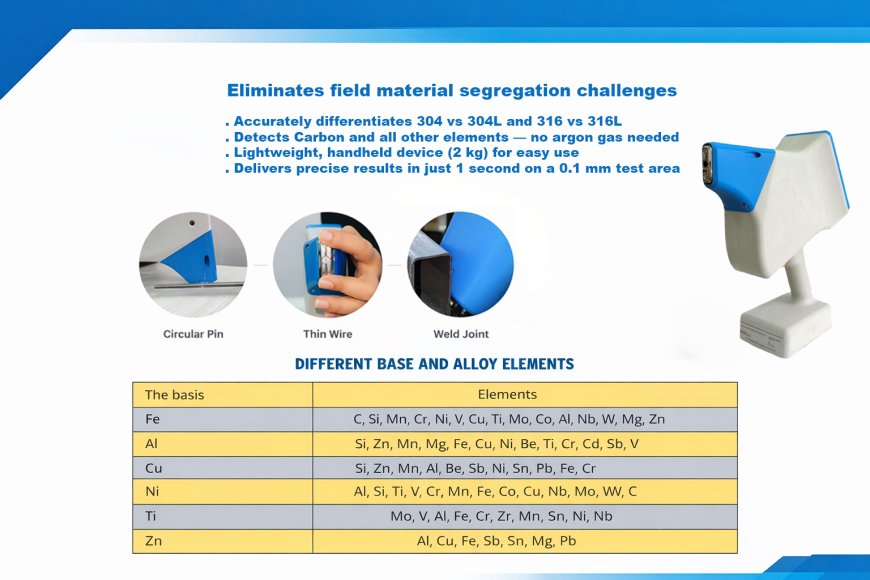
The supplied LIS-02 image lists different element combinations for several base materials. These combinations indicate the elements associated with the corresponding analytical configurations.
| Base material | Elements listed in the product image |
|---|---|
| Fe (Iron) | C, Si, Mn, Cr, Ni, V, Cu, Ti, Mo, Co, Al, Nb, W, Mg, Zn |
| Al (Aluminium) | Si, Zn, Mn, Mg, Fe, Cu, Ni, Be, Ti, Cr, Cd, Sb, V |
| Cu (Copper) | Si, Zn, Mn, Al, Be, Sb, Ni, Sn, Pb, Fe, Cr |
| Ni (Nickel) | Al, Si, Ti, V, Cr, Mn, Fe, Co, Cu, Nb, Mo, W, C |
| Ti (Titanium) | Mo, V, Al, Fe, Cr, Zr, Mn, Sn, Ni, Nb |
| Zn (Zinc) | Al, Cu, Fe, Sb, Sn, Mg, Pb |
The table reproduces the element lists shown in the image. It does not guarantee that every listed element can be measured across every concentration range or sample condition. Confirm the validated analytical range for the intended alloy family.
Industrial Applications of a Portable LIBS Spectrometer
1. Positive Material Identification (PMI)
Positive Material Identification helps verify whether a material's composition matches its intended specification. A portable LIBS instrument can support PMI workflows by providing rapid elemental information at the inspection location.
Inspectors may use it to check alloy components, incoming materials, or selected items during fabrication. Acceptance decisions should follow the relevant project specification and approved inspection procedure.
2. Steel Grade Identification
Steel manufacturers and component suppliers work with different grades that may look similar. A portable metal analyzer can help distinguish supported grades by comparing measured elemental composition with stored reference data.
This can reduce reliance on visual identification alone. However, the instrument must measure the elements that distinguish the grades in question.
3. Incoming Material Inspection
Quality teams can use portable elemental analysis to screen materials before they enter manufacturing. For instance, inspectors may check selected bars, plates, pipes, or metal components against purchasing requirements.
A defined sampling plan is important. One measurement cannot necessarily represent an entire batch, particularly when material composition varies.
4. Scrap Metal Sorting
Recycling facilities handle mixed metals and alloys that may have similar appearances. Portable LIBS analysis can help operators distinguish supported material types and direct them toward suitable sorting streams.
The choice of instrument should reflect the actual alloy mix, required sorting speed, and elements needed for identification.
5. Manufacturing and Quality Control
Manufacturing teams can integrate portable analysis into selected quality checkpoints. They may use it to investigate material mix-ups, verify incoming stock, or support process troubleshooting.
Consistent measurement procedures and traceable records improve the value of these results.
6. Welding and Fabrication
Material verification is relevant to welding and fabrication because the wrong alloy can affect component performance. LIBS measurements may support alloy identification before fabrication or during selected inspection activities.
Carbon equivalent information may also support weldability assessments when the instrument's calculation method matches the applicable procedure. It should not replace required welding qualifications or approved material testing.
Practical Example: Verifying Incoming Steel
Consider a manufacturer that receives several batches of steel bars for component production. The bars look similar, but each batch must meet a specified material grade.
A practical inspection workflow could follow these steps:
- Review the purchase order and required material specification.
- Select representative samples according to the inspection plan.
- Prepare the measurement surface as instructed by the manufacturer.
- Check the instrument's calibration or verification status.
- Measure each selected sample using the approved procedure.
- Compare the results with the expected grade and acceptance limits.
- Repeat or escalate any questionable result.
- Record the sample identification, measurement results, date, and operator.
A Portable LIBS Spectrometer LIS-02 may help accelerate the initial screening process where its validated capabilities match the required alloy analysis. However, this example is an illustrative workflow, not a documented customer case study or a claim of independently tested performance.
Practical Considerations Before Measurement
Reliable results depend on more than the instrument's specifications. Operators should consider the following factors.
- Surface condition: Paint, coatings, rust, oil, and contamination can affect readings. Prepare the surface according to the approved procedure.
- Sample geometry: Curved, rough, thin, or irregular components may require special positioning or preparation.
- Calibration: Use the correct calibration and reference materials for the relevant alloy family.
- Repeatability: Repeat measurements when required by the inspection plan, especially for critical components.
- Environmental conditions: Follow the manufacturer's limits for temperature, humidity, dust, and other operating conditions.
- Result interpretation: Compare results with the applicable material specification and account for measurement uncertainty.
- Traceability: Record sample IDs and relevant inspection details so that results can be reviewed later.
These practices help users avoid treating a rapid reading as automatic proof of material compliance.
LIBS Compared with X-Ray Fluorescence (XRF)
LIBS and XRF are both used for elemental analysis, but they rely on different physical principles and have different analytical strengths.
| Comparison | Portable LIBS | Portable XRF |
|---|---|---|
| Analytical principle | Laser-induced plasma emission | Characteristic X-ray fluorescence |
| Carbon analysis | Can support carbon measurement on suitable, validated systems | Conventional handheld XRF generally does not provide reliable carbon measurement |
| Argon requirement | Depends on instrument design; the supplied LIS-02 information states steel carbon analysis without argon | Usually does not require argon |
| Sample interaction | Laser ablates a small amount of material | X-rays interact with the sample |
| Common uses | Alloy analysis, selected light-element measurements, material identification | Alloy identification and analysis of many metallic elements |
| Selection criteria | Required elements, detection limits, calibration, surface effects | Required elements, detection limits, calibration, matrix effects |
Neither technique is universally better. The correct choice depends on the target elements, material types, required detection limits, sample condition, and applicable testing standards.
For critical applications, compare the instrument's validated performance with an appropriate reference method before selecting a measurement system.
Laser Safety and Operator Training
The supplied product image lists the LIS-02 laser safety classification as Class 3B. Users should verify this classification against the current manufacturer's documentation and follow all supplied safety instructions.
Laser operation requires trained personnel and appropriate controls. Operators should never look directly into the laser beam or its hazardous reflections. They should also follow site-specific procedures for access control, protective equipment, sample positioning, and safe operation.
Training should cover instrument handling, surface preparation, measurement procedures, calibration checks, result interpretation, data recording, and abnormal-result escalation. Practical instruction helps ensure that different operators follow a consistent method.
Frequently Asked Questions
1. What is a Portable LIBS Spectrometer?
A Portable LIBS Spectrometer uses laser-induced plasma and emitted light to identify elements in a material. Portable systems allow users to perform supported elemental analysis directly at the inspection site.
2. What is the LIS-02 used for?
The LIS-02 is presented as a portable instrument for metal and alloy analysis. Potential applications include steel identification, PMI support, incoming inspection, and selected quality-control tasks.
3. Can the LIS-02 measure carbon without argon gas?
The supplied product information states that the LIS-02 can measure carbon in steel without argon gas. Users should confirm the applicable steel grades, measurement range, and performance limits in the current datasheet.
4. How long does one measurement take?
The supplied image lists a measurement duration of approximately one second. Actual inspection time can be longer when surface preparation, repeat measurements, positioning, and documentation are included.
5. What is the spectral resolution of the LIS-02?
The supplied image lists a spectral resolution of 0.01 nm. This value describes the ability to distinguish nearby spectral features; it does not independently establish analytical accuracy or detection limits.
6. Which metals can the instrument analyze?
The product image lists analytical configurations for iron, aluminium, copper, nickel, titanium, and zinc base materials. Confirm the supported alloy grades and validated elemental ranges before testing a specific material.
7. Can it identify steel grades automatically?
The product information describes a built-in grade library that displays a steel or alloy grade based on measurement results. Identification depends on the instrument's calibration, measured elements, database, and the differences between candidate grades.
8. Is a Portable LIBS Spectrometer suitable for PMI?
It can support PMI when the instrument measures the elements required by the relevant material specification. Users should validate the method and follow the project's acceptance criteria.
9. Does a one-second result mean the inspection takes one second?
Not necessarily. The stated duration refers to the listed measurement time. Complete inspection may require additional preparation, repeat readings, verification, and recordkeeping.
10. What should buyers check before selecting the LIS-02?
Check the required alloy grades, element coverage, detection limits, measurement uncertainty, calibration process, data handling, safety requirements, support arrangements, and compatibility with existing inspection procedures.
Conclusion
The Portable LIBS Spectrometer LIS-02 is designed to support rapid, on-site elemental analysis of metals and alloys. Its listed features include carbon analysis in steel without argon gas, approximately one-second measurement time, 0.01 nm spectral resolution, a built-in grade library, and a high-resolution camera.
For technical and commercial users, the key selection factors are analytical capability, measurement reliability, supported materials, operating requirements, and compliance with the relevant inspection procedure. By checking these factors against the current datasheet and using a consistent measurement workflow, organisations can determine whether the LIS-02 meets their material identification and quality-control needs.
Technical reference note: For authoritative verification, consult the current LIS-02 manufacturer datasheet and operating manual, relevant ISO/IEC 17025-accredited laboratory reports where applicable, and the material or inspection standards specified for the intended application.
What's Your Reaction?