
























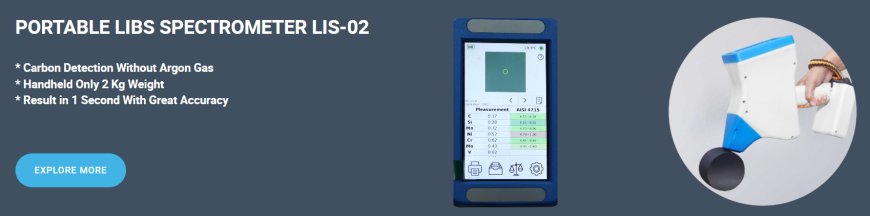
Portable LIBS Spectrometer LIS-02, Carbon detection spectrometer
Portable LIBS Spectrometer LIS-02 deducts the carbon without use of argon gas in one second. It is Fast, precise metal analyzer.

Portable LIBS Spectrometer for Welding: Carbon Equivalent Checks Before You Strike an Arc
Weld cracks often trace back to the base metal, not the welder. Two plates with the same label can have different chemistry. One may weld cleanly. The other may crack hours after cooling. A portable LIBS spectrometer lets a welding team check the chemistry at the bench, before any heat goes in.
This article explains carbon equivalent (CE), how LIBS supports it, and where the method needs care. It uses the Portable LIBS Spectrometer LIS-02 as a reference for typical features.
What Is Carbon Equivalent?
Carbon is not the only element that hardens steel. Manganese, chromium, molybdenum, and others add to the effect. Carbon equivalent combines them into a single number. That number estimates how hard the heat-affected zone can become after welding.
Harder zones crack more easily. Therefore a higher CE usually means a higher crack risk and a greater need for preheat.
The most common formula comes from the International Institute of Welding (IIW):
CE = C + Mn/6 + (Cr + Mo + V)/5 + (Ni + Cu)/15
Each symbol is the element's weight percent. Some standards use other formulas, such as Pcm, especially for low-carbon steels. Always use the formula your specification names.
Why Cracking Risk Depends on Chemistry
Cold cracking, also called hydrogen-induced cracking, needs three conditions:
- A hard, brittle microstructure
- Hydrogen in the weld
- Tensile stress
Chemistry controls the first condition. Preheat, low-hydrogen consumables, and good joint design control the other two. So a wrong-chemistry plate can defeat a well-written welding procedure.
How LIBS Supports the Check
A LIBS unit fires a short laser pulse at the plate. The pulse forms a tiny plasma. The plasma emits light, and the spectrometer reads it. Software then reports element percentages.
Some units, including the LIS-02, also calculate CE from the measured chemistry. This saves manual math and reduces arithmetic errors. Carbon matters most in the formula, and LIBS reads carbon directly. Handheld XRF cannot do that reliably.
The LIS-02 uses a 1064 nm pulsed laser and a 177–380 nm spectral range. A reading takes about one second. Confirm the exact element list and formula options against the current datasheet, because they depend on the calibration installed.
Rough CE Guidance for Weld Planning
Rules of thumb vary by code, thickness, and joint restraint. The table below shows commonly cited ranges. Treat it as orientation, not as a procedure.
| CE (IIW) | General Weldability | Typical Practice |
|---|---|---|
| Below about 0.35 | Good | Often no preheat for thin sections |
| About 0.35 to 0.45 | Fair | Preheat may be needed, especially on thick plate |
| Above about 0.45 | Demanding | Preheat and controlled cooling are common |
Codes such as EN 1011-2 and AWS D1.1 give the actual preheat methods. Your welding procedure specification (WPS) overrides any rule of thumb.
A Practical Workflow for Welding Teams
Follow these steps for each new plate or heat:
- Verify the device. Read a certified reference sample of similar steel. Stop if the result drifts.
- Prepare the spot. Grind to bare metal. Remove mill scale, paint, and oil.
- Take three readings. Use different spots on the same plate.
- Check the CE. Compare it with the limit in your WPS.
- Compare with the certificate. Flag any plate that differs from the mill test report.
- Adjust the plan. Raise preheat, or hold the plate for review, if CE exceeds the procedure limit.
- Log the result. Record plate ID, heat number, and readings.
Where Results Go Wrong
Most errors come from sample handling. Watch these points:
- Scale and coatings. The laser reads the surface layer only. Dirty surfaces skew carbon and alloy values.
- Decarburized skin. Hot-rolled plate can lose carbon near the surface. Grind deeper before testing.
- Segregation. Center-line segregation in thick plate can differ from surface chemistry. A surface reading may understate the risk.
- Single readings. One shot can hit a local variation. Average several.
- Wrong formula. IIW and Pcm give different numbers. Match the formula to the specification.
Illustrative Scenario: Structural Plate Arrives Short of Paperwork
This is a composite example for explanation. It is not a client report.
A fabricator receives structural plate for a pressure-bearing frame. The mill certificate lists a CE below the procedure limit. However, the plates arrive without heat numbers on the edges.
The welding engineer grinds a spot on each plate and takes three LIBS readings. Most plates show a CE close to the certificate value. Two plates read noticeably higher because of raised manganese and carbon.
The team holds those two plates. It requests the missing traceability from the supplier and sends samples to an accredited lab. The lab result decides whether the plates go into the frame.
The point is practical. LIBS raised the flag quickly. The lab, not the field unit, made the final call.
LIBS Compared With Other Options for Weld Prep
| Factor | Portable LIBS | Handheld XRF | Mill Certificate Only |
|---|---|---|---|
| Reads carbon | Yes | No | Yes (from the mill's test) |
| Checks the actual plate in hand | Yes | Yes | No |
| Calculates CE | On some units | Not reliably, lacks carbon | Reported value |
| Speed | About one second per reading | Seconds | Instant, but not tied to the part |
| Precision | Good for screening | Limited for light elements | Depends on the mill |
A certificate describes a heat of steel. It does not prove that the plate in your shop came from that heat. LIBS closes that gap.
Limits You Should Respect
- Not a certification tool. Spark OES gives higher precision. ASTM E415 covers it for carbon and low-alloy steel.
- Micro-damage. The laser leaves a small crater. Avoid finished or fatigue-critical surfaces unless the specification allows it.
- Laser safety. Class 3B lasers need eye protection and training. IEC 60825-1 defines laser classes.
- Element coverage. Some elements, such as boron, are hard to read by LIBS. Check the device's list before you rely on formulas that need them.
Questions to Ask Before Choosing a Unit for Weld Work
- Does it calculate CE, and which formulas does it support?
- Can the vendor show carbon readings on your own steels?
- Which elements does the calibration cover?
- Does the device save readings with images and time stamps?
- Do certified reference samples come with it?
- What operator training and calibration support exist locally?
Frequently Asked Questions
What is carbon equivalent in welding?
It is a single number that combines carbon and other alloying elements. It estimates how hard the heat-affected zone can become, and therefore how likely the weld is to crack.
Can a portable LIBS spectrometer calculate carbon equivalent?
Some units can. The LIS-02 calculates CE from the measured chemistry. Confirm which formula it uses.
Why not use handheld XRF for CE?
Carbon carries the largest weight in most CE formulas. XRF does not detect carbon reliably, so the result would be incomplete.
Does a mill certificate make LIBS testing unnecessary?
No. The certificate covers a heat of steel. LIBS checks the plate in front of you and helps catch mix-ups.
Should I take more than one reading?
Yes. Take at least three at different spots and compare them.
Final Thought
Carbon equivalent turns chemistry into a weld-planning decision. A portable LIBS spectrometer gives that chemistry at the bench, with carbon included. Use it to catch mix-ups and to adjust preheat early. Then rely on your WPS and an accredited lab for critical decisions.
What's Your Reaction?