
































India Makhana Market 2026-2034: Size, Share, Growth Outlook and Analysis Report
The India makhana market size was valued at INR 9.29 Billion in 2025 and is projected to reach INR 19.95 Billion by 2034, growing at a compound annual growth rate of 8.85% from 2026-2034.

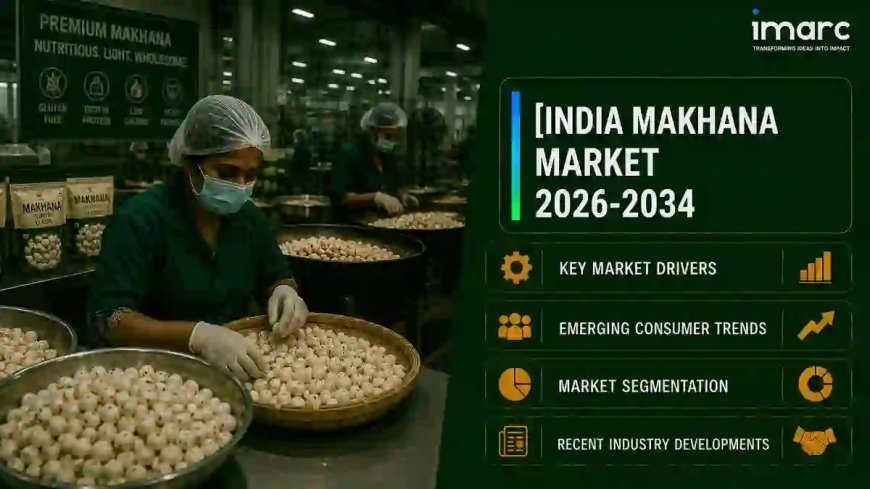
According to IMARC Group’s report titled “India Makhana Market Size, Share, Trends and Forecast by Pack Size, Packaging Type, Distribution Channel, and Region, 2026-2034“, the report offers a comprehensive analysis of the industry, including market share, forecast, growth and regional insights.
The India makhana market size was valued at INR 9.29 Billion in 2025 and is projected to reach INR 19.95 Billion by 2034, growing at a compound annual growth rate of 8.85% from 2026-2034.
The processed agricultural and functional food sector in India is experiencing a profound structural realignment as traditional commodities transition into high-margin, value-added consumer packaged goods (CPG). Driven by an accelerating domestic demand for plant-based, allergen-friendly, and nutrient-dense options, the commercial processing and distribution of fox nuts present highly viable asset-backed entry points for corporate investors and FMCG capital allocators.
- Premiumization Revenue Streams: Establishing integrated manufacturing lines for roasted, nitrogen-flushed, and strategically seasoned product variants allows brands to capture high-margin retail pockets and escape raw commodity price volatility.
- Supply Chain Modernization Premiums: Transitioning from subjective volume-based trading to weight-and-diameter-based grading frameworks unlocks standardized raw material pricing, maximizing corporate gross margins.
- Export Procurement Scalability: Scaling processing operations to produce uniform, export-grade large-diameter formats (greater than 6.0 Suta) secures lucrative supply agreements with institutional distributors across the United States, Europe, and the United Arab Emirates.
The Strategic Market Challenge: Navigating the Makhana Market in India
A critical operational challenge confronting institutional leaders within the food and beverages sector is the pervasive lack of supply chain standardization and heavy reliance on informal pre-processing infrastructure. Because localized harvesting and seed-popping remain highly manual and concentrated within decentralized rural hubs, large-scale CPG firms frequently experience severe variance in raw material caliber, high moisture contamination risks, and unpredictable yield volumes. This lack of upstream formalization restricts corporate capacity to execute long-term, fixed-price supply agreements with modern trade networks and global retailers who mandate strict, uncompromised phytosanitary and bulk-uniformity certifications.
➤ Access Key Market Statistics and Actionable Insights - Request Sample Report
India's Strategic Vision for the Makhana Market:
- Macro-Agricultural Value Addition: The central government aims to structurally scale the domestic agro-processing footprint, systematically moving raw farm-level outputs into branded, shelf-ready functional foods to maximize rural income generation.
- One District One Product (ODOP) Formalization: Public policy frameworks are actively targeting localized production strongholds—particularly across Bihar—to provide institutional funding for modern storage, automatic roasting machinery, and technical capability building.
- Geographical Indication (GI) Export Leverage: Institutional strategies leverage the formal GI tag status of regional varieties to build premium brand equity in international consumer segments, targeting an expansion of processed agricultural exports.
Why Invest in the India Makhana Market: Key Growth Drivers & ROI
- Institutional Agro-Processing Infrastructure Support: Dedicated financial allocations under national cold-chain and mega food park initiatives provide corporate processors with state-backed subsidies to establish centralized grading, sorting, and multi-layered automated packaging units.
- Evolving Preventive Health Consumption Trends: The rapid structural increase in metabolic and lifestyle disorders across urban demographics is driving a steady institutional consumption shift toward low-glycemic, gluten-free, and high-protein alternatives over traditional carbohydrate-dense snacks.
- Technological Sorting and Seasoning Upgrades: The deployment of advanced optical color sorters, automated roasting drums, and precise continuous seasoning application systems allows enterprise processors to ensure high product consistency and maximize throughput efficiency.
India Makhana Market Trends & Future Outlook:
- Consistent Value Compounding: The domestic market value is structurally positioned to expand at a steady compound annual growth rate (CAGR) of 8.85% between 2026 and 2034, indicating highly predictable long-term volume stability for capital allocations.
- Proliferation of Innovative Seasoning Matrices: Modern FMCG brands are expanding corporate revenue streams by blending domestic regional spices with international flavor profiles to drive rapid product trials among younger consumer demographics.
- Omnichannel and D2C Logistics Dominance: Digital retail platforms and direct-to-consumer subscription frameworks are fundamentally reshaping distribution dynamics, allowing agility-focused brands to access underserved Tier-1 and Tier-2 urban households without heavy traditional intermediary overheads.
- Predominance of Family-Sized Consumer Formats: Medium-sized bulk packaging variants between 250-500 grams continue to dictate major consumer purchasing loops, capturing a decisive 46% value share in 2025 due to alignment with monthly domestic pantry replenishment patterns.
Regulatory Landscape & Policy Catalysts in India:
- Food Safety and Standards Authority of India (FSSAI) Strictures: According to the Ministry of Health and Family Welfare, the systematic tightening of moisture thresholds and heavy-metal residue limits in processed snacks mandates that processors implement rigorous batch-testing protocols.
- Pradhan Mantri Formalisation of Micro Food Processing Enterprises (PMFME) Scheme: According to the Ministry of Food Processing Industries (MoFPI), capital subsidies and credit-linked grants are being actively deployed to transition unorganized packing units into compliant, hygienic corporate facilities.
- Agricultural and Processed Food Products Export Development Authority (APEDA) Incentives: According to the Ministry of Commerce and Industry, financial assistance programs are structured to subsidize international market promotions, phytosanitary certifications, and sample distribution pipelines for domestic manufacturers.
- Production Linked Incentive Scheme for Food Processing Industry (PLISFPI): According to the Ministry of Food Processing Industries, fiscal outlays under the innovative organic and functional food categories provide direct percentage-based financial sales incentives for large-scale branded CPG production.
By the IMARC Group, the Top Competitive Landscape & their Positioning:
Some of the key players operative in the industry include:
- Dharampal Premchand Limited (Snack Factory)
- Divinutty Products Private Limited
- Farmley
- Happilo
- Harry Food Processing
- Madhubani Makhana
- Makhana Wala
- Mithilia Naturals
- Rishab Global Industries Private Ltd. (Mr. Makhana)
- Sattviko
- Snackible
- Sun Organic Industries Private Limited
- Sunirav Impex
- Swastik Food Group
- VKC Nuts Pvt. Ltd (Nutraj)
India Makhana Market Segmentation:
The market report offers a comprehensive analysis of the segments, highlighting those with the largest India makhana market share. It includes forecasts for the period 2026-2034 and historical data from 2020-2025 for the following segments.
Pack Size Insights:
- Less than 250 gm
- 250-500 gm
- More than 500 gm
250-500 gm dominates with a market share of 46% of the total India makhana market in 2025.
Packaging Type Insights:
- Pouches
- Jars
- Others
Pouches leads with a share of 50% of the total India makhana market in 2025.
Distribution Channel Insights:
- Modern Trade
- General Trade
- Online/E-commerce
General trade exhibits a clear dominance with a 39% share of the total India makhana market in 2025.
Regional Insights:
- North India
- West & Central India
- South India
- East India
- Northeast India
North India represents the leading region with a 25% share of the total India makhana market in 2025.
Note: If you need specific information that is not currently within the scope of the report, we can provide it to you as a part of the customization.
➤ Shape the Data to Answer Your Specific Questions - Request Customization
Frequently Asked Questions (FAQs)
Q1: What is the current value and projected growth of the India Makhana Market?
A1: According to IMARC Group, the India makhana market size was valued at INR 9.29 Billion in 2025. Looking forward, the market is projected to reach INR 19.95 Billion by 2034, exhibiting a structured compound annual growth rate (CAGR) of 8.85% during the 2026-2034 forecast period.
Q2: Which packaging type segment commands the largest market share in India?
A2: The market infrastructure is heavily led by the pouches segment, which secured a prominent 50% market share in 2025. This dominance is primarily driven by its cost-efficient manufacturing profile, flexible transport logistics, and excellent suitability for automated form-fill-seal packaging lines.
Q3: What distribution channel remains the primary driver of product accessibility?
A3: General trade networks, consisting of traditional Kirana operations, remain the leading segment with a 39% market share in 2025. This position reflects their extensive geographical reach across tier-2 and tier-3 cities, where organized modern trade infrastructure is still expanding.
Q4: Which pack size segment is most favored by domestic consumer demographics?
A4: The 250-500 gm pack size dominates the industry with a market share of 46% of the total India makhana market. This specific size aligns perfectly with household purchasing volumes, presenting an optimal balance between value-for-money and family-sized snacking portions.
Q5: How does geographic concentration affect the industry's industrial supply security?
A5: Over 85% of India’s domestic output is highly concentrated in the state of Bihar. While this concentration exposes corporate buyers to localized weather risks, it simultaneously presents a highly defensible procurement moat for institutional players establishing direct, farm-gate collection infrastructure.
Strategic Insight & Verdict:
The structural evolution of the fox nut industry from an informal regional crop into a formalized global superfood presents an exceptional window for high-volume corporate consolidation. As consumer demand permanently shifts toward premium healthy snacking options, we at IMARC Group have observed that the highest financial returns will belong to enterprise investors who aggressively deploy automated processing technologies and build secure, direct-to-farm sourcing integrations. Moving forward, strategic positioning within the consumer food vertical must prioritize brand equity and standardized supply mechanics to fully unlock the sector's long-term margin potential.
Verified Data Source: India Makhana Market Report by IMARC Group
What's Your Reaction?