

































India Baby Care Products Market 2026-2034: Share, Trends, Industry Expansion & Future Outlook
The India baby care products market size was valued at USD 4.82 Billion in 2025 and is projected to reach USD 10.62 Billion by 2034, growing at a compound annual growth rate of 9.17% from 2026-2034.

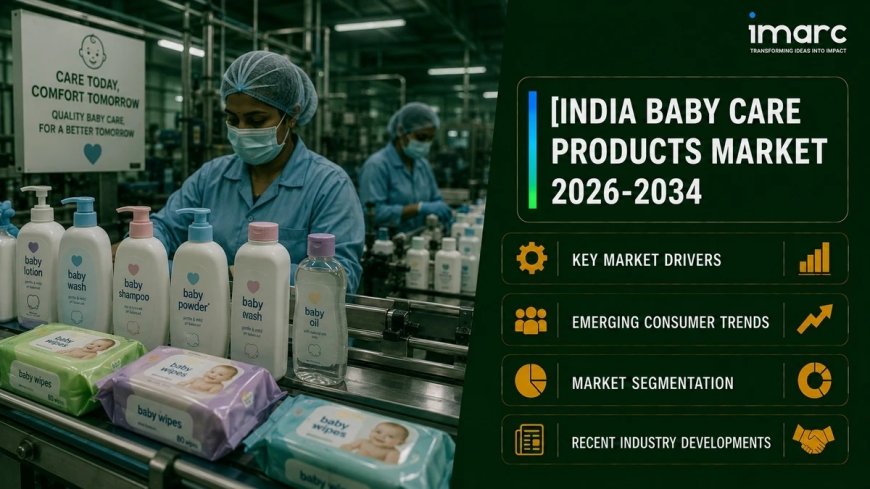
According to IMARC Group’s report titled “India Baby Care Products Market Size, Share, Trends and Forecast by Product Type, Category, Distribution Channel, and Region, 2026-2034“, the report offers a comprehensive analysis of the industry, including market share, forecast, growth and regional insights.
The India baby care products market size was valued at USD 4.82 Billion in 2025 and is projected to reach USD 10.62 Billion by 2034, growing at a compound annual growth rate of 9.17% from 2026-2034.
The consumer retail sector in India is undergoing a rapid formalization, transitioning from a fragmented commodity trade to a high-margin, brand-led retail ecosystem driven by aggressive premiumization across urban demographics. This structural evolution, catalyzed by expanding consumer awareness and modern distribution channels, presents highly lucrative deployment opportunities for institutional capital allocators and enterprise retail operators.
- Premiumization Capture Margins: Establishing high-tier lines for natural, organic, and toxin-free formulations taps into an urban consumer segment increasingly willing to absorb higher price-per-unit metrics for certified infant safety.
- Strategic Category Diversification: Allocating capital toward baby toiletries and skin care captures a dominant revenue cluster that accounts for approximately 40% of the aggregate industry volume.
- Omnichannel Network Integration: Investing in integrated quick-commerce and vertical e-tailer architectures taps into a digital channel that currently commands 38% of total sector sales.
The Strategic Market Challenge: Navigating the Baby Care Products Market in IndiaA critical operational challenge confronting enterprise leaders within the consumer retail sector is managing strict ingredient supply chain integrity while containing production costs. Because the domestic ecosystem is increasingly sensitive to synthetic additives, brands face substantial pressure to eliminate parabens, sulfates, and artificial fragrances, which requires redesigning chemical formulations and re-engineering procurement networks. This operational shift occurs within a dual market structure where mass-market, lower-margin products continue to dictate primary volume, leaving branded players to absorb the elevated costs of dermatological clinical trials and regulatory safety protocols without immediate pricing flexibility.
➤ Access Key Market Statistics and Actionable Insights - Request Sample Report
India's Strategic Vision for the Baby Care Products Market:
- Formalization of Organized Retail: Public economic frameworks aim to accelerate the migration of consumer spending from unorganized mom-and-pop stores to modern trade formats, expanding the geographic footprint of structured supermarkets and hypermarkets.
- Promotion of Domestic Production Capabilities: Institutional blueprints under the "Make in India" initiative encourage the localized manufacturing of high-volume baby gear and hygiene products to reduce historical reliance on foreign imports.
- Digitization of Consumer Supply Infrastructure: National digital commerce strategies focus on expanding rural internet connectivity, enabling specialized baby care brands to scale their distribution loops into Tier-2, Tier-3, and rural markets.
Why Invest in the India Baby Care Products Market: Key Growth Drivers & ROI
- Macro-Demographic Infrastructure Support: Strategic state outlays in dedicated logistics hubs and robust supply chain networks drastically optimize urban distribution efficiency, facilitating rapid fulfillment models that lower storage overhead for high-turnover inventory like diapers and wipes.
- Evolving Middle-Class Consumption Trends: The expansion of the domestic middle class is adding an estimated 140 million households to the high-intent consumer bracket, structurally shifting consumer spending from basic necessities toward specialized, premium baby toiletries and fortified nutritional supplements.
- Advanced Technological Upgrades: The enterprise integration of smart inventory tracking systems and automated packaging lines enables consumer goods companies to optimize batch tracing, minimize cross-contamination risks, and deliver predictable gross margins.
India Baby Care Products Market Trends & Future Outlook:
- Consistent Value Compounding: The domestic market value is structurally positioned to expand at a steady compound annual growth rate (CAGR) of 9.17% between 2026 and 2034, ensuring long-term volume stability for capital investments.
- Ascendancy of Toiletries and Skin Care: Baby toiletries and specialized skin formulations continue to dictate core revenue performance, capturing a significant 32% share of total retail revenues as parents prioritize infant dermatological health.
- Predominance of Mass-Market Volume: While premium segments generate high margins, mass-market consumer options remain the primary engine of total volume distribution, requiring balanced portfolio allocation from large conglomerates.
- Regional Dominance of South India: The South India regional territory maintains the leading consumption position across the country, driven by high literacy rates, deep urbanization metrics, and strong organized retail penetration.
- Accelerated Digital Commerce Adoption: Digital procurement channels continue their upward trajectory, leveraging quick-commerce logistics infrastructure to secure predictable, re-occurring subscription purchases from urban dual-income households.
Regulatory Landscape & Policy Catalysts in India:
- Central Drugs Standard Control Organization (CDSCO) Oversight: According to the Ministry of Health and Family Welfare, all infant skincare and hair formulations are subject to stringent cosmetic safety classifications, mandating rigorous verification of chemical compositions before commercial launch.
- Food Safety and Standards Authority of India (FSSAI) Strictures: According to the Ministry of Health and Family Welfare, fortified infant nutritional inputs and baby foods are governed by strict compliance mandates regarding heavy metal limits and pesticide residues.
- Digital Personal Data Protection (DPDP) Act Application: According to the Ministry of Electronics and Information Technology (MeitY), strict data compliance frameworks govern how direct-to-consumer (D2C) brands leverage parent and child demographic data for targeted digital marketing pipelines.
- Consumer Protection (E-Commerce) Rules: According to the Ministry of Consumer Affairs, Food and Public Distribution, standardized country-of-origin displays and clear product expiration transparency are strictly mandated across all digital marketplaces to protect consumer purchasing loops.
➤ Explore the Full Report with Charts, Table of Contents, and List of Figures
India Baby Care Products Market Segmentation:
The market report offers a comprehensive analysis of the segments, highlighting those with the largest India baby care products market share. It includes forecasts for the period 2026-2034 and historical data from 2020-2025 for the following segments.
Product Type Insights:
- Baby Skin Care
- Baby Hair Care
- Baby ToiletriesBaby Bath Products and FragrancesBaby Diapers and Wipes
- Baby Food and Beverages
Baby toiletries dominate with a market share of 40% of the total market in 2025.
Category Insights:
- Premium
- Mass
Mass leads with a share of 80.0% of the total market in 2025.
Distribution Channel Insights:
- Supermarkets and Hypermarkets
- Convenience Stores
- Pharmacies/Drug Stores
- Online Stores
- Others
Supermarkets and hypermarkets exhibit a clear dominance with a 45.5% share of the total market in 2025.
Regional Insights:
- North India
- West and Central India
- South India
- East India
South India represents the leading segment with 35.0% share of the total market in 2025.
By the IMARC Group, the Top Competitive Landscape & their Positioning:
Covering an in-depth analysis of the competitive landscape, market structure, key player positioning, competitive dashboards, top winning strategies, and detailed profiles of all major industry participants you will gain access to all these exclusive insights within the full research report.
Note: If you need specific information that is not currently within the scope of the report, we can provide it to you as a part of the customization.
➤ Shape the Data to Answer Your Specific Questions - Request Customization
Frequently Asked Questions (FAQs)
Q1: What is the current value and projected growth of the India Baby Care Products Market?
A1: According to IMARC Group, the market was valued at USD 4.82 Billion in 2025 and is projected to reach USD 10.62 Billion by 2034, growing at a compound annual growth rate (CAGR) of 9.17% during the forecast period of 2026–2034.
Q2: Which product type category commands the largest revenue share in the domestic industry?
A2: The baby toiletries segment—encompassing baby bath products, fragrances, diapers, and wipes—dominates the market with approximately 40% share, supported by high recurring institutional and household demand.
Q3: How is the market bifurcated between mass-market and premium product tiers?
A3: Mass-market products continue to drive the largest volume share across the country due to pricing accessibility in semi-urban areas, though the premium tier is expanding rapidly within metropolitan zones due to the clean-label trend.
Q4: What distribution channel represents the primary volume gateway for these products?
A4: Supermarkets and hypermarkets constitute the largest distribution segment due to bulk availability and physical brand visibility, while online retail platforms represent the fastest-growing channel via quick-commerce integration.
Q5: Which geographical region within the country demonstrates the highest market concentration?
A5: South India occupies the leading position in the domestic market, sustained by robust consumer awareness, higher average household disposable incomes, and an extensive network of organized pharmacy and retail outlets.
Strategic Insight & Verdict:
The structural evolution of the domestic infant care market is moving rapidly toward clean-label formalization, omnichannel logistics, and brand-led customization. In assessing this structural transition, we at IMARC Group have observed that the window for capturing high-yield margins requires a strategic pivot away from generic mass-market commodities toward specialized, clinical-grade formulations. Corporate investors must deploy capital into enterprises that control agile, toxin-free supply chains and possess the operational capacity to integrate seamlessly with quick-commerce fulfillment networks.
Verified Data Source: India Baby Care Products Market Report by IMARC Group
What's Your Reaction?