






























India Luxury Watch Market Analysis: Valuation, Industry Growth and Forecast Report 2026-2034
The India luxury watch market reached USD 1.70 Billion in 2025 and is projected to reach USD 2.86 Billion by 2034, growing at a CAGR of 5.66% during 2026-2034.

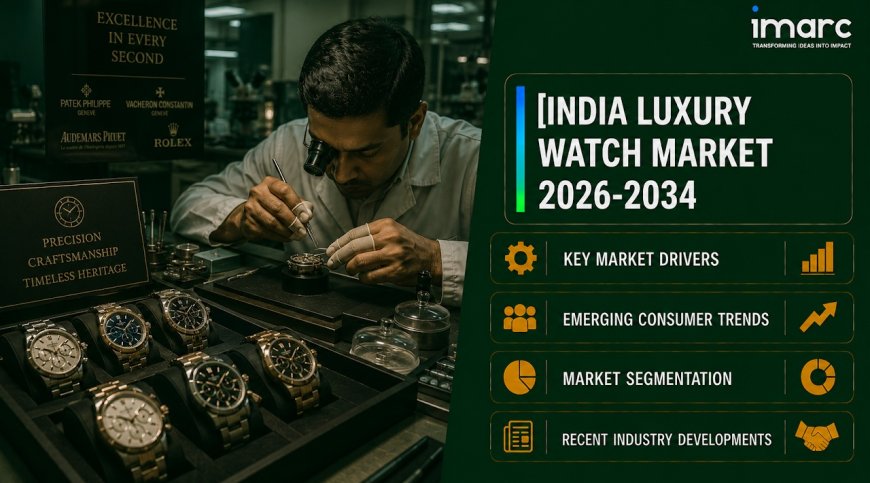
According to IMARC Group’s report titled “India Luxury Watch Market Size, Share, Trends and Forecast by Type, End User, Distribution Channel, and Region, 2026-2034“, the report offers a comprehensive analysis of the industry, including India luxury watch industry share, forecast, growth and regional insights.
The India luxury watch market reached USD 1.70 Billion in 2025 and is projected to reach USD 2.86 Billion by 2034, growing at a CAGR of 5.66% during 2026-2034.
The luxury consumer landscape in India is undergoing a profound structural evolution as an accelerating wealth wave redefines ultra-premium discretionary investments. For international horology conglomerates, brand custodians, and corporate investors, the formalization of high-end physical boutiques and a surging class of alternative asset collectors position this market as a vital frontier for high-margin business-to-business growth.
- Core Segment Preservation: Traditional analog timepieces anchor the sector, commanding a dominant 62.4% market share in 2025 due to their strong historical legacy, mechanical precision, and long-term asset value retention.
- Regional Hub Capitalization: West & Central India operates as the country's primary luxury engine, accounting for a leading 29.8% market share in 2025, driven by a high concentration of ultra-high-net-worth individuals (HNWIs) in the Mumbai metropolitan zone.
- Rapid Female Collector Proliferation: Serving as a significant growth catalyst, the women's end-user segment is expanding aggressively at an estimated CAGR of approximately 6.1%, fueled by rising financial independence and a shift toward jewelry-forward mechanical horology.
The Strategic Market Challenge: Navigating the Luxury Watch Market in India
Corporate leaders frequently overlook the complex multi-channel vulnerabilities and margin pressures caused by India's high import tariffs, which can add up to 15.71% on Swiss timepieces. This fiscal framework drives a notable pricing discrepancy between domestic authorized boutiques and international tax-free hubs, feeding a parallel grey market that captures roughly 15% to 20% of total demand. This leakage, compounded by severe shortages in regional certified mechanical service centers, limits long-term customer retention and slows market penetration across emerging Tier-2 luxury corridors.
➤ Access Key Market Statistics and Actionable Insights - Request Sample Report
India's Strategic Vision for the Luxury Watch Market:
-
Formalization of Alternative Asset Classes: Financial regulators and domestic wealth systems are increasingly recognizing limited-edition mechanical horology as valid passion investments, yielding average annual capital appreciations of 9% to 10%.
-
Phygital Infrastructure Modernization: National single-brand guidelines are steering retail groups to merge high-touch physical flagship stores with secure, AI-driven digital authentication portals to scale consumer trust.
-
Expansion of Regional Retail Footprints: Major commercial developers are shifting away from traditional metro clusters to set up high-end experiential retail spaces across affluent Tier-2 urbanization hubs.
Why Invest in the India Luxury Watch Market: Key Growth Drivers & ROI
-
Rapid HNWI Demographics Upscaling: Strong macroeconomic growth, including a 7.4% real GDP growth rate in FY 2025-26, supports projections that India's affluent consumer class will reach 88 Million, providing an extensive audience for premium luxury assets.
-
Deeply Embedded Institutional Gifting Patterns: Traditional high-value gifting during national festive seasons, weddings, and high-level corporate events drives strong volume consistency, generating approximately 30% to 35% of total annual industry revenues.
-
Secondary Market Maturation: The certified pre-owned (CPO) watch segment is expanding at a solid 10% CAGR, establishing safe trade spaces that mitigate counterfeit risks and maximize the lifetime liquidity of luxury assets.
India Luxury Watch Market Trends & Future Outlook:
-
Convergence of Smart and Luxury Features: Premium connected watches priced between USD 1,500 and USD 2,500 are capturing a fast-growing 37.6% segment share, driven by a projected 7.2% CAGR among corporate professionals.
-
Dominance of Organized Physical Footprints: Organized brick-and-mortar luxury networks command over 92% of primary market sales, highlighting the need for tactile, immersive, and high-security boutique environments.
-
Surge in Unique Collector Collaborations: High-end watchmakers are increasingly utilizing limited-run collections featuring regional art, historical storytelling, or bespoke materials to build deep engagement with domestic collectors.
-
Integration of Virtual Luxury Concierges: Horology houses are utilizing advanced omnichannel platforms to connect online discovery with invite-only offline viewings, structurally reducing customer acquisition costs.
Regulatory Landscape & Policy Catalysts in India:
-
Customs Duty Structures: According to the Ministry of Finance, the application of targeted import customs frameworks requires strict pricing transparency and compliance from authorized single-brand retail importers.
-
Foreign Direct Investment (FDI) Compliance: According to Invest India, 100% FDI under the automatic route for single-brand retail trade allows global watch houses to own and run direct flagship networks across major metros.
-
Anti-Counterfeiting and IP Protections: According to the Ministry of Commerce and Industry, intensified enforcement of Intellectual Property Rights (IPR) helps authorized retail channels combat the spread of high-grade counterfeit products.
-
Consumer Protection for E-Commerce: According to the Ministry of Consumer Affairs, updated e-commerce rules mandate explicit disclosures of product country-of-origin, warranty policies, and clear certification of authenticity on high-value digital platforms.
➤ Explore the Full Report with Charts, Table of Contents, and List of Figures
By the IMARC Group, the Top Competitive Landscape & their Positioning:
- ROLEX SA
- The Swatch Group Ltd
- LVMH Moët Hennessy – Louis Vuitton
- Compagnie Financière Richemont SA
- Titan Company
India Luxury Watch Market Segmentation:
The market report offers a comprehensive analysis of the segments, highlighting those with the largest India luxury watch market share. It includes forecasts for the period 2026-2034 and historical data from 2020-2025 for the following segments.
Analysis by Type:
- Analog Watch (62.4% market share in 2025)
- Digital Watch (37.6% market share in 2025)
Analysis by End User:
- Women (32.7% share in 2025)
- Men (48.9% market share in 2025)
- Unisex (18.4% share in 2025)
Analysis by Distribution Channel:
- Online Stores
- Offline Stores
Regional Analysis:
- South India (24.6% market share in 2025)
- North India (27.9% market share in 2025)
- West & Central India (29.8% market share in 2025)
- East India (17.7% market share in 2025)
Note: If you need specific information that is not currently within the scope of the report, we can provide it to you as a part of the customization.
➤ Shape the Data to Answer Your Specific Questions - Request Customization
Frequently Asked Questions (FAQs)
Q1: What is the current value and projected growth of the India Luxury Watch Market?
A1: According to IMARC Group, the India luxury watch market size reached USD 1.70 Billion in 2025. Looking forward, the market is projected to reach USD 2.86 Billion by 2034, exhibiting a structured compound annual growth rate (CAGR) of 5.66% during the 2026–2034 forecast period.
Q2: Which primary watch type commands the largest market share in India?
A2: The horological architecture matrix is distinctly categorized into Analog Watches and Digital Watches. Analog watches command clear dominance across the domestic industry, securing a prominent 62.4% share of total revenue in 2025 due to their premium investment value, complex physical engineering, and superior brand heritage equity.
Q3: How is market consumption structured across key downstream user categories?
A3: The structural consumer pipeline is segmented into Men, Women, and Unisex users. The men's segment represents the largest volume footprint with a 48.9% market share in 2025, while the women's category is expanding at the fastest operational growth rate of approximately 6.1% CAGR.
Q4: What specific distribution channel dominates transaction volumes for high-value watches?
A4: The commercial fulfillment framework maps across Offline Stores and Online Stores. Offline retail configurations—including authorized luxury dealerships, exclusive brand boutiques, and specialized high-end modern trades—retain the vast majority of volume due to the consumer preference for tactile verification and white-glove personalization.
Q5: Which regional geographic block exhibits the highest concentration of luxury watch spending?
A5: The domestic operational framework maps across North India, South India, East India, and West & Central India. West & Central India holds the top position with a commanding 29.8% revenue share in 2025, anchored by dense concentrations of industrial corporate wealth and high-earning executive networks in metropolitan centers like Mumbai.
Strategic Insight & Verdict:
The structural consolidation of India’s luxury lifestyle and horology vertical presents a definitive window for high-volume institutional capital deployment. As consumer purchasing patterns permanently shift away from unauthorized grey-market options toward quality-certified, traceable, and heritage-backed timepieces, we at IMARC Group have observed that the highest financial yields will favor investors who secure control over authorized distribution networks and build integrated, certified technical service infrastructures across high-velocity tier-1 and tier-2 urban centers. Moving forward, the strategic positioning of retail and consumer capital must prioritize absolute supply chain authenticity tracking and direct multi-channel brand alignments to capture dominant equity across the expanding domestic luxury economy.
Verified Data Source: India Luxury Watch Market Report by IMARC Group
What's Your Reaction?