




























Philippines Logistics Market 2026: Projected to Reach USD 42.1 Billion by 2034
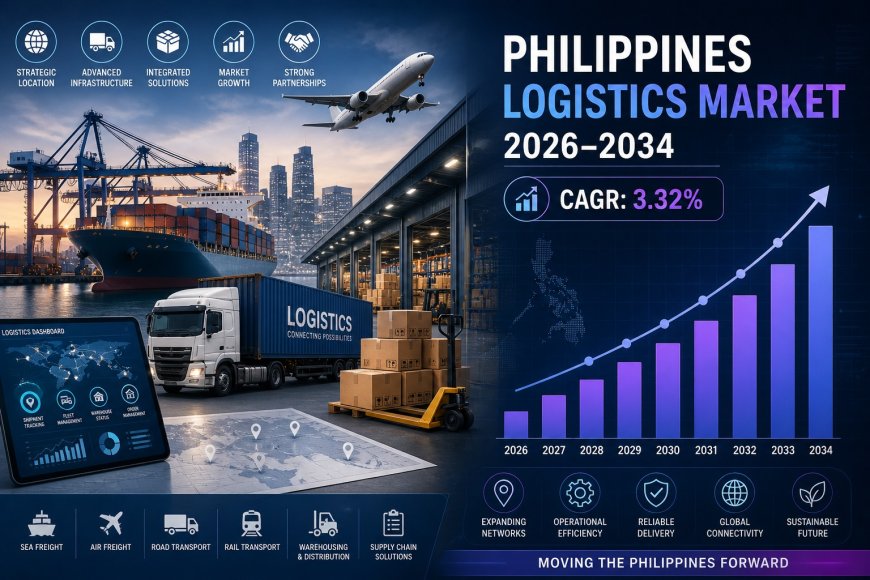
The Philippines logistics market size reached USD 31.1 Billion in 2025. Looking forward, IMARC Group expects the market to reach USD 42.1 Billion by 2034, exhibiting a growth rate (CAGR) of 3.32% during 2026-2034.

Market Overview
The Philippines logistics market size reached USD 31.1 Billion in 2025 and is projected to reach USD 42.1 Billion by 2034, growing at a compound annual growth rate (CAGR) of 3.32% from 2026 to 2034.
The growing e-commerce activities, enhancements in transportation infrastructure, and government policies that aim to improve trade efficiency and establish the country as a key logistics center in Southeast Asia are some of the factors propelling the market growth. The market is strategically important to the Philippines' economy as it enables the nation to meet evolving trade and consumer demands while supporting supply chain efficiency, economic growth, and regional integration.
Request a Sample Report for In-Depth Market Insights: https://www.imarcgroup.com/philippines-logistics-market/requestsample
Philippines Logistics Market Summary
-
The Philippines logistics market encompasses a broad range of logistics services, including 2 PL, 3 PL, and 4 PL model types, across various transportation modes.
-
These services are valued for their role in facilitating the movement, storage, and management of goods, and are used across manufacturing, consumer goods, retail, food and beverages, IT hardware, healthcare, chemicals, construction, automotive, telecom, oil and gas, and other end-use sectors.
-
The ecosystem includes logistics service providers, transportation companies, warehouse operators, technology providers, government agencies, and end-users.
-
Major segments identified in the market include model type (2 PL, 3 PL, 4 PL), transportation mode (roadways, seaways, railways, airways), end use (manufacturing, consumer goods, retail, food and beverages, IT hardware, healthcare, chemicals, construction, automotive, telecom, oil and gas, others), and region (Luzon, Visayas, Mindanao).
-
The market is benefiting from the growing popularity of e-commerce, sustainable and green logistics initiatives, and growing focus on collaborations and partnerships.
-
Infrastructure enhancements, government trade-efficiency policies, and digital technology integration are driving sustained expansion across all application categories.
PORTER'S FIVE FORCES ANALYSIS -- PHILIPPINES LOGISTICS MARKET
Bargaining Power of Suppliers – Moderate
-
The logistics supply chain includes transportation providers (road, sea, rail, air), warehouse operators, technology providers, and fuel suppliers.
-
Large transportation companies and infrastructure providers have significant bargaining power, particularly in specialized segments (e.g., airways, seaways).
-
Technology providers offering logistics software, tracking systems, and automation solutions are gaining leverage as digital transformation becomes essential.
-
However, the presence of multiple service providers and the ability of large logistics firms to develop in-house capabilities reduce dependency on any single supplier.
Bargaining Power of Buyers – Moderate to High
-
Buyers in the Philippine logistics market include manufacturing companies, retailers, e-commerce platforms, and government entities with varying degrees of bargaining power.
-
Large corporations with significant shipping volumes have substantial bargaining power through competitive bidding and long-term contracts.
-
The availability of multiple logistics service providers and the rise of digital freight platforms give buyers choice and leverage.
-
However, specialized logistics requirements (e.g., cold chain, hazardous materials) and the need for reliable service moderate buyer power in some segments.
Threat of New Entrants – Moderate
-
The market is influenced by established logistics providers with strong infrastructure networks, brand recognition, and operational expertise.
-
Capital requirements for transportation fleets, warehousing, and technology systems favor established players.
-
Regulatory compliance, including licensing and safety standards, creates barriers to entry.
-
However, the rise of technology-driven logistics startups and niche players (e.g., green logistics, last-mile delivery) is creating new competitive dynamics.
Threat of Substitutes – Low
-
Logistics services face limited substitution from in-house logistics operations, which may be less efficient and cost-effective.
-
Alternative transportation modes (e.g., shifting from road to rail or sea) are complements rather than substitutes, offering different service levels.
-
The increasing complexity of supply chains and demand for integrated solutions reduces the attractiveness of in-house alternatives.
Competitive Rivalry – High
-
The market features a competitive landscape of global logistics providers (DHL), regional players (Ninja Van), and local firms.
-
Differentiation occurs through service reliability, speed, geographic coverage, technology integration, and cost competitiveness.
-
Competition is intensifying as e-commerce growth drives demand for last-mile delivery and warehousing services.
-
Strategic partnerships and collaborations (e.g., Sojitz Fuso and Bespoke Logistics) are key competitive dynamics.
MARKET GROWTH DRIVERS
Growing Popularity of E-commerce
According to the International Trade Administration, the e-commerce market in the Philippines saw sales of $17 billion in 2021, mainly due to 73 million active online users. It is predicted to increase to $24 billion, with a 17% rise, by 2025. The increasing number of online shoppers is driving the need for effective logistics services, especially in last-mile deliveries and warehousing. In order to handle this increase in demand, logistics firms are making significant investments in intelligent warehouses and enlarging their distribution networks. These investments are focused on improving the speed and efficiency of order processing and delivery, which are essential for meeting user demands for timely service. The changing logistics environment due to e-commerce expansion requires more flexibility and digital technology incorporation in logistics operations. This shift is not only about responding to present needs but also about ensuring the logistics industry is prepared for an ever-changing digital business environment.
Sustainable and Green Logistics Initiatives
The Philippines is actively promoting sustainable and eco-friendly logistics efforts to address environmental concerns and comply with global benchmarks. The shift towards sustainable logistics involves using electric vehicles (EVs), incorporating renewable energy sources in warehouses and transportation, and utilizing eco-friendly packaging choices. Implementing eco-friendly measures reduces the carbon footprint of logistics and meets the needs of eco-conscious individuals and businesses. The logistics industry in the Philippines is not only reducing its environmental impact but also encouraging innovation and creating opportunities for green logistics services through a focus on sustainability. For instance, in July 2023, Payo decided to make a sustainable change by adding EV cargo tricycles to Agila Logistics and Delivery Express's lineup in an effort to decrease carbon emissions. The initiative is part of a broader effort of Payo to promote environment-friendly logistics solutions, including bike deliveries and biodegradable pouches.
Growing Focus on Collaborations and Partnerships
In the Philippines, the logistics industry is seeing a rise in partnerships and collaborations in order to improve services and expand technological capabilities. These collaborations are vital for merging knowledge in different logistics areas like shipping, storing, and managing supply chains, allowing businesses to deliver customized solutions for a range of industry requirements. Collaborative initiatives also help open new markets by merging local companies with international corporations that bring in cutting-edge technologies and worldwide market knowledge. Additionally, these alliances help in cost reduction and risk-sharing, making significant investments more manageable and mitigating potential losses. These strategic partnerships are essential for maintaining competitiveness in a global marketplace, guaranteeing operational efficiency, and adhering to intricate regulatory requirements. In September 2023, Sojitz Fuso Philippines Corp. (SFP) and Bespoke Logistics partnered to improve automotive logistics in the Philippines, marked by a contract-signing ceremony. Bespoke Logistics offered comprehensive services, such as vehicle transport, storage management, and last-mile delivery, while SFP utilized its varied international business knowledge.
PHILIPPINES LOGISTICS MARKET SEGMENTATION
Model Type Insights:
-
2 PL
-
3 PL
-
4 PL
Transportation Mode Insights:
-
Roadways
-
Seaways
-
Railways
-
Airways
End Use Insights:
-
Manufacturing
-
Consumer Goods
-
Retail
-
Food and Beverages
-
IT Hardware
-
Healthcare
-
Chemicals
-
Construction
-
Automotive
-
Telecom
-
Oil and Gas
-
Others
Regional Insights:
-
Luzon
-
Visayas
-
Mindanao
COMPETITIVE LANDSCAPE
The Philippines logistics market features a competitive landscape of global logistics providers, regional players, and local firms. Leading players differentiate through service reliability, speed, geographic coverage, technology integration, and cost competitiveness. The market is moderately concentrated, with competition intensifying as e-commerce growth drives demand for last-mile delivery and warehousing services. Strategic partnerships and collaborations are key competitive dynamics.
Key players mentioned in the report context include:
-
Ninja Van Philippines
-
DHL Express Philippines
-
Sojitz Fuso Philippines Corp. (SFP)
-
Bespoke Logistics
-
Payo
-
Agila Logistics and Delivery Express
Ninja Van Philippines improved its operational abilities in September 2023 by inaugurating a new 3,700 square meter warehouse in Cabuyao, Laguna, aimed at aiding small businesses in warehousing and inventory control. The service provided full Fulfillment services and smoothly connected with Ninja Van's final mile delivery, guaranteeing effective inventory control and quick parcel processing.
DHL Express Philippines enhanced its fleet in February 2023 by switching from an A300 to an A330-300, increasing cargo capacity from 42 to 55 tons and allowing for quicker shipments to Manila and Cebu. This investment greatly reduced delivery times, with inbound flights in Manila arriving up to 15 hours earlier and in Cebu up to 9 hours earlier.
Sojitz Fuso Philippines Corp. (SFP) and Bespoke Logistics partnered in September 2023 to improve automotive logistics in the Philippines, with Bespoke Logistics offering comprehensive services, such as vehicle transport, storage management, and last-mile delivery.
Payo added EV cargo tricycles to Agila Logistics and Delivery Express's lineup in July 2023 in an effort to decrease carbon emissions, part of a broader effort to promote environment-friendly logistics solutions.
REGIONAL ANALYSIS
Luzon: Luzon, particularly Metro Manila, plays an important role in the Philippines logistics market, driven by the region's concentrated population, advanced infrastructure, and economic activity. The region benefits from high population density, the presence of major business districts, and strong industrial and manufacturing bases. The concentration of e-commerce hubs, warehouses, and logistics facilities in Luzon supports efficient supply chains and last-mile delivery. The region's ports and airports serve as key gateways for international trade.
Visayas: The Visayas region, anchored by Cebu, is experiencing growing logistics activity driven by improving infrastructure, tourism, and expanding e-commerce. The region's strategic location and growing industrial base support logistics demand. Cebu's port and airport facilities serve as key hubs for inter-island trade and distribution. The rise of e-commerce and retail in the region is driving demand for warehousing and last-mile delivery services.
Mindanao: Mindanao represents an emerging market for logistics, with growth driven by rising economic activity, agricultural production, and improving infrastructure. Davao and other urban centers are seeing growing logistics demand. The region's agricultural and mineral resources create demand for transportation and storage services. However, infrastructure gaps and inter-island connectivity challenges remain, with ongoing government and private sector investments aimed at improving logistics capabilities.
RECENT INDUSTRY DEVELOPMENTS
June 2026: The Philippines continued strengthening its logistics sector through infrastructure upgrades, expanding ports, airports, and multimodal transport networks. Rising domestic trade and cross-border commerce supported growing demand for freight, warehousing, and distribution services.
May 2026: Logistics providers accelerated investments in digital supply chains, warehouse automation, transport management systems (TMS), and AI-powered route optimization to improve delivery efficiency and reduce operating costs. The sector also benefited from continued growth in e-commerce fulfillment services.
April 2026: Logistics operators faced higher operating costs as diesel prices increased by 59.5% year-on-year, while transport costs rose by 9.9%, prompting greater adoption of fuel-efficient fleet management and route optimization technologies.
March 2026: Demand for warehousing and cold-chain logistics continued expanding, driven by growth in food, pharmaceuticals, healthcare products, and online retail. Companies increased investments in temperature-controlled storage and distribution facilities.
February 2026: The Philippines remained one of Asia's fastest-growing emerging economies, with strong economic growth supporting higher freight volumes, manufacturing activity, and logistics demand across domestic and international supply chains.
January 2026: The Philippines logistics market entered 2026 after reaching USD 31.1 billion in 2025, supported by expanding e-commerce, transportation infrastructure improvements, and government initiatives to enhance trade efficiency.
January 2026: The freight and logistics segment reached approximately USD 19.1 billion in 2025, reflecting strong demand from manufacturing, retail, and international trade. Continued investment in warehousing and last-mile delivery supported market expansion.
January 2026: The country's archipelagic geography of 7,641 islands continued driving investment in integrated sea, air, and land transport networks, encouraging logistics providers to expand regional distribution hubs and inter-island freight services.
Note: If you need any specific information that is not covered currently within the scope of the report, we will provide the same as a part of customization.
Speak to an analyst: https://www.imarcgroup.com/request?type=report&id=23542&flag=C
About Us
IMARC Group is a global management consulting firm that helps the world's most ambitious changemakers to create a lasting impact. The company provides a comprehensive suite of market entry and expansion services. IMARC offerings include thorough market assessment, feasibility studies, company incorporation assistance, factory setup support, regulatory approvals and licensing navigation, branding, marketing and sales strategies, competitive landscape and benchmarking analyses, pricing and cost research, and procurement research.
Contact Us
IMARC Group
134 N 4th St., Brooklyn, NY 11249, USA
Email: sales@imarcgroup.com
Tel No: (D) +91 120 433 0800
United States: +1-201-971-6302
What's Your Reaction?