

































India Drop Shipping Market Size, Share and Outlook Report 2026-2034: Growth USD 76.2 Billion at 20.83% CAGR
The India drop shipping market reached USD 13.24 Billion in 2025 and is projected to reach USD 76.23 Billion by 2034, growing at a CAGR of 20.83% during 2026-2034.

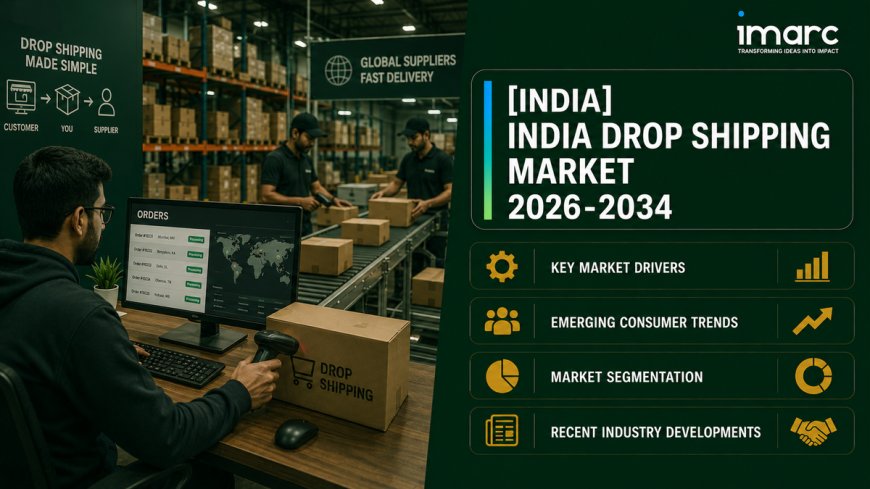
According to IMARC Group's report titled "India Drop Shipping Market Size, Share, Trends and Forecast by Product, and Region, 2026-2034", the report offers a comprehensive analysis of the industry, including market share, forecast, growth and regional insights.
The rapid evolution of India’s digital retail infrastructure has positioned the decentralized fulfillment sector at the center of high-yield corporate asset deployment and digital commerce optimization. Driven by the transition toward zero-inventory retail frameworks, widespread smartphone access, and expanding logistics networks, this market is transforming standard product distribution into a data-dense, highly scalable electronic asset class.
- Massive Market Valuation: Corporate investors can leverage a high-velocity digital ecosystem that achieved a baseline market size of USD 13.24 Billion in 2025, offering deep transaction liquidity and rapid entry potential.
- Predictable Long-Term Capital Velocity: Strategic forecasting indicates a robust growth trajectory scaling toward USD 76.23 Billion by 2034, registering a compounding annual growth rate (CAGR) of 20.83% during the 2026–2034 forecast period.
- Dominance of the Fashion Segment: High-margin apparel and lifestyle products command a leading 31.8% market share, functioning as a primary volume driver while expanding at an estimated 22.1% CAGR.
- Anchored Geographic Demand Hubs: North India anchors the largest regional concentration at 30.9%, heavily supported by massive e-commerce consumption, established transit corridors, and extensive merchant networks across the Delhi-NCR sub-region.
The Strategic Market Challenge: Navigating the Drop Shipping Market in India
The primary structural bottleneck in optimizing the domestic drop shipping framework lies in managing high reverse logistics volumes within highly fragmented last-mile delivery corridors. Corporate retail entities frequently face systemic profit dilution because domestic e-commerce return rates consistently hover between 28% and 35% in fashion and 8% to 12% in electronics. This operational strain forces zero-inventory merchants to absorb heavy return costs without direct asset ownership or local warehouse leverage. Consequently, institutional stakeholders face severe margin compression without deploying automated API fraud checks, centralized multi-tier distribution networks, and standardized supplier service level agreements.
➤ Access Key Market Statistics and Actionable Insights - Request Sample Report
India's Strategic Vision for the Drop Shipping Market:
-
Formalization of Micro-Retail Trade: Systematically transitioning independent social commerce resellers and online merchants into compliance-verified, organized tax entities to stabilize formal retail transaction lines.
-
Expansion of Regional Digital Inclusion: Leveraging public broadband networks to expand digital merchant onboarding pipelines across Tier-2, Tier-3, and rural production hubs.
-
Global Export Corridor Integration: Establishing seamless international logistics and trade gateways to enable domestic drop shipping enterprises to efficiently execute cross-border business-to-consumer (B2C) operations.
Why Invest in the India Drop Shipping Market: Key Growth Drivers & ROI
-
Robust Digital Public Infrastructure: The ongoing expansion of digital network connectivity—heavily supported by affordable cellular data tariffs and automated digital verification tools—vastly minimizes entry costs for corporate merchant platforms.
-
Widespread Digital Payment Trust: The rapid, nationwide adoption of real-time instant checkout applications ensures immediate transactional liquidity, accelerates order processing loops, and eliminates reliance on expensive cash-on-delivery (COD) cycles.
-
Rapid Integration of API-Driven Storefronts: The widespread commercial use of automated plugins and application programming interfaces (APIs) seamlessly connects supplier catalogs to storefronts, minimizing human error and reducing inventory management overheads.
India Drop Shipping Market Trends & Future Outlook:
-
Deep Proliferation of Social Commerce Channels: Drop shipping fulfillment models are integrating heavily with streaming platforms, WhatsApp Business, and creator networks, generating annual influencer-reseller sector growth of 25% to 30%.
-
Sustained Strength in Electronics and Media: Capturing a substantial 24.6% market share, consumer electronics and multimedia accessories represent the second-largest product segment, driven by rapid consumer replacement cycles.
-
Strategic Move Toward Niche Specialization: Enterprise storefronts are systematically moving away from general merchandise inventories toward specialized high-margin segments—such as eco-friendly items, specialized fitness gear, and boutique apparel.
-
Widespread Deployments of Automated AI Tools: Large merchant platforms are deploying advanced machine learning systems to manage dynamic pricing variables, automate customer service workflows, and streamline international supplier matching.
-
Consolidation of Third-Party Logistics Networks: Top-tier drop shipping platforms are entering into multi-year enterprise contracts with organized logistics providers to offer unified tracking and fast regional shipping timelines.
Regulatory Landscape & Policy Catalysts in India:
-
National Electronic Commerce Support Directives: According to the Ministry of Commerce and Industry, structured frameworks promoting open network digital initiatives are designed to level the digital retail playing field, allowing decentralized merchants to directly access nationwide supplier databases.
-
Macro-Level Artificial Intelligence Funding: Large-scale public allocations under the India AI Mission, managed by the Ministry of Electronics and Information Technology (MeitY), are driving down data-processing costs and expanding access to automated analytics engines for retail tech platforms.
-
Digital Financial Transaction Safeguards: Rigorous compliance updates and digital transaction rules overseen by the Reserve Bank of India (RBI) secure high-volume online checkout architectures, reducing transaction failure rates for small businesses.
-
Strict Retail Quality and Safety Control Mandates: Quality control directives enforced by the Bureau of Indian Standards (BIS) regulate consumer product benchmarks, protecting organized, high-compliance suppliers from substandard manufacturing competition.
➤ Explore the Full Report with Charts, Table of Contents, and List of Figures
By the IMARC Group, the Top Competitive Landscape & their Positioning:
- com, Inc.
- Walmart
- Meesho
- Shopify Inc.
India Drop Shipping Market Segmentation
The market report offers a comprehensive analysis of the segments, highlighting those with the largest India drop shipping market share. It includes forecasts for the period 2026-2034 and historical data from 2020-2025 for the following segments.
Product Insights:
- Toys, Hobby and DIY (14.7% market share in 2025)
- Furniture and Appliances (18.9% market share in 2025)
- Food and Personal Care (10.0% share in 2025)
- Electronics and Media (24.6% market share in 2025)
- Fashion (31.8% share in 2025)
Regional Insights:
- North India (30.9% market share in 2025)
- South India (24.5% majority share in 2025)
- East India (17.9% market share in 2025)
- West India (26.7% share in 2025)
Note: If you need specific information that is not currently within the scope of the report, we can provide it to you as a part of the customization.
➤ Shape the Data to Answer Your Specific Questions - Request Customization
Frequently Asked Questions (FAQs)
Q1: What is the current value and projected growth of the India Drop Shipping Market?
A1: According to IMARC Group, the India drop shipping market reached an institutional valuation of USD 13.24 Billion in 2025. Looking forward, the market is projected to reach USD 76.23 Billion by 2034, expanding at a compounding annual growth rate (CAGR) of 20.83% during the forecast period of 2026–2034.
Q2: Which product category type configuration commands the highest market share?
A2: The fashion segment represents the largest product category, capturing a dominant 31.8% market share in 2025. This leading position is propelled by high consumer demand for ethnic wear, seasonal apparel, and rapid influencer-driven lifestyle trend changes across urban demographics.
Q3: What role does North India play in the overall market structure?
A3: North India holds the primary regional market share at 30.9% due to the deep presence of major digital commerce hubs and logistics clusters within the Delhi-National Capital Region (NCR), which supports high consumer demand and a large concentration of online entrepreneurs.
Q4: How does the threat of high return rates impact profit margins in this industry?
A4: Elevated product returns—ranging between 28% and 35% in fashion categories—represent a primary operational hurdle. These volumes inflate reverse fulfillment expenses, requiring merchants to employ data-driven fraud detection and secure premium delivery partnerships to insulate margins.
Q5: What are the second-largest product drivers expanding within this ecosystem?
A5: Electronics and media products represent the second-largest segment, accounting for a 24.6% market share in 2025. This volume is driven by continuous consumer demand for smartphone accessories, wearable computing gear, and consumer entertainment hardware.
Strategic Insight & Verdict:
The structural maturation and rapid scaling of the domestic decentralized fulfillment ecosystem offer an exceptional, high-margin opportunity for digital platforms, logistics innovators, and global retail tech investors. Analysis by we at IMARC Group have observed that long-term asset profitability in this space is heavily dependent on the aggressive implementation of API-automated cataloging, automated reverse fulfillment networks, and targeted niche product specialization. Organizations that proactively align their operations with emerging social commerce technologies and automated delivery networks will isolate their margins from operational shocks, securing defensible corporate market dominance across the upcoming decade.
Verified Data Source: India Drop Shipping Market Report by IMARC Group
What's Your Reaction?