



























Germany Drones Market Size, Share, Trends and Outlook 2034
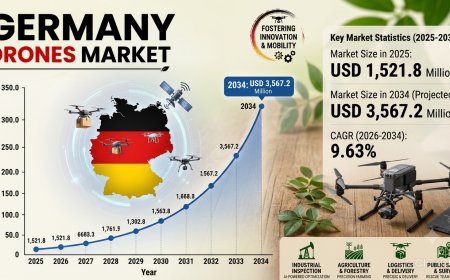
Germany drones market size reached USD 1,521.8 Million in 2025 to reach USD 3,567.2 Million by 2034 at a CAGR of 9.63% during 2026-2034.

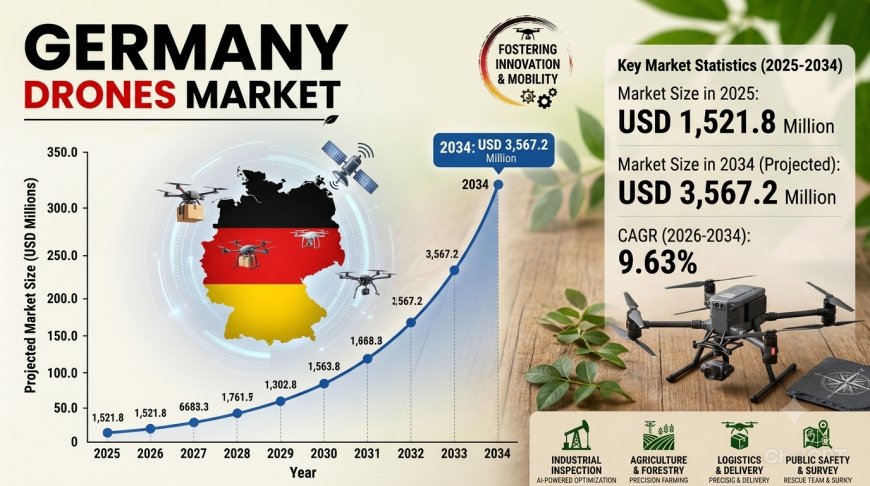
The Germany drones market is witnessing strong growth driven by rising adoption of unmanned aerial systems across agriculture, logistics, public safety, and construction, alongside military modernization and Germany's alignment with NATO defense priorities. The market size reached USD 1,521.8 Million in 2025 and is projected to reach USD 3,567.2 Million by 2034, exhibiting a compound annual growth rate (CAGR) of 9.63% during 2026-2034. Improved navigation systems, artificial intelligence (AI) integration, better battery performance, and expanding commercial uses such as aerial photography and infrastructure inspection are widening the range of missions drones can perform. This market is strategically important to Germany's economy as it connects the country's strong engineering and industrial base with fast-growing demand for autonomous, data-driven, and defense-ready aerial technologies.
The Germany drones market is poised for sustained expansion, driven by commercial adoption, AI-enabled autonomy, and increasing investment in military drone capabilities. With a projected CAGR of 9.63% through 2034 and a market expected to more than double to USD 3,567.2 Million, the market presents significant opportunities for established aerospace and defense companies, drone manufacturers, software providers, and new entrants focused on autonomous, high-payload, and AI-driven solutions.
GERMANY DRONES MARKET SUMMARY
• Market Scope: The Germany drones market encompasses unmanned aerial vehicles and their supporting hardware, software, and accessories, used for surveying, mapping, inspection, aerial photography, precision agriculture, package delivery, law enforcement, and military reconnaissance, surveillance, and intelligence missions.
• Ecosystem: The ecosystem includes aerospace and defense primes, specialized drone and counter-drone developers, software and AI providers, component suppliers, original equipment manufacturers (OEMs), aftermarket service providers, and end users across commercial, public-sector, and defense settings.
• Type and Component: The market is segmented by type (fixed wing, rotary wing, hybrid) and by component (hardware, software, accessories), reflecting the diversity of platforms and the growing role of software and AI in drone performance.
• Payload and Point of Sale: Demand is analyzed across payload classes (less than 25 kg, 25-170 kg, and more than 170 kg) and across points of sale (OEM and aftermarket).
• End-Use and Region: Construction, agriculture, military and defense, law enforcement, logistics, media and entertainment, and other end-use industries are covered across Western, Southern, Eastern, and Northern Germany.
PORTER'S FIVE FORCES ANALYSIS – GERMANY DRONES MARKET
The competitive dynamics of the Germany drones market can be analyzed using Porter's Five Forces framework.
Porter's Five Forces Analysis – Germany Drones Market
• Competitive Rivalry: High, with active competition among aerospace and defense leaders, specialized drone developers, and new defense technology entrants such as Airbus, Kratos Defense, Rheinmetall, Anduril Industries, Alpine Eagle, and Stark. Rivalry is driven by AI-enabled autonomy, payload capacity, and mission-specific capabilities. Business implication: Companies must differentiate through technology leadership, strategic partnerships, and the ability to deliver proven, scalable systems to win commercial and defense programs.
• Supplier Power: Moderate. Drone makers rely on specialized suppliers for batteries, sensors, navigation systems, AI processors, and mission systems, which gives suppliers meaningful influence for advanced components. Business implication: Manufacturers should build diversified supplier networks and long-term technology partnerships to secure access to next-generation components.
• Buyer Power: Moderate. Large buyers, including defense procurement bodies, public safety agencies, and industrial users, purchase at scale and set demanding performance and reliability requirements, while commercial buyers in agriculture, construction, and logistics increasingly compare solutions on value and total cost of ownership. Business implication: Suppliers must demonstrate clear return on investment, reliable support, and tailored solutions to build long-term customer relationships.
• Threat of Substitutes: Low to Moderate. Drones offer speed, safety, and data-collection advantages over manual inspections, ground-based surveys, and conventional surveillance, though satellite imagery, manned aircraft, and ground robotics serve some of the same needs. Business implication: Companies should emphasize the unique benefits of drones, such as real-time data, autonomous operation, and lower operating cost, and integrate them into broader data and workflow solutions.
• Threat of New Entrants: Moderate. Technology, certification, and defense qualification requirements create barriers to entry, while growing defense budgets, NATO-aligned modernization, and international partnerships (for example, Anduril Industries with Rheinmetall) open doors for innovative newcomers. Business implication: Established players should strengthen technology portfolios, secure strategic alliances, and invest in domestic manufacturing and support capabilities.
Competitive Rivalry – Moderate to High (Healthy)
• Multi-tier competition spans aerospace and defense leaders (Airbus, Rheinmetall), specialized unmanned systems providers (Kratos Defense), and technology disruptors (Alpine Eagle, Stark, Anduril Industries) – driving differentiation through autonomy, AI integration, payload capacity, and counter-drone capabilities rather than purely price competition.
• Alpine Eagle's launch of the Sentinel drone-based counter-UAS system (June 2025), the Anduril Industries and Rheinmetall partnership on Barracuda and Fury drones (June 2025), Airbus's partnership with Kratos Defense to deliver combat drones to the German Air Force by 2029 (July 2025), and Stark's drone manufacturing plant announcement (July 2025) reflect active strategic expansion that is strengthening the overall market ecosystem.
Request for Sample Report: https://www.imarcgroup.com/germany-drones-market/requestsample
MARKET GROWTH DRIVERS: Expanding Commercial Adoption and AI-Enabled Technology
Several key factors are propelling the expansion of the Germany drones market. The rising adoption of drones across agriculture, logistics, and public safety is a powerful demand driver. Drones are increasingly used for crop monitoring, precision application, parcel and package delivery, emergency response, and law enforcement support, offering faster, safer, and more cost-effective alternatives to traditional methods. Additionally, improved navigation and AI integration are enabling more autonomous flight, obstacle recognition, route optimization, and AI-driven decision-making, which expands the range of tasks drones can handle with minimal human intervention. Gains in battery performance are further extending flight times and operational range, making drones practical for surveying, mapping, and delivery missions at larger scale.
MARKET GROWTH DRIVERS: Commercial Uses and Military Modernization
The Germany drones market is also benefiting from broadening commercial applications and strong defense investment. Commercial uses such as aerial photography and infrastructure inspection are growing steadily, as construction firms, utilities, and media and entertainment companies use drones to capture high-quality imagery, inspect assets, and gather data efficiently. At the same time, military modernization and NATO alignment are driving Germany's investment in reconnaissance, surveillance, and intelligence drones, with emphasis on AI, autonomous flight, and higher payload capacity. Furthermore, partnerships between established defense companies and innovative drone developers are accelerating the development of combat, counter-drone, and unmanned systems for the German and wider European markets.
GERMANY DRONES MARKET SEGMENTATION
Segmentation analysis provides a detailed view of the Germany drones market by category:
• Type Insights: Fixed Wing, Rotary Wing, Hybrid.
• Component Insights: Hardware, Software, Accessories.
• Payload Insights: Less than 25 kg, 25-170 kg, More than 170 kg.
• Point of Sale Insights: Original Equipment Manufacturers (OEM), Aftermarket.
• End-Use Industry Insights: Construction, Agriculture, Military and Defense, Law Enforcement, Logistics, Media and Entertainment, Others.
• Regional Insights: Western Germany, Southern Germany, Eastern Germany, Northern Germany.
COMPETITIVE LANDSCAPE
The Germany drones market features a dynamic competitive landscape, with multi-tier competition spanning established aerospace and defense companies and fast-growing drone and counter-drone innovators. Key companies operating in and shaping the market include:
• Airbus
• Kratos Defense
• Rheinmetall
• Anduril Industries
• Alpine Eagle
• Stark
Strategic developments are shaping the competitive arena, notably Alpine Eagle's launch of the Sentinel, described as the world's first drone-based counter-UAS system (June 2025); the partnership between Anduril Industries and Rheinmetall to develop Barracuda and Fury drones for European markets (June 2025); Airbus's partnership with Kratos Defense to deliver XQ-58A Valkyrie combat drones with Airbus mission systems to the German Air Force by 2029 (July 2025); and Stark's announcement of a drone manufacturing plant for the OWE-V Virtus unmanned weapon system (July 2025).
REGIONAL ANALYSIS:
Regional dynamics within the Germany drones market are shaped by differences in industrial concentration, defense and aerospace presence, agricultural activity, and urban infrastructure across the four regional markets covered in the report.
• Western Germany: A densely populated and highly industrialized region, supporting demand for drones in infrastructure inspection, construction, logistics, and public safety applications.
• Southern Germany: A major hub for aerospace, engineering, and advanced technology, supporting demand for high-performance, AI-enabled, and defense-oriented drone solutions.
• Eastern Germany: A growing center for innovation and development, with opportunities in agriculture, surveying and mapping, and expanding technology and startup activity.
• Northern Germany: Supported by ports, logistics networks, and extensive coastal and agricultural areas, the region offers opportunities for logistics, inspection, monitoring, and surveillance applications.
RECENT INDUSTRY DEVELOPMENTS
July 2025: Airbus partnered with Kratos Defense to deliver combat drones, the XQ-58A Valkyrie with Airbus mission systems, to the German Air Force by 2029.
July 2025: Stark, a German defense company, announced a drone manufacturing plant in Swindon, UK, expected to create 100 local jobs and produce the OWE-V Virtus unmanned weapon system.
June 2025: Alpine Eagle launched the Sentinel, described as the world's first drone-based counter-UAS system, using radar-equipped drones with swarm formations and interceptor missile capability.
June 2025: Anduril Industries and Rheinmetall partnered to develop Barracuda and Fury drones for European markets.
Key Aspects Required for the Germany Drones Market
• Market Performance: USD 1,521.8 Million in 2025, with a projected trajectory to USD 3,567.2 Million by 2034.
• Market Outlook: A 9.63% CAGR during 2026-2034 indicates robust growth across fixed wing, rotary wing, and hybrid drones, spanning commercial, law enforcement, and military and defense applications.
• Growth Drivers: Rising adoption across agriculture, logistics, and public safety; improved navigation and AI integration; commercial uses such as aerial photography and infrastructure inspection; and military modernization and NATO alignment.
• Competitive Landscape: A multi-tier structure spanning aerospace and defense leaders (Airbus, Rheinmetall), unmanned systems specialists (Kratos Defense), and defense technology innovators (Anduril Industries, Alpine Eagle, Stark), with partnerships and new product launches shaping competition.
• Value Chain Analysis: From component and technology supply (batteries, sensors, navigation, AI software) through drone design and manufacturing, OEM and aftermarket sales, to deployment, data analytics, and maintenance and support services.
• Industry Trends: Growing investment in military reconnaissance, surveillance, and intelligence drones; AI-driven decision-making and autonomous flight; improved battery performance; obstacle recognition and route optimization; and expanding use in surveying, mapping, and package delivery.
• Strategic Recommendations: Focus on AI-enabled and autonomous platforms, higher-payload and defense-grade systems, and software and analytics offerings; build strategic partnerships between defense primes and drone innovators; expand commercial applications in agriculture, construction, and logistics; and strengthen OEM and aftermarket service capabilities.
Note: If you need any specific information that is not covered currently within the scope of the report, we will provide the same as a part of customization.
Request Customization: https://www.imarcgroup.com/request?type=report&id=39903&flag=E
Report Format, Delivery, and Customization Details
• Report Format Mode: PPT, PDF, and Excel
• Report Delivery Mode: Online Delivery, Physical Delivery
• Report Delivery Time: Report Delivered Over Email within 24 to 48 hours. If requested by the client, a physical copy will be delivered within three to ten days.
• Report Confirmation Mode: Yes via Email
• Report Customization Mode: Yes via Email / Call
• Report Table of Content: Yes
• Report List of Figures: Yes
• Report Methodology Mode: Yes
• Request For Sample Report: Yes
What's Your Reaction?