






























Europe Wine Market Projected to Reach USD 116.9 Billion by 2034
Europe wine market reached USD 81.7 Billion in 2025 and is projected to reach USD 116.9 Billion by 2034, growing at a CAGR of 4.06% during 2026-2034.

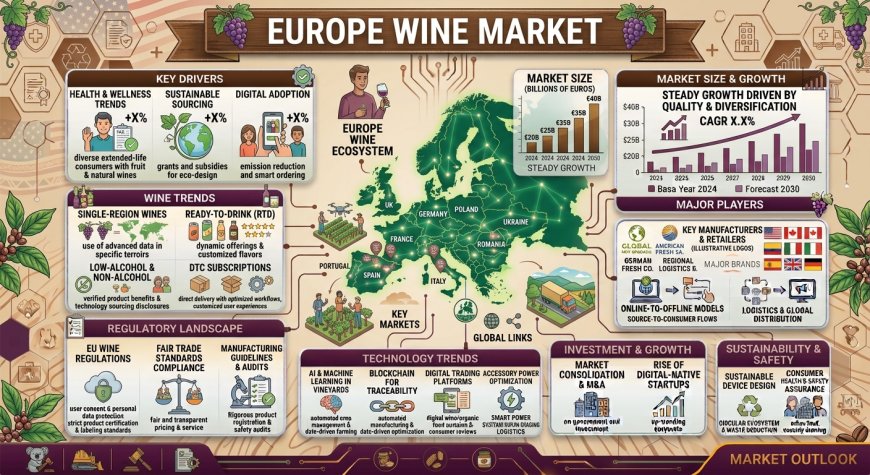
Market Overview
The Europe wine market reached USD 81.7 Billion in 2025 and is projected to reach USD 116.9 Billion by 2034, growing at a CAGR of 4.06% during 2026‑2034. The market is driven by strong cultural consumption, premiumization, tourism‑linked demand, and the region's established wine‑producing heritage. Growth is also supported by rising demand for organic, sustainable, and low-alcohol wine varieties.
This market is strategically important to Europe's agricultural and beverage economy, as the European Union remains the leading wine producer, with an average annual production of 157 million hectolitres between 2020 and 2025. This strong production base supports Europe's wine market by ensuring wide availability, export strength, product variety, and continued investment in vineyards, wineries, and premium wine categories. The Europe wine market expanded from USD 67.0 Billion in 2020 to USD 81.7 Billion in 2025, anchored at USD 99.7 Billion in 2030, and forecast to reach USD 116.9 Billion by 2034.
The Europe wine market is poised for sustained expansion, driven by premiumization, sustainability trends, and the growing popularity of organic and low‑alcohol wine varieties. With a projected CAGR of 4.06% through 2034, the market presents significant opportunities for producers focusing on organic and biodynamic certified wines, premium positioning, and e‑commerce distribution.
EUROPE WINE MARKET SUMMARY
- Still wine dominates the product type segment with a share of 68.4% in 2025, through the breadth of European still wine from entry‑level through the complete fine wine hierarchy.
- Red wine leads the color segment with a share of 47.6% in 2025, through the dominance in both fine wine and everyday drinking occasions.
- France commands the largest country share with 24.8% in 2025, through Champagne and luxury pricing concentration.
- Sparkling wine grows fastest at approximately 4.6% CAGR through high penetration, Champagne's continued luxury premiumization, accessibility positioning, and English sparkling wine's emerging premium credibility.
- White wine grows at approximately 4.1% CAGR due to mass market reach and growing premium positioning.
- The COVID‑19 pandemic shifted European wine consumption from on‑trade to off‑trade, with e‑commerce wine sales. The post‑COVID on‑trade recovery created the highest simultaneous on‑trade and off‑trade wine demand in European market history.
PORTER'S FIVE FORCES ANALYSIS – EUROPE WINE MARKET
The competitive dynamics of the Europe wine market can be analysed using Porter's Five Forces framework.
Bargaining Power of Suppliers – Moderate
- Wine producers rely on grape growers and vineyard suppliers. Europe's established wine‑producing regions provide multiple sourcing options. However, premium wine regions with limited production capacity give suppliers of high‑quality grapes moderate leverage.
Bargaining Power of Buyers – Moderate to High
- European consumers benefit from extensive choice across wine varieties, price points, and distribution channels. The rise of e‑commerce wine sales has increased price transparency and consumer access.
Threat of New Entrants – Moderate
- Significant capital requirements for vineyard establishment, winemaking facilities, and brand building create barriers. However, the growing demand for organic and low‑alcohol wines has enabled niche entrants.
Threat of Substitutes – Moderate
- Beer, spirits, and non‑alcoholic beverages represent partial substitutes, but wine's strong cultural association with European dining provides differentiation.
Competitive Rivalry – High (Healthy)
- The market features intense competition among established wine producers, emerging boutique wineries, and international brands. Competition is driven by brand heritage, quality perception, and sustainability credentials.
Request for Sample Report: https://www.imarcgroup.com/europe-wine-market/requestsample
MARKET GROWTH DRIVERS
Premiumization and Quality‑Driven Consumption
The Europe wine market is experiencing sustained growth through premiumization, as consumers increasingly prioritize quality over volume. This trend is evident in the growing demand for premium still wines, Champagne, and luxury wine categories. Market opportunities exist in organic and biodynamic certified wines, as well as sustainable packaging innovations.
Organic and Sustainable Wine Production
Rising demand for organic, sustainable, and low‑alcohol wine varieties is supporting market growth. Consumers are increasingly seeking wines produced with environmentally responsible practices, including organic and biodynamic certification.
Tourism‑Linked Demand and Cultural Consumption
Europe's established wine‑producing heritage and tourism‑linked demand are significant drivers. The region's prestigious wine designations attract wine tourism, supporting direct sales and brand awareness. Wine tourism and e‑commerce are identified as key market opportunities.
EUROPE WINE MARKET SEGMENTATION
Segmentation analysis provides a detailed view of the Europe wine market by category:
- Product Type Insights: Still Wine (68.4% share in 2025), Sparkling Wine (~4.6% CAGR), Fortified Wine.
- Color Insights: Red Wine (47.6% share in 2025), White Wine (~4.1% CAGR), Rosé Wine.
- Distribution Channel Insights: Off‑Trade, On‑Trade.
- Country Insights: France (24.8% share), Italy, Spain, Germany, United Kingdom, Others.
COMPETITIVE LANDSCAPE
The competitive landscape of the Europe wine market features intense competition among established wine producers, emerging boutique wineries, and international brands. Investment opportunities exist in organic and biodynamic certified wines, low‑alcohol wine varieties, e‑commerce platforms, and sustainable packaging solutions.
REGIONAL ANALYSIS
- France commands the largest country share with 24.8% in 2025, through Champagne and luxury pricing concentration.
- Italy is a major wine producer and exporter, with strong domestic consumption and growing premium wine demand.
- Spain contributes significantly to European wine production and exports, with growing interest in premium and organic wines.
- Germany is a key wine market with strong domestic consumption and growing demand for premium wines.
- United Kingdom is a major wine importing market with growing domestic wine production, particularly sparkling wines.
RECENT INDUSTRY DEVELOPMENTS
- 2025 Activity: The Europe wine market continued its growth trajectory from USD 81.7 Billion in 2025 to USD 116.9 Billion by 2034.
- 2025 Activity: Sparkling wine emerged as the fastest‑growing product type at approximately 4.6% CAGR.
Note: If you need any specific information that is not covered currently within the scope of the report, we will provide the same as a part of customization.
https://www.imarcgroup.com/request?type=report&id=9435&flag=E
Report Format, Delivery, and Customization Details
- Report Format Mode: PPT, PDF, and Excel
- Report Delivery Mode: Online Delivery, Physical Delivery
- Report Delivery Time: Report Delivered Over Email within 24 to 48 hours. If requested by the client, a physical copy will be delivered within three to ten days.
- Report Confirmation Mode: Yes via Email
- Report Customization Mode: Yes via Email / Call
- Report Table of Content: Yes
- Report List of Figures: Yes
- Report Methodology Mode: Yes
- Request For Sample Report: Yes
What's Your Reaction?