



























Australia Beauty and Personal Care Market 2026 | Worth USD 16,130.0 Million by 2034
Explore the Australia beauty and personal care market, valued at USD 11.07 billion in 2025, with 4.15% CAGR growth projected through 2034.

Market Overview
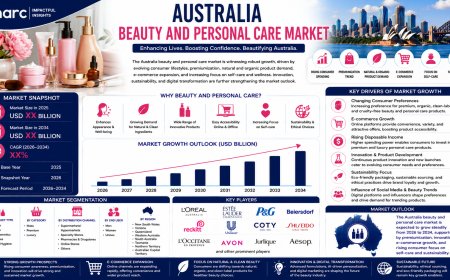
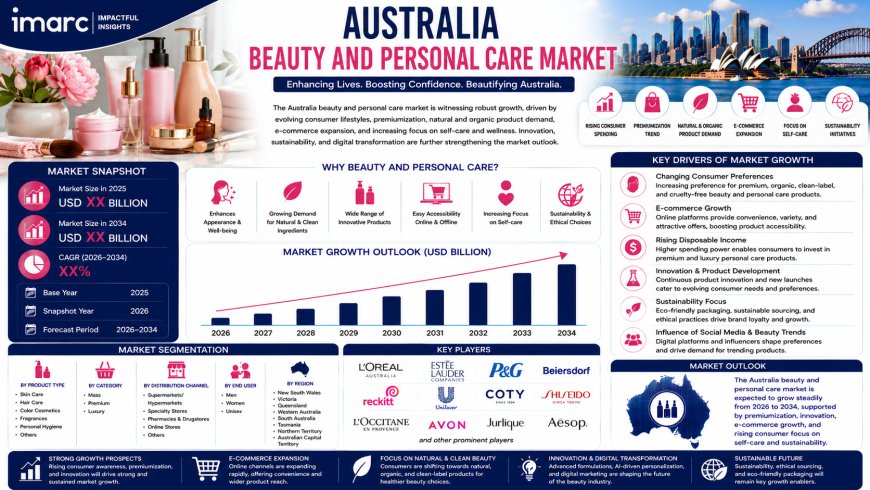
The Australia beauty and personal care market size reached USD 11,066.6 Million in 2025. Looking forward, IMARC Group expects the market to reach USD 16,130.0 Million by 2034, exhibiting a growth rate (CAGR) of 4.15% during 2026-2034. The market is fueled by growing demand for organic and natural products, heightened health and sustainability consciousness, and greater demand for ethical brands. Digital innovation, e-commerce growth, and influencer marketing also drive consumer interest, particularly among younger, digitally native consumers looking for personalized and clean-label solutions.
The Australia beauty and personal care market encompasses personal care products (hair care, skin care, bath and shower, oral care, men's grooming, and fragrances) and cosmetics/make-up products (facial cosmetics, eye cosmetic products, lip and nail products, and hair styling and coloring products), available in premium and mass categories, distributed through specialist retailers, hypermarkets/supermarkets, online retailing, and other channels across Australia Capital Territory & New South Wales, Victoria & Tasmania, Queensland, Northern Territory & Southern Australia, and Western Australia.
This market is strategically important to Australia's consumer wellness, personal expression, and retail innovation, supporting the daily routines and self-care practices of households across the country's diverse and health-conscious population. The market is shaped by a strong shift toward natural and organic products fueled by growing consumer concern about ingredient safety, environmental sustainability, and ethical sourcing. Increasing numbers of Australians are turning to clean beauty solutions—products that contain no parabens, sulfates, or artificial fragrances—due to concerns over skin sensitivity and long-term health consequences, prompting local and international brands to invest in research and development to create safer, plant-derived alternatives. Some of the top Australian brands such as Sukin, Jurlique, and MooGoo have taken advantage of this trend and provided eco-friendly skincare and personal care ranges appealing to sustainability-oriented consumers. The digital revolution is redefining the way consumers shop and find products, with Australia Post's yearly eCommerce Report showing that Australians spent a historic A$69bn (USD 43.6 billion) on online shopping in 2024, marking a 12% rise compared to the prior year, with 9.8 million households engaged in online shopping and nearly 50% of Gen Z and millennials making a weekly online purchase through social media. Sustainability is emerging as an overarching priority among customers, with cruelty-free, vegan, zero-waste, and carbon-neutral beauty products moving from a niche to mainstream marketplaces. In February 2023, Unilever consented to invest A$2 million ($1.42 million) in the Australian scalp care brand Straand, established in 2022, with Unilever Ventures' pre-seed funding allocated for growth in China, Southeast Asia, Europe, and the US.
The Australia beauty and personal care market is poised for sustained expansion, underpinned by increasing demand for natural and organic products, e-commerce and digital beauty acceleration, ethical consumerism and sustainable beauty, social media and influencer influence, increased focus on skincare, male grooming growth, and technological integration. With a projected CAGR of 4.15% through 2034, the market presents significant opportunities for providers focusing on clean and natural formulations, sustainable and refillable packaging, e-commerce and social commerce platforms, personalized beauty solutions and AI skin analysis, virtual try-on technology, expanding anti-aging products, male grooming ranges, and at-home beauty devices.
AUSTRALIA BEAUTY AND PERSONAL CARE MARKET SUMMARY
The Australia beauty and personal care market encompasses the development, manufacture, distribution, and retail of skincare, haircare, cosmetics, oral care, grooming, and fragrance products for personal use across the country.
The ecosystem spans international beauty and personal care manufacturers (Unilever and other global brands), Australian natural and organic brands (Sukin, Jurlique, MooGoo, Straand), ingredient and formulation suppliers, packaging innovators including refillable and recyclable providers, specialist retailers, hypermarkets and supermarkets, online retailers (Adore Beauty, Sephora Australia), social media and influencer platforms, beauty technology providers including AR try-on and AI skin analysis developers, subscription beauty box services, and consumers across Gen Z, millennials, and older demographics throughout Australia.
By Type, the market is segmented into Personal Care Products (Hair Care Products including shampoo, conditioner, hair oil, and others; Skin Care Products including facial care, body care, and lip care; Bath and Shower Products; Oral Care Products including toothbrushes and replacements, toothpaste, mouthwashes and rinses, and others; Men's Grooming Products; and Fragrances and Perfumes) and Cosmetics/Make-up Products (Facial Cosmetics, Eye Cosmetic Products, Lip and Nail Products, and Hair Styling and Coloring Products).
By Category, the market is segmented into Premium Products and Mass Products.
By Distribution Channel, the market is segmented into Specialist Retailers, Hypermarkets/Supermarkets, Online Retailing, and Others.
By Region, the market serves Australia Capital Territory & New South Wales, Victoria & Tasmania, Queensland, Northern Territory & Southern Australia, and Western Australia.
Key trends shaping the market include increasing demand for natural and organic products, e-commerce and digital beauty acceleration with AR try-ons and skincare quizzes, emergence of ethical consumerism and sustainable beauty, social media and influencer influence, increased focus on skincare with active ingredients, male grooming expansion, personalized beauty solutions, and technological integration including virtual try-ons, AI-based skin analysis, and at-home beauty devices.
PORTER'S FIVE FORCES ANALYSIS – AUSTRALIA BEAUTY AND PERSONAL CARE MARKET
Competitive Rivalry: High. The market features intense competition among international beauty and personal care manufacturers, Australian natural and organic brands, and emerging digital-native and indie brands. Competition centres on ingredient safety and transparency, sustainability credentials, product efficacy, brand storytelling, influencer partnerships, and digital engagement. Retailers are giving more shelf space to organic brands and highlighting environmental credentials on labels, while digital marketplaces and online platforms like Adore Beauty and Sephora Australia are expanding with large product offerings, rapid shipping, and loyalty schemes. Business implication: Brands must differentiate through clean formulations, sustainability commitments, influencer marketing, and personalized consumer engagement to capture share.
Supplier Power (Ingredient and Packaging Providers): Moderate. Beauty and personal care manufacturers depend on suppliers of active ingredients, plant-derived alternatives, fragrance compounds, and packaging materials including refillable and recyclable formats. Specialised clean beauty ingredients and sustainable packaging solutions are concentrated among limited suppliers, conferring moderate power, while consumer demand for ingredient safety and sustainability credentials raises supplier qualification requirements. Business implication: Long-term supply partnerships, ingredient innovation collaboration, and sustainable packaging sourcing can reduce dependency and support clean beauty positioning.
Buyer Power (Consumers): High. Consumers exercise substantial power through abundant brand and product choice, price sensitivity across premium and mass categories, ingredient scrutiny, and willingness to switch based on reviews and influencer recommendations. Digital-native Gen Z and millennial consumers in particular demand clean-label solutions, ethical sourcing, and personalized products, while online comparison and social media reviews further strengthen buyer leverage. Business implication: Brands must deliver efficacy, transparency, ethical credentials, and personalized experiences to retain loyalty in a highly competitive and informed market.
Threat of Substitutes: Moderate. Within beauty and personal care, alternative brands, formats, and product categories substitute readily for one another, while natural and DIY alternatives substitute for commercial products among some consumer segments. Skincare devices and at-home beauty treatments substitute for topical products in specific applications, and wellness supplements substitute for topical anti-aging approaches. Business implication: Demonstrating efficacy, safety, and convenience is essential to defend share against alternative products, devices, and DIY approaches.
Threat of New Entrants: Moderate to High. E-commerce platforms, social commerce, and influencer marketing have lowered barriers for indie and digital-native brands to reach consumers directly, with nearly 50% of Gen Z and millennials making weekly online purchases through social media. However, brand trust, formulation expertise, regulatory compliance, and retail shelf-space access constrain scale entry in established categories. Business implication: Incumbents must leverage brand heritage, retail relationships, and formulation capability while monitoring digital-native and influencer-driven entrants.
KEY ASPECTS REQUIRED FOR THE AUSTRALIA BEAUTY AND PERSONAL CARE MARKET
Market Performance: USD 11,066.6 Million in 2025, projected to reach USD 16,130.0 Million by 2034, driven by organic and natural product demand, sustainability consciousness, e-commerce growth, and influencer marketing.
Market Outlook: A 4.15% CAGR through 2034 reflects steady growth led by skincare and haircare products, premium and mass categories, online retailing expansion, and ACT and NSW regional dominance, alongside rising demand for personalized and clean-label solutions.
Growth Drivers: Increasing demand for natural and organic products with clean beauty solutions free from parabens, sulfates, and artificial fragrances (Sukin, Jurlique, and MooGoo leading eco-friendly ranges); e-commerce and digital beauty acceleration with AR try-ons and bespoke skincare quizzes (Australians spent A$69bn/USD 43.6 billion on online shopping in 2024, up 12%, with 9.8 million households engaged); emergence of ethical consumerism and sustainable beauty with cruelty-free, vegan, zero-waste, and carbon-neutral products (refillable and recyclable packaging, plastic reduction pledges, locally made products); influence of social media and influencers on Instagram, TikTok, and YouTube; increased focus on skincare with active ingredients and targeted solutions for anti-aging, hydration, acne, and pigmentation; male grooming expansion with gender-neutral and men-focused products; expanding anti-aging market; personalized beauty solutions; technological integration including virtual try-ons, AI skin analysis, and at-home beauty devices; rising investment in Australian brands (Unilever's A$2 million investment in Straand in February 2023).
Competitive Landscape: A highly competitive market with international beauty and personal care manufacturers, Australian natural and organic brands, and emerging digital-native and indie brands. Competition centres on clean formulations, sustainability credentials, influencer partnerships, digital engagement, and personalized experiences, with retailers giving more shelf space to organic brands.
Value Chain Analysis: From active ingredient and packaging sourcing through formulation development and manufacturing, quality control and regulatory compliance, distribution through specialist retailers, hypermarkets/supermarkets, and online retailing, influencer marketing and social commerce engagement, and end consumption across personal care and cosmetics applications.
Industry Trends: Natural and organic product demand with clean beauty formulations; e-commerce and digital beauty acceleration (AR try-ons, bespoke skincare quizzes, subscription beauty boxes, rapid shipping, loyalty schemes); ethical consumerism and sustainable beauty (cruelty-free, vegan, zero-waste, carbon-neutral products; refillable and recyclable packaging; plastic reduction; locally made products); social media and influencer influence (Instagram, TikTok, YouTube reviews and tutorials); increased skincare focus with active ingredients and targeted solutions; male grooming growth with gender-neutral and men-focused products; personalized beauty solutions (online skin assessments, custom formulations, bespoke foundation shades); technological integration (virtual try-ons, AI-based skin analysis, at-home beauty devices such as facial massagers and LED masks); anti-aging expansion including supplements and wellness products; rising investment in Australian indie brands.
Strategic Recommendations: Invest in clean and natural formulations free from parabens, sulfates, and artificial fragrances; develop sustainable and refillable packaging with plastic reduction commitments; build e-commerce and social commerce capability with AR try-ons and skincare quizzes; deploy AI-based skin analysis and personalized formulation technology; develop virtual try-on tools for makeup and skincare; expand anti-aging product ranges targeting diverse age groups from preventative to mature skin concerns; develop male grooming ranges with gender-neutral and men-focused positioning; pursue influencer partnerships and TikTok and Instagram engagement strategies; expand subscription beauty box offerings for brand discovery; invest in at-home beauty devices including facial massagers and LED masks; strengthen presence in specialist retail and online channels; pursue investment in emerging Australian brands.
Request for Sample Report: https://www.imarcgroup.com/australia-beauty-personal-care-market/requestsample
MARKET GROWTH DRIVERS
Increasing Demand for Natural and Organic Products
The Australia beauty and personal care market share is experiencing a strong shift toward natural and organic products, fueled by growing consumer concern about ingredient safety, environmental sustainability, and ethical sourcing. Increasing numbers of Australians are turning to clean beauty solutions—products that contain no parabens, sulfates, or artificial fragrances—due to concerns over skin sensitivity and long-term health consequences. This has prompted local and international brands to invest in research and development to create safer, plant-derived alternatives. Some of the top Australian brands such as Sukin, Jurlique, and MooGoo have taken advantage of this trend and provided eco-friendly skincare and personal care ranges appealing to sustainability-oriented consumers. Apart from this, the trend is consistent with Australia's larger cultural predisposition toward wellness and a natural lifestyle. Hence, retailers are giving more shelf space to organic brands and highlighting environmental credentials on labels.
E-commerce and Digital Beauty Acceleration
The digital revolution of the Australia beauty and personal care market outlook is redefining the way consumers shop and find products. The ease of shopping online, and breakthroughs in digital technology such as augmented reality (AR) try-ons and bespoke skincare quizzes, have added to the shopping experience. Australia Post's yearly eCommerce Report has shown that Australians spent a historic A$69bn (USD 43.6 billion) on online shopping in 2024, marking a 12% rise compared to the prior year. The report indicates that in the previous year, 9.8 million households engaged in online shopping, with the highest expenditures at online marketplaces (nearly A$16bn/USD 10.1 billion), followed by food and alcohol (A$13.6bn/USD 8.6 billion) and clothing and accessories (A$9.6bn/USD 6 billion). Nearly 50% of Gen Z and millennials made a weekly online purchase through social media. Hence, Australian consumers, especially Gen Z and millennials, are increasingly driven by beauty influencers, YouTube tutorials, and TikTok reviews, making for a dynamic and trend-oriented shopping experience. Digital marketplaces and online platforms like Adore Beauty and Sephora Australia are expanding with large product offerings, rapid shipping, and loyalty schemes to promote customer retention. Subscription beauty boxes are also becoming popular, with handpicked product experiences and the promotion of brand discovery. This wave is generating sales and enabling brands to collect customer information to facilitate more focused marketing and product development.
Emergence of Ethical Consumerism and Sustainable Beauty
Sustainability is emerging as an overarching priority among customers, which is also fueling the Australia beauty and personal care market growth. The ascent of ethical consumerism signifies that cruelty-free, vegan, zero-waste, and carbon-neutral beauty products are no longer a niche—as they are moving into the mainstream marketplaces. Brands are being compelled to evolve through redesigning packaging to be refillable or recyclable and pledging plastic reduction throughout their supply chains. Campaigns promoting a brand's social and environmental responsibility now play a significant role in purchasing decisions. Locally made products are also gaining popularity with several Australian consumers to cut down on carbon footprints and assist domestic businesses. This emphasis on sustainability carries over from the product itself to the entire brand philosophy—from the sourcing of ingredients to labor and community practices. The extent that ethical beauty takes hold in consumers' sensibilities, is that brands that do live up to such expectations risk becoming irrelevant within a marketplace that is increasingly conscious and values driven.
Influence of Social Media and Influencers
Social media sites such as Instagram, TikTok, and YouTube have heavily influenced the beauty and personal care industry in Australia. Beauty influencers and content creators on social media steer consumer behavior by posting product reviews, tutorials, and beauty trends. Their potential to access a large audience and generate viral content has made them influential in driving purchasing decisions. Consequently, consumers prefer influencer recommendations and hence tend to buy more of the product. Brands are also joining forces with influencers to popularize new products, activating targeted campaigns that engage digital-native consumers. This has reshaped conventional beauty marketing, with the resulting marketing being more interactive, real, and consumer centric.
Increased Focus on Skincare
Skincare has emerged as a high-profile category in the Australian beauty and personal care market, spurred by heightened consumer knowledge of skincare regimens and the significance of the health of their skin. Products addressing individual needs like anti-aging, hydration, treatment of acne, and skin pigmentation are gaining popularity. Consumers are now looking for products with active ingredients, and there is a move toward tailored skincare solutions meeting the needs of different skin types and issues, which in turn contributes positively to the Australia beauty and personal care market demand. With increased exposure to information via the internet, individuals are better aware of the advantages of regular skincare practices and the technology involved in skincare products. This is driving both product diversity and customer investment in high-end skincare products.
Male Grooming Expansion
Male grooming market is growing at an impressive rate and fueling the growth of the Australian beauty market. Historically, beauty and personal care products have been targeted towards women, but now more and more men are adopting grooming products. Ranging from skincare, hair care, and beard care to perfumes and makeups, there is increased curiosity towards personal care among male customers. This change is motivated by evolving societal perspectives, where men are increasingly concerned about their looks and grooming regimens. Beauty companies are meeting this need with gender-neutral or men-focused products, and more grooming services are being launched to appeal to this segment. The growing influence of male influencers also contributes to mainstreaming and popularizing male grooming.
Technological Integration
The integration of technology into the beauty and personal care market is reshaping the way consumers interact with brands and products. Virtual try-ons, AI-based skin analysis, and at-home beauty devices are becoming popular tools to enhance the customer experience. Virtual try-ons, for example, allow consumers to test makeup shades and styles in real-time through their smartphones, offering convenience and reducing the need for in-store visits. Tools that utilize artificial intelligence for skin analysis can suggest customized skincare routines tailored to a person's specific skin conditions. Additionally, at-home beauty devices, such as facial massagers and LED masks, are becoming increasingly popular for personal care treatments. These technological innovations improve the consumer experience and offer new ways for brands to engage and retain customers in an increasingly digital marketplace.
AUSTRALIA BEAUTY AND PERSONAL CARE MARKET SEGMENTATION
Segmentation analysis provides a detailed view of the Australia beauty and personal care market by category:
Type Insights: The report has provided a detailed breakup and analysis of the market based on the type. This includes personal care products and cosmetics/make-up products. Personal care products include hair care products (shampoo, conditioner, hair oil, and others), skin care products (facial care products, body care products, and lip care products), bath and shower products, oral care products (toothbrushes and replacements, toothpaste, mouthwashes and rinses, and others), men's grooming products, and fragrances and perfumes. Skincare has emerged as a high-profile category spurred by heightened consumer knowledge of skincare regimens and the significance of skin health, with products addressing individual needs like anti-aging, hydration, acne treatment, and pigmentation gaining popularity. Hair care products serve daily cleansing, conditioning, and treatment needs, while oral care products including toothbrushes, toothpaste, and mouthwashes represent essential daily-use categories. Men's grooming products are growing at an impressive rate with skincare, hair care, beard care, perfumes, and makeups appealing to male customers. Fragrances and perfumes serve personal expression and gifting occasions. Cosmetics/make-up products include facial cosmetics, eye cosmetic products, lip and nail products, and hair styling and coloring products, serving personal expression and beauty enhancement needs across diverse consumer segments.
Category Insights: A detailed breakup and analysis of the market based on the category has also been provided in the report. This includes premium products and mass products. Premium products serve consumers seeking high-performance formulations, clean beauty credentials, and luxury brand experiences, supported by increasing consumer investment in high-end skincare products and growing demand for active ingredient products. Mass products serve everyday personal care needs across broad consumer segments, supported by supermarket and hypermarket distribution and accessible pricing, with retailers giving more shelf space to organic brands and highlighting environmental credentials.
Distribution Channel Insights: A detailed breakup and analysis of the market based on the distribution channel has also been provided in the report. This includes specialist retailers, hypermarkets/supermarkets, online retailing, and others. Specialist retailers including beauty specialty stores provide expert advice, product testing, and premium assortments. Hypermarkets and supermarkets serve everyday convenience and broad product availability. Online retailing represents a fast-growing channel, with Australians spending A$69bn (USD 43.6 billion) on online shopping in 2024, and digital marketplaces and online platforms like Adore Beauty and Sephora Australia expanding with large product offerings, rapid shipping, and loyalty schemes to promote customer retention. Subscription beauty boxes are also becoming popular, with handpicked product experiences and the promotion of brand discovery.
Regional Insights: The report has also provided a comprehensive analysis of all the major regional markets, which include Australia Capital Territory & New South Wales, Victoria & Tasmania, Queensland, Northern Territory & Southern Australia, and Western Australia. Australia Capital Territory & New South Wales represents the dominant region, supported by population concentration, high disposable incomes, dense retail infrastructure, and the highest concentration of beauty retailers and online platforms in Sydney. Victoria & Tasmania contributes through Melbourne's fashion and beauty culture, strong specialist retail presence, and growing online channel adoption. Queensland experiences strong demand supported by population growth, warm climate driving skincare and sun care demand, and expanding retail infrastructure. Northern Territory & Southern Australia represents a significant market with growing online channel adoption improving access to diverse products in remote areas. Western Australia is driven by population concentration in Perth, high disposable incomes, and growing online retail adoption.
COMPETITIVE LANDSCAPE
The market research report has also provided a comprehensive analysis of the competitive landscape. Competitive analysis such as market structure, key player positioning, top winning strategies, competitive dashboard, and company evaluation quadrant has been covered in the report. Also, detailed profiles of all major companies have been provided.
The Australia beauty and personal care market features intense competition among international beauty and personal care manufacturers, Australian natural and organic brands, and emerging digital-native and indie brands. Competition centres on ingredient safety and transparency, sustainability credentials, product efficacy, brand storytelling, influencer partnerships, and digital engagement. Retailers are giving more shelf space to organic brands and highlighting environmental credentials on labels, while digital marketplaces and online platforms like Adore Beauty and Sephora Australia are expanding with large product offerings, rapid shipping, and loyalty schemes to promote customer retention. Subscription beauty boxes are also becoming popular, with handpicked product experiences and the promotion of brand discovery.
Major participants include international beauty and personal care manufacturers such as Unilever, alongside Australian natural and organic brands such as Sukin, Jurlique, MooGoo, and Straand, and digital-native and indie brands competing on clean formulations, sustainability credentials, and influencer-driven marketing.
Recent Developments:
In February 2023, Unilever consented to invest A$2 million ($1.42 million) in the Australian scalp care brand Straand, established in 2022. Unilever Ventures' pre-seed funding has been allocated for growth in China, Southeast Asia, Europe, and the US. Straand was poised to enter the US and Southeast Asia soon and aims to debut in Europe by April 2023.
Investment opportunities exist in clean and natural formulations, sustainable and refillable packaging, e-commerce and social commerce platforms, personalized beauty solutions and AI skin analysis, virtual try-on technology, expanding anti-aging products, male grooming ranges, at-home beauty devices, and investment in emerging Australian brands.
REGIONAL ANALYSIS
Australia Capital Territory & New South Wales represents the dominant region in the Australia beauty and personal care market, supported by population concentration, high disposable incomes, dense retail infrastructure, and the highest concentration of beauty retailers and online platforms in Sydney. The region hosts major beauty retail headquarters, specialist retailers, and digital marketplace operations, with consumers demonstrating strong adoption of clean beauty, premium skincare, and online purchasing. Sydney's concentration of influencer communities and media infrastructure supports brand marketing and product discovery across social media platforms.
Victoria & Tasmania contributes through Melbourne's fashion and beauty culture, strong specialist retail presence, and growing online channel adoption. Melbourne's consumer base demonstrates strong interest in natural and organic products, ethical beauty, and personalized skincare solutions, while Tasmania's smaller population shows growing adoption of clean beauty through online channels and specialist retailers.
Queensland experiences strong demand supported by population growth, warm climate driving skincare and sun care demand, and expanding retail infrastructure. The state's climate supports demand for lightweight skincare, sun protection, and body care products, while population growth in south-east Queensland drives retail expansion and online channel adoption.
Northern Territory & Southern Australia represents a significant market with growing online channel adoption improving access to diverse products in remote areas. The region's dispersed population benefits from e-commerce platforms offering access to brands and products unavailable in local retail, while growing health consciousness supports demand for skincare and personal care products.
Western Australia is driven by population concentration in Perth, high disposable incomes, and growing online retail adoption. The state's geographic isolation reinforces the value of online channels for accessing diverse product ranges, with consumers demonstrating growing interest in natural and organic brands and premium skincare solutions.
RECENT INDUSTRY DEVELOPMENTS
2026 Activity: The Australia beauty and personal care market continued its growth trajectory from USD 11,066.6 Million in 2025 toward USD 16,130.0 Million by 2034 at a CAGR of 4.15%, driven by organic and natural product demand, sustainability consciousness, and e-commerce growth.
February 2023: Unilever consented to invest A$2 million ($1.42 million) in the Australian scalp care brand Straand, established in 2022. Unilever Ventures' pre-seed funding has been allocated for growth in China, Southeast Asia, Europe, and the US. Straand was poised to enter the US and Southeast Asia soon and aims to debut in Europe by April 2023.
Market initiatives: Australians spent a historic A$69bn (USD 43.6 billion) on online shopping in 2024, marking a 12% rise compared to the prior year, with 9.8 million households engaged in online shopping; nearly 50% of Gen Z and millennials made a weekly online purchase through social media; digital marketplaces and online platforms like Adore Beauty and Sephora Australia expanding with large product offerings, rapid shipping, and loyalty schemes; subscription beauty boxes gaining popularity; retailers giving more shelf space to organic brands and highlighting environmental credentials; brands redesigning packaging to be refillable or recyclable and pledging plastic reduction throughout supply chains.
FREQUENTLY ASKED QUESTIONS
Q1: What is the current size of the Australia beauty and personal care market?
A: The Australia beauty and personal care market size reached USD 11,066.6 Million in 2025 and is projected to reach USD 16,130.0 Million by 2034, exhibiting a CAGR of 4.15% from 2026-2034.
Q2: What are the key drivers of the Australia beauty and personal care market?
A: The market is driven by: (i) growing demand for organic and natural products with clean beauty solutions free from parabens, sulfates, and artificial fragrances; (ii) heightened health and sustainability consciousness; (iii) greater demand for ethical brands; (iv) digital innovation and e-commerce growth with AR try-ons and skincare quizzes; (v) influencer marketing on Instagram, TikTok, and YouTube; (vi) increased focus on skincare with active ingredients; (vii) male grooming expansion; (viii) expanding anti-aging market; (ix) personalized beauty solutions; and (x) technological integration including virtual try-ons, AI skin analysis, and at-home beauty devices.
Q3: What are the major types in the Australia beauty and personal care market?
A: Major types include Personal Care Products (Hair Care Products including shampoo, conditioner, and hair oil; Skin Care Products including facial care, body care, and lip care; Bath and Shower Products; Oral Care Products including toothbrushes and replacements, toothpaste, and mouthwashes; Men's Grooming Products; and Fragrances and Perfumes) and Cosmetics/Make-up Products (Facial Cosmetics, Eye Cosmetic Products, Lip and Nail Products, and Hair Styling and Coloring Products). Skincare has emerged as a high-profile category spurred by heightened consumer knowledge of skincare regimens, while men's grooming is growing at an impressive rate.
Q4: Which category and distribution channel lead the Australia beauty and personal care market?
A: Premium and mass products serve distinct consumer segments, with premium products supported by increasing consumer investment in high-end skincare and mass products serving everyday personal care needs across broad segments. Online retailing represents a fast-growing distribution channel, with Australians spending A$69bn (USD 43.6 billion) on online shopping in 2024, and digital marketplaces and online platforms like Adore Beauty and Sephora Australia expanding with large product offerings, rapid shipping, and loyalty schemes, alongside specialist retailers and hypermarkets/supermarkets.
Q5: Which region leads the Australia beauty and personal care market?
A: Australia Capital Territory & New South Wales represents the dominant region, supported by population concentration, high disposable incomes, dense retail infrastructure, and the highest concentration of beauty retailers and online platforms in Sydney, alongside concentration of influencer communities and media infrastructure. Victoria & Tasmania, Queensland, Northern Territory & Southern Australia, and Western Australia represent significant markets with distinct demand characteristics.
Q6: What are the challenges facing the Australia beauty and personal care market?
A: Key challenges include intense competition from international manufacturers, Australian natural and organic brands, and emerging digital-native and indie brands; the need to balance sustainability investments with price competitiveness across premium and mass segments; ingredient sourcing complexity for clean beauty formulations; regulatory compliance for cosmetic product safety and labeling; consumer scrutiny and switching behavior driven by reviews and influencer recommendations; and the requirement to continuously invest in digital capability including AR try-ons, AI skin analysis, and social commerce to remain competitive.
Q7: What is the outlook for the Australia beauty and personal care market?
A: The market is projected to grow at a 4.15% CAGR through 2034, driven by natural and organic product demand, ethical consumerism, e-commerce acceleration, and technological integration. Opportunities include expanding anti-aging products targeting diverse age groups from early-age preventative products to mature skin concerns, personalized beauty solutions with online skin assessments and custom formulations, technological integration including virtual try-ons, AI-based skin analysis, and at-home beauty devices, male grooming ranges, sustainable and refillable packaging, subscription beauty boxes, and social commerce expansion targeting Gen Z and millennial consumers.
Q8: Who are the key players in the Australia beauty and personal care market?
A: Key participants include international beauty and personal care manufacturers such as Unilever, which invested A$2 million in Australian scalp care brand Straand in February 2023, alongside Australian natural and organic brands such as Sukin, Jurlique, MooGoo, and Straand, and digital-native and indie brands competing on clean formulations, sustainability credentials, and influencer-driven marketing.
Note: If you need any specific information that is not covered currently within the scope of the report, we will provide the same as a part of customization.
https://www.imarcgroup.com/request?type=report&id=32834&flag=E
Report Format, Delivery, and Customization Details
Report Format Mode: PDF and Excel (editable PPT/Word version available on special request)
Report Delivery Mode: Online Delivery (Email), Physical Delivery
Report Delivery Time: Report Delivered Over Email within 24 to 48 hours. If requested by the client, a physical copy will be delivered within three to ten days.
Report Confirmation Mode: Yes via Email
Report Customization Mode: Yes via Email / Call (10% free customization included)
Report Table of Content: Yes
Report List of Figures: Yes
Report Methodology Mode: Yes
Post-Sale Analyst Support: 10-12 Weeks
Request For Sample Report: Yes
What's Your Reaction?