































Australia Air Cargo Market 2026 | Worth 5.6 Million Tons by 2034
Australia air cargo market to grow from 2.2M tons in 2025 to 5.6M tons by 2034, driven by e-commerce and cross-border trade.

Market Overview
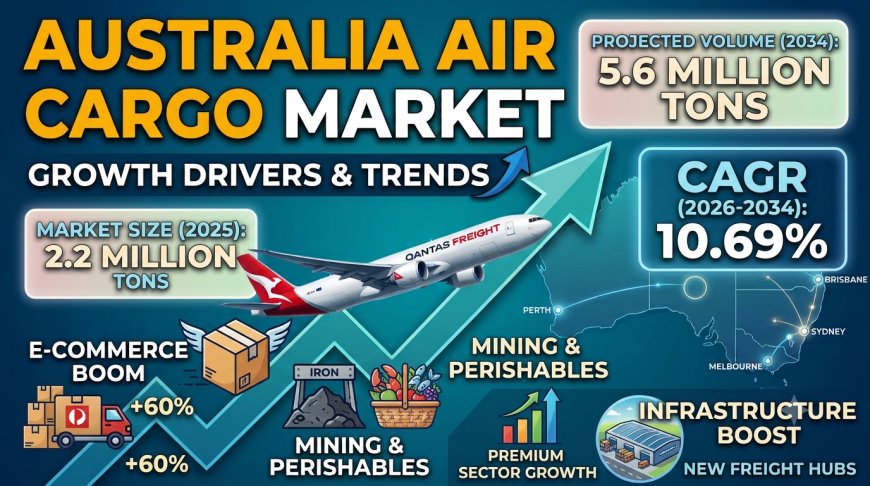
The Australia air cargo market size reached 2.2 Million Tons in 2025. Looking forward, IMARC Group expects the market to reach 5.6 Million Tons by 2034, exhibiting a growth rate (CAGR) of 10.69% during 2026-2034. The market is driven by expanding e-commerce volumes, rising demand for high-value and time-sensitive goods, and increased cross-border trade with other Asia-Pacific nations. Strong growth in pharmaceutical, electronics, and perishable food shipments is extending air freight activity, while infrastructure upgrades at key airports, including Sydney and Melbourne, are enhancing handling capacity. Moreover, the integration of digital tracking systems and logistics automation are further expanding the Australia air cargo market share.
The Australia air cargo market encompasses air freight and air mail types, express and regular services, domestic and international destinations, serving retail, food and beverages, pharmaceutical and healthcare, consumer electronics, automotive, and other end users across Australia Capital Territory & New South Wales, Victoria & Tasmania, Queensland, Northern Territory & Southern Australia, and Western Australia.
This market is strategically important to Australia's international trade connectivity, e-commerce fulfillment, and time-sensitive supply chains, supporting cross-border commerce and high-value goods movement across the Asia-Pacific region. The market is shaped by surge in cross-border e-commerce and express delivery services, with growing international consumer demand putting increased pressure on freight operators to deliver faster and more reliable services, and categories like apparel, electronics, beauty products, and specialty foods dominating cross-border retail transactions. According to industry reports, in 2023, China accounted for 55% of cross-border shopping transactions involving Australia, followed by the United States at 48%, representing year-on-year growth of 6% and 2% respectively, with momentum further supported by streamlined customs processes and increased digitalisation. A key development in the air cargo landscape is Australia's implementation of stricter air cargo security measures for shipments originating from 55 countries in Europe and the Commonwealth of Independent States, effective September 26, 2025, under which only cargo from shippers with an Established Business Relationship with freight forwarders is permitted on passenger flights to or through Australia, with shipments over 500 grams from unknown senders restricted to freighter aircraft subject to additional screening, aligning with similar policies in the US and Canada. International shopping festivals and promotions continue to contribute to seasonal spikes, prompting increased use of chartered freighter services and dedicated cargo flights, while B2C and B2B platforms demand integrated logistics solutions, leading to growth in express delivery partnerships between airlines and e-commerce companies. Expansion and modernisation of airport cargo infrastructure are contributing to growth, with facilities at Sydney Kingsford Smith, Melbourne Tullamarine, and Brisbane undergoing upgrades to improve cargo handling efficiency, increase throughput, and accommodate freighter aircraft, alongside projects expanding warehousing capacity, advancing cargo terminals, temperature-controlled storage for perishables and pharmaceuticals, and upgraded apron space for wide-body aircraft. The Western Sydney International (Nancy-Bird Walton) Airport is set to open in late 2026, initially serving up to 10 million domestic and international passengers annually, and beyond passenger traffic is poised to become a major logistics hub with dedicated freight precincts and round-the-clock operations designed to support continuous cargo movement. Digitalisation of cargo operations through electronic airway bills, automated handling systems, and real-time cargo tracking is enabling smoother coordination among freight forwarders, ground handlers, and carriers.
The Australia air cargo market is poised for sustained expansion, underpinned by cross-border e-commerce growth, airport infrastructure modernisation, digital tracking and logistics automation, pharmaceutical and perishable shipment growth, express delivery partnerships, and Asia-Pacific trade expansion. With a projected CAGR of 10.69% through 2034, the market presents significant opportunities for providers focusing on express and cross-border e-commerce logistics, temperature-controlled pharmaceutical and perishable handling, digital booking and tracking platforms, freighter capacity expansion, airport cargo infrastructure investment, customs digitisation and compliance, integrated B2C and B2B logistics solutions, and Western Sydney International Airport logistics hub development.
AUSTRALIA AIR CARGO MARKET SUMMARY
The Australia air cargo market encompasses the transportation of freight and mail by air for domestic and international destinations across the country.
The ecosystem spans airlines and freighter operators (Qantas Freight, Jetstar, and international carriers), ground handlers and cargo terminal operators (Swissport International), freight forwarders and logistics companies (OIA Global, BTi Logistics, Airmark Ocean & Air Logistics), digital air cargo booking platforms (Freightos), airport operators including Sydney Kingsford Smith, Melbourne Tullamarine, Brisbane, and Western Sydney International, customs authorities and regulatory bodies, e-commerce platforms and retailers, pharmaceutical and healthcare manufacturers, perishable food producers, consumer electronics suppliers, and automotive manufacturers serving customers throughout Australia and international markets.
By Type, the market is segmented into Air Freight and Air Mail.
By Service, the market is segmented into Express and Regular.
By Destination, the market is segmented into Domestic and International.
By End User, the market is segmented into Retail, Food and Beverages, Pharmaceutical and Healthcare, Consumer Electronics, Automotive, and Others.
By Region, the market serves Australia Capital Territory & New South Wales, Victoria & Tasmania, Queensland, Northern Territory & Southern Australia, and Western Australia.
Key trends shaping the market include surge in cross-border e-commerce and express delivery services, expansion and modernisation of airport cargo infrastructure, stricter air cargo security measures for European and CIS shipments, digital booking platforms and real-time cargo tracking, temperature-controlled storage for perishables and pharmaceuticals, Western Sydney International Airport logistics hub development, integrated B2C and B2B logistics solutions, and seasonal charter freighter services.
PORTER'S FIVE FORCES ANALYSIS – AUSTRALIA AIR CARGO MARKET
Competitive Rivalry: High. The market features intense competition among airlines and freighter operators, ground handlers and cargo terminal operators, freight forwarders and logistics companies, and digital booking platforms. Competition centres on capacity availability, transit times, reliability, pricing, temperature-controlled capability, customs expertise, and digital integration. Recent developments including Qantas Freight joining Freightos' digital air cargo booking platform in November 2024, Swissport International expanding air cargo handling operations in Melbourne and Sydney in March 2025, and OIA Global acquiring BTi Logistics and Airmark Ocean & Air Logistics in November 2024 intensify competitive dynamics. Business implication: Providers must differentiate through capacity access, digital booking capability, temperature-controlled handling, and integrated end-to-end logistics solutions.
Supplier Power (Airlines and Freighter Capacity Providers): High. Freight forwarders and shippers depend on airlines and freighter operators for cargo capacity across passenger and dedicated freighter aircraft. Capacity availability is constrained by belly-hold limitations on passenger flights, with stricter security measures restricting shipments over 500 grams from unknown senders to freighter aircraft subject to additional screening. Seasonal demand spikes drive increased use of chartered freighter services. Business implication: Long-term capacity agreements, freighter charter arrangements, and diversified carrier relationships can secure capacity and mitigate supply constraints.
Buyer Power (Shippers, E-commerce Platforms, and Manufacturers): High. Shippers including e-commerce platforms, pharmaceutical manufacturers, perishable food producers, electronics suppliers, and automotive companies negotiate substantial contracts demanding reliable transit times, temperature-controlled capability, customs compliance, and competitive pricing. Growing international consumer demand puts increased pressure on freight operators to deliver faster and more reliable services, while B2C and B2B platforms demand integrated logistics solutions. Business implication: Providers must deliver reliability, speed, temperature control, and integrated digital solutions to win and retain high-value shipper contracts.
Threat of Substitutes: Moderate. Sea freight, road transport, and rail substitute for air cargo in cost-sensitive, non-time-sensitive shipments, while dedicated express and courier services substitute for consolidated air freight in specific applications. Within air cargo, passenger belly-hold capacity substitutes for dedicated freighter aircraft subject to security restrictions. Business implication: Demonstrating speed advantage, reliability, and handling capability for high-value and time-sensitive goods is essential to defend share against sea and surface transport alternatives.
Threat of New Entrants: Moderate. Capital requirements for freighter aircraft, cargo terminal infrastructure, and customs and security compliance create meaningful barriers at scale. However, digital booking platforms, freight forwarding startups, and e-commerce-integrated logistics providers have entered the market, while infrastructure developments including Western Sydney International Airport create new capacity opportunities. Business implication: Incumbents must leverage capacity access, infrastructure relationships, and digital capability while monitoring digital-native and e-commerce-integrated entrants.
KEY ASPECTS REQUIRED FOR THE AUSTRALIA AIR CARGO MARKET
Market Performance: 2.2 Million Tons in 2025, projected to reach 5.6 Million Tons by 2034, driven by e-commerce volumes, high-value and time-sensitive goods demand, cross-border trade, and infrastructure upgrades.
Market Outlook: A 10.69% CAGR through 2034 reflects rapid growth led by air freight, express services, international destinations, retail and pharmaceutical end users, and ACT and NSW regional dominance, alongside digital tracking integration and airport infrastructure modernisation.
Growth Drivers: Surge in cross-border e-commerce and express delivery services with China accounting for 55% of cross-border shopping transactions involving Australia and the United States at 48% in 2023, representing year-on-year growth of 6% and 2% respectively; rising demand for high-value and time-sensitive goods; increased cross-border trade with other Asia-Pacific nations; strong growth in pharmaceutical, electronics, and perishable food shipments; expansion and modernisation of airport cargo infrastructure at Sydney Kingsford Smith, Melbourne Tullamarine, and Brisbane with expanded warehousing capacity, advanced cargo terminals, temperature-controlled storage, and upgraded apron space; Western Sydney International (Nancy-Bird Walton) Airport opening late 2026 serving up to 10 million passengers annually with dedicated freight precincts and round-the-clock operations; integration of digital tracking systems and logistics automation with electronic airway bills, automated handling systems, and real-time cargo tracking; streamlined customs processes and increased digitalisation; international shopping festivals and promotions driving seasonal spikes and chartered freighter services; integrated B2C and B2B logistics solutions and express delivery partnerships; improvements in last-mile delivery networks.
Competitive Landscape: A highly competitive market with airlines and freighter operators, ground handlers and cargo terminal operators, freight forwarders and logistics companies, and digital booking platforms. Competition centres on capacity availability, transit times, reliability, pricing, temperature-controlled capability, and digital integration, with recent acquisitions and expansions intensifying competitive dynamics.
Value Chain Analysis: From cargo booking and documentation through pickup and consolidation, customs clearance and security screening, line-haul transportation by passenger and freighter aircraft, ground handling and cargo terminal operations, temperature-controlled storage for perishables and pharmaceuticals, and last-mile delivery and distribution across domestic and international destinations.
Industry Trends: Surge in cross-border e-commerce and express delivery services (China 55% and US 48% of cross-border shopping transactions with Australia in 2023); stricter air cargo security measures for shipments from 55 European and CIS countries effective September 26, 2025, with Established Business Relationship requirements and shipments over 500 grams from unknown senders restricted to freighter aircraft; expansion and modernisation of airport cargo infrastructure with temperature-controlled storage, advanced cargo terminals, and upgraded apron space; Western Sydney International Airport opening late 2026 as major logistics hub with dedicated freight precincts and round-the-clock operations; digitalisation with electronic airway bills, automated handling systems, and real-time cargo tracking; digital booking platforms (Qantas Freight joining Freightos in November 2024); ground handler expansion (Swissport International's Melbourne and Sydney facilities in March 2025); freight forwarder consolidation (OIA Global acquiring BTi Logistics and Airmark Ocean & Air Logistics in November 2024); seasonal charter freighter services; integrated B2C and B2B logistics solutions and express delivery partnerships between airlines and e-commerce companies; temperature-controlled handling for perishables and pharmaceuticals.
Strategic Recommendations: Invest in express and cross-border e-commerce logistics capability aligned with China and US trade flows; develop temperature-controlled pharmaceutical and perishable handling infrastructure with advanced storage and monitoring; deploy digital booking platforms and real-time cargo tracking for operational efficiency and customer visibility; expand freighter capacity and charter arrangements to address seasonal demand spikes; invest in airport cargo infrastructure including warehousing, cargo terminals, and apron space; pursue customs digitisation and compliance capability aligned with security measures and Established Business Relationship requirements; develop integrated B2C and B2B logistics solutions through airline and e-commerce partnerships; establish logistics hub presence at Western Sydney International Airport; expand ground handling operations at Melbourne, Sydney, and Brisbane; pursue strategic acquisitions and consolidation opportunities in freight forwarding; strengthen presence in ACT and NSW where airport infrastructure and trade flows concentrate; develop automated handling systems and electronic airway bill capability.
Request for Sample Report: https://www.imarcgroup.com/australia-air-cargo-market/requestsample
MARKET GROWTH DRIVERS
Surge in Cross-Border E-Commerce and Express Delivery Services
Australia is witnessing a steady rise in cross-border e-commerce, which is significantly shaping the market. Growing international consumer demand is putting increased pressure on freight operators to deliver faster and more reliable services. Categories like apparel, electronics, beauty products, and specialty foods dominate cross-border retail transactions and require timely fulfillment, reinforcing air freight's role as the preferred transport mode due to its speed and dependability. According to industry reports, in 2023, China accounted for 55% of cross-border shopping transactions involving Australia, followed by the United States at 48%. These shares represented year-on-year growth of 6% and 2%, respectively. This momentum is further supported by streamlined customs processes and increased digitalization, which allow for more agile and responsive logistics operations tailored to the needs of international e-commerce. International shopping festivals and promotions continue to contribute to seasonal spikes, prompting increased use of chartered freighter services and dedicated cargo flights, while B2C and B2B platforms are demanding integrated logistics solutions, leading to growth in express delivery partnerships between airlines and e-commerce companies. This trend is also supported by improvements in customs processing and last-mile delivery networks, enhancing the overall reliability of international air cargo services.
Expansion and Modernization of Airport Cargo Infrastructure
Infrastructure developments at major Australian airports are contributing to the Australia air cargo market growth. Facilities at airports such as Sydney Kingsford Smith, Melbourne Tullamarine, and Brisbane are undergoing upgrades to improve cargo handling efficiency, increase throughput, and accommodate freighter aircraft, with projects including expanding warehousing capacity, advancing cargo terminals, temperature-controlled storage for perishables and pharmaceuticals, and upgraded apron space for wide-body aircraft. Notably, the Western Sydney International (Nancy-Bird Walton) Airport is set to open in late 2026 and will initially serve up to 10 million domestic and international passengers annually, with development aimed at easing capacity limits in the Sydney basin while significantly improving air travel access for residents of Western Sydney. Beyond passenger traffic, the airport is poised to become a major logistics hub, with dedicated freight precincts and round-the-clock operations designed to support continuous cargo movement. Additionally, digitalization of cargo operations through electronic airway bills, automated handling systems, and real-time cargo tracking is enabling smoother coordination among freight forwarders, ground handlers, and carriers. These infrastructure and technological upgrades are essential for supporting long-term growth, especially in high-value cargo segments and international trade volumes.
Rising Demand for High-Value and Time-Sensitive Goods
Rising demand for high-value and time-sensitive goods is driving air cargo growth, with strong growth in pharmaceutical, electronics, and perishable food shipments extending air freight activity. These categories require reliable transit times, temperature-controlled handling, and security assurance that air freight provides, supporting premium pricing and capacity demand across domestic and international routes.
Increased Cross-Border Trade with Asia-Pacific Nations
Increased cross-border trade with other Asia-Pacific nations is supporting market expansion, with China and the United States representing the largest cross-border shopping transaction sources for Australia. Growing trade volumes across the region drive demand for air cargo capacity, express delivery services, and integrated logistics solutions connecting Australian markets with Asia-Pacific trading partners.
Integration of Digital Tracking Systems and Logistics Automation
The integration of digital tracking systems and logistics automation is expanding the Australia air cargo market share, with digitalization of cargo operations through electronic airway bills, automated handling systems, and real-time cargo tracking enabling smoother coordination among freight forwarders, ground handlers, and carriers. In November 2024, Qantas Freight joined Freightos' digital air cargo booking platform, allowing freight forwarders to access and book capacity for Qantas and Jetstar services across key US, Australia, and New Zealand routes, enhancing operational efficiency with digital booking options, greater capacity, and instant rate quotes for both ground and air freight.
Stricter Air Cargo Security Measures
Australia's implementation of stricter air cargo security measures for shipments originating from 55 countries in Europe and the Commonwealth of Independent States, effective September 26, 2025, is reshaping market dynamics. Under the new directive, only cargo from shippers with an Established Business Relationship with freight forwarders is permitted on passenger flights to or through Australia, while shipments over 500 grams from unknown senders are restricted to freighter aircraft, subject to additional screening. These regulations, aligning with similar policies in the US and Canada following security threats in European parcel networks, have raised operational concerns among freight forwarders while driving demand for compliant, screened cargo services and freighter capacity.
AUSTRALIA AIR CARGO MARKET SEGMENTATION
Segmentation analysis provides a detailed view of the Australia air cargo market by category:
Type Insights: The report has provided a detailed breakup and analysis of the market based on the type. This includes air freight and air mail. Air freight represents the dominant segment, driven by expanding e-commerce volumes, high-value and time-sensitive goods shipments, and cross-border trade with Asia-Pacific nations, alongside strong growth in pharmaceutical, electronics, and perishable food shipments. Air mail serves document and correspondence delivery applications, supported by postal networks and express courier services, with digital communication trends shaping long-term demand while e-commerce parcel volumes support ongoing air mail and small parcel movement.
Service Insights: A detailed breakup and analysis of the market based on service has also been provided in the report. This includes express and regular. Express services represent a fast-growing segment, driven by growing international consumer demand for faster and more reliable delivery, with categories like apparel, electronics, beauty products, and specialty foods requiring timely fulfillment. Express delivery partnerships between airlines and e-commerce companies are growing, supported by improvements in customs processing and last-mile delivery networks. Regular services serve consolidated freight and bulk shipment applications where transit time flexibility allows cost optimization, supporting pharmaceutical, electronics, and perishable food shipments alongside industrial and automotive cargo.
Destination Insights: A detailed breakup and analysis of the market based on destination has also been provided in the report. This includes domestic and international. International destinations represent a significant segment, driven by cross-border e-commerce with China accounting for 55% and the United States at 48% of cross-border shopping transactions involving Australia in 2023, alongside increased cross-border trade with other Asia-Pacific nations. Domestic destinations serve intranational freight movement across Australia's vast geography, supporting time-sensitive goods distribution between major cities and regional areas where surface transport is impractical or slower.
End User Insights: A detailed breakup and analysis of the market based on end user has also been provided in the report. This includes retail, food and beverages, pharmaceutical and healthcare, consumer electronics, automotive, and others. Retail represents a significant segment, driven by e-commerce expansion and cross-border shopping with apparel, electronics, beauty products, and specialty foods dominating transactions. Pharmaceutical and healthcare represent a fast-growing segment requiring temperature-controlled handling, security assurance, and reliable transit times for high-value medical products. Food and beverages include perishable food shipments requiring temperature-controlled storage and rapid transit. Consumer electronics represent high-value, time-sensitive goods requiring secure and reliable air freight. Automotive serves parts and component shipments supporting manufacturing and aftermarket operations. Others include industrial and specialised cargo applications.
Regional Insights: The report has also provided a comprehensive analysis of all the major regional markets, which include Australia Capital Territory & New South Wales, Victoria & Tasmania, Queensland, Northern Territory & Southern Australia, and Western Australia. Australia Capital Territory & New South Wales represents a leading region, supported by Sydney Kingsford Smith Airport infrastructure, the upcoming Western Sydney International (Nancy-Bird Walton) Airport opening in late 2026 as a major logistics hub with dedicated freight precincts and round-the-clock operations, population concentration, and the highest concentration of e-commerce and trade activity. Victoria & Tasmania contributes through Melbourne Tullamarine Airport infrastructure upgrades and Swissport International's new facilities in Melbourne in March 2025, alongside food and beverage, pharmaceutical, and consumer goods shipments. Queensland experiences strong demand supported by Brisbane Airport cargo infrastructure upgrades, perishable food exports, and growing e-commerce activity. Northern Territory & Southern Australia represents a significant market with perishable and specialty food exports and resource sector cargo requirements. Western Australia is driven by resource sector cargo, perishable food exports, and geographic necessity for time-sensitive goods distribution across vast distances.
COMPETITIVE LANDSCAPE
The market research report has also provided a comprehensive analysis of the competitive landscape. Competitive analysis such as market structure, key player positioning, top winning strategies, competitive dashboard, and company evaluation quadrant has been covered in the report. Also, detailed profiles of all major companies have been provided.
The Australia air cargo market features intense competition among airlines and freighter operators, ground handlers and cargo terminal operators, freight forwarders and logistics companies, and digital booking platforms. Competition centres on capacity availability, transit times, reliability, pricing, temperature-controlled capability, customs expertise, and digital integration, with recent acquisitions and expansions intensifying competitive dynamics.
Major participants include airlines and freighter operators such as Qantas Freight, which joined Freightos' digital air cargo booking platform in November 2024, allowing freight forwarders to access and book capacity for Qantas and Jetstar services across key US, Australia, and New Zealand routes; ground handlers such as Swissport International, which announced expansion of its air cargo handling operations in Australia with new facilities in Melbourne and Sydney in March 2025, offering advanced services such as temperature-controlled spaces and state-of-the-art equipment; freight forwarders and logistics companies such as OIA Global, which expanded its presence in Oceania by acquiring BTi Logistics and Airmark Ocean & Air Logistics in November 2024, strengthening service offerings in automotive, healthcare, and energy industries; and digital platforms such as Freightos, enabling digital booking with greater capacity and instant rate quotes.
Recent Developments:
On 5 November 2024, Qantas Freight has joined Freightos' digital air cargo booking platform, allowing freight forwarders to access and book capacity for Qantas and Jetstar services across key US, Australia, and New Zealand routes. This collaboration enhances operational efficiency with digital booking options, offering greater capacity and instant rate quotes for both ground and air freight.
On 6 February 2025, Swissport International announced that it is going to expand its air cargo handling operations in Australia with new facilities in Melbourne and Sydney in March 2025. This expansion will enhance operational efficiency and support growing air cargo demand, offering advanced services such as temperature-controlled spaces and state-of-the-art equipment.
On 6 November 2024, OIA Global has expanded its presence in Oceania by acquiring BTi Logistics and Airmark Ocean & Air Logistics, enhancing its capabilities in Australia and New Zealand. This acquisition strengthens OIA's service offerings in industries such as automotive, healthcare, and energy, while also boosting its logistics capacity across these regions.
Investment opportunities exist in express and cross-border e-commerce logistics, temperature-controlled pharmaceutical and perishable handling, digital booking and tracking platforms, freighter capacity expansion, airport cargo infrastructure investment, customs digitisation and compliance, integrated B2C and B2B logistics solutions, and Western Sydney International Airport logistics hub development.
REGIONAL ANALYSIS
Australia Capital Territory & New South Wales represents a leading region in the Australia air cargo market, supported by Sydney Kingsford Smith Airport infrastructure and the upcoming Western Sydney International (Nancy-Bird Walton) Airport, set to open in late 2026 and initially serve up to 10 million domestic and international passengers annually. Beyond passenger traffic, the airport is poised to become a major logistics hub with dedicated freight precincts and round-the-clock operations designed to support continuous cargo movement, easing capacity limits in the Sydney basin. The region's population concentration, highest concentration of e-commerce and trade activity, and concentration of freight forwarders and logistics companies reinforce its dominant position.
Victoria & Tasmania contributes through Melbourne Tullamarine Airport infrastructure upgrades and Swissport International's new facilities in Melbourne announced in February 2025, offering advanced services such as temperature-controlled spaces and state-of-the-art equipment. The region's food and beverage, pharmaceutical, and consumer goods shipments, alongside e-commerce activity and freight forwarder operations, support significant market demand.
Queensland experiences strong demand supported by Brisbane Airport cargo infrastructure upgrades, perishable food exports, and growing e-commerce activity. The state's agricultural and food production supports perishable food shipments requiring temperature-controlled handling and rapid transit, while population growth and tourism activity drive consumer goods and retail cargo demand.
Northern Territory & Southern Australia represents a significant market with perishable and specialty food exports and resource sector cargo requirements. The region's agricultural production and resource operations generate air cargo demand for time-sensitive goods, while geographic dispersion reinforces air freight's role in connecting regional areas with major markets.
Western Australia is driven by resource sector cargo, perishable food exports, and geographic necessity for time-sensitive goods distribution across vast distances. The state's mining and resource operations require air cargo for equipment and component shipments, while agricultural and food production supports perishable exports, and Perth's geographic isolation reinforces air freight's importance for connecting with eastern states and international markets.
RECENT INDUSTRY DEVELOPMENTS
2026 Activity: The Australia air cargo market continued its rapid growth trajectory from 2.2 Million Tons in 2025 toward 5.6 Million Tons by 2034 at a CAGR of 10.69%, driven by e-commerce volumes, high-value goods demand, and infrastructure upgrades.
6 February 2025: Swissport International announced that it is going to expand its air cargo handling operations in Australia with new facilities in Melbourne and Sydney in March 2025. This expansion will enhance operational efficiency and support growing air cargo demand, offering advanced services such as temperature-controlled spaces and state-of-the-art equipment.
5 November 2024: Qantas Freight has joined Freightos' digital air cargo booking platform, allowing freight forwarders to access and book capacity for Qantas and Jetstar services across key US, Australia, and New Zealand routes. This collaboration enhances operational efficiency with digital booking options, offering greater capacity and instant rate quotes for both ground and air freight.
6 November 2024: OIA Global has expanded its presence in Oceania by acquiring BTi Logistics and Airmark Ocean & Air Logistics, enhancing its capabilities in Australia and New Zealand. This acquisition strengthens OIA's service offerings in industries such as automotive, healthcare, and energy, while also boosting its logistics capacity across these regions.
Regulatory developments: Australia's implementation of stricter air cargo security measures for shipments originating from 55 countries in Europe and the Commonwealth of Independent States, effective September 26, 2025, with only cargo from shippers with an Established Business Relationship with freight forwarders permitted on passenger flights, and shipments over 500 grams from unknown senders restricted to freighter aircraft subject to additional screening.
Market initiatives: China accounting for 55% and the United States 48% of cross-border shopping transactions involving Australia in 2023, with year-on-year growth of 6% and 2% respectively; Western Sydney International (Nancy-Bird Walton) Airport set to open in late 2026 with dedicated freight precincts and round-the-clock operations; expansion of warehousing capacity, advanced cargo terminals, temperature-controlled storage for perishables and pharmaceuticals, and upgraded apron space for wide-body aircraft at Sydney Kingsford Smith, Melbourne Tullamarine, and Brisbane; digitalisation with electronic airway bills, automated handling systems, and real-time cargo tracking; international shopping festivals driving seasonal spikes and chartered freighter services; integrated B2C and B2B logistics solutions and express delivery partnerships between airlines and e-commerce companies.
FREQUENTLY ASKED QUESTIONS
Q1: What is the current size of the Australia air cargo market?
A: The Australia air cargo market size reached 2.2 Million Tons in 2025 and is projected to reach 5.6 Million Tons by 2034, exhibiting a CAGR of 10.69% from 2026-2034.
Q2: What are the key drivers of the Australia air cargo market?
A: The market is driven by: (i) expanding e-commerce volumes with China accounting for 55% and the United States 48% of cross-border shopping transactions involving Australia in 2023; (ii) rising demand for high-value and time-sensitive goods; (iii) increased cross-border trade with other Asia-Pacific nations; (iv) strong growth in pharmaceutical, electronics, and perishable food shipments; (v) infrastructure upgrades at key airports including Sydney and Melbourne enhancing handling capacity; (vi) integration of digital tracking systems and logistics automation; (vii) surge in cross-border e-commerce and express delivery services; and (viii) expansion and modernisation of airport cargo infrastructure.
Q3: What are the major types and services in the Australia air cargo market?
A: Major types include Air Freight (dominant, driven by expanding e-commerce volumes, high-value and time-sensitive goods shipments, and cross-border trade with Asia-Pacific nations, alongside strong growth in pharmaceutical, electronics, and perishable food shipments) and Air Mail (serving document and correspondence delivery applications, supported by postal networks and express courier services). Major services include Express (fast-growing, driven by growing international consumer demand for faster and more reliable delivery with categories like apparel, electronics, beauty products, and specialty foods requiring timely fulfillment, alongside express delivery partnerships between airlines and e-commerce companies) and Regular (serving consolidated freight and bulk shipment applications where transit time flexibility allows cost optimization).
Q4: What are the major destinations and end users in the Australia air cargo market?
A: Major destinations include Domestic (serving intranational freight movement across Australia's vast geography supporting time-sensitive goods distribution between major cities and regional areas) and International (driven by cross-border e-commerce with China and the United States representing the largest transaction sources, alongside increased cross-border trade with other Asia-Pacific nations). Major end users include Retail (driven by e-commerce expansion and cross-border shopping), Food and Beverages (including perishable food shipments requiring temperature-controlled storage and rapid transit), Pharmaceutical and Healthcare (fast-growing, requiring temperature-controlled handling, security assurance, and reliable transit times), Consumer Electronics, Automotive, and Others.
Q5: Which region leads the Australia air cargo market?
A: Australia Capital Territory & New South Wales represents a leading region, supported by Sydney Kingsford Smith Airport infrastructure, the upcoming Western Sydney International (Nancy-Bird Walton) Airport opening in late 2026 as a major logistics hub with dedicated freight precincts and round-the-clock operations, population concentration, and the highest concentration of e-commerce and trade activity. Victoria & Tasmania, Queensland, Northern Territory & Southern Australia, and Western Australia represent significant markets with distinct regional characteristics.
Q6: What are the challenges facing the Australia air cargo market?
A: Key challenges include stricter air cargo security measures for shipments originating from 55 countries in Europe and the Commonwealth of Independent States effective September 26, 2025, with only cargo from shippers with an Established Business Relationship with freight forwarders permitted on passenger flights, and shipments over 500 grams from unknown senders restricted to freighter aircraft subject to additional screening, raising operational concerns among freight forwarders; capacity constraints from belly-hold limitations on passenger flights and seasonal demand spikes requiring chartered freighter services; competition from sea freight and surface transport for cost-sensitive shipments; capital requirements for freighter aircraft, cargo terminal infrastructure, and customs and security compliance; and the need to balance infrastructure investment with growing throughput requirements at constrained airports.
Q7: What is the outlook for the Australia air cargo market?
A: The market is projected to grow at a 10.69% CAGR through 2034, driven by rising e-commerce and express delivery demand, increasing international trade, and growth in time-sensitive shipments, alongside investments in modern logistics infrastructure, technological advancements in tracking and handling, and the need for rapid transportation of perishable and high-value goods. Key trends include surge in cross-border e-commerce and express delivery services, expansion and modernisation of airport cargo infrastructure, stricter air cargo security measures, digital booking platforms and real-time cargo tracking, temperature-controlled storage for perishables and pharmaceuticals, Western Sydney International Airport logistics hub development, integrated B2C and B2B logistics solutions, and seasonal charter freighter services. Opportunities include express and cross-border e-commerce logistics, temperature-controlled pharmaceutical and perishable handling, digital booking and tracking platforms, freighter capacity expansion, airport cargo infrastructure investment, customs digitisation and compliance, integrated B2C and B2B logistics solutions, and Western Sydney International Airport logistics hub development.
Q8: Who are the key players in the Australia air cargo market?
A: Key participants include airlines and freighter operators such as Qantas Freight (which joined Freightos' digital air cargo booking platform in November 2024), ground handlers such as Swissport International (which announced expansion of its air cargo handling operations in Melbourne and Sydney in February 2025), freight forwarders and logistics companies such as OIA Global (which acquired BTi Logistics and Airmark Ocean & Air Logistics in November 2024), and digital platforms such as Freightos (enabling digital booking with greater capacity and instant rate quotes), alongside airport operators including Sydney Kingsford Smith, Melbourne Tullamarine, Brisbane, and the upcoming Western Sydney International Airport.
Note: If you need any specific information that is not covered currently within the scope of the report, we will provide the same as a part of customization.
https://www.imarcgroup.com/request?type=report&id=34488&flag=E
Report Format, Delivery, and Customization Details
Report Format Mode: PDF and Excel (editable PPT/Word version available on special request)
Report Delivery Mode: Online Delivery (Email), Physical Delivery
Report Delivery Time: Report Delivered Over Email within 24 to 48 hours. If requested by the client, a physical copy will be delivered within three to ten days.
Report Confirmation Mode: Yes via Email
Report Customization Mode: Yes via Email / Call (10% free customization included)
Report Table of Content: Yes
Report List of Figures: Yes
Report Methodology Mode: Yes
Post-Sale Analyst Support: 10-12 Weeks
Request For Sample Report: Yes
What's Your Reaction?