


































Top 10 Factors to Consider When Planning AI Product Development
Discover the top 10 factors to consider when planning AI Product Development, from data and technology selection to security, scalability, and testing.

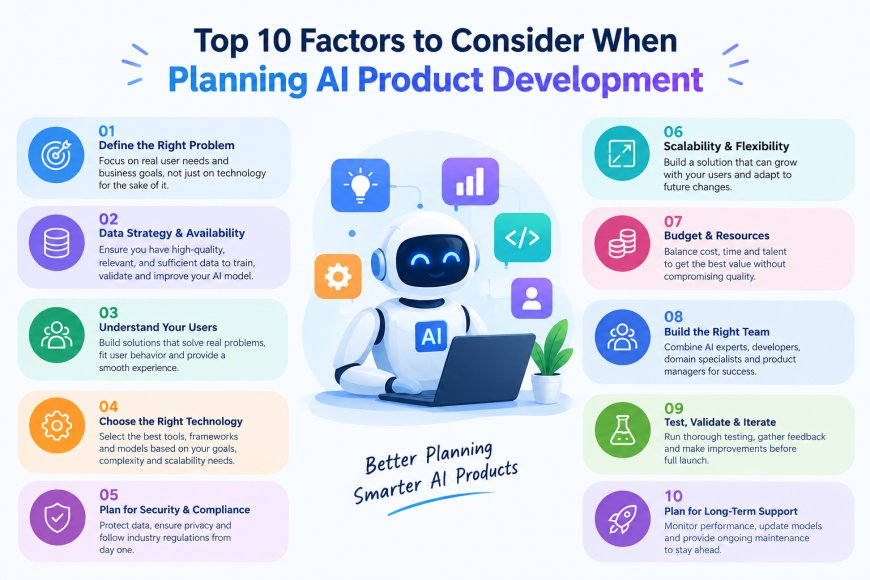
Artificial intelligence is becoming an important part of modern software development. Businesses are using AI to automate repetitive tasks, analyze information, personalize customer experiences, and build new digital products. However, developing an AI product requires more than selecting an AI model and adding it to an application.
A successful product needs careful planning across business objectives, users, data, technology, security, and long-term maintenance. Whether a company is building an AI assistant, recommendation platform, predictive application, or intelligent workflow tool, considering the right factors early can reduce unnecessary complexity and improve the development process.
Here are ten important factors to consider before starting an AI product project.
1. Define the Problem Clearly
The first step is to identify the specific problem the product will solve. Instead of starting with a particular AI technology, businesses should begin with user needs and business challenges.
Ask what process needs improvement, who experiences the problem, and what outcome the product should deliver. A clearly defined problem provides direction for every later development decision.
2. Understand Your Target Users
AI products should be designed around real user requirements. Researching target users can reveal their expectations, technical knowledge, workflows, and common frustrations.
Understanding users also helps determine which AI features are genuinely useful. A technically advanced product may still struggle if its interface is confusing or its functionality does not match how people actually work.
3. Evaluate Data Availability
Data is one of the most important considerations in AI development. Depending on the product, teams may need customer interactions, documents, transactions, images, audio, or other datasets.
Before development begins, evaluate whether the required data exists and whether it is accurate, relevant, sufficiently structured, and legally appropriate to use.
Poor-quality data can affect AI performance, making data preparation an important part of the overall AI Product Development Process.
4. Choose the Right AI Technology
Not every AI product requires the same technology. Depending on the use case, developers may work with machine learning, natural language processing, computer vision, generative AI, retrieval-augmented generation, or AI agents.
The technology should be selected based on the product's requirements rather than current trends. In some cases, an existing model or API may be sufficient, while specialized applications may require additional customization.
5. Plan the Product Architecture
AI is only one part of a complete software product. The architecture may also include databases, APIs, authentication, cloud infrastructure, user interfaces, analytics, and monitoring systems.
A scalable architecture can make it easier to accommodate growing users, larger datasets, additional integrations, and changing AI requirements.
Planning these components early can help avoid major technical changes later.
6. Consider Security and Privacy
AI applications may process sensitive business or customer information. Security and privacy should therefore be considered from the beginning rather than added after development.
Teams should establish appropriate access controls, data protection practices, authentication, monitoring, and secure integration methods.
Depending on the industry and location, businesses may also need to consider specific regulatory and compliance requirements.
7. Define the MVP Scope
Trying to build every possible AI feature at once can increase development complexity. A minimum viable product can provide a more practical starting point.
The MVP should focus on the core problem and essential functionality. After launch, user feedback and performance data can help determine which additional features are worth developing.
This approach can make AI-Powered Product Development more focused and manageable.
8. Plan for Testing and Evaluation
AI products require both conventional software testing and AI-specific evaluation.
Teams may need to measure accuracy, relevance, response quality, reliability, latency, scalability, and usability. Generative AI applications may also require evaluation for inconsistent or unsupported outputs.
Testing should continue after launch because real-world usage can reveal issues that were not identified during development.
9. Consider Development and Maintenance Resources
Building an AI product requires multiple skills, including product management, software engineering, AI engineering, data engineering, cloud infrastructure, and quality assurance.
Businesses should determine which capabilities are available internally and where external expertise may be useful.
AI Product Development Services can support different stages of development, from product discovery and technical planning to AI integration, application development, testing, and deployment.
10. Plan for Long-Term Scalability
Launching an AI product is only the beginning. As the number of users grows, the product may require additional infrastructure, improved performance, new integrations, and updated AI capabilities.
Businesses should consider long-term monitoring, model updates, data management, infrastructure costs, and ongoing product improvements.
For specialized requirements, Custom AI Product Development may provide greater control over integrations, functionality, and user experiences. However, custom development also requires ongoing technical resources and maintenance.
How to Choose an AI Development Partner
If external support is required, businesses should carefully evaluate an AI Product Development Company based on relevant experience and technical capabilities.
Rather than focusing only on a provider's technology list, consider its experience with product engineering, AI integration, cloud infrastructure, data, security, testing, and post-launch support.
A development partner should also understand the business problem and be able to translate it into practical technical requirements.
Companies such as CodeCones provide an example of a development team working across AI, software engineering, data, cloud, and DevOps. Exploring different development approaches can help businesses understand what capabilities may be required for their own projects.
Conclusion
Planning is one of the most important stages of AI product development. Defining the problem, understanding users, evaluating data, selecting appropriate technology, planning architecture, and considering security can create a stronger foundation for development.
Businesses should also start with a focused MVP, establish measurable evaluation criteria, prepare for ongoing maintenance, and consider scalability from the beginning.
By addressing these ten factors before development starts, organizations can approach AI product development with clearer objectives and a more structured path from concept to a practical, scalable solution.
What's Your Reaction?