
































Shampoo Manufacturing Unit DPR 2026: Cost Optimization, ROI Analysis and Production Planning

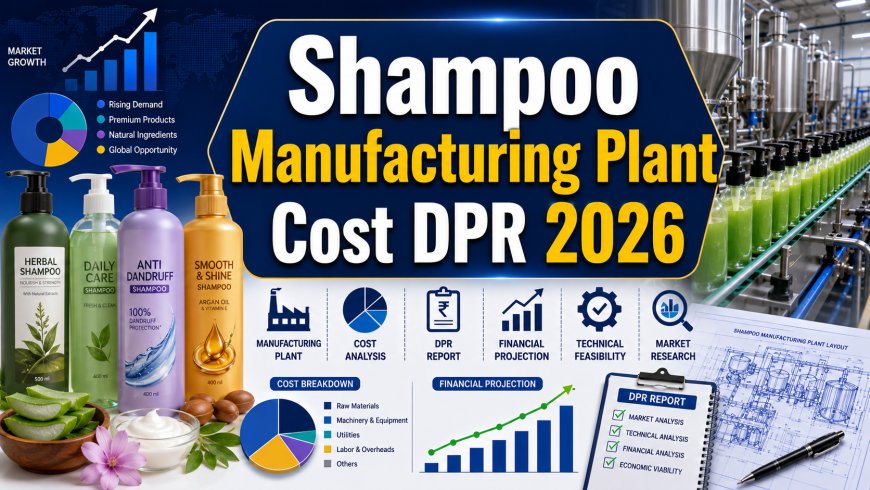
A shampoo manufacturing plant is an industrial facility dedicated to the production of liquid and semi-liquid hair cleansing products through a series of carefully controlled processes, including formulation, mixing, heating, homogenization, filling, and packaging. The manufacturing process involves blending key ingredients such as surfactants, including Sodium Lauryl Sulfate (SLS) and Sodium Laureth Sulfate (SLES), with water, conditioning agents, fragrances, preservatives, thickeners, and functional additives to create a wide range of shampoo variants. These may include anti-dandruff, moisturizing, volumizing, herbal, sulfate-free, medicated, and baby shampoos. As the industry requires considerable investment in processing equipment, quality control systems, and packaging infrastructure, evaluating a shampoo manufacturing plant project report is essential for determining capital requirements, production capacity, operating costs, and overall financial feasibility.
Understanding Shampoo
Shampoo is a widely used personal care product formulated to cleanse the hair and scalp by removing dirt, excess sebum, sweat, styling residues, and environmental contaminants. Its primary cleansing action is delivered through surfactants, while additional ingredients such as conditioning polymers, fragrances, preservatives, and viscosity modifiers enhance product performance, appearance, and consumer appeal. The global shampoo market continues to expand due to rising awareness of personal hygiene, increasing demand for specialized haircare solutions, growing consumer preference for premium and herbal products, and expanding distribution channels across urban and semi-urban regions.
Applications of Shampoo
Shampoo serves a broad range of applications across personal care, cosmetic, healthcare, and hospitality sectors. It is primarily used for routine hair and scalp cleansing, helping maintain hygiene, regulate oil production, improve hair manageability, and enhance overall hair health. In the beauty and salon industry, shampoos are an integral component of professional haircare treatments and cosmetic routines aimed at improving hair texture, shine, and appearance. Specialized formulations are also utilized in healthcare applications to address scalp-related conditions such as dandruff, dryness, and sensitivity. Additionally, shampoos are widely supplied in travel-sized and single-use packaging formats for hotels, resorts, airlines, and other hospitality establishments. Given its extensive usage across multiple industries and consumer segments, conducting a detailed assessment of shampoo manufacturing plant cost is crucial for effective investment planning, operational management, and long-term business success.
Get the Sample Report: https://www.imarcgroup.com/shampoo-manufacturing-plant-project-report/requestsample
Key Factors for Shampoo Plant Setup Requirements
Establishing a shampoo manufacturing plant requires careful consideration of several key factors that directly impact both the initial plant setup cost and long-term profitability.
• Raw Materials and Supply Chain: The cost and availability of primary raw materials such as surfactants (SLS, SLES), water, perfumes, and additives are paramount. A secure and cost-effective supply chain is vital for managing the shampoo manufacturing cost.
• Manufacturing Technology and Equipment: The selection of stainless-steel reactors, mixers, homogenizers, storage tanks, filling machines, labeling units, and packaging systems directly influences operational efficiency and the final shampoo manufacturing plant cost.
• Environmental Compliance and Approvals: Securing environmental clearances, effluent treatment approvals, and adhering to cosmetics regulations and emission standards is essential for sustainable operations and avoiding costly penalties.
• Location and Infrastructure: Proximity to surfactant suppliers and target markets, along with access to reliable utilities, water resources, and transportation networks, significantly impacts operational efficiency and overall shampoo manufacturing cost analysis.
Detailed Process Flow and Quality Control
The manufacturing process for shampoo involves a series of precisely controlled formulation and blending operations. Raw materials including surfactants, conditioning agents, fragrances, and additives are weighed, mixed under controlled temperature conditions, homogenized for uniformity, cooled to ambient temperature, subjected to quality testing, and then filled and packaged. A thorough shampoo manufacturing plant report would detail each of these critical steps.
• Unit Operations Involved:The process includes key stages such as raw material weighing, batch mixing, heating, homogenization, pH adjustment, cooling, quality inspection, filling, capping, labeling, and packaging. Each step is carefully controlled to ensure optimal product consistency and safety.
• Mass Balance and Raw Material Requirements:A precise mass balance calculation is essential for determining the exact quantity of surfactants, water, perfumes, and functional additives required per batch of finished shampoo. This directly influences the total shampoo manufacturing cost.
• Quality Assurance Criteria:Quality is assessed based on pH level, viscosity, foam performance, fragrance stability, microbial limits, and physical appearance. Technical tests including chemical analysis, stability studies, and microbiological testing are performed to meet regulatory requirements.
Cost of Setting Up a Shampoo Manufacturing Plant:
The cost of establishing a shampoo manufacturing plant depends on plant capacity, technology selection, location, level of automation, and regulatory compliance obligations. A detailed cost assessment covering both capital and operational expenditure is essential for accurate financial planning. The proposed manufacturing facility supports an annual production capacity ranging between 500 and 2,000 KL, with gross profit margins typically ranging between 45-55% and net profit margins between 15-25%.
CapEx and OpEx Analysis for Shampoo Manufacturing Cost:
• Raw Material Costs: As the largest component of variable costs, surfactants (SLS, SLES) account for approximately 50-60% of total operating expenses. Global petrochemical price fluctuations significantly impact profitability and operating margins.
• Capital Investment: The initial plant setup cost for stainless steel reactors, mixers, homogenizers, filling machines, land, and construction constitutes a significant barrier to entry. This substantial one-time expense is amortized over the plant's operational life.
• Operational Costs: These include fixed costs such as skilled labor, maintenance, and insurance, as well as variable costs such as utilities (electricity, water, steam), cleaning-in-place systems, and environmental compliance measures.
• Formulation Grade and Quality: The viscosity profile, foam properties, fragrance character, and pH stability of the shampoo formulation affect its suitability for specific market segments. Consistent quality with appropriate sensory attributes is essential and impacts processing requirements.
• Manufacturing Capacity: The scale of manufacturing significantly influences unit costs through economies of scale. Larger plants benefit from lower per-unit capital and operational costs, affecting the overall shampoo manufacturing plant cost.
• Location and Market Conditions: The geographical location influences transportation costs for raw materials and finished products, as well as access to skilled labor. Proximity to distribution channels and regional market demand further affect pricing and logistics costs.
Ask An Analyst: https://www.imarcgroup.com/request?type=report&id=8579&flag=C
Leading Shampoo Manufacturers
The global shampoo market is dominated by several major multinational personal care and FMCG companies that lead the industry in manufacturing capacity, product innovation, and technological advancement. These manufacturers set industry standards for quality, sustainability, and efficiency.
• L’Oréal S.A.
• Unilever Plc.
• The Procter & Gamble Company
• Henkel AG & Co. KGaA
• Johnson & Johnson Services, Inc.
• Coty Inc.
• Estée Lauder Companies, Inc.
• Kao Corporation
• Beiersdorf AG
• Shiseido Co. Ltd.
Timeline to Start the Plant
• Feasibility study and project report preparation
• Land acquisition and site development
• Regulatory approvals and environmental clearances
• Factory licence and fire safety compliance
• Machinery procurement and installation
• Raw material supplier agreements and supply chain setup
• Trial production and quality testing
• Commercial production launch
Licences and Regulatory Requirements
Starting a shampoo manufacturing unit requires several approvals:
• Business registration (Proprietorship, LLP, or Pvt Ltd)
• Factory Licence under the Factories Act
• Environmental Clearance from State Pollution Control Board
• GST Registration
• BIS/IS Certification for cosmetic products
• Central Drugs Standard Control Organisation (CDSCO) approval for medicated variants
• Fire Safety NOC
• Effluent Treatment Plant (ETP) operational clearance
• Occupational Health and Safety compliance
Frequently Asked Questions:
1. How much does it cost to set up a shampoo manufacturing plant?
The total setup cost varies depending on plant capacity, technology, and location. It typically includes expenses for land, civil construction, mixing and homogenization equipment, filling and packaging machines, pollution control systems, utilities, and working capital. A detailed feasibility report provides accurate, project-specific cost estimates.
2. Is shampoo manufacturing profitable in 2026?
Yes. Shampoo manufacturing offers strong profitability potential, driven by robust demand from personal care, cosmetics, and FMCG industries. Gross profit margins typically range between 45-55% and net margins between 15-25%. Profitability depends on raw material sourcing, energy costs, operational efficiency, and market positioning.
3. What machinery is required for a shampoo manufacturing plant?
Key equipment includes stainless steel reactors, mixing tanks with heating jackets, high-shear homogenizers, storage tanks, filling machines, capping machines, labeling units, packaging systems, cooling towers, and quality control instruments such as viscometers and pH meters.
4. What licences and approvals are required to start a shampoo manufacturing plant?
Typical requirements include business registration, factory licence, environmental clearance, GST registration, BIS certification for cosmetic standards, fire safety approval, and compliance with occupational health and safety regulations. Medicated shampoos may require additional CDSCO approvals.
5. What raw materials are needed for shampoo manufacturing?
The primary raw materials include surfactants such as Sodium Lauryl Sulfate (SLS) and Sodium Laureth Sulfate (SLES), water, conditioning agents (silicones, BTAC), fragrances, preservatives (parabens or paraben-free alternatives), thickeners (salt, HPMC), and specialty functional additives such as zinc pyrithione for anti-dandruff variants.
6. What are the environmental compliance requirements for a shampoo manufacturing plant?
Manufacturers must obtain environmental approvals, install effluent treatment and water recycling systems, and comply with emission standards, waste disposal regulations, and chemical handling guidelines. Compliance with the Bureau of Indian Standards (BIS) and CPCB norms is mandatory.
7. What is the best location to set up a shampoo manufacturing plant?
Ideal locations are those with easy access to surfactant suppliers, reliable power and water supply, strong logistics infrastructure, and proximity to downstream FMCG distribution networks. Proximity to export hubs provides additional advantages for international markets.
8. What is the break-even period for this type of plant?
The break-even period generally ranges from 3 to 5 years, depending on plant scale, capital investment, operating efficiency, raw material costs, product mix, and prevailing market demand for personal care products.
9. What government incentives are available for manufacturers?
Governments may offer various incentives such as capital subsidies for MSME units, tax benefits under manufacturing promotion schemes, reduced utility tariffs, export incentives for cosmetics and personal care products, and interest subsidies under industrial development programs.
About Us:
IMARC Group is a global management consulting firm that helps the world's most ambitious changemakers to create a lasting impact. The company excels in understanding its client's business priorities and delivering tailored solutions that drive meaningful outcomes. We provide a comprehensive suite of market entry and expansion services. Our offerings include thorough market assessment, feasibility studies, company incorporation assistance, factory setup support, regulatory approvals and licensing navigation, branding, marketing and sales strategies, competitive landscape, and benchmarking analyses, pricing and cost research, and procurement research.
Contact Us:
IMARC Group
134 N 4th St. Brooklyn, NY 11249, USA
Email: sales@imarcgroup.com
Tel No: (D) +91 120 433 0800
United States: (+1-201-971-6302)
What's Your Reaction?