





























Rainwater Harvesting Market Size, Growth, and Trends Report 2026-2034
The global rainwater harvesting market size was valued at USD 1,683.7 Million in 2025. Looking forward, IMARC Group estimates the market to reach USD 2,483.2 Million by 2034, exhibiting a CAGR of 4.41% from 2026-2034.
Market Overview:
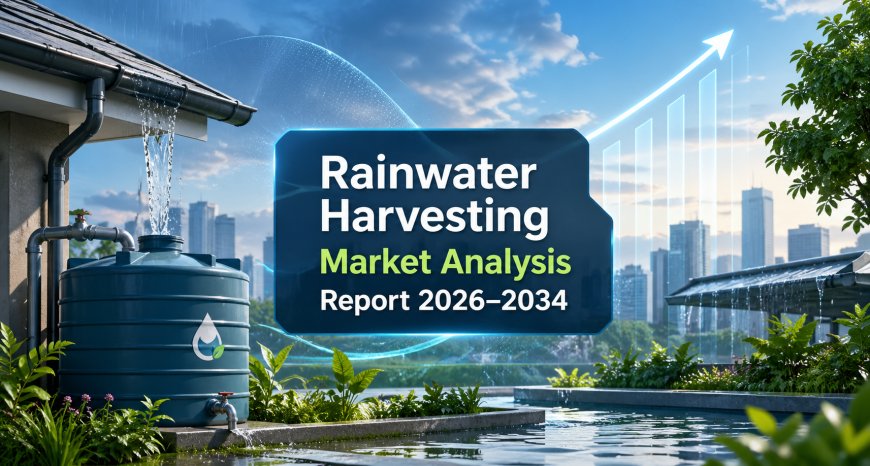
The rainwater harvesting market is experiencing rapid growth, driven by intensifying global water scarcity, proactive government policy and subsidies, and expansion of sustainable agricultural practices. According to IMARC Group's latest research publication, "Rainwater Harvesting Market Size, Share, Trends and Forecast by Harvesting Method, End-User, and Region, 2026-2034", the global rainwater harvesting market size was valued at USD 1,683.7 Million in 2025. Looking forward, IMARC Group estimates the market to reach USD 2,483.2 Million by 2034, exhibiting a CAGR of 4.41% from 2026-2034.
This detailed analysis primarily encompasses industry size, business trends, market share, key growth factors, and regional forecasts. The report offers a comprehensive overview and integrates research findings, market assessments, and data from different sources. It also includes pivotal market dynamics like drivers and challenges, while also highlighting growth opportunities, financial insights, technological improvements, emerging trends, and innovations. Besides this, the report provides regional market evaluation, along with a competitive landscape analysis.
Download a sample PDF of this report: https://www.imarcgroup.com/rainwater-harvesting-market/requestsample
Our report includes:
- Market Dynamics
- Market Trends and Market Outlook
- Competitive Analysis
- Industry Segmentation
- Strategic Recommendations
Growth Factors in the Rainwater Harvesting Market
- Intensifying Global Water Scarcity
- Proactive Government Policy and Subsidies
National and local governments are playing a pivotal role in market expansion by implementing mandatory water conservation regulations and attractive financial incentives. In India, the Jal Jeevan Mission has integrated rainwater harvesting as a mandatory component for rural and urban sustainability, aiming to provide safe water to every household. Similarly, in the United States, states like California and Texas offer tax credits and rebates to homeowners who install certified collection systems to mitigate the impact of prolonged droughts. These initiatives are often coupled with updated building codes in countries like Australia and Singapore, where new residential and commercial constructions must include integrated water catchment designs. By offering subsidies that cover a significant portion of installation costs—reaching up to 50,000 rupees in certain Indian states—governments are successfully lowering the entry barrier for low-income families and small-scale farmers, ensuring widespread adoption of these sustainable technologies across diverse socio-economic segments.
- Expansion of Sustainable Agricultural Practices
The agricultural sector remains a dominant force in the rainwater harvesting market as farmers seek to protect crop yields against climate variability. With agriculture accounting for nearly 70% of global freshwater withdrawals, the depletion of traditional aquifers has forced a transition toward decentralized water storage. Modern farming operations are increasingly adopting large-scale pond lining and modular tank systems to capture seasonal rainfall for use during dry spells. In China and Sub-Saharan Africa, rain-fed farming supported by these harvesting systems has been shown to increase agricultural output by 35% in semi-arid zones. Major industry players are responding by developing high-capacity, low-maintenance filtration units specifically designed for the rugged conditions of rural fields. These systems allow for the efficient watering of livestock and irrigation of crops without the need for expensive energy-intensive pumping from deep wells, thereby reducing operational overhead while enhancing long-term food security and resilience against environmental shocks.
Key Trends in the Rainwater Harvesting Market
- Integration of IoT and Smart Monitoring
A major shift in the industry is the adoption of "Smart Rainwater Harvesting," which utilizes Internet of Things (IoT) technology to optimize collection and usage. Modern systems are now equipped with ultrasonic sensors and automated control valves that monitor water levels and quality in real-time. These smart platforms can sync with local weather forecasts to automatically release stored water ahead of heavy storms, creating "dead storage" space to maximize new runoff collection and prevent urban flooding. For users, this means receiving mobile alerts regarding tank capacity and filter health, which reduces the need for manual inspections. The U.S. Environmental Protection Agency indicates that these digital management tools can improve overall water system efficiency by up to 30%. Companies like RainHarvest Systems are leading this trend by offering cloud-based dashboards that allow commercial facility managers to track water savings and environmental impact metrics directly from their smartphones.
- Development of Modular and Prefabricated Systems
To address the challenges of high installation costs and space constraints, the market is moving toward modular and prefabricated harvesting solutions. Unlike traditional concrete cisterns that require extensive excavation and labor, modular tanks are made from lightweight, high-density polyethylene and can be assembled in various configurations to fit narrow urban alleyways or crawl spaces. This "plug-and-play" approach significantly reduces the time required for installation, often completing in a single day what used to take a week. Manufacturers like Kingspan and Graf Water have introduced slimline tanks and underground modular crates that can be buried under driveways or garden beds without compromising land use. Research indicates that these modular designs can lower total installation expenses by 15% to 20%, making them particularly attractive for retrofitting existing residential buildings and small-scale commercial properties where space is at a premium.
- Growth of Green Roof and Permeable Infrastructure
The convergence of rainwater harvesting with "Green Building" standards like LEED and BREEAM has spurred the rise of multifunctional green roof systems. These installations do more than just collect water; they use layers of vegetation and specialized soil to naturally filter pollutants from rainwater before it enters storage tanks. In densely populated cities, these systems are being paired with permeable pavements that allow water to seep into underground collection chambers rather than overwhelming the sewer system. This integrated approach is becoming a standard feature in "Sponge City" initiatives across Asia, where the goal is to absorb and reuse at least 70% of rainwater. Corporate developers, such as Tata Housing, are now incorporating these features into all certified green projects to meet strict environmental mandates. These systems not only provide non-potable water for irrigation and cooling but also help reduce the urban heat island effect, offering a holistic solution to urban environmental challenges.
Leading Companies Operating in the Global Rainwater Harvesting Industry:
- Kingspan Group
- Watts Water Technologies, Inc.
- Graf Group
- WISY AG
- Innovative Water Solutions LLC
- D&D Ecotech Services
- Rain Harvesting Supplies, Inc.
- Water Field Technologies Pvt. Ltd
- Stormsaver
- Climate Inc
- Water Harvesters
- Heritage Tanks
Rainwater Harvesting Market Report Segmentation:
By Harvesting Method:
- Above Ground
- Underground
Above-ground rainwater harvesting is the dominant method due to its simplicity, accessibility, and cost-effectiveness in collecting and storing rainwater using visible systems like rooftop setups and storage tanks.
By End-User:
- Commercial
- Residential
- Industrial
The commercial sector holds the largest share in the rainwater harvesting market due to businesses recognizing its significant potential for water savings, supporting sustainability initiatives, and aligning with corporate social responsibility goals.
Regional Insights:
- North America (United States, Canada)
- Asia Pacific (China, Japan, India, South Korea, Australia, Indonesia, Others)
- Europe (Germany, France, United Kingdom, Italy, Spain, Russia, Others)
- Latin America (Brazil, Mexico, Others)
- Middle East and Africa
North America holds the largest share in the rainwater harvesting market due to its diverse climate, increasing environmental awareness, supportive government initiatives, and the growing trend towards green building practices.
Note: If you require specific details, data, or insights that are not currently included in the scope of this report, we are happy to accommodate your request. As part of our customization service, we will gather and provide the additional information you need, tailored to your specific requirements. Please let us know your exact needs, and we will ensure the report is updated accordingly to meet your expectations.
About Us:
IMARC Group is a global management consulting firm that helps the world’s most ambitious changemakers to create a lasting impact. The company provide a comprehensive suite of market entry and expansion services. IMARC offerings include thorough market assessment, feasibility studies, company incorporation assistance, factory setup support, regulatory approvals and licensing navigation, branding, marketing and sales strategies, competitive landscape and benchmarking analyses, pricing and cost research, and procurement research.
Contact Us:
IMARC Group
134 N 4th St. Brooklyn, NY 11249, USA
Email: sales@imarcgroup.com
Tel No:(D) +91 120 433 0800
United States: +1-201971-6302
What's Your Reaction?