



























India Q-commerce Market 2026-2034: Size, Share, Growth Trajectory & Future Outlook
India q-commerce market size reached USD 5.3 Billion in 2025. Looking forward, IMARC Group expects the market to reach USD 134.1 Billion by 2034, exhibiting a growth rate (CAGR) of 42.02% during 2026-2034.

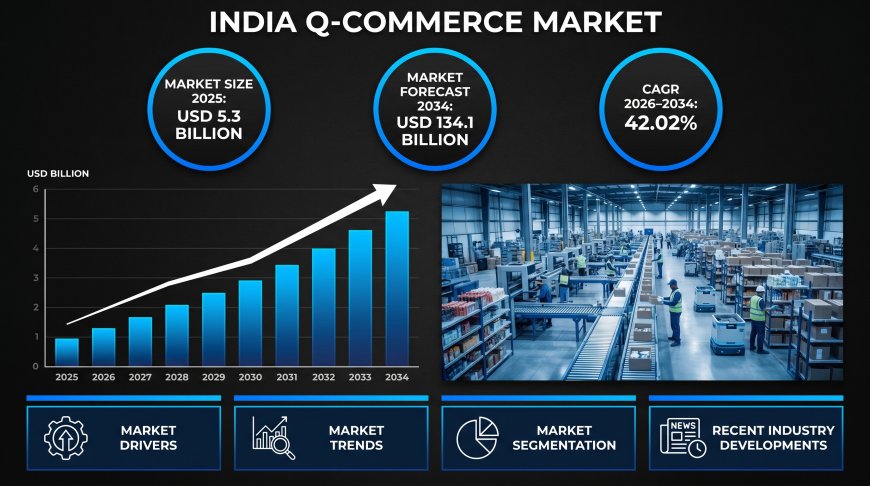
According to IMARC Group’s report titled “India Q-Commerce Market Size, Share, Trends and Forecast by Product Type, Platform, and Region, 2026-2034“, The report offers a comprehensive analysis of the industry, including India q-commerce market forecast, growth and regional insights.
India q-commerce market size reached USD 5.3 Billion in 2025. Looking forward, IMARC Group expects the market to reach USD 134.1 Billion by 2034, exhibiting a growth rate (CAGR) of 42.02% during 2026-2034.
India’s retail sector is experiencing a hyper-accelerated structural shift, evolving from traditional e-commerce to a dark-store-led Quick Commerce (Q-Commerce) ecosystem that prioritizes sub-30-minute delivery and immediate gratification.
- Segment Migration: While groceries constitute approximately 60% of the Gross Order Value (GOV), high-margin categories like pharmacy, beauty, and electronics are experiencing the fastest volume growth as consumer trust deepens.
- Urban Concentration: Tier-1 metropolitan hubs drive the primary demand engine, sustained by high smartphone penetration, nuclear family structures, and an expanding affluent demographic demanding instant retail fulfillment.
➤ Access Key Market Statistics and Actionable Insights - Request Sample Report: https://www.imarcgroup.com/india-q-commerce-market/requestsample
India's Strategic Vision for the Q-Commerce Market
- Digital Infrastructure Integration: The macroeconomic vision utilizes the Open Network for Digital Commerce (ONDC) to democratize hyper-local retail, structurally allowing localized stores to seamlessly plug into rapid delivery logistics grids.
- Tier-2 Expansion Viability: National retail targets involve moving beyond saturated Tier-1 metros, adapting the dark-store real estate model to optimize micro-fulfillment economics in high-growth Tier-2 urban corridors.
- Sustainable Logistics: Policy frameworks targeting the decarbonization of last-mile delivery heavily incentivize the mass deployment of electric vehicle (EV) fleets for two-wheeler gig workers, structurally reducing per-delivery unit costs.
Why Invest in the India Q-Commerce Market: Key Growth Drivers & ROI
- High-Frequency Consumption Patterns: Q-commerce naturally captures non-discretionary, recurring household expenditure. Investing in platforms handling essential FMCG products yields stable ROI through exceptional customer retention and high-frequency impulse purchases.
- Dark Store Unit Economics: Despite initial capital expenditure, matured dark stores in densely populated urban nodes achieve operational break-even significantly faster than traditional retail formats, driven by optimized picking times and ultra-high inventory turnover.
- Adjacency Expansion Margins: Capital allocation toward non-grocery adjacencies—such as cosmetics, over-the-counter (OTC) pharmaceuticals, and gifting—allows operators to capture substantially higher basket values and blend overall gross margin profitability.
India Q-Commerce Market Trends & Future Outlook
- AI-Driven Predictive Replenishment: Platforms are deploying advanced machine learning algorithms to map highly localized, block-by-block consumption patterns, virtually eliminating fresh produce wastage.
- Retail Media Network Monetization: Q-commerce interfaces are rapidly evolving into high-margin ad platforms, monetizing user search intent by offering FMCG brands premium digital shelf space.
- Direct-to-Consumer (D2C) Launchpads: Hyper-local delivery networks act as instant-access launchpads for digital-first D2C brands, allowing them to bypass legacy distribution chokepoints and capture immediate consumer feedback.
- Private Label Proliferation: To combat inherently thin grocery margins, leading operators are aggressively expanding high-quality, in-house private labels across staples, dairy, and household cleaning categories.
Regulatory Landscape & Policy Catalysts in India
- FDI in E-Commerce Rules: According to the Department for Promotion of Industry and Internal Trade (DPIIT), strict regulations mandate that marketplace platforms cannot directly hold inventory, forcing compliance through sophisticated B2B2C operational structures.
- Gig Worker Welfare Mandates: Monitored by the Ministry of Labour and Employment, evolving state-level frameworks are pushing platforms to institutionalize social security, algorithmic transparency, and accidental insurance for the massive delivery workforce.
- FSSAI Compliance for Dark Stores: As regulated by the Food Safety and Standards Authority of India (FSSAI), all hyper-local fulfillment centers must adhere to stringent cold-chain, traceability, and hygiene standards for perishable and frozen goods.
- Plastic Waste Management Rules: Enforced by the Ministry of Environment, Forest and Climate Change (MoEFCC), platforms are legally required to transition to sustainable, biodegradable packaging to meet strict Extended Producer Responsibility (EPR) targets.
- Motor Vehicle Aggregator Guidelines: As stipulated by the Ministry of Road Transport and Highways (MoRTH), guidelines are continuously updated to manage the deployment and licensing of commercial two-wheeler EV fleets utilized for last-mile delivery.
➤ Explore the Exact Chapters and Data Scope - Get Full Brochure: https://www.imarcgroup.com/request?type=report&id=21128&flag=A
India Q-Commerce Market Segmentation:
The market report offers a comprehensive analysis of the segments, highlighting those with the largest India q-commerce market share. It includes forecasts for the period 2026-2034 and historical data from 2020-2025 for the following segments.
Product Type Insights:
- Grocery
- Pharmacy
- Others
Platform Insights:
- App Based
- Web Based
Regional Insights:
- North India
- West and Central India
- South India
- East and Northeast India
By the IMARC Group, the Top Competitive Landscape & their Positioning:
Covering an in-depth analysis of the competitive landscape, market structure, key player positioning, competitive dashboards, top winning strategies, and detailed profiles of all major industry participants you will gain access to all these exclusive insights within the full research report.
Note: If you need specific information that is not currently within the scope of the report, we can provide it to you as a part of the customization.
➤ Shape the Data to Answer Your Specific Questions - Request Customization: https://www.imarcgroup.com/request?type=report&id=21128&flag=E
Frequently Asked Questions (FAQs)
1. What is the current value and projected growth of the India Q-Commerce Market?
According to IMARC Group, the India Q-commerce market reached a value of USD 5.3 Billion in 2025 and is projected to reach USD 134.1 Billion by 2034, exhibiting a CAGR of 42.02% during the 2026-2034 forecast period.
2. Which product categories are driving the highest order volumes?
While fresh groceries and daily FMCG staples dominate absolute transaction volume, high-margin categories like beauty, personal care, pharmacy, and small electronics are currently experiencing the most rapid sequential growth.
3. What is the primary operational model powering this sector?
The market relies entirely on the 'dark store' or micro-fulfillment model, where small, strategically located, non-customer-facing warehouses in dense residential areas enable inventory picking and dispatch within a 10-minute window.
4. How does technology impact delivery profitability?
Technology acts as the absolute core differentiator. Advanced algorithms map live traffic patterns, predict highly localized SKU demand, and optimize batch-routing for fleet riders, which is mathematically essential to lowering the delivery cost per order.
5. What are the primary hurdles to scaling beyond major metropolitan areas?
Expanding into Tier-2 cities is challenged by lower average order values (AOV), sparse population densities that disrupt the catchment radius of dark stores, and a historical lack of organized cold-chain logistics.
Strategic Insight & Verdict:
India’s Q-commerce sector is executing a disruptive, permanent alteration of urban consumption habits, moving from an experimental convenience to a primary retail channel. Analyzing this hyper-growth, we at IMARC Group have observed that long-term profitability relies not on speed alone, but on dominating non-grocery adjacencies and scaling high-margin retail media networks. For corporate investors, the strategic mandate is absolute: deploy capital into AI-optimized micro-fulfillment and premium category expansion to capture exponential yields in this rapidly formalizing USD 134.1 Billion ecosystem.
Gaurav, Digital Market Research Strategist at IMARC Group: https://www.linkedin.com/in/gourav-shah-005425345
Verified Data Source: IMARC Group
Contact Us:
IMARC Group
134 N 4th St. Brooklyn, NY 11249, USA
Email: sales@imarcgroup.com
Tel No:(D) +91 120 433 0800
United States: +1-202071-6302
What's Your Reaction?