





























What Is Portable Hardness Tester - UCI & LEEB Portable Hardness Tester
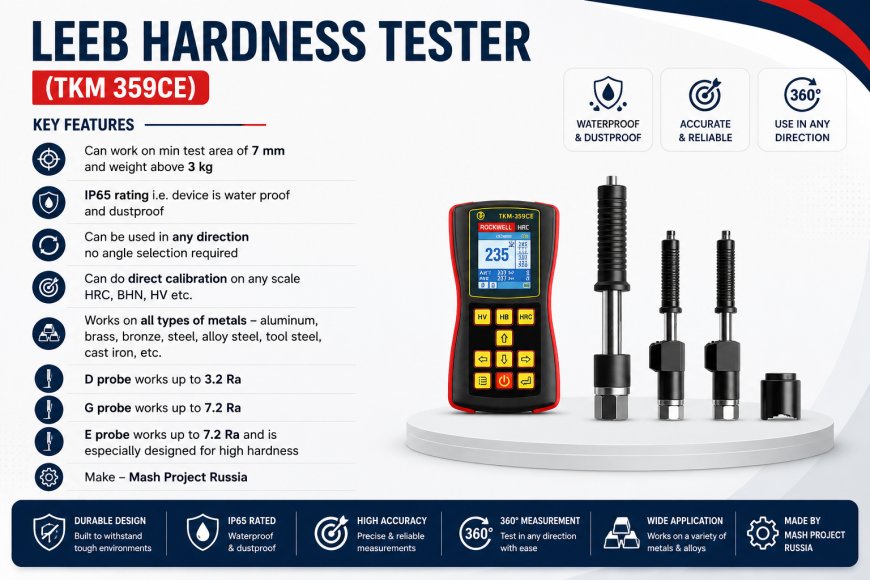
A portable hardness tester is used to measure the hardness of small & heavy jobs in field. Leeb & UCI is also portable hardness testers.

Portable Hardness Tester: Complete Guide to UCI Hardness
Testing for Precision Metal Inspection
Accurate hardness measurement is essential for verifying the quality, strength, and performance of metal components. In aerospace, automotive, manufacturing, tooling, and engineering applications, many components cannot be conveniently moved to a laboratory for inspection. A Portable Hardness Tester allows technicians and quality professionals to perform hardness measurements directly at the component or inspection site.
For applications involving small testing areas, thin sections, finished components, and difficult-to-access locations, a Portable UCI Hardness Tester can be particularly useful. RiM LaS Pvt Ltd provides industrial testing and measurement solutions for professionals who need practical and reliable hardness inspection capabilities across demanding metal applications.
What Is a Portable Hardness Tester?
A Portable Hardness Tester is a compact instrument designed to measure the hardness of metallic components outside a conventional laboratory environment. It allows inspection teams to take the testing equipment directly to the component, reducing the need to transport large, heavy, or installed parts.
Hardness testing can help manufacturers verify heat-treatment results, identify variations in material properties, support incoming-material inspection, and maintain consistent production quality.
Portable instruments are available with different testing principles. The appropriate technology depends on factors such as component geometry, surface condition, material, thickness, accessibility, and the required measurement area.
What Is a Portable UCI Hardness Tester?
A Portable UCI Hardness Tester uses the Ultrasonic Contact Impedance (UCI) method to determine material hardness. Unlike testing methods that require a relatively large impact area, UCI testing uses a diamond indenter mounted on a vibrating probe.
When the probe makes contact with the material surface, the change in ultrasonic frequency is related to the contact area created by the indenter. The instrument uses this measurement to determine hardness.
This makes UCI technology valuable for applications where the available testing area is limited or where a localized hardness measurement is required.
Portable Hardness Tester for Small and Difficult-to-Test Components
One of the biggest advantages of a Portable Hardness Tester based on UCI technology is its suitability for localized testing.
Traditional laboratory hardness testing can become inconvenient when the component is:
- Small or lightweight
- Thin-walled
- Already installed
- Difficult to remove
- Accessible only from a limited area
- A finished or precision-machined component
- Designed with slots, grooves, or other restricted areas
A Portable UCI Hardness Tester can help quality teams inspect such components without requiring extensive sample preparation or destructive testing, provided the component and test conditions are suitable for the method.
How Does UCI Hardness Testing Work?
UCI hardness testing is based on the relationship between the contact area of an indenter and the change in ultrasonic frequency produced when the indenter contacts the test material.
The typical process involves:
1. Preparing the Test Surface
The testing area should be clean, stable, and suitable for contact with the probe. Surface condition can have an important influence on measurement quality.
2. Applying the Probe
The UCI probe is placed against the test surface with the required force.
3. Measuring the Contact Response
The instrument detects the change in ultrasonic response caused by the indenter contacting the material.
4. Calculating Hardness
The device processes the measurement and provides the corresponding hardness value according to the selected scale or material calibration.
For reliable results, operators should follow the instrument manufacturer's procedure and applicable testing requirements.
Key Benefits of a Portable UCI Hardness Tester
Precise Localized Measurement
UCI testing is well suited to situations where only a small area is available for hardness measurement. This can be valuable when inspecting precision components and finished parts.
Convenient Field Inspection
A portable system can be taken to the component instead of transporting the component to a laboratory. This is especially useful for large production assemblies, maintenance work, and on-site inspections.
Useful for Thin Components
Certain thin or small components may not be practical candidates for conventional hardness testing. UCI technology can provide an alternative when the component meets the requirements of the testing method.
Minimal Testing Area
Because UCI testing is localized, it can be useful when engineers need hardness information from a specific region of a component rather than a large test surface.
Suitable for Quality Control
Portable UCI testing can support incoming inspection, in-process quality control, heat-treatment verification, maintenance inspection, and final component verification.
Portable Hardness Tester Applications in Aerospace and Automotive Industries
Aerospace and automotive manufacturers frequently work with precision-machined, heat-treated, forged, and engineered metal components. Consistent material properties are important for component reliability and production quality.
A Portable Hardness Tester can be used for applications such as:
- Heat-treated components
- Gears and shafts
- Tooling and dies
- Precision-machined parts
- Automotive components
- Aerospace components
- Weld-related inspection applications where appropriate
- Small metal parts
- Engineering components
- Production and maintenance inspections
The exact testing method should always be selected according to the material, component geometry, surface condition, and applicable standards or procedures.
Portable UCI Hardness Tester vs Other Portable Methods
Selecting the right hardness testing technology is important because no single method is ideal for every application.
A UCI-based Portable Hardness Tester is particularly attractive when localized measurements, small components, or restricted testing areas are important.
Before choosing equipment, consider:
- Material type
- Component thickness
- Test area size
- Surface finish
- Component geometry
- Required hardness scale
- Testing location
- Measurement frequency
- Applicable standards
- Required documentation and reporting
For large, heavy components, a Portable Leeb Hardness Tester may be more appropriate in many situations, while UCI can be advantageous for localized or precision measurements.
Why Choose RiM LaS Pvt Ltd?
RiM LaS Pvt Ltd works with industrial testing and measurement requirements across sectors including metals, automotive, aerospace, and engineering.
Choosing a hardness tester should involve more than comparing specifications. The testing method, probe configuration, calibration approach, component characteristics, and operator technique can all affect measurement reliability.
RiM LaS can help technical and commercial teams understand their application requirements and identify an appropriate hardness testing solution. For organizations involved in technical training and professional development, application-focused knowledge can also help personnel use inspection equipment more effectively and consistently.
How to Select the Right Portable Hardness Tester
Before purchasing a Portable Hardness Tester, ask the following questions:
What material will be tested?
Different metals and alloys may require specific calibration or testing considerations.
How large is the testing area?
Small testing locations may make UCI technology particularly attractive.
Is the component thin or lightweight?
Component thickness and support conditions can influence the suitability of a testing method.
Will testing be performed in the field?
If components cannot be transported easily, portability becomes a major selection factor.
What hardness scale is required?
Make sure the selected instrument supports the hardness scale and conversion requirements relevant to your application.
A technical evaluation before purchase can help avoid selecting equipment that is unsuitable for the actual inspection environment.
Conclusion
A Portable Hardness Tester provides a practical way to bring hardness measurement directly to the component. When inspections involve small testing areas, precision components, thin sections, or difficult-to-access locations, a Portable UCI Hardness Tester can offer valuable flexibility for localized hardness measurement.
For aerospace, automotive, metalworking, manufacturing, and engineering applications, selecting the right testing technology is essential for obtaining dependable results. RiM LaS Pvt Ltd can support organizations in evaluating their hardness testing requirements and identifying an appropriate solution for their application.
Need a Portable Hardness Tester for your industrial application? Contact RiM LaS Pvt Ltd today to discuss your component, material, and inspection requirements and get professional guidance on the right hardness testing solution.
What's Your Reaction?