

































Philippines Air Compressor Market | Size, Growth, Trends and Analysis 2026-2034
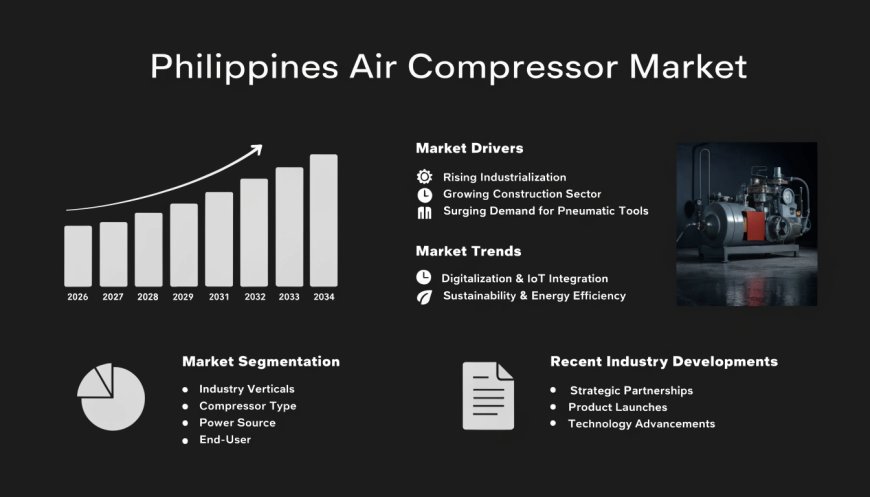
The Philippines air compressor market size was valued at USD 393.37 Million in 2025 and is projected to reach USD 512.18 Million by 2034, growing at a compound annual growth rate of 2.98% from 2026-2034.

Market Overview
The Philippines air compressor market is experiencing steady expansion, driven by the country's accelerating industrialization and large-scale infrastructure development programs. According to IMARC Group, the market size was valued at USD 393.37 Million in 2025 and is projected to reach USD 512.18 Million by 2034, growing at a compound annual growth rate (CAGR) of 2.98% from 2026 to 2034. The market is propelled by growing demand from manufacturing, semiconductors, and construction sectors, which is fueling the adoption of advanced compressed air systems. Advancements in energy-efficient compressor technologies, expanding industrial zones, and government-led infrastructure modernization efforts are strengthening the foundation for sustained growth, positioning the Philippines as a key contributor to the regional market share.
The Philippines air compressor market is poised for sustained expansion, driven by a robust manufacturing sector, large-scale infrastructure investments under the Build Better More program, and rising demand from advanced manufacturing sectors. With strong government support and increasing adoption of energy-efficient and IoT-enabled compressor technologies, the market presents significant opportunities for manufacturers, distributors, and service providers focused on providing reliable, cost-effective, and sustainable compressed air solutions.
Philippines Air Compressor Market Summary
The Philippines air compressor market encompasses a wide range of products including stationary and portable compressors, utilizing various technologies such as rotary screw, piston, and centrifugal designs, serving diverse end-use industries including manufacturing, construction, mining, and oil and gas. The ecosystem includes global manufacturers, local distributors, service providers, and end-users across the country's expanding industrial landscape.
- By Type: Stationary dominates the market with a share of 61.2% in 2025, owing to its widespread deployment across manufacturing facilities, industrial parks, and fixed-location operations requiring continuous and reliable compressed air supply.
- By Technology: Rotary or screw leads the market with a share of 46.8% in 2025, driven by its superior energy efficiency, continuous duty capability, and reduced maintenance requirements.
- By Lubrication Method: Oil-filled exhibits a clear dominance with 58.9% share in 2025, reflecting industrial preference for durable, cost-effective compressor systems.
- By Power Rating: 101 to 300 kW represents the largest segment with 34.6% share in 2025, suited for medium-to-large-scale industrial operations.
- By End User: Manufacturing comprises the biggest segment with 39.7% share in 2025, driven by the country's expanding industrial base in electronics, automotive components, and food processing.
- By Region: Luzon accounts for the most prominent region with 66.1% share in 2025, driven by the concentration of industrial parks and manufacturing clusters in Metro Manila and CALABARZON.
PORTER'S FIVE FORCES ANALYSIS – PHILIPPINES AIR COMPRESSOR MARKET
Bargaining Power of Suppliers – Moderate
The market relies on a mix of global manufacturers and local distributors. Established global players such as Atlas Copco, Kobelco, and others maintain significant market presence. The presence of multiple international suppliers and the growing capabilities of local distributors provide end-users with alternative sourcing options, balancing supplier influence.
Bargaining Power of Buyers – Moderate
Buyers include large-scale manufacturing facilities, construction companies, and mining operations. The availability of diverse compressor technologies and brands provides buyers with choices. However, the technical nature of compressed air systems and the importance of after-sales support and spare-part availability mean that buyers often prioritize reliability and service over price alone.
Threat of New Entrants – Moderate
Capital requirements for establishing manufacturing facilities are significant, but the growing demand for air compressors from various end-use sectors attracts new entrants. Niche opportunities exist in energy-efficient and oil-free compressor segments, as well as in rental and leasing models that reduce upfront costs for SMEs.
Threat of Substitutes – Low
While electric tools and manual processes can substitute for pneumatic systems in some applications, compressed air remains essential for a wide range of industrial operations including automation, material handling, and precision manufacturing. The unique benefits of compressed air systems in terms of reliability, cleanliness, and power density make substitution difficult.
Competitive Rivalry – Moderate
The market is competitive, with global manufacturers dominating industrial demand alongside local distributors and service providers. Players compete through energy-efficient models, after-sales support, spare-part availability, and strong presence across construction, manufacturing, and mining end-users.
Request for Sample Report: https://www.imarcgroup.com/philippines-air-compressor-market/requestsample
MARKET GROWTH DRIVERS
Robust Manufacturing Sector Growth Driving Industrial Compressor Demand
A key factor shaping market momentum is the robust growth of the manufacturing sector, which remains the primary demand driver for compressed air systems across factory operations, assembly lines, and material handling applications. The country's manufacturing purchasing managers' index (PMI) reached 54.3 in December 2024, marking the joint-strongest reading since November 2017 and signaling sustained expansion in factory activity. The PMI further rose to 52.9 in January 2026 and 54.6 in February 2026, indicating continued strong operating conditions for manufacturers. Increased investment in special economic zones, rising electronics production, and modernization of food processing and pharmaceutical manufacturing are collectively generating higher demand for reliable compressed air solutions. The food processing and light manufacturing industries, in particular, rely on mid-to-small compressors for packaging, pneumatic automation, assembly lines, and precision machinery.
Large-Scale Infrastructure Investment Under Build Better More Program
Government infrastructure programs, including the Build Better More initiative, are further supporting industrial development and creating favorable conditions for compressor adoption. The administration allocated ₱1.556 trillion (USD 27.1 billion) for the Build Better More program in 2026, representing 5.0% of GDP, aligned with the target infrastructure spending of 5.0 to 6.0 percent of GDP. Priority projects include the Bataan-Cavite Interlink Bridge (₱27.9 billion), the Laguna Lakeshore Road Network (₱22.9 billion), and the Cebu-Mactan Bridge and Coastal Road Construction Project (₱3.7 billion), among 54 infrastructure flagship projects. The Department of Transportation will receive ₱197.3 billion, with its Rail Transport Program allocated ₱124.1 billion and Aviation Infrastructure Program ₱6.2 billion. Major developments, including roadways, bridges, airports, industrial facilities, and urban housing, rely on compressed air for drilling, concrete spraying, pneumatic tools, and other site-specific applications.
Accelerating Adoption of Energy-Efficient and Smart Compressor Technologies
The Philippines is witnessing growing adoption of variable speed drive and energy-efficient compressor technologies as industries seek to optimize operational costs amid elevated electricity prices. Manufacturers and industrial operators are increasingly prioritizing compressor systems that dynamically adjust air output to match real-time demand, minimizing energy waste during partial-load conditions. The Department of Energy has raised its energy efficiency targets from 30% to 35% by 2030, with a longer-term objective of reaching 50% by 2050. Industrial facilities across the Philippines are progressively integrating Internet of Things (IoT) capabilities into compressed air systems, enabling real-time performance monitoring, predictive maintenance scheduling, and remote diagnostics. These digitally connected compressor systems allow plant operators to detect potential failures before they cause costly downtime, optimize air pressure settings for varying production demands, and reduce unnecessary energy consumption.
MARKET GROWTH DRIVERS
Expanding Demand from Semiconductor and Electronics Manufacturing
The Philippines' semiconductor and electronics manufacturing sector is driving specialized compressor demand, particularly for oil-free and high-purity compressed air systems that meet stringent cleanroom requirements. Assembly, testing, and packaging facilities concentrated in special economic zones require contamination-free air supply for sensitive production processes. As the country positions itself to capture a larger share of global semiconductor supply chains, investments in precision manufacturing infrastructure are generating sustained demand for advanced compressor systems designed to deliver consistent air quality standards essential for electronic component production and testing operations. In October 2025, ACUVEX Corp. invested P3 million in the Cavite Economic Zone to fabricate jigs and fixtures for industrial production, with PEZA expecting the project to boost precision manufacturing and strengthen supply chains.
Growth of Rental and Portable Compressor Market from Construction Activity
The rapid expansion of infrastructure and construction projects has increased demand for temporary rental and portable compressor units. Major developments rely on compressed air for drilling, concrete spraying, pneumatic tools, and other site-specific applications, driving demand for flexible, mobile compressed air solutions. Strong opportunities exist through leasing and pay-per-use models that reduce upfront costs and provide maintenance support, enabling SMEs and food processors to access modern compressor technology, enhance productivity, and scale operations sustainably.
Strategic Industrial Development and Foreign Direct Investment
Manufacturing is poised for sustained growth in 2026, supported by initiatives like Tatak Pinoy, the Philippines' industrial strategy under Republic Act 11981. These initiatives are key to deepening capacity, enhancing competitiveness, and ensuring inclusive and durable growth. Foreign direct investment continues to flow into industrial zones, with Maxort investing P400 million in LIMA Estate, expected to generate about 150 construction jobs during the initial phase. These investments are creating new industrial facilities requiring compressed air systems, further stimulating market growth.
Philippines Air Compressor Market Segmentation
Segmentation analysis provides a detailed view of the Philippines air compressor market by category:
- Type Insights: Stationary (61.2% share in 2025), Portable
- Technology Insights: Rotary or Screw (46.8% share in 2025), Piston, Centrifugal
- Lubrication Method Insights: Oil-filled (58.9% share in 2025), Oil-free
- Power Rating Insights: 101 to 300 kW (34.6% share in 2025), 0-100 kW, 301-500 kW, 501 kW & Above
- End-Use Industry Insights: Manufacturing (39.7% share in 2025), Construction, Mining, Oil and Gas, Others
- Regional Insights: Luzon (66.1% share in 2025), Visayas, Mindanao
Competitive Landscape
The competitive landscape of the Philippines air compressor market features a mix of global manufacturers and local distributors. Key players drive the market by expanding product portfolios, investing in energy-efficient and IoT-enabled technologies, and strengthening distribution and service networks. Major companies and distributors in the market include:
- Atlas Copco Philippines Incorporated – Established in 1967, a leading provider of innovative compressed air and vacuum solutions, energy solutions, pumps, power tools, and assembly solutions. Offers oil-free air compressors, piston compressors, rotary screw air compressors, air dryers, and gas compressors including hydrogen and natural gas compressors.
- KOBELCO COMPRESSORS AND MACHINERY PHILIPPINES CORPORATION (KCMP) – Established in 1999, operating as the official local distributor in the Philippines for KOBELCO COMPRESSORS CORPORATION (KCC), a group company of KOBE STEEL, LTD. Offers oil-injected and oil-free compressors, specializing in direct sales and direct service.
- Compresstech Resources, Inc. – A prominent manufacturer of compressed air systems with 34 years of experience, offering a variety of air compressors, tailored solutions, and maintenance services. Provides Gast Oilless Linear Pumps known for compact size and long operational life.
- Le Price International Corporation – Specializes in engineering solutions, offering a comprehensive range of products including gearboxes and lubrication systems.
- Other participants: Macro Construction Equipment (offering Airman compressors), Trade One Incorporated (Hey-wel Roots Blowers), Standard Refrigeration Supply, and various local distributors and service providers. These companies compete on product reliability, after-sales support, spare-part availability, and energy efficiency.
Regional Analysis
Regional dynamics within the Philippines air compressor market are shaped by the concentration of industrial parks, manufacturing clusters, and infrastructure activity.
- Luzon is the largest region, accounting for 66.1% of the market in 2025, driven by the concentration of industrial parks, special economic zones, and manufacturing clusters in Metro Manila, Central Luzon, and CALABARZON. These regions collectively drive the majority of compressor demand, with major manufacturing facilities, electronics assembly plants, and food processing operations located across these industrial hubs.
- Visayas represents a growing market, supported by industrial development in Cebu and Iloilo, as well as infrastructure projects including the Cebu-Mactan Bridge and Coastal Road Construction Project.
- Mindanao is an emerging market for air compressors, with increasing industrial activity, agricultural processing, and infrastructure development driving demand for compressed air solutions for food processing, mining, and construction applications.
Recent Industry Developments
- May 2026: The Australia-ASEAN Development Cooperation Program announced the Second Country Programming Document for the Philippines, which will support Mindanao and promote economic resilience and inclusivity, creating further opportunities for industrial growth and compressor demand.
- March 2026: The integration of the PPP Projects Dashboard with the Project Information and Management System is expected to allow for real-time monitoring of every major infrastructure project, aiming to restore investor confidence and accelerate project implementation.
- February 2026: The Philippines manufacturing PMI reached 54.6, marking the strongest performance since late 2017, driven by a sharp influx of new orders and robust growth of output.
- January 2026: Manufacturing PMI rose to a nine-month high of 52.9, signaling stronger operating conditions for manufacturers following a low of 47.4 in November 2025.
- October 2025: ACUVEX Corp. invested P3 million in the Cavite Economic Zone to fabricate jigs and fixtures for industrial production, with PEZA expecting the project to boost precision manufacturing and strengthen supply chains.
- September 2025: The Department of Budget and Management allocated ₱1.556 trillion for the Build Better More program under the FY 2026 National Expenditure Program, representing 5% of GDP, with priority infrastructure projects including the Bataan-Cavite Interlink Bridge and the Cebu-Mactan Bridge and Coastal Road Construction Project.
- 2025 (Throughout): Leading compressor manufacturers continued to expand their product portfolios, with increasing focus on energy-efficient and IoT-enabled models. Atlas Copco maintained its position as a leading provider of compressed air solutions, while Kobelco Philippines strengthened its direct sales and service capabilities across Luzon and Visayas. Compresstech Resources continued to provide tailored solutions and maintenance services for industrial clients nationwide.
- 2025 (Throughout): The shift toward energy optimization continued to reshape procurement decisions across manufacturing, semiconductor, and food processing sectors, supporting market growth. Energy efficiency improvements and advanced compressor technologies enhanced operational viability across cost-sensitive industries throughout the Philippines.
Browse Full Report with TOC & List of Figures for In‑Depth Market Insights: https://www.imarcgroup.com/philippines-air-compressor-market
Note: If you need any specific information that is not covered currently within the scope of the report, we will provide the same as a part of customisation.
About Us
IMARC Group is a global management consulting firm that helps the world's most ambitious changemakers to create a lasting impact. The company provides a comprehensive suite of market entry and expansion services. IMARC offerings include thorough market assessment, feasibility studies, company incorporation assistance, factory setup support, regulatory approvals and licensing navigation, branding, marketing and sales strategies, competitive landscape and benchmarking analyses, pricing and cost research, and procurement research.
Contact Us
IMARC Group
134 N 4th St., Brooklyn, NY 11249, USA
Email: sales@imarcgroup.com
Tel No.: (D) +91 120 433 0800
United States: +1-201-971-6302
What's Your Reaction?