

































India Algorithmic Trading Market: Navigating the High-Frequency Financial Frontier
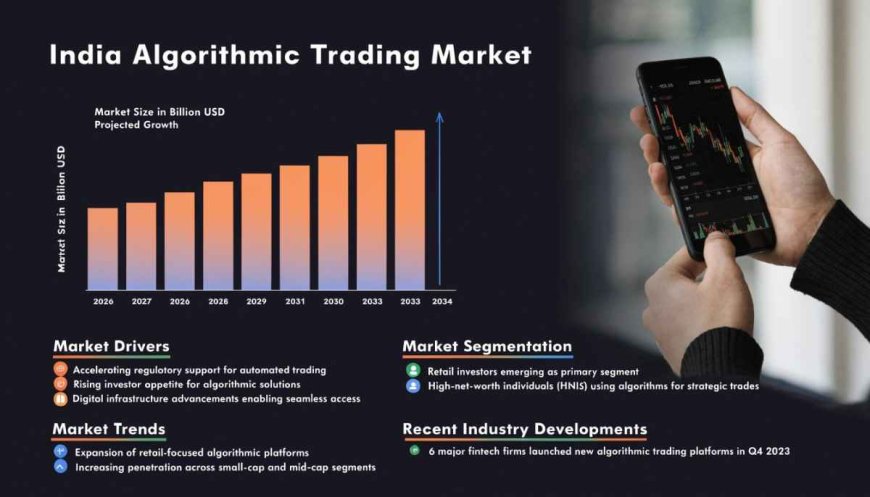
The India algorithmic trading market size was valued at USD 615.61 Million in 2025 and is projected to reach USD 1,350.34 Million by 2034, growing at a compound annual growth rate of 9.12% from 2026-2034.
Market Overview
The Indian capital market is witnessing a tectonic shift as traditional manual trading is rapidly superseded by automated, high-frequency execution. Once the exclusive domain of institutional giants, algorithmic trading has now permeated the retail and mid-tier brokerage segments. According to the latest strategic assessment by IMARC Group, the India Algorithmic Trading Market reached a valuation of USD 615.61 Million in 2025. Driven by the massive influx of retail participants and a sophisticated technological infrastructure, the market is projected to reach USD 1,350.34 Million by 2034, expanding at a robust CAGR of 9.12%.
Why Invest in the India Algorithmic Trading Market
SEBI's algo trading framework for retail investors is creating a compliance-driven rush among fintechs and brokerages to understand the competitive landscape before launching licensed algo products. This regulatory evolution is transforming the market from an unregulated "grey area" into a structured, transparent ecosystem. Financial institutions and technology providers who secure market intelligence now will be better positioned to navigate the mandatory auditing, risk management, and API-standardization protocols required by the new SEBI mandates. As retail participation in India hits record highs, the "institutionalization" of retail trading through licensed algos represents a massive, untapped revenue stream.
Core Market Drivers: The 9.12% Growth Engine
Several structural factors are accelerating the adoption of algorithmic trading across the Indian subcontinent:
-
Surge in Retail Participation: India has seen a massive jump in "Demat" accounts, with over 150 million active investors as of early 2026. This new demographic is increasingly seeking automated tools to manage volatility, leading to a surge in demand for "Algo-as-a-Service" platforms.
-
Low Latency Infrastructure: The deployment of Co-location (Colo) facilities at the National Stock Exchange (NSE) and Bombay Stock Exchange (BSE) has enabled micro-second execution speeds. The ongoing transition to 5G-enabled edge computing for trading is further reducing the latency for sub-second trade execution.
-
AI and Machine Learning Integration: Modern trading algos have evolved beyond simple "If-Then" logic. The market is now being driven by Deep Learning and Reinforcement Learning models that can analyze vast datasets—including social media sentiment and alternative data—to predict short-term price movements with higher accuracy.
-
Institutional Mandates for Best Execution: Foreign Portfolio Investors (FPIs) and domestic Mutual Funds are increasingly utilizing algorithms to minimize "market impact" and achieve "Best Execution" as mandated by global compliance standards.
Strategic Market Segmentation
The market is analyzed through several critical lenses that define the current trading landscape:
-
By Component: Software holds the largest market share, as brokerages invest heavily in custom-built execution engines and back-testing suites. However, the Services segment (consulting and maintenance) is growing rapidly due to the new SEBI compliance requirements.
-
By Type: Trend-following strategies remain the most popular, accounting for a significant portion of the volume. Arbitrage and Market-Making strategies are also seeing high adoption as firms look to capture spreads in a highly liquid market.
-
By Deployment: Cloud-based deployment is the fastest-growing segment, allowing smaller fintech startups to scale their infrastructure without the capital expenditure of physical servers.
➤ Request Sample Report - Evaluate Core Statistics Driving Your Industry Trends
Recent Developments & News (2025-2026)
The market has witnessed transformative developments in the last 12 months:
-
SEBI’s "Algo-Safety" Framework (2025): The introduction of mandatory "kill switches" and real-time risk management controls for retail-facing APIs has standardized the industry, weeding out unverified providers and favoring established, tech-heavy brokerages.
-
Gift City Expansion: The India International Exchange (India INX) in GIFT City has introduced advanced algorithmic trading incentives to attract global HFT (High-Frequency Trading) firms, positioning India as a global gateway for automated finance.
-
Consolidation in Fintech: Several leading discount brokers have recently acquired AI-specialized startups to integrate automated "Strategy Builders" directly into their mobile apps, targeting the Gen-Z investor base.
Future Outlook
Looking toward 2034, the India algorithmic trading market is set to become one of the most technologically advanced in the world. As the distinction between "institutional" and "retail" tools continues to blur, the focus will shift toward Zero-Code Algo Builders, allowing non-programmers to deploy complex strategies. For stakeholders, the current intersection of regulatory clarity and massive retail liquidity ensures that the algorithmic trading sector will remain a high-alpha growth vertical for the next decade.
Strategic Investment FAQ
What is the projected size of the India Algorithmic Trading Market by 2034?
The market is expected to reach USD 1,350.34 Million by 2034, representing more than double its 2025 valuation.
How is SEBI impacting the market currently?
SEBI's new framework is bringing transparency to retail algo trading, mandating broker-level oversight and strategy validation, which is driving a rush for compliant technology and competitive intelligence.
What technology is seeing the fastest adoption?
Cloud-based algorithmic platforms and AI-driven predictive models are the fastest-growing technologies, as they allow for rapid scaling and complex pattern recognition in volatile markets.
Note: If you require specific details, data, or insights that are not currently included in the scope of this report, we are happy to accommodate your request. As part of our customization service, we will gather and provide the additional information you need, tailored to your specific requirements. Please let us know your exact needs, and we will ensure the report is updated accordingly to meet your expectations.
➤ Speak to an Analyst - Discuss Custom Data Needs for Your Market Strategy
Strategic Insight & Verdict
Strategic Insight & Verdict Having analyzed market microstructure and technological adoption, we observe India’s algorithmic trading market evolving toward latency-sensitive, AI-driven execution strategies and advanced quantitative models. Firms investing in high-frequency infrastructure, robust risk controls, and regulatory compliance will gain competitive advantage. We at IMARC Group anticipate sustained growth driven by increasing institutional participation, data availability, and continuous advancements in trading technologies and analytics.
— Pragati Bharadwaj, Digital Market Research Strategist at IMARC Group https://www.linkedin.com/in/pragati-bharadwaj/
Verified Data Source : IMARC Group
About Us
IMARC Group is a leading market research company offering strategic insights and data-driven solutions across industries. The firm specializes in market forecasting, competitive analysis, and industry intelligence to support informed business decisions.
Contact Details
IMARC Group
134 N 4th St, Brooklyn, NY 11249, USA
Email: sales@imarcgroup.com
Tel No: (D) +91 120 433 0800
United States: +1-201-971-6302
What's Your Reaction?