






























Europe Smart Airport Market 2026 | Worth USD 20,936.2 Million by 2034
Europe smart airport market to grow from USD 10.2B in 2025 to USD 20.9B by 2034, driven by AI, biometrics, automation, and sustainable airport solutions.

Market Overview
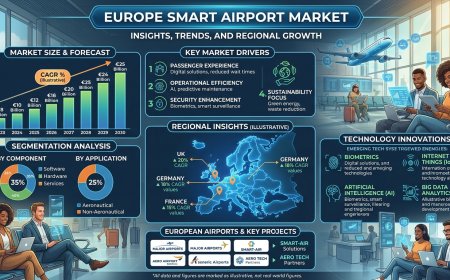
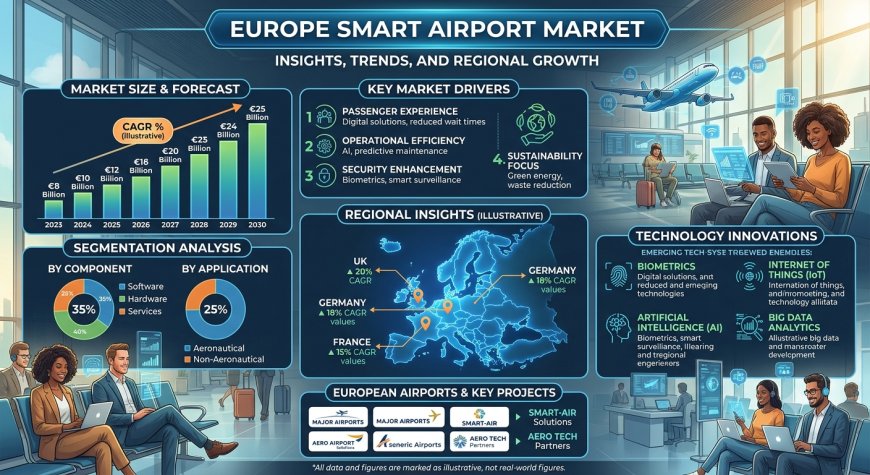
The Europe smart airport market size reached USD 10,155.5 Million in 2025. Looking forward, IMARC Group expects the market to reach USD 20,936.2 Million by 2034, exhibiting a growth rate (CAGR of 8.12%) during 2026-2034. The increasing focus on sustainability and passenger-centric solutions is impelling the market growth. Airports are adopting advanced technologies like biometric systems, automated baggage handling, and real-time data analytics in order to ensure seamless passenger experiences and efficient operations.
Smart airports refer to advanced automation-and-digital-technology-based operational and passenger-experience enhancements with the help of burgeoning smart technologies. This includes artificial intelligence, biometrics, and IoT-driven solutions in check-in, security, and baggage handling to make these processes efficient and seamless. With increasing air passenger numbers, the thrust for an ecosystem that facilitates real-time tracking, predictive maintenance, and optimized allocation of resources is furthering the cause of the smart airport market. Smart technologies are also being embraced by governments and airport authorities to help with safety, operational cost control, and sustenance. The Europe smart airport market encompasses Airport 2.0, Airport 3.0, and Airport 4.0 types, large, medium, and small sizes, wearables, LPWAN and WLAN, tags and sensors, platforms, NFC, RFID and Bluetooth, wireless, and other systems, aeronautical and non-aeronautical operations, implementation and upgrade and services end markets, and airside, air traffic maintenance, aircraft maintenance, passenger screening and experience, digital video surveillance and management, building management, intelligent advertising, and other applications across Germany, France, United Kingdom, Italy, Spain, Russia, and other European countries.
This market is strategically important to Europe's aviation infrastructure, passenger experience, and sustainability agenda, supporting the region's position as a global leader in smart airport innovation. Technological advancements are central to market growth. Smart airports in Europe are leveraging IoT, artificial intelligence, and big data to optimize operations and improve security. For instance, smart sensors enable real-time monitoring of airside activities, while AI-driven predictive maintenance reduces equipment downtime. Digital twin technology, adopted by major hubs, enhances operational efficiency by simulating and optimizing airport processes in real-time. Additionally, there is a rise in the adoption of smart technologies in airports to reduce energy consumption, emissions, and waste. Innovations, such as renewable energy systems, smart grids, and energy-efficient terminal designs, are helping airports achieve carbon-neutral targets. For example, Amsterdam's Schiphol Airport has integrated smart HVAC systems and LED lighting to lower its environmental impact while improving efficiency. As per reports, in 2023, more than 6.7 Million flights departed from European airports, emitting a total of 164.85 Mt of CO2.
The Europe smart airport market is poised for sustained expansion, underpinned by technological advancements, rising passenger expectations, growing demand for operational efficiency, and increasing focus on sustainability. With a projected CAGR of 8.12% through 2034, the market presents significant opportunities for providers focusing on AI-driven automation, IoT-based monitoring, biometric security solutions, digital twin technology, sustainable infrastructure, and real-time data analytics.
EUROPE SMART AIRPORT MARKET SUMMARY
The Europe smart airport market encompasses the development, integration, and deployment of advanced automation and digital technologies designed to enhance airport operations, passenger experience, security, and sustainability across aeronautical and non-aeronautical functions.
The ecosystem spans technology providers (Honeywell, Siemens, IBM, Cisco, Thales), airport operators, system integrators, cybersecurity providers, and regulatory bodies serving customers across airport authorities, airlines, ground handlers, and passengers throughout Europe .
By Type, the market is segmented into Airport 3.0 (dominating), Airport 2.0, and Airport 4.0.
By Size, the market serves Large (dominating), Medium, and Small.
By System, the market serves Platforms (dominating), Wearables, LPWAN and WLAN, Tags and Sensors, NFC, RFID and Bluetooth, Wireless, and Others.
By Operation, the market serves Non-Aeronautical (dominating at ~70%) and Aeronautical.
By End Market, the market serves Upgrade and Services (dominating) and Implementation.
By Application, the market serves Airside (dominating at ~40%), Air Traffic Maintenance, Aircraft Maintenance, Passenger Screening and Experience, Digital Video Surveillance and Management, Building Management, Intelligent Advertising, and Others.
By Country, the market serves Germany (dominating), France, United Kingdom, Italy, Spain, Russia, and Others.
Key trends shaping the market include technological advancements (IoT, AI, data analytics), rising passenger expectations, growing demand for operational efficiency, and increasing focus on sustainability.
PORTER'S FIVE FORCES ANALYSIS – EUROPE SMART AIRPORT MARKET
Competitive Rivalry: High. The market is defined by major technology providers, airport operators, and system integrators driving digital transformation. Competition centres on AI-driven automation, IoT-based monitoring, biometric security, integration capabilities, and sustainability credentials. Strategic partnerships between technology firms and airport authorities are accelerating the adoption of smart infrastructure. Business implication: Companies must differentiate through innovation, data-driven decision-making, and real-time analytics capabilities.
Supplier Power (Technology and System Providers): Moderate to High. Airports rely on suppliers of IoT sensors, biometric systems, AI platforms, networking equipment, and software. Critical technology components are concentrated among a limited number of global providers, creating supplier power. Integration complexity and cybersecurity requirements further increase dependence on specialized suppliers. Business implication: Strategic partnerships with technology providers and investment in interoperable platforms can reduce long-term dependency and integration risk.
Buyer Power (Airport Operators and Authorities): High. Airport operators and authorities leverage significant purchasing power through large-scale modernization contracts and framework agreements. Buyers increasingly demand proven technology, integration capabilities, cybersecurity assurance, and documented sustainability benefits. Long-term service contracts provide revenue stability but require vendors to demonstrate lifecycle value. Business implication: Providers must demonstrate proven deployment, integration expertise, and measurable operational and sustainability outcomes.
Threat of Substitutes: Low to Moderate. Traditional non-automated airport systems and manual processes represent substitutes. However, rising passenger volumes, security requirements, and efficiency demands make smart technologies increasingly essential. Within the market, competing technology standards and platforms substitute for each other. Business implication: Demonstrating superior efficiency, security, and passenger experience outcomes is essential.
Threat of New Entrants: Moderate. Significant capital requirements for R&D, integration expertise, cybersecurity certification, and established airport relationships create barriers. However, growth of specialized AI, IoT, and digital twin solutions has enabled new entrants focused on niche applications and innovative technologies. Business implication: Incumbents must leverage scale, integration expertise, and airport relationships while monitoring emerging specialized technology players.
KEY ASPECTS REQUIRED FOR THE EUROPE SMART AIRPORT MARKET
Market Performance: USD 10,155.5 Million in 2025, projected to reach USD 20,936.2 Million by 2034, driven by sustainability focus, passenger-centric solutions, biometric systems, automated baggage handling, and real-time data analytics.
Market Outlook: An 8.12% CAGR through 2034 reflects strong growth led by Airport 3.0, large airports, platforms, non-aeronautical operations, upgrade and services, airside applications, and German market dominance.
Growth Drivers: Increasing focus on sustainability and passenger-centric solutions; technological advancements (IoT, AI, big data); rising passenger expectations for seamless and personalized travel; growing demand for operational efficiency; air traffic growth; government investments in airport modernization; sustainability initiatives (renewable energy, smart grids, energy-efficient terminals); biometric security advancements; 5G connectivity.
Competitive Landscape: A highly competitive market with major technology providers and airport operators. Key players invest in AI-driven automation, IoT-based monitoring, biometric security, digital twin technology, and sustainable solutions.
Value Chain Analysis: From technology and system development through integration, deployment, and ongoing upgrade and services, to airport operations across aeronautical and non-aeronautical functions.
Industry Trends: Technological advancements (IoT, AI, data analytics); digital twin technology; biometric screening and facial recognition; contactless solutions (NFC, RFID, Bluetooth); sustainability initiatives (smart HVAC, renewable energy, energy-efficient terminals); real-time data analytics and predictive maintenance; self-service kiosks and automated baggage handling; 5G connectivity; cybersecurity.
Strategic Recommendations: Invest in AI-driven automation and IoT-based monitoring; develop biometric security and contactless solutions; implement digital twin technology for operational optimization; pursue sustainability initiatives (smart HVAC, renewable energy); expand real-time data analytics and predictive maintenance capabilities; target large airports and airside applications; pursue strategic partnerships with airport authorities; strengthen presence in Germany, France, and high-growth markets; enhance cybersecurity capabilities.
Request for Sample Report: https://www.imarcgroup.com/smart-airport-market/requestsample
MARKET GROWTH DRIVERS
Technological Advancements
The integration of the Internet of Things (IoT) makes it possible to gather massive amounts of data for monitoring passenger movement and equipment status. Artificial intelligence (AI) is used to handle large volumes of data, support decision-making in real time, and improve operational effectiveness. Additionally, the integration of data analytics systems assists in enabling predictive maintenance and offering insightful data on passenger behavior that helps airports customize their services for optimal impact, thereby supporting the smart airport market growth. According to the IMARC Group, the global data analytics market reached USD 74.3 Billion in 2024. As a result, these technologies create an integrated and intelligent system that enhances the capabilities of traditional airports into the realm of smart operations. On 15 September 2023, The Devon-based firm Rezcomm, developers of the 'plug-and-play' airport marketplace, utilized artificial intelligence (AI) technology to enhance airports globally, aiming to revolutionize the way travelers navigate through airports.
Rising Passenger Expectations
The growing passenger expectations for a seamless and personalized travel experience are offering a favorable smart airport market outlook. These airports aid in meeting these expectations by employing various technologies to provide real time updates on flight status, reduce check-in times through automated kiosks, and assist in navigation via mobile apps. Furthermore, the adoption of facial recognition technology to expedite security processes and customize retail experiences based on individual passenger preferences is influencing the market positively. As per reports, 97% of US airports are expected to implement facial recognition technology by the 2023 end. These technologies not only improve passenger satisfaction but also alleviate stress associated with air travel. In addition, key players are focusing on catering to passenger expectations for smart technologies. For instance, on 25 April 2023, CGI and Fraport AG partnered to accelerate the airport's digitization under a five-year framework agreement. Fraport AG, a prominent airport operator managing 29 airports across four continents, chose CGI as its digital partner to improve the user experience at Frankfurt Airport and boost its overall competitiveness.
Growing Demand for Operational Efficiency
Airports have complex ecosystem with a multitude of operations occurring simultaneously such as luggage handling, flight scheduling, security checks, and retail management. Smart airports utilize data-driven insights to streamline these operations. Furthermore, they use real time monitoring to improve the efficiency of baggage systems, reduce aircraft turnaround time, and optimize resource allocation. In addition, smart airports use predictive maintenance tools to forecast equipment failures before they occur that allow for proactive measures. This improved operational efficiency not only decreases expenditure but also enhances safety, sustainability, and overall performance, thereby catalyzing the smart airport demand. For example, on 31 May 2023, Malaysia Airports Holdings Berhad (MAHB), the ground handler of Kuala Lumpur International Airport, commissioned the German provider Materna IPS to provide a state-of-the-art self-bag drop (SBD) solution. Materna IPS system Flex.Go kiosks are equipped with an integrated camera system for automatic conveyability checks and tub detection.
Sustainability Focus
The increasing focus on sustainability and passenger-centric solutions is impelling the market growth. Airports are adopting advanced technologies like biometric systems, automated baggage handling, and real-time data analytics in order to ensure seamless passenger experiences and efficient operations. Technological advancements are central to market growth. Smart Airports in Europe are leveraging IoT, artificial intelligence, and big data to optimize operations and improve security. For instance, smart sensors enable real-time monitoring of airside activities, while AI-driven predictive maintenance reduces equipment downtime. Digital twin technology, adopted by major hubs, enhances operational efficiency by simulating and optimizing airport processes in real-time. Additionally, there is a rise in the adoption of smart technologies in airports to reduce energy consumption, emissions, and waste. Innovations, such as renewable energy systems, smart grids, and energy-efficient terminal designs, are helping airports achieve carbon-neutral targets. For example, Amsterdam's Schiphol Airport has integrated smart HVAC systems and LED lighting to lower its environmental impact while improving efficiency.
Government Investments and Modernization Initiatives
Government investments in airport modernization play a critical role in driving the adoption of smart airport technologies. Initiatives such as the FAA's USD 970 million award to 125 U.S. airports under Biden's Infrastructure Law support nationwide infrastructure upgrades. In Europe, airports are increasingly adopting smart technologies to meet regulatory requirements and improve operational efficiency. Major technology firms collaborate with airport authorities to deploy AI-powered security systems, contactless check-ins, and smart air traffic management solutions. The expansion of 5G connectivity and sustainability-driven innovations, such as energy-efficient terminals and predictive maintenance, further support market growth.
EUROPE SMART AIRPORT MARKET SEGMENTATION
Segmentation analysis provides a detailed view of the Europe smart airport market by category:
Type Insights: Airport 3.0 stands as the largest type in 2025. A new era of technology innovation and integration within airports, marked by the IoT, AI, biometrics, and advanced data analytics, is symbolized by Airport 3.0. It prioritizes the passenger experience by utilizing technology to optimize workflows, minimize wait times, and provide customized services. Additionally, Airport 3.0 streamlines operations by managing lineups, allocating resources efficiently, and improving overall airport management through the application of data-driven insights. Furthermore, it makes use of cutting-edge security tools like biometric screening, facial recognition, and real time threat detection systems to guarantee both passenger safety and legal compliance, which positively influences the smart airport market forecast. Airport 2.0 and Airport 4.0 represent significant segments with growing adoption across European airports.
Size Insights: Large leads the market in 2025. Large airports have more budgets and resources compared to smaller airports, which allows them to implement advanced smart technologies and infrastructure. They handle a higher volume of passengers and flights, which necessitates efficient processes, automation, and technology to manage operations smoothly and enhance the passenger experience. Additionally, large airports offer a wide range of services and facilities including shopping, dining, lounges, and entertainment options. Smart technologies are widely used to optimize these services and provide passengers with personalized experiences, thereby showing a positive smart airport industry outlook. Medium and small airports represent significant segments with growing adoption of smart technologies.
System Insights: Wearable devices like smartwatches and wristbands provide passengers with convenient access to real time flight information, boarding passes, and updates about their journey. This seamless experience eliminates the need for physical documents, reduces waiting times, and enhances overall passenger satisfaction. LPWAN and WLAN are two key networking technologies that play significant roles in the implementation and operation of smart airports. Tags and sensors let real time tracking and monitoring of assets, baggage, equipment, and personnel throughout the airport, which aids in improving operational efficiency and minimizing delays. Smart airport platforms integrate data from multiple sources, enabling centralized airport management. These platforms use AI and big data analytics to optimize flight scheduling, passenger flow, and baggage handling. NFC, RFID, and Bluetooth enable contactless solutions in smart airports. Wireless technology is the backbone of smart airport infrastructure, enabling seamless connectivity for passengers and operations. Platforms represent a leading segment, driven by the need for centralized airport management and data integration.
Operation Insights: Non-aeronautical leads the market with around 70% of the market share in 2025. Non-aeronautical operations involve activities like retail, dining, parking, advertising, and more. These operations provide airports with diversified revenue streams beyond traditional aeronautical activities including landing fees and passenger charges. Furthermore, they contribute significantly towards creating a positive and enjoyable experience for travelers and leading to enhanced passenger satisfaction. Manufacturers in the market are introducing technologies in non-aeronautical operations to increase their smart airport market revenue. For instance, on 30 May 2024, Munich Airport announced the successful completion of a four-month test using radar technology to monitor the Single Engine Taxi (SET) procedure, which aims to reduce carbon dioxide emissions and noise pollution on the ground. Aeronautical operations represent a significant segment, supporting flight operations, airside management, and aircraft maintenance.
End Market Insights: Upgrade and services lead the market in 2025. Upgrade and services have established physical infrastructure in place, which make economic benefits to retrofit existing systems with new sensors, automation tools, and data analytics capabilities. Additionally, integrating smart technologies into existing infrastructure enhances efficiency and passenger experience without the high costs associated with constructing entirely new facilities. Moreover, upgrades and services allow airports to implement smart solutions in a phased manner, which minimizes disruption to airport operations. Apart from this, these services can be tailored to the specific needs of an airport, which is impelling the market growth. Implementation represents a significant segment, supporting new airport construction and greenfield smart airport projects.
Application Insights: Airside leads the market with around 40% of the market share in 2025. Airside is critical for the timely departure and arrival of flights. Implementing smart technologies in the airside area aids in streamlining aircraft movement, gate assignment, and runway utilization. These technologies optimize aircraft turnaround times and reduce congestion, ultimately leading to more efficient flight schedules. Moreover, airside improves communication between air traffic controllers and pilots, leading to better coordination of departures and arrivals. Besides this, key players are introducing advanced airside solutions to provide an enhanced traveler experience. For example, on 10 May 2023, Honeywell launched an updated suite of airside solutions, displaying enhancements to its gate and turnaround and airfield lighting portfolios including the Honeywell NAVITAS smart visual docking system. Air traffic maintenance, aircraft maintenance, passenger screening and experience, digital video surveillance and management, building management, intelligent advertising, and other applications represent significant segments with growing demand.
Country Insights: Germany represents a leading market in the Europe smart airport market, driven by strong technological infrastructure, advanced aviation sector, and significant investments in airport modernization. Major German airports, including Frankfurt and Munich, have implemented advanced smart technologies, including digital twin technology, AI-driven automation, and biometric systems. France represents a significant market, driven by strong aviation infrastructure and investments in smart airport technologies at major hubs including Paris Charles de Gaulle. The United Kingdom represents a significant market, driven by major airport hubs including Heathrow and Gatwick, and investments in biometric screening, automated baggage handling, and sustainability initiatives. Italy and Spain represent growing markets, with investments in airport modernization and smart technologies at major hubs including Rome Fiumicino, Madrid-Barajas, and Barcelona-El Prat. Russia and other European markets represent significant segments with growing smart airport adoption.
COMPETITIVE LANDSCAPE
The competitive landscape of the smart airport market is defined by major technology providers, airport operators, and system integrators driving digital transformation. Leading companies such as Honeywell, Siemens, IBM, and Cisco are developing AI-driven automation, IoT-based monitoring, and biometric security solutions to enhance airport operations. For instance, in 2025, Honeywell announced plans to separate Automation and Aerospace Technologies, creating three publicly listed companies by 2026, focusing on AI-driven automation, sustainability, and digitalization to enhance productivity and industrial infrastructure. Strategic partnerships between technology firms and airport authorities are accelerating the adoption of smart infrastructure, including self-service kiosks, contactless security, and intelligent air traffic management. Investments in cybersecurity, 5G connectivity, and sustainable solutions are intensifying competition. As passenger expectations for seamless travel increase, companies are prioritizing innovation, data-driven decision-making, and real-time analytics to gain a competitive edge.
Major players include Amadeus IT Group SA, Ascent Technology Inc., Cisco Systems Inc., Collins Aerospace (Raytheon Technologies Corporation), Honeywell International Inc., Huawei Technologies Co. Ltd., Indra Sistemas S.A., International Business Machines Corporation, Sabre Corp., Siemens AG, T-Systems International GmbH, Wipro Limited, and others investing in AI-driven automation, IoT-based monitoring, and biometric security solutions.
Recent Developments:
September 2024: Adani Airports Holdings Ltd, part of the Adani group and managing seven airports in the nation, introduced the 'aviiot' digital platform to offer travelers real-time information on various airport features, including wait times, gate changes, and baggage on the carousel.
October 2024: Adani Airport Holdings Limited (AAHL), India's leading private airport operator, and Thales revealed a strategic collaboration aimed at transforming AAHL's international airport services and passenger experience throughout the nation, encompassing intelligent airport security, biometric passenger experience, and operational efficiency.
October 2024: Smart Airport Systems (SAS) collaborated with AirAsia to launch an APU OFF program at Terminal 2 in Kuala Lumpur. By implementing the combo units from Smart Airport Systems, AirAsia anticipates lowering APU expenses and related carbon emissions by 90 percent with ideal usage.
June 2023: Pittsburgh International Airport (PIT) teamed up with CleanRobotics to deploy the AI recycling bin TrashBot to support the airport's waste management efforts, sorting passenger waste and recyclables with 96% precision.
Investment opportunities exist in AI-driven automation, IoT-based monitoring, biometric security, digital twin technology, sustainable infrastructure, and real-time data analytics.
REGIONAL ANALYSIS
Germany represents a leading market in the Europe smart airport market, driven by strong technological infrastructure, advanced aviation sector, and significant investments in airport modernization. Major German airports, including Frankfurt and Munich, have implemented advanced smart technologies, including digital twin technology, AI-driven automation, and biometric systems. Germany's strong engineering and technology ecosystem supports innovation in smart airport solutions. The country's commitment to sustainability and operational efficiency drives adoption of smart technologies across airport operations.
France represents a significant market, driven by strong aviation infrastructure and investments in smart airport technologies at major hubs including Paris Charles de Gaulle. French airports are increasingly adopting biometric screening, automated baggage handling, and real-time data analytics to enhance passenger experience and operational efficiency. The country's strong technology ecosystem supports innovation in smart airport solutions.
The United Kingdom represents a significant market, driven by major airport hubs including Heathrow and Gatwick, and investments in biometric screening, automated baggage handling, and sustainability initiatives. UK airports are increasingly adopting AI-driven automation and contactless solutions to enhance passenger experience. The country's strong technology and aviation sectors support market growth.
Italy and Spain represent growing markets, with investments in airport modernization and smart technologies at major hubs including Rome Fiumicino, Madrid-Barajas, and Barcelona-El Prat. Both countries are increasingly adopting biometric systems, automated baggage handling, and real-time data analytics to enhance airport operations. Growing tourism and air traffic support demand for smart airport technologies.
Russia and other European markets including Netherlands, Belgium, Nordic countries, and others collectively contribute to the Europe smart airport market. Amsterdam's Schiphol Airport has integrated smart HVAC systems and LED lighting to lower its environmental impact while improving efficiency. Nordic countries lead in sustainability and smart technology adoption, supporting market growth.
RECENT INDUSTRY DEVELOPMENTS
2026 Activity: The Europe smart airport market continued its growth trajectory from USD 10,155.5 Million in 2025 toward USD 20,936.2 Million by 2034 at a CAGR of 8.12%.
September 2024: Adani Airports Holdings Ltd introduced the 'aviiot' digital platform to offer travelers real-time information on various airport features, including wait times, gate changes, and baggage on the carousel.
October 2024: Adani Airport Holdings Limited (AAHL) and Thales revealed a strategic collaboration aimed at transforming AAHL's international airport services and passenger experience, encompassing intelligent airport security, biometric passenger experience, and operational efficiency.
October 2024: Smart Airport Systems (SAS) collaborated with AirAsia to launch an APU OFF program at Terminal 2 in Kuala Lumpur, anticipating lowering APU expenses and related carbon emissions by 90 percent.
June 2023: Pittsburgh International Airport (PIT) teamed up with CleanRobotics to deploy the AI recycling bin TrashBot to support the airport's waste management efforts, sorting passenger waste and recyclables with 96% precision.
FREQUENTLY ASKED QUESTIONS
Q1: What is the current size of the Europe smart airport market?
A: The Europe smart airport market reached USD 10,155.5 Million in 2025 and is projected to reach USD 20,936.2 Million by 2034, exhibiting a CAGR of 8.12% from 2026-2034.
Q2: What are the key drivers of the Europe smart airport market?
A: The market is driven by: (i) increasing focus on sustainability and passenger-centric solutions; (ii) technological advancements (IoT, AI, big data); (iii) rising passenger expectations for seamless and personalized travel; (iv) growing demand for operational efficiency; (v) air traffic growth; (vi) government investments in airport modernization; (vii) sustainability initiatives; (viii) biometric security advancements; and (ix) 5G connectivity.
Q3: What are the major types in the Europe smart airport market?
A: Major types include Airport 3.0 (dominating), Airport 2.0, and Airport 4.0.
Q4: What are the major sizes in the Europe smart airport market?
A: Major sizes include Large (dominating), Medium, and Small.
Q5: What are the major systems in the Europe smart airport market?
A: Major systems include Platforms (dominating), Wearables, LPWAN and WLAN, Tags and Sensors, NFC, RFID and Bluetooth, Wireless, and Others.
Q6: What are the major operations in the Europe smart airport market?
A: Major operations include Non-Aeronautical (dominating at ~70%) and Aeronautical.
Q7: What are the major end markets in the Europe smart airport market?
A: Major end markets include Upgrade and Services (dominating) and Implementation.
Q8: What are the major applications in the Europe smart airport market?
A: Major applications include Airside (dominating at ~40%), Air Traffic Maintenance, Aircraft Maintenance, Passenger Screening and Experience, Digital Video Surveillance and Management, Building Management, Intelligent Advertising, and Others.
Q9: Which country leads the Europe smart airport market?
A: Germany represents a leading market, driven by strong technological infrastructure, advanced aviation sector, and significant investments in airport modernization. France, United Kingdom, Italy, and Spain represent significant markets.
Q10: What are the challenges facing the Europe smart airport market?
A: Key challenges include high implementation and integration costs, cybersecurity risks, interoperability issues between legacy and new systems, regulatory compliance complexity, and the need for skilled workforce to manage advanced technologies.
Q11: What is the outlook for the Europe smart airport market?
A: The market is projected to grow at an 8.12% CAGR through 2034, with growth driven by sustainability focus, passenger-centric solutions, and technological advancements. The shift toward AI-driven automation, IoT-based monitoring, biometric security, digital twin technology, and sustainable infrastructure are expected to shape the market's evolution.
Q12: Who are the key players in the Europe smart airport market?
A: Key players include Amadeus IT Group SA, Ascent Technology Inc., Cisco Systems Inc., Collins Aerospace (Raytheon Technologies Corporation), Honeywell International Inc., Huawei Technologies Co. Ltd., Indra Sistemas S.A., International Business Machines Corporation, Sabre Corp., Siemens AG, T-Systems International GmbH, and Wipro Limited.
Note: If you need any specific information that is not covered currently within the scope of the report, we will provide the same as a part of customization.
https://www.imarcgroup.com/request?type=report&id=4400&flag=E
Report Format, Delivery, and Customization Details
Report Format Mode: PPT, PDF, and Excel
Report Delivery Mode: Online Delivery, Physical Delivery
Report Delivery Time: Report Delivered Over Email within 24 to 48 hours. If requested by the client, a physical copy will be delivered within three to ten days.
Report Confirmation Mode: Yes via Email
Report Customization Mode: Yes via Email / Call
Report Table of Content: Yes
Report List of Figures: Yes
Report Methodology Mode: Yes
Request For Sample Report: Yes
What's Your Reaction?