































Ethiopia Cloud Computing Market Size, Share & Forecast by 2026-2034
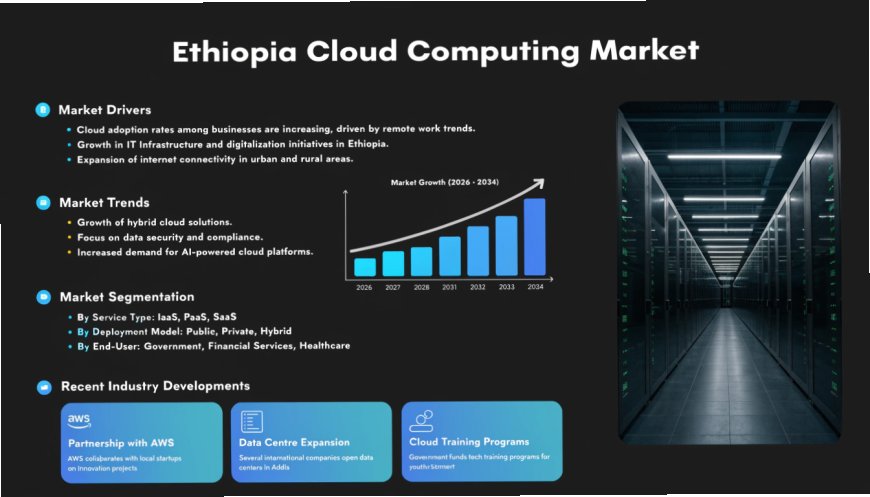
According to IMARC Group's latest research report, the Ethiopia cloud computing market reached a value of USD 918.8 Million in 2025. Looking forward, the market is expected to reach USD 5,729.5 Million by 2034, growing at a CAGR of 21.88% during 2026-2034.

Ethiopia Cloud Computing Market Overview
According to IMARC Group's latest research report, the Ethiopia cloud computing market reached a value of USD 918.8 Million in 2025. Looking forward, the market is expected to reach USD 5,729.5 Million by 2034, growing at a CAGR of 21.88% during 2026-2034. The market is being propelled by the government's Digital Ethiopia 2030 strategy that prioritizes sovereign cloud infrastructure and national data governance, the liberalization of the telecom sector bringing competitive internet services, and a rapid surge in enterprise digitalization across banking, government ministries, and technology startups. Major data center investments from Wingu Africa, Huawei, and Ethio Telecom are laying the infrastructure foundation, while 97 million mobile subscribers and 57 million internet users create a massive addressable market for cloud-based services.
Get a sample copy of this report: https://www.imarcgroup.com/ethiopia-cloud-computing-market/requestsample
Ethiopia Cloud Computing Market Summary
• Ethiopia's telecom liberalization is fundamentally reshaping the cloud computing landscape, with the market moving from a state monopoly to a competitive environment. Safaricom has rapidly acquired over 10 million active subscribers and built more than 3,100 cell towers covering approximately 42% of the population, while the Ethiopian Communications Authority is working to license a third telecom operator, intensifying competition that drives down data costs and expands internet accessibility.
• The government's Digital Ethiopia 2025 strategy has delivered significant milestones, connecting 1,030 cities with 4G network services and reaching 97 million mobile subscribers and 57 million internet users. The successor Digital Ethiopia 2030 framework shifts focus from planning to institutionalized digital execution, prioritizing sovereign government cloud infrastructure, energy-efficient data centers, and strict data sovereignty regulations that keep Ethiopian citizens' data within national borders.
• Ethio Telecom has partnered with Huawei Cloud Stack to build Ethiopia's national sovereign cloud and Africa's largest carrier B2B cloud platform, now serving over 90 enterprise customers including core government ministries, banks, and local technology companies. The Huawei-powered Tier III modular data center in Addis Ababa's Gola Sefer area can hold up to 800 servers, providing critical infrastructure for public and private sector cloud adoption.
• Wingu Africa has made transformative investments in Ethiopian digital infrastructure, inaugurating the country's first Tier III-certified data center at the Addis ICT Park with capacity for 800 racks, 10 MW power, and hosting Ethiopia's first Internet Exchange Point (ADDIX). The company secured an additional USD 60 million from Rand Merchant Bank to accelerate expansion across East Africa, reinforcing Addis Ababa's position as an emerging regional data hub.
• The financial services sector is emerging as a major cloud adoption driver, with Ethiopia's Homegrown Economic Reform Plan liberalizing financial services and enabling new digital payment providers who depend on cloud infrastructure to scale rapidly. Banking institutions are migrating core systems to cloud platforms to improve transaction processing, customer analytics, and regulatory compliance capabilities.
• Data sovereignty has become a central pillar of Ethiopia's cloud computing strategy, with the government enforcing strict rules on personal data transfers outside the country. This is driving demand for locally hosted cloud solutions, with Wingu Africa launching the Wingu Cloud Exchange (WCX) offering secure, compliant cloud services with local data hosting, predictable pricing in Ethiopian Birr, and hybrid cloud integration capabilities.
• Renewable energy resources are positioning Ethiopia as a competitive destination for data center operations, with BitCluster operating a facility in Addis Ababa powered by the Grand Ethiopian Renaissance Dam. The country's abundant hydroelectric capacity offers significant cost advantages for power-intensive cloud infrastructure, attracting both domestic and international data center operators looking to reduce carbon footprints.
• Enterprise cloud adoption across East Africa has reached 70 to 77% penetration, placing the region among the continent's leaders in digital transformation. In Ethiopia specifically, Infrastructure as a Service (IaaS) is the fastest-growing segment as organizations move away from capital-intensive on-premises hardware investments toward scalable, pay-as-you-go cloud models that reduce upfront costs and improve operational flexibility.
Key Trends Shaping the Ethiopia Cloud Computing Market
• Sovereign cloud mandates are driving localized infrastructure investment, with the Ethiopian government requiring critical public systems to be hosted on nationally controlled cloud platforms. Ethio Telecom's Huawei-powered sovereign cloud and Wingu Africa's Tier III facility at the Addis ICT Park are directly responding to this regulatory push, creating a protected digital environment for government and financial sector workloads.
• The convergence of mobile money and cloud computing is accelerating digital financial inclusion, as telecom operators expand mobile payment services that rely on scalable cloud backends. With mobile data prices among the cheapest in Africa and average data consumption per subscriber surpassing levels in more mature markets like Kenya, the foundation for cloud-based fintech services is rapidly strengthening.
• Modular and prefabricated data center designs are addressing Ethiopia's infrastructure challenges, with Huawei's modular facilities enabling faster deployment timelines compared to traditional brick-and-mortar constructions. This approach allows operators to scale capacity incrementally in response to demand, reducing upfront capital requirements while maintaining Tier III reliability standards.
• The arrival of a potential third telecom operator is expected to further intensify competition and drive down connectivity costs, creating a more favorable environment for cloud service adoption across small and medium enterprises. The Ethiopian Communications Authority's licensing process signals continued commitment to market liberalization that benefits cloud ecosystem development.
• AI and machine learning workloads are beginning to emerge as a cloud computing growth vector in Ethiopia, driven by government interest in leveraging artificial intelligence for agricultural optimization, healthcare delivery, and urban planning. Global hyperscalers' massive investments in AI infrastructure are creating trickle-down effects that improve cloud service capabilities available to emerging markets.
Explore the full report with TOC & list of figures: https://www.imarcgroup.com/ethiopia-cloud-computing-market
Market Growth Factors
Government Digital Transformation Agenda and Sovereign Cloud Development
Ethiopia's cloud computing growth is deeply rooted in the government's ambitious digital transformation strategy. The Digital Ethiopia 2025 program delivered substantial gains, connecting 1,030 cities with 4G services and growing mobile subscribers to 97 million and internet users to 57 million. The successor Digital Ethiopia 2030 framework shifts from planning to execution, with specific emphasis on building sovereign government cloud infrastructure, energy-efficient data centers in cities like Adama, Hawassa, and Bahir Dar, and a modernized government backbone network. The government has introduced data sovereignty as a core policy principle, mandating that Ethiopian citizens' data remain within national borders. This regulatory framework is channeling cloud investment into domestic facilities rather than overseas hyperscaler regions, with Ethio Telecom's Huawei Cloud Stack platform already hosting over 90 enterprise customers including core government ministries. The Digital Impact Alliance is also supporting Ethiopia in strengthening its national data governance ecosystem, creating clearer frameworks for cloud service providers operating in the country.
Telecom Liberalization and Expanding Internet Connectivity
The liberalization of Ethiopia's telecommunications sector represents a structural catalyst for cloud computing adoption. Safaricom's entry in October 2022 broke the decades-long state monopoly, and the company has since acquired over 10 million active subscribers while building more than 3,100 cell towers covering approximately 42% of the population. Ethio Telecom has responded competitively through its NEXT HORIZON: Digital & Beyond 2028 Strategy, a three-year transformation plan targeting global competitiveness and regional diversification. The anticipated licensing of a third telecom operator further signals deepening competition that will continue pushing data prices lower. Mobile data in Ethiopia has already become among the cheapest in Africa, with average data consumption per Safaricom customer surpassing levels in Kenya. This expanding, affordable connectivity is creating the user base that cloud service providers need to achieve viable scale, particularly for SaaS applications targeting SMEs, educational institutions, and healthcare providers across the country.
Data Center Investment and Regional Hub Positioning
Substantial capital deployment into data center infrastructure is establishing Ethiopia as an emerging regional cloud and data hub within East Africa. Wingu Africa's Tier III-certified facility at the Addis ICT Park offers 800-rack capacity with 10 MW power and houses Ethiopia's first Internet Exchange Point (ADDIX), while the company's USD 60 million funding round from Rand Merchant Bank will support further expansion. Ethio Telecom's Huawei-built Tier III modular data center in Gola Sefer provides 800-server capacity for enterprise cloud services. BitCluster operates a renewable energy-powered facility leveraging hydroelectric capacity from the Grand Ethiopian Renaissance Dam. Planned data centers in Adama, Hawassa, and Bahir Dar will distribute capacity beyond Addis Ababa, improving latency for provincial enterprises and government services. These investments are supported by Ethiopia's abundant renewable energy resources, which offer competitive power costs and lower carbon footprints compared to fossil fuel-dependent alternatives in other African markets, making the country increasingly attractive for both domestic and international cloud infrastructure operators.
Ethiopia Cloud Computing Market Segmentation
• The report has segmented the market based on service, workload, deployment mode, organization size, vertical, and region.
• Breakup by Service: Infrastructure as a Service (IaaS), Platform as a Service (PaaS), and Software as a Service (SaaS).
• Breakup by Workload: Storage, Backup, and Disaster Recovery, Application Development and Testing, Database Management, Business Analytics, Integration and Orchestration, Customer Relationship Management, Enterprise Resource Management, and Others.
• Breakup by Deployment Mode: Public Cloud, Private Cloud, and Hybrid Cloud.
• Breakup by Organization Size: Small and Medium-Sized Enterprises, and Large Enterprises.
• Breakup by Vertical: BFSI, IT and Telecom, Government and Public Sector, Retail and Consumer Goods, Manufacturing, Healthcare and Life Sciences, Media and Entertainment, Energy and Utilities, and Others.
• Breakup by Region: Addis Ababa, Oromia, Amhara, Tigray, SNNPR, and Others.
Key Players in the Ethiopia Cloud Computing Market
The competitive landscape of the Ethiopia cloud computing market has been studied in the report, covering the profiles of the key players operating in the market. Some of the major players include Ethio Telecom, Huawei Cloud, Wingu Africa, Safaricom Ethiopia, BitCluster, Amazon Web Services (AWS), Microsoft Azure, Google Cloud, and other regional and international cloud service providers. Ethio Telecom maintains a dominant position through its sovereign cloud platform built on Huawei Cloud Stack, while Wingu Africa is rapidly establishing itself as a leading independent data center and cloud services operator with significant infrastructure investments and local billing capabilities in Ethiopian Birr.
Key Aspects Required for the Ethiopia Cloud Computing Market Report
• Market Performance: An in-depth analysis of the Ethiopia cloud computing market covering historical trends and current dynamics, with a focus on the USD 918.8 Million valuation and the explosive growth trajectory reaching USD 5,729.5 Million by 2034.
• Market Segmentation: Comprehensive breakdown across service types (IaaS, PaaS, SaaS), workload categories, deployment models (public, private, hybrid), organization sizes, verticals (BFSI, IT, government, retail, manufacturing, healthcare), and regional dimensions.
• Regional Analysis: Detailed evaluation of cloud adoption patterns across Addis Ababa, Oromia, Amhara, Tigray, SNNPR, and other regions, examining infrastructure availability, enterprise concentration, and government digitalization priorities.
• Competitive Landscape: Profiling of major players including Ethio Telecom, Huawei Cloud, Wingu Africa, Safaricom Ethiopia, and BitCluster, covering infrastructure investments, partnership models, and cloud service portfolios.
• Industry Trends and Drivers: Assessment of Digital Ethiopia 2030 strategy, telecom liberalization, data sovereignty mandates, fintech expansion, and renewable energy-powered data centers shaping cloud adoption across enterprise verticals.
• Regulatory Framework: Analysis of data sovereignty policies, telecom licensing developments, Digital Ethiopia 2030 framework, and government cloud mandates influencing infrastructure investment decisions and service provider compliance requirements.
• Infrastructure Development: Examination of Tier III data center deployments, Internet Exchange Points, modular facility designs, and hydroelectric-powered operations that form the physical backbone of Ethiopia's cloud computing ecosystem.
• Future Outlook: Forward-looking projections covering the implications of third telecom operator licensing, expanding 4G and 5G coverage, AI workload growth, and sovereign cloud scaling on market dynamics and investment opportunities.
Recent News and Developments
• December 2025: Ethiopia unveiled the Digital Ethiopia 2030 strategy, transitioning from the completed Digital Ethiopia 2025 roadmap to a new framework focused on institutionalized digital execution, sovereign cloud infrastructure, and knowledge-led economic transformation.
• August 2025: Ethio Telecom and Huawei completed North Africa's first live deployment of GigaAAU FDD Tri-Band Massive MIMO technology, significantly improving network performance and user experience for cloud service delivery.
• August 2025: Ethio Telecom and Huawei launched Solar-on-Tower sites in Ethiopia, deploying Africa's first commercial batch of the solution to drive green transformation of ICT energy infrastructure supporting cloud operations.
• June 2025: Wingu Africa secured USD 60 million from Rand Merchant Bank to accelerate data infrastructure development across East Africa, with Ethiopia as a primary expansion market alongside Djibouti and Tanzania.
• 2025: Wingu Africa inaugurated Ethiopia's first Tier III-certified data center at the Addis ICT Park in Addis Ababa, offering 800-rack capacity, 10 MW power, and hosting the country's first Internet Exchange Point (ADDIX).
• 2025: Wingu Africa launched Wingu Cloud Exchange (WCX) in Ethiopia, delivering secure, compliant cloud services with local data hosting, predictable pricing in Ethiopian Birr, and hybrid cloud integration for enterprise customers.
• 2025: Safaricom Ethiopia's losses narrowed significantly in the six months ended September 2025, while the operator targets 70 million subscribers by 2030, expanding the addressable market for cloud-based digital services.
• 2025: Ethio Telecom's Huawei Cloud Stack sovereign cloud platform surpassed 90 enterprise customers including core government ministries, banks, and local technology companies, establishing Africa's largest carrier B2B cloud operation.
About Us
IMARC Group is a global management consulting firm that helps the world's most ambitious changemakers to create a great impact. The company provides a comprehensive suite of market entry and expansion services. IMARC's offerings include thorough market assessment, feasibility studies, company incorporation assistance, factory setup support, regulatory approvals and licensing navigation, branding, marketing and sales strategies, and networking facilitation, among others.
The company has done projects in over 135 countries and has helped more than 2,500 clients across the globe. IMARC currently works from 11 offices across the world, including its headquarters in Noida, India. It has a team of over 600 people, including former industry executives, subject matter experts, and management professionals. IMARC is among the top 10 management consulting firms based in India.
Contact Us
IMARC Group
134 N 4th St. Brooklyn, NY 11249, USA
Email: sales@imarcgroup.com
Tel No: (D) +91 120 611 7970
United States: +1-631-791-1145
What's Your Reaction?