





























Philippines Real Estate Market: Industry Investment Growth and Analysis Report 2026–2034
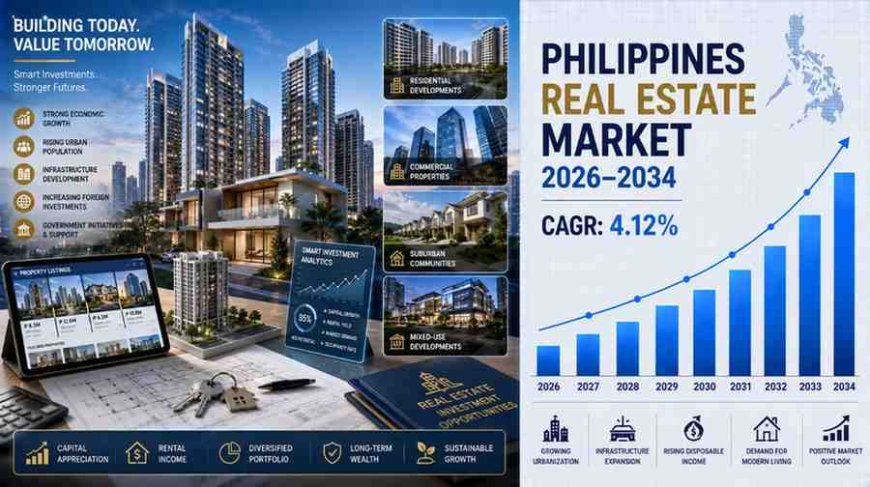
The Philippines real estate market size reached USD 94.4 Billion in 2025. Looking forward, the market is expected to reach USD 135.9 Billion by 2034, exhibiting a growth rate (CAGR) of 4.12% during 2026-2034.

Market Overview
The Philippines real estate market size reached USD 94.4 Billion in 2025 and is projected to reach USD 135.9 Billion by 2034, growing at a compound annual growth rate of 4.12% from 2026–2034. The market is expanding driven by rapid urbanisation concentrating 48.7% of the population in urban areas, sustained BPO sector growth anchoring commercial office and residential demand across Metro Manila, Cebu, and Davao, and robust OFW remittance inflows exceeding USD 38 billion annually sustaining residential property investment. The September 2025 landmark law extending private land lease limits to 99 years for foreign investors, major developers committing over USD 2 billion in new project investments in June 2025, the residential property price index recording 6.7% year-on-year growth in Q4 2024, and outstanding residential real estate loans accelerating to 16.3% annual growth in 2024 are collectively reinforcing the market's strong and sustained growth trajectory throughout the forecast period.
Request for Sample Report: https://www.imarcgroup.com/philippines-real-estate-market/requestsample
Market Trends
Urbanisation and Expanding Middle-Class Demand
The Philippines' sustained urbanisation trajectory — with 56.43 million individuals or 48.7% of the total population residing in urban areas as of 2024 — is generating structurally reliable and growing demand for residential and commercial property across Metro Manila, Cebu, and Davao. Rising middle-class households are prioritising homeownership, accelerating demand for affordable and mid-range vertical developments, gated communities, and co-living spaces proximate to employment hubs. Developers are responding with innovative mixed-use solutions merging residential units with retail, office, and recreational spaces, reflecting growing consumer preference for integrated urban living convenience across the archipelago's major metropolitan centres.
Infrastructure Expansion and Transit-Oriented Development
The Philippine government's "Build, Better, More" infrastructure programme is reshaping real estate demand patterns by progressively improving transport connectivity between Metro Manila and previously underdeveloped peri-urban and provincial corridors. Major railway, expressway, and airport projects — including the North-South Commuter Railway and Metro Manila Subway — are catalysing transit-oriented residential and commercial development clusters around new infrastructure nodes. The March 2024 announcement of the US-Philippines Luzon Economic Corridor underscored the bilateral commitment to infrastructure-led growth, with improved connectivity elevating property values along development corridors and attracting multinational corporations into well-connected regional business hubs.
Rise of Mixed-Use, Sustainable, and Smart Developments
Developers across the Philippines are increasingly delivering master-planned mixed-use communities integrating residential, commercial, and recreational components — a format that directly addresses Metro Manila's chronic traffic congestion by enabling live-work-play convenience within single developments. Simultaneously, green building certifications are gaining commercial traction, with 32% of office transactions in the first nine months of 2023 occurring in LEED-certified buildings — forecast to reach 47% of new office towers between 2024 and 2026. Smart home technology adoption is accelerating, with 10.4% of Filipinos owning at least one smart device by 2023, compelling developers to integrate intelligent building systems into premium residential and commercial offerings.
Market Growth Drivers
Thriving BPO Sector and Commercial Real Estate Demand
The Philippines' sustained position as a leading global BPO destination is a primary structural demand driver for both commercial office and supporting residential real estate across Metro Manila, Cebu, Iloilo, and Davao. BPO expansion is attracting a continuous stream of young professionals into urban business districts, generating consistent demand for condominiums, rental apartments, and co-living facilities near commercial hubs. Colliers projects office vacancy rates in the secondary market declining from 15% in 2024 to approximately 10% by end-2026 as BPO seat demand returns, confirming the sector's durable role as the Philippines commercial real estate market's most structurally reliable occupancy driver throughout the forecast period.
OFW Remittances and Foreign Investor Access Reforms
OFW remittances — projected to reach USD 39 billion in 2024 and remaining robust above USD 38 billion annually — represent a critical and structurally reliable capital source sustaining residential property demand across mid-range and premium segments nationwide. Filipino workers abroad consistently channel earnings into home acquisitions for families, condominium investments in Metro Manila, Cebu, and Davao, and gated community properties offering rental yield and long-term capital appreciation. The September 2025 landmark legislation extending private land lease limits to 99 years for foreign investors — up from the previous 50-year plus 25-year extension framework — materially improves the Philippines' foreign investment attractiveness and is expected to accelerate foreign capital deployment into commercial, industrial, and tourism real estate throughout the forecast period.
PropTech Adoption and Real Estate Digitalisation
Digital transformation is fundamentally reshaping the Philippines real estate market operational model, with PropTech platforms enabling virtual property tours, AI-driven recommendations, online payment systems, and remote transaction completion that extend market accessibility beyond Metro Manila's geographic constraints. The pandemic-accelerated transition to digital property discovery and transactional platforms permanently elevated tech-savvy buyer expectations and broadened the addressable investor pool to include international OFW buyers and foreign investors evaluating Philippine properties remotely. Government digitalization reform initiatives — including online land titling, building permit applications, and GIS-integrated land records — are progressively improving transaction transparency and investor confidence across a market historically constrained by paper-based and manual administrative processes.
Porter's Five Forces Analysis of the Philippines Real Estate Market
1. Threat of New Entrants — Low to Moderate
- High capital requirements for land acquisition, development financing, and multi-year project delivery create substantial entry barriers favouring established conglomerates including Ayala Land, SM Prime, Megaworld, and DMCI Homes over smaller new market participants lacking equivalent balance sheet capacity and regulatory relationships
- Foreign ownership restrictions limiting direct land purchase to Filipino nationals or majority Filipino-owned corporations continue to constrain international developer market entry, compelling joint ventures or long-term leasehold structures that add operational complexity and legal cost for incoming foreign participants
- The September 2025 extension of land lease limits to 99 years for foreign investors modestly lowers structural barriers for international real estate capital, potentially broadening the competitive landscape in commercial, tourism, and industrial property segments over the forecast period
2. Bargaining Power of Suppliers — Moderate
- Construction contractors, civil engineering firms, and skilled building trades personnel hold moderate leverage given persistent labour shortage pressures and the rapid expansion of infrastructure and residential development activity competing for the same qualified workforce across the archipelago
- Land owners in supply-constrained Metro Manila submarkets — including BGC, Makati CBD, and Ortigas Center — exercise meaningful pricing leverage, with strategically located development-ready parcels commanding significant premiums over comparable peripheral sites with lower connectivity
- Building material suppliers face moderate collective leverage given global commodity price exposure, though the Philippines' active construction market supports a sufficiently diverse domestic and import supply base that prevents excessive individual supplier concentration in standard material categories
3. Bargaining Power of Buyers — Moderate to High
- Individual property buyers benefit from online listing platforms including Lamudi, Property24, and developer direct digital channels that provide comprehensive market intelligence, comparable transaction data, and project specification comparison across competing developments and price tiers
- Large corporate occupiers and BPO operators procuring significant office floor areas exercise strong lease negotiation leverage through volume commitments, long-term tenancy durations, and the ability to drive competitive building selection processes among multiple qualified landlords in Metro Manila's major business districts
- OFW buyers — while individually price-sensitive — demonstrate strong brand loyalty toward established developers offering OFW-specific payment schemes and instalment structures aligned with overseas income remittance cycles, moderately constraining this segment's comparative price negotiation leverage
4. Threat of Substitutes — Low
- Residential property ownership has no genuine functional substitute in the Philippine cultural and financial context, where homeownership remains the primary wealth accumulation strategy and generational aspiration for the majority of Filipino household balance sheets across all income segments
- Long-term rental in professionally managed condominium and apartment developments represents a growing lifestyle alternative for younger urban professionals, but provides no capital appreciation participation and limited tenure security compared to ownership, preserving strong structural homeownership demand
- Commercial office occupancy faces modest substitution from hybrid and remote work arrangements that reduce per-employee space requirements, though BPO operations — which require secure, supervised, on-site work environments — are structurally resistant to meaningful workspace substitution and maintain consistent commercial real estate demand
5. Competitive Rivalry — High
- Major property conglomerates including Ayala Land, SM Prime Holdings, Megaworld Corporation, Robinsons Land, DMCI Homes, and Filinvest Land compete intensely across residential, commercial, and mixed-use segments through brand equity, project scale, master-planned township development, and integrated amenity offerings across Metro Manila and key regional cities
- The decentralisation of real estate investment beyond Metro Manila into Cebu, Clark, Iloilo, Bacolod, and Davao is intensifying regional competitive rivalry as established national developers enter previously localised markets alongside regional specialists, compressing development margins and accelerating product quality standards in secondary city submarkets
- Industrial and logistics real estate is emerging as a new competitive frontier attracting both domestic property developers and international logistics real estate specialists — including players targeting the Batangas, Subic, and Clark corridors — progressively intensifying rivalry in a segment that was previously underserved by institutional grade investment product
Market Segments
By Property:
- Residential
- Commercial
- Industrial
- Land
By Business:
- Sales
- Rental
By Mode:
- Online
- Offline
By Region:
- Luzon
- Visayas
- Mindanao
Competitive Landscape
The market research report has provided a comprehensive analysis of the competitive landscape in the Philippines real estate market. A competitive analysis covering market structure, key player positioning, top winning strategies, a competitive dashboard, and a company evaluation quadrant with detailed profiles of all major companies has been included in the report. Key participants, including Ayala Land Inc., SM Prime Holdings, Megaworld Corporation, Robinsons Land Corporation, DMCI Homes, and Filinvest Land, compete across residential, commercial, industrial, and land segments through township development, transit-oriented project positioning, green building certification investment, Proptech adoption, and OFW-targeted payment scheme innovation throughout Luzon, Visayas, and Mindanao.
Latest News and Developments
May 2026: The collapse of a condo-hotel project in Angeles City prompted renewed scrutiny of construction and real estate development practices in the Philippines. Authorities launched investigations into permitting, structural compliance, and project oversight, raising concerns about governance standards in the property sector.
May 2026: Property developers and investors continued to focus on regional growth hubs outside Metro Manila, with increasing interest in mixed-use developments and emerging urban centers driven by infrastructure expansion and decentralization trends.
April 2026: Commercial real estate activity remained active as market participants tracked office, retail, and industrial property demand trends. Industry reports highlighted ongoing adjustments in supply, occupancy, and pricing across key Philippine real estate segments.
March 2026: Industry analysts reported that the Philippine real estate sector was facing a more challenging operating environment due to economic uncertainty and slower market activity, prompting developers to focus on resilient asset classes and strategic project launches.
February 2026: Investor sentiment toward Asia-Pacific real estate reached its highest level in four years, according to a CBRE survey, supporting expectations of stronger capital flows into regional property markets, including the Philippines.
Note: If you require any specific information that is not currently covered within the scope of the report, we will provide the same as a part of the customisation.
Speak to an analyst for a customized sample report: https://www.imarcgroup.com/request?type=report&id=28690&flag=C
About Us
IMARC Group is a global management consulting firm that helps the world's most ambitious changemakers to create a lasting impact. The company provides a comprehensive suite of market entry and expansion services. IMARC offerings include thorough market assessment, feasibility studies, company incorporation assistance, factory setup support, regulatory approvals and licensing navigation, branding, marketing and sales strategies, competitive landscape and benchmarking analyses, pricing and cost research, and procurement research.
Contact Us
IMARC Group
134 N 4th St., Brooklyn, NY 11249, USA
Email: sales@imarcgroup.com
Tel No.: (D) +91 120 433 0800
United States: +1-201-971-6302
What's Your Reaction?