


































Custom Primary Research: Services, Methods & Benefits
Explore Custom Primary Research, its methods, benefits, and applications. Learn how tailored research services help businesses make informed decisions.
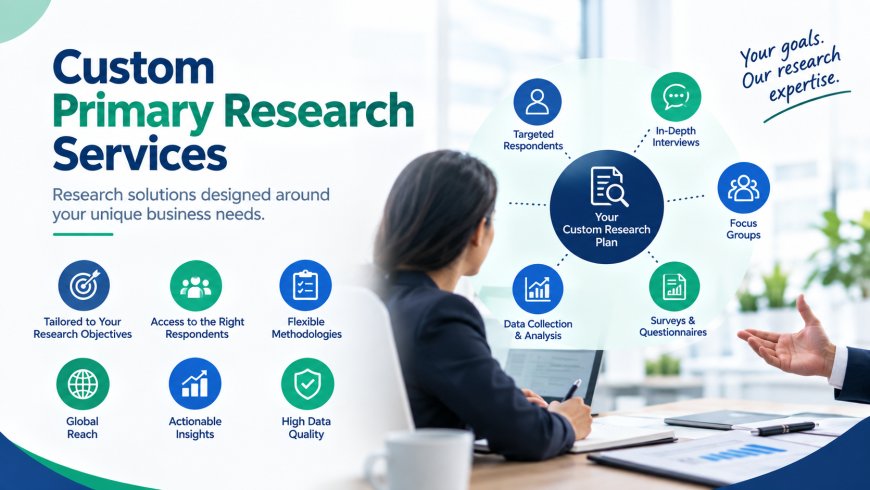
Custom Primary Research: Tailored Research Solutions for Better Business Decisions
Every business faces unique challenges, from understanding changing customer expectations to evaluating new market opportunities and identifying the factors influencing purchasing decisions. While existing reports and general market studies can provide useful background information, they may not address the specific questions an organization needs to answer. This is where Custom Primary Research becomes valuable.
Custom Primary Research enables businesses to collect original data tailored to their objectives, target audiences, industries, and research requirements. Instead of relying entirely on existing information, organizations can design research studies that address their individual business questions and provide relevant evidence for decision-making.
Through customized research methodologies, targeted respondent recruitment, and structured data collection, businesses can gain a clearer understanding of their markets, customers, competitors, and industry dynamics. Whether an organization is exploring a new opportunity, validating a business concept, or investigating a specific market challenge, tailored research can help bridge information gaps.
In this article, we explore what Custom Primary Research involves, why it matters, how businesses can use it, and what to consider when selecting a research partner.
What Is Custom Primary Research?
Custom Primary Research is the process of collecting original data specifically designed to answer a business's research questions. Unlike syndicated reports or standardized studies, which provide information developed for a broader audience, customized research focuses on the particular objectives and information needs of an individual organization.
The research process begins by identifying the business problem, defining the information required, and determining the appropriate audience and methodology. Researchers then develop a study tailored to these requirements, collect relevant data, and analyze the findings to support informed decisions.
For example, a company planning to introduce a new product may need to understand how a particular customer segment perceives the concept, which features matter most, and what barriers could affect adoption. A general industry report might provide an overview of the market, but a custom research study can investigate these specific questions directly with the intended audience.
Custom Primary Research can involve qualitative methods, quantitative methods, or a combination of both, depending on the objectives of the study.
Key Characteristics of Custom Primary Research
Custom Primary Research typically includes several defining characteristics:
-
Objective-specific design: The research is developed around clearly defined business questions.
-
Targeted audience selection: Participants are recruited according to relevant demographic, professional, behavioral, or industry criteria.
-
Flexible methodology: Research methods are selected based on the information required.
-
Original data collection: Findings are generated through direct engagement with respondents or other relevant primary sources.
-
Purpose-driven analysis: Data collection and interpretation remain focused on the decisions the research needs to support.
These characteristics make customized research particularly useful when businesses require information that existing studies cannot adequately provide.
Why Do Businesses Need Custom Primary Research?
Business decisions often involve uncertainty. Organizations may understand their overall market but lack detailed information about a specific customer group, product category, purchasing behavior, or commercial opportunity.
Custom Primary Research helps address these information gaps by collecting evidence directly related to the business challenge.
1. Address Specific Business Questions
Every organization operates within a distinct context. A business may need to understand why customers are switching providers, what prevents potential buyers from adopting a product, or how decision-makers evaluate competing solutions.
Standardized research may not explore these questions in sufficient detail. Customized research allows organizations to define the scope of an investigation around the exact information they need.
This focused approach helps ensure that research findings are relevant to the decisions under consideration.
2. Understand Customers and Target Audiences
Understanding customer needs requires more than knowing basic demographic characteristics. Businesses may also need to explore preferences, motivations, expectations, perceptions, and purchasing considerations.
Custom Market Research can help organizations investigate these factors by collecting information directly from selected audiences.
For example, a company may research how different customer groups evaluate product features, what influences brand selection, or which service improvements would create greater value.
These insights can inform product development, marketing communication, customer engagement, and service improvement initiatives.
3. Evaluate New Market Opportunities
Entering a new market or expanding into an existing one requires a clear understanding of customer expectations, purchasing behavior, market conditions, and potential barriers.
Custom Primary Research allows businesses to investigate specific markets and audiences rather than relying solely on broad industry information.
Organizations can use the findings to evaluate customer demand, understand unmet needs, identify relevant market segments, and assess the suitability of a proposed offering.
Although research cannot eliminate uncertainty, it can provide evidence that helps businesses evaluate opportunities more systematically.
4. Reduce Information Gaps Before Major Decisions
Launching a product, changing a pricing strategy, or investing in a new customer segment can involve significant resources.
Making these decisions without adequate evidence may expose an organization to avoidable risks. Customized research can help decision-makers examine assumptions, understand stakeholder perspectives, and identify potential challenges before committing resources.
The value of the research depends on the quality of its design, the relevance of its respondents, and the reliability of the collected data.
5. Generate Insights Relevant to Business Objectives
Generic research findings may be informative without being sufficiently specific to guide an individual organization.
Customized Primary Research focuses on the company's own objectives, making it possible to investigate particular audiences, geographic markets, business models, or product categories.
This relevance helps organizations connect research findings with practical business questions and define more informed next steps.
Types of Custom Primary Research
Custom Primary Research can be conducted through several methodologies. The appropriate approach depends on the research objectives, target audience, complexity of the questions, and type of information required.
1. Qualitative Research
Qualitative research explores the reasons behind people's opinions, decisions, experiences, and behaviors. It is particularly useful when businesses need a deeper understanding of a subject rather than a numerical measurement of its prevalence.
Common qualitative methods include:
-
In-depth interviews
-
Focus group discussions
-
Online qualitative interviews
-
Observational research
-
Exploratory discussions with relevant stakeholders
For example, a business may conduct interviews with customers to understand why they prefer one service provider over another. The findings can reveal motivations, concerns, and expectations that may not emerge from structured surveys alone.
Qualitative research is valuable for exploration, but its findings should not automatically be interpreted as representative of an entire population.
2. Quantitative Research
Quantitative research collects structured data that can be analyzed numerically. It is useful for measuring preferences, evaluating perceptions, comparing audience segments, and identifying patterns across a defined sample.
Common methods include:
-
Online surveys
-
Telephone surveys
-
Structured interviews
-
Customer and stakeholder surveys
-
Quantitative concept testing
For example, a business may survey a defined group of potential buyers to measure awareness of a product category, compare preferences for different features, or understand reported purchase intentions.
The reliability and generalizability of quantitative findings depend on factors such as sampling design, questionnaire quality, respondent selection, and data quality.
3. Mixed-Method Research
Mixed-method research combines qualitative and quantitative approaches within a coordinated study.
This approach can be useful when an organization needs to understand both the reasons behind a behavior and the extent to which a finding appears across a target population.
For instance, researchers may begin with interviews to identify the factors influencing product selection. These findings can then inform a structured survey designed to measure the importance of those factors among a larger group of relevant respondents.
By combining different forms of evidence, businesses can develop a more comprehensive understanding of the research question.
4. B2B Custom Research
Business-to-business research focuses on organizations, professionals, and decision-makers involved in commercial purchasing or industry-specific activities.
B2B Custom Primary Research may investigate:
-
Purchasing criteria and supplier selection
-
Business challenges and operational priorities
-
Product or service adoption
-
Industry-specific requirements
-
Decision-making processes
-
Customer and partner perceptions
Because B2B audiences can be specialized or difficult to reach, respondent recruitment and eligibility verification are particularly important.
A carefully designed study helps ensure that the collected information comes from participants with relevant professional experience or decision-making responsibilities.
5. Customer and Market-Specific Research
Some studies focus on a defined customer segment, geographic market, product category, or industry.
Examples include research involving existing customers, prospective buyers, distributors, industry professionals, or other relevant stakeholders.
By defining the audience and research scope carefully, organizations can investigate questions that broad market studies may not address in sufficient detail.
Custom Primary Research vs. Standard Market Research
Custom Primary Research and standard market research serve related but different purposes. Understanding the distinction helps organizations determine which approach best fits their objectives.
| Comparison Factor | Custom Primary Research | Standard or Syndicated Research |
|---|---|---|
| Research objectives | Designed around a specific organization's questions | Developed for a broader audience or predefined information need |
| Data collection | Original data collected for the individual study | May use existing datasets, previously collected information, or standardized research |
| Audience selection | Can target a defined audience based on study requirements | Audience coverage depends on the existing research |
| Methodology | Adapted to the research objectives | Determined by the provider's established study design |
| Flexibility | Research scope and questions can be customized | Customization may be limited |
| Main advantage | Provides evidence tailored to a specific business challenge | Can offer convenient access to existing market information |
| Consideration | Requires study design, recruitment, fieldwork, and analysis | May not answer highly specific business questions |
Neither approach is universally superior. Existing research can provide valuable context and help organizations understand the broader market. Custom Primary Research becomes particularly useful when decision-makers need original information tailored to a specific audience or question.
In many cases, combining existing market information with customized primary data can provide a stronger foundation for analysis.
What Are Custom Primary Research Services?
Custom Primary Research Services support organizations throughout the process of designing and conducting research tailored to their requirements.
The scope of these services varies by provider and project. Depending on the study, support may include research planning, respondent recruitment, questionnaire development, qualitative and quantitative fieldwork, data collection, quality checks, and research reporting.
The objective is to develop a research process that aligns with the business question and produces relevant, dependable information.
Research Planning and Study Design
A successful study begins with a clear understanding of the business problem.
Research planning involves translating business objectives into research questions, identifying the target audience, determining the information required, and selecting suitable methods.
A well-defined design also establishes the scope of the study, participant eligibility criteria, data requirements, and quality expectations.
Respondent Recruitment
Respondent recruitment involves identifying and engaging individuals who meet the study's participation criteria.
Depending on the project, participants may include consumers, business professionals, industry specialists, customers, or other relevant stakeholders.
Recruitment quality is important because even a well-designed questionnaire cannot produce relevant findings if the participants do not represent the intended audience or possess the required experience.
Eligibility screening, participant verification, and appropriate recruitment procedures help support data reliability.
Quantitative and Qualitative Fieldwork
Fieldwork is the stage during which researchers collect information from the selected respondents.
Qualitative fieldwork may involve interviews or focus groups, while quantitative fieldwork may involve structured surveys or interviews.
The appropriate method depends on the research questions, audience characteristics, study objectives, and practical requirements.
Consistent fieldwork procedures help maintain the quality and comparability of collected information.
Data Collection and Quality Control
Reliable findings depend on collecting accurate and relevant information.
Research quality measures may include respondent eligibility checks, questionnaire testing, response validation, monitoring for duplicate or inconsistent submissions, and reviewing fieldwork progress.
The specific checks required depend on the research method and study design.
Quality control should be incorporated throughout the research process rather than treated as a final administrative step.
Data Preparation and Research Reporting
Once data collection is complete, information may need to be reviewed, organized, validated, and prepared for analysis.
Research reporting then presents the findings in a format appropriate to the organization's objectives.
A useful report should clearly distinguish observed findings from interpretation, explain relevant limitations, and connect the evidence to the business questions that initiated the study.
How to Design an Effective Custom Research Study
A successful Custom Research Study requires more than choosing a methodology or preparing a questionnaire. It involves a structured process that connects the business objective with the right audience, reliable data collection, and actionable interpretation.
Step 1: Define the Business Problem
Begin by identifying the decision the organization needs to make.
The research objective should describe the information required to support that decision.
For example, instead of using a broad objective such as understanding customer preferences, a business might investigate which product attributes influence selection among a specific customer segment.
Clear objectives help prevent unnecessary questions and keep the study focused.
Step 2: Identify the Target Audience
Determine whose perspectives or experiences are necessary to answer the research questions.
Depending on the project, the target audience may include current customers, prospective buyers, purchasing managers, technical specialists, distributors, or other stakeholders.
Define relevant inclusion and exclusion criteria before recruitment begins.
These criteria help researchers identify participants who can provide appropriate information for the study.
Step 3: Select the Research Methodology
Choose the methodology based on the nature of the research question.
Qualitative research is often suitable for exploring unfamiliar topics, motivations, and experiences. Quantitative research is useful for measuring defined variables across a sample. Mixed-method research can combine exploratory understanding with structured measurement.
The choice should also consider feasibility, audience accessibility, data requirements, and the intended use of the findings.
Step 4: Develop Research Instruments
Research instruments may include interview guides, questionnaires, discussion guides, or screening forms.
Questions should be clear, neutral, and aligned with the study objectives.
Avoid wording that suggests a preferred answer, combines multiple questions into one, or assumes that respondents have experiences they may not have had.
Testing research instruments before full fieldwork can help identify unclear questions and practical issues.
Step 5: Establish Recruitment and Sampling Requirements
Define how participants will be selected and what constitutes an eligible respondent.
For quantitative studies, the sampling approach and sample size should reflect the research objectives and desired level of precision. For qualitative studies, recruitment should prioritize relevance, experience, and the depth of information needed.
Specialized or low-incidence audiences may require additional screening and recruitment planning.
Step 6: Conduct Fieldwork and Monitor Quality
During data collection, monitor recruitment progress, respondent eligibility, completion rates, and emerging quality concerns.
Apply suitable validation procedures to identify duplicate, incomplete, inconsistent, or otherwise questionable responses.
Where necessary, review fieldwork procedures and address issues before they compromise the study.
Step 7: Analyze the Findings
Analysis should address the original research questions rather than simply describe the data collected.
Depending on the study, this may involve identifying themes, comparing respondent groups, measuring preferences, examining patterns, or exploring relationships between variables.
Researchers should avoid treating correlation as proof of causation or presenting limited findings as universally applicable.
Step 8: Translate Findings Into Business Implications
The final stage connects the research evidence with the decisions the organization needs to make.
A useful research output identifies the key findings, explains their relevance, acknowledges limitations, and highlights areas where further investigation may be required.
This makes the study more useful to stakeholders who need to apply the results to business planning or operational decisions.
Industries That Can Benefit From Custom Market Research
Custom Market Research can support organizations across industries because businesses in different sectors face distinct information requirements.
Consumer Goods and Retail
Retailers and consumer goods companies may use customized research to understand shopping preferences, product perceptions, brand selection, and customer expectations.
Research can help organizations investigate specific customer segments, evaluate product concepts, and explore factors influencing purchasing behavior.
Healthcare and Life Sciences
Healthcare-related research may involve qualified professionals, patients, caregivers, or other relevant stakeholders, depending on the study's objectives and applicable requirements.
Organizations may use customized studies to explore stakeholder experiences, service expectations, product perceptions, and professional decision-making processes.
Research involving sensitive information or regulated audiences requires appropriate privacy safeguards and ethical procedures.
Technology and Software
Technology businesses may need to understand adoption barriers, user expectations, feature priorities, and purchasing considerations.
Custom research can help organizations investigate how different user groups evaluate solutions and what factors influence their selection or continued use.
These findings may inform product development, positioning, and customer engagement strategies.
Manufacturing and Industrial Markets
Industrial businesses often serve specialized audiences with distinct technical, operational, and purchasing requirements.
Customized research can engage procurement professionals, engineers, distributors, business leaders, and other relevant stakeholders to understand supplier selection, product requirements, and operational challenges.
Financial and Professional Services
Financial and professional service providers may use research to explore customer expectations, service preferences, decision-making factors, and perceptions of existing offerings.
The research design should reflect the audience, subject matter, and any applicable confidentiality or compliance requirements.
Travel, Hospitality, and Consumer Services
Organizations in travel, hospitality, and other consumer services may investigate customer expectations, service experiences, booking preferences, and factors influencing repeat business.
Custom research can help identify specific areas for improvement and provide a clearer understanding of the needs of selected customer groups.
Common Challenges in Custom Primary Research
Although customized research offers flexibility, its effectiveness depends on how well the study is planned and executed.
Unclear Research Objectives
Broad or poorly defined objectives can lead to lengthy questionnaires, irrelevant data, and findings that do not answer the original business question.
How to address it: Define the business decision first, then identify the specific information required to support it.
Difficulty Reaching the Right Respondents
Some audiences are difficult to identify or recruit, particularly when research requires specialized knowledge, professional experience, or membership in a narrow population.
How to address it: Establish clear eligibility criteria, select suitable recruitment channels, and incorporate appropriate screening and verification procedures.
Poor Questionnaire Design
Leading, ambiguous, or overly complex questions can affect how respondents interpret and answer a survey.
How to address it: Use clear language, align questions with research objectives, and test instruments before beginning full-scale data collection.
Inconsistent Data Quality
Duplicate responses, incomplete answers, inaccurate information, and unsuitable participants can weaken the reliability of research findings.
How to address it: Apply appropriate quality checks throughout recruitment, fieldwork, and data preparation.
Misinterpreting Research Findings
Research findings may be overgeneralized when sample limitations, respondent characteristics, or methodological constraints are ignored.
How to address it: Interpret findings in the context of the study design, explain limitations, and avoid claims that go beyond the available evidence.
Limited Alignment With Business Decisions
Even technically sound research may have limited value if its findings are not connected to the organization's actual needs.
How to address it: Involve relevant stakeholders during study planning and structure reporting around the questions that decision-makers need answered.
How to Choose the Right Custom Primary Research Partner
Selecting a research partner is an important consideration when an organization requires customized data collection and reliable findings.
The right partner should understand the research objectives, work with the appropriate audience, and follow a process that supports data quality.
Consider the following factors when evaluating potential providers.
1. Research Design Capabilities
Assess whether the provider can translate business questions into a clear research design.
The proposed methodology should reflect the objectives, audience, and type of evidence required rather than relying on a standard approach for every project.
2. Respondent Recruitment Expertise
Determine whether the provider can reach the intended audience and apply appropriate screening procedures.
For specialized B2B or niche audiences, ask how participant eligibility and relevant experience will be assessed.
3. Fieldwork and Data Collection Processes
Understand how the provider manages recruitment, fieldwork, data collection, and quality monitoring.
A clearly defined process helps establish expectations and provides greater visibility into how the research will be conducted.
4. Quality Assurance Practices
Ask which checks will be used to assess respondent eligibility, identify inconsistent data, and maintain the integrity of the collected information.
Quality assurance procedures should be appropriate to the research methodology and the risks associated with the study.
5. Geographic and Audience Requirements
If the study involves multiple markets or specialized respondent groups, confirm that the proposed research approach can accommodate the required audiences and locations.
The provider should clearly communicate any recruitment constraints or methodological considerations that may affect the study.
6. Communication and Project Coordination
Research projects benefit from clear communication about timelines, recruitment progress, fieldwork requirements, and emerging challenges.
Agreeing on responsibilities and reporting expectations at the beginning can help stakeholders manage the project effectively.
7. Alignment With Research Objectives
Ultimately, the provider should understand what the organization needs to learn and why that information matters.
A strong research partnership focuses on the relevance and quality of the evidence rather than simply completing data collection activities.
Why Custom Primary Research Matters for Long-Term Business Planning
Custom Primary Research can contribute to long-term planning by helping organizations develop a more evidence-based understanding of their customers, markets, and stakeholders.
Rather than treating research as a one-time activity, businesses can use customized studies to investigate emerging questions as their needs evolve.
How IMARC Pulse Supports Custom Primary Research
IMARC Pulse specializes in primary research and global fieldwork, helping organizations connect with the people who shape their markets. Its work includes respondent recruitment, quantitative and qualitative fieldwork, data collection, and research quality services across industries and global markets.
For organizations undertaking Custom Primary Research, these capabilities are relevant to building a research process around defined business objectives and target audiences.
Depending on the requirements of a study, customized research may involve identifying suitable respondents, conducting quantitative or qualitative fieldwork, collecting information, and applying appropriate quality measures to support data reliability.
By emphasizing rigorous fieldwork and verified data, IMARC Pulse aims to help organizations obtain reliable research inputs that support informed business decisions.
Organizations considering a Custom Research Study should begin by defining the questions they need answered, identifying the audiences they need to reach, and determining the type of evidence required. These decisions provide a foundation for developing a research approach that fits their objectives.
Conclusion
Custom Primary Research helps organizations investigate business questions that cannot be fully addressed through general market information alone. By tailoring research objectives, respondent selection, methodologies, and data collection to specific requirements, businesses can obtain evidence that is more relevant to their decisions.
From understanding customer expectations and evaluating market opportunities to investigating specialized B2B audiences, customized research can help organizations identify information gaps and assess important business assumptions.
Frequently Asked Questions About Custom Primary Research
1. What is Custom Primary Research?
Custom Primary Research is the collection of original data designed to answer a specific organization's research questions. It uses tailored research objectives, audience criteria, and methodologies to investigate particular business challenges or information gaps.
2. How is Custom Primary Research different from syndicated research?
Custom Primary Research is designed around an individual organization's requirements and involves collecting original information for the study. Syndicated research generally provides standardized information developed for multiple clients or a broader audience. Both can be useful, depending on the research objectives.
3. What are Custom Primary Research Services?
Custom Primary Research Services support the planning and execution of research tailored to a business's needs. Depending on the provider and project, these services may include research design, respondent recruitment, quantitative and qualitative fieldwork, data collection, quality control, and reporting.
4. When should a business consider Custom Market Research?
A business should consider Custom Market Research when existing information does not adequately answer its questions. It can be useful when evaluating a new product, investigating customer preferences, understanding a specialized audience, exploring a market opportunity, or examining a specific business challenge.
5. What methods are used in a Custom Research Study?
A Custom Research Study may use qualitative interviews, focus groups, quantitative surveys, structured interviews, or a combination of methods. The appropriate approach depends on the objectives, target audience, type of information required, and intended use of the findings.
What's Your Reaction?