




























Custom LLM Development Services: What the Process Actually Looks Like
see how custom llm development services actually work, step by step — from data to deployment. Xpiderz builds LLM systems that last.

Most articles about custom LLM development stay at the conceptual level — why it matters, why generic tools fall short, and so on. Fair enough, but at some point a business owner or CTO has to ask a more practical question: what does actually building one of these look like, step by step, and how long does it realistically take?
If you're evaluating llm development services for your company, it helps to understand the process itself, not just the pitch. Here's what a serious custom LLM engagement typically involves, from the first conversation to a system running in production.
Step One: Defining the Actual Problem
Every good custom LLM project starts narrower than people expect. Instead of "we want AI," the useful starting point is a specific, measurable problem: support tickets take too long to resolve, sales reps spend hours summarizing calls manually, employees can't find answers buried across a dozen internal wikis. A development team worth hiring will push back if the initial ask is too vague, because a vague problem produces a vague system.
This stage usually includes an audit of existing data — what's structured, what's messy, what's missing entirely. That audit shapes everything that follows, since the quality of an LLM system depends heavily on the quality of what it's trained on or retrieves from.
Step Two: Choosing the Right Foundation and Architecture
Very few custom projects start with a model trained from scratch — that's reserved for a small number of companies with massive budgets and very specific needs. Most custom LLM development services instead start with a strong existing foundation model and build the custom layer on top of it.
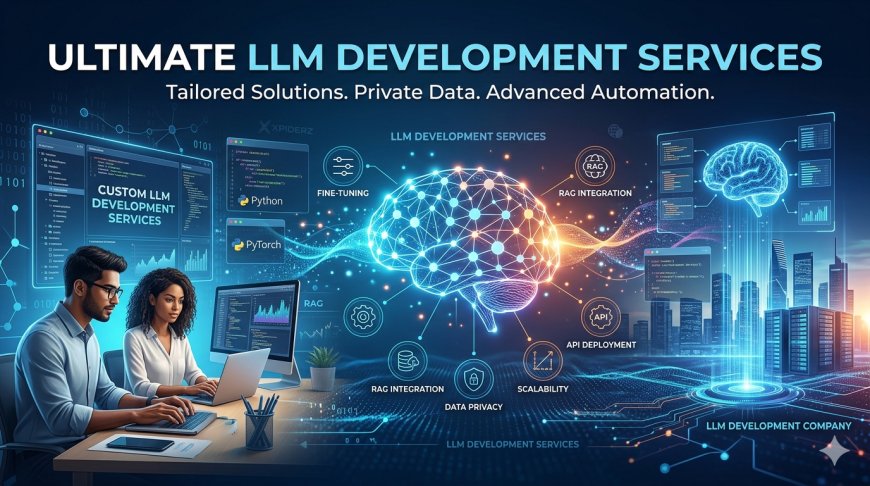
This is also where the architecture gets decided: does the system need retrieval-augmented generation to pull live, accurate data from internal systems? Does it need fine-tuning to adopt specific terminology and tone? Does it need to call external tools or APIs to actually take action, not just answer questions? These decisions shape cost, timeline, and long-term maintainability far more than which base model gets chosen.
Step Three: Building the Data and Retrieval Layer
This is often the least glamorous and most important part of the process. A model is only as useful as the information it can access. Building a reliable retrieval layer means cleaning and organizing internal documentation, connecting the system to live databases where needed, and setting up a pipeline that keeps the model's knowledge current instead of frozen at a single point in time.
Skip this step, or rush it, and the rest of the system inherits the problem — a confident-sounding assistant that quietly gives outdated or incorrect answers.
Step Four: Testing Against Real Scenarios, Not Just Demos
A demo that handles five polished sample questions proves very little. Real testing means throwing messy, ambiguous, and adversarial inputs at the system — the kind actual customers or employees send. It means checking how the system behaves when it doesn't know something, whether it hallucinates convincingly rather than admitting uncertainty, and how it performs under genuine load, not a single test conversation.
This is also where guardrails get built in — limits on what the system will and won't do, especially in regulated industries where a wrong answer carries real consequences.
Step Five: Deployment and Ongoing Monitoring
A custom LLM system isn't a one-time deliverable. Once it's live, its performance needs to be tracked — how often it resolves questions successfully, where it escalates unnecessarily, and where its answers start drifting as your business changes. Good llm development services include this monitoring layer as part of the engagement, not as an afterthought billed separately once something breaks.
Where a Company Like Xpiderz Fits Into This
Every step above requires a different kind of expertise — data engineering, model fine-tuning, retrieval architecture, testing discipline, and long-term monitoring. Few teams do all of it well. Xpiderz, a custom AI development company, structures its LLM engagements around this full lifecycle rather than just handing over a model and walking away, which matters because most of the value in a custom LLM project shows up in the parts that happen after the initial build — the retrieval accuracy, the ongoing tuning, the monitoring that catches problems before customers do.
What This Means for Your Timeline and Budget
Understanding this process helps set realistic expectations. A narrow, well-defined use case with clean existing data might move from kickoff to production in a matter of weeks. A broader system spanning multiple departments with messy, scattered data will take considerably longer — and any vendor promising an enterprise-wide AI transformation in a week or two is skipping steps that matter.
The Bottom Line
Custom LLM development isn't a single purchase — it's a process, with real engineering work at every stage from data preparation to post-launch monitoring. Companies that understand this going in tend to get systems that actually work. Companies that skip straight to "just turn on the AI" tend to get exactly what that shortcut implies.
What's Your Reaction?