




















Bludesign Vision for the Future of Corporate Interior Design Companies in India
Explore Bludesign vision for the future of corporate interior design companies in India flexibility, sustainability, and technology integrated offices.
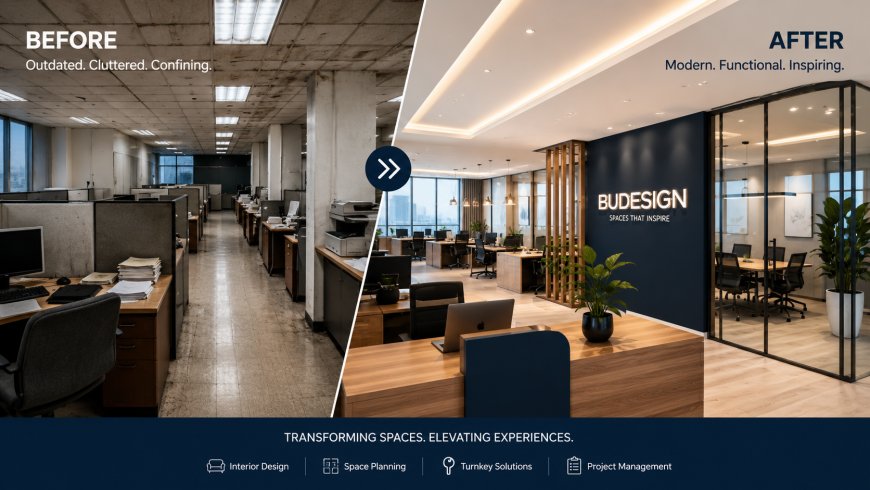
The Indian workplace has changed more in the last five years than in the previous twenty. Hybrid work, shifting employee expectations, and a growing focus on sustainability have all reshaped what businesses actually need from their offices. Corporate interior design is evolving alongside these changes and where it goes next matters for every business planning a workspace investment today.
At Bludesign, we've spent over a decade watching these shifts unfold across 50,000+ projects. Here's how we see the industry evolving, and how we're shaping our own approach around it.
Why the Future of Office Design Looks Different From Its Past
Traditional corporate offices were designed around fixed headcounts, rigid cabin structures, and uniform desk grids. That model made sense when teams were static and work happened almost entirely in person. It doesn't make sense anymore.
Today's businesses need workspaces that adapt to fluctuating attendance, support both focused and collaborative work, and reflect a company's identity clearly often across multiple locations. A modern corporate interior design company in India has to design for this ongoing change, not for a snapshot of how a business looks on day one.
Where We See the Industry Heading
1. Flexibility Will Become the Default, Not the Exception
Modular furniture systems, reconfigurable meeting spaces, and layouts that can shift with minimal disruption are becoming standard expectations rather than premium upgrades. We expect office interior design over the next few years to be judged as much on adaptability as on initial appearance.
2. Sustainability Will Shift From Optional to Expected
As more Indian businesses formalize ESG commitments, sustainable materials, energy-efficient lighting, and reduced-waste construction practices will move from a nice-to-have to a standard client requirement. We're already seeing this shift in client conversations, and it's one we expect to accelerate.
3. Technology Integration Will Be Designed In, Not Added On
Hybrid meetings, smart lighting, and integrated AV systems are increasingly expected to be part of the original design plan rather than retrofitted afterward. Offices that fail to plan for this upfront often face costly rework later.
4. Wellness-Centered Design Will Deepen
Biophilic elements, acoustic planning, and natural light optimization are moving beyond aesthetic trends into measurable factors tied to employee retention and productivity. We expect wellness considerations to become a core part of the design brief, not an afterthought layered on at the end.
5. Speed and Predictability Will Matter More Than Ever
As businesses scale faster and lease terms tighten, the ability to deliver offices on time, with minimal disruption, will become an increasingly important differentiator between design companies — arguably as important as design quality itself.
How Bludesign Is Building Toward This Future
We're not waiting for these shifts to become mainstream before adapting. Our structured 4-stage process planning, execution, monitoring, and inspection is specifically designed to accommodate flexible, technology-integrated layouts without requiring extended timelines. Immersive 3D walkthroughs, already part of every project, allow us to test adaptable design concepts with clients before committing to construction.
As a corporate interior design company in India, we're also expanding our material sourcing toward more sustainable, durable options that align with where client expectations are clearly heading, rather than treating sustainability as a separate premium tier.
What This Means for Businesses Planning Ahead
If you're planning an office project now or in the near future these shifts are worth factoring into your own decision-making:
- Choose layouts that can adapt as your team changes, not just fit your current headcount
- Ask potential design partners about their approach to sustainability and material sourcing
- Prioritize firms that plan for technology integration from the start, not as a retrofit
- Value predictability and turnkey delivery as much as design aesthetics
Businesses that factor these considerations in now will likely spend less on future rework as these trends become standard practice across the industry.
Final Thoughts
The future of corporate interior design in India is being shaped by flexibility, sustainability, and a deeper focus on how offices actually support the people using them not just how they photograph. At Bludesign, we see this evolution not as a distant trend to prepare for later, but as the standard we're already building toward in every project today.
Ready to build an office designed for where work is heading, not just where it's been?
Get a free consultation with Bludesign and start planning a workspace built for the future.
FAQs
1. How is corporate interior design in India expected to change in the coming years? Corporate interior design is shifting toward greater flexibility, sustainability, integrated technology, and wellness-centered elements, moving away from rigid, fixed-headcount office layouts.
2. Why is flexibility becoming more important in office design? Businesses today experience more frequent changes in team size and work patterns, making adaptable, modular layouts more practical than fixed, permanent office structures.
3. Is sustainability really becoming a priority in corporate office design? Yes. As more Indian businesses adopt formal ESG commitments, sustainable materials and energy-efficient design are increasingly expected as standard practice rather than optional upgrades.
4. How is Bludesign preparing for future shifts in office design? Bludesign's structured process and 3D visualization approach allow flexible, technology-integrated, and sustainable design elements to be planned in from the start of every project.
5. What should businesses consider when planning an office for the long term? Businesses should prioritize adaptable layouts, sustainable material choices, upfront technology integration, and design partners who offer predictable, turnkey delivery
What's Your Reaction?