


























Australia Waste Plastic Recycling Market Size, Share, Trends & Outlook Report 2025-2033
The Australia waste plastic recycling market size reached USD 1.2 billion in 2024 and is projected to grow to USD 2.6 billion by 2033, exhibiting a steady growth rate of 8.10% during the forecast period.

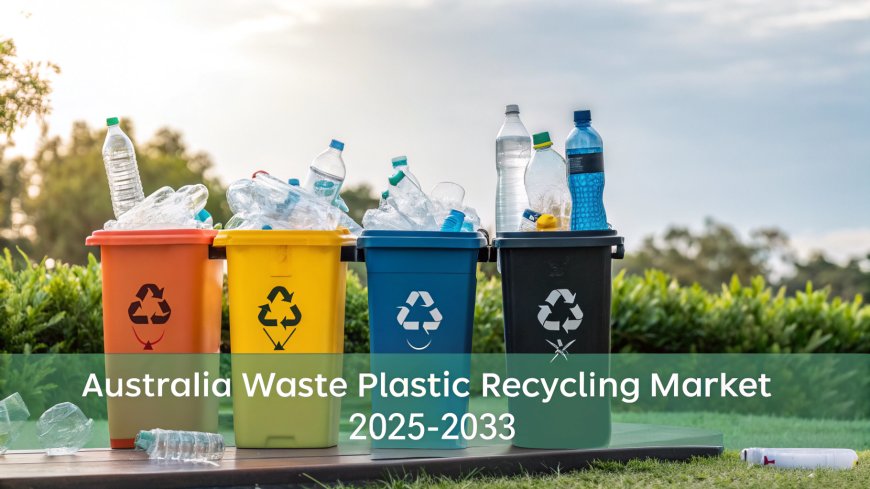
The latest report by IMARC Group, "Australia Waste Plastic Recycling Market Size, Share, Trends and Forecast by Treatment, Material, Application, Recycling Process, and Region, 2025-2033," provides an in-depth analysis of the Australia waste plastic recycling market. The report also includes competitor and regional analysis, along with a breakdown of segments within the Australia waste plastic recycling industry. The Australia waste plastic recycling market size reached USD 1.2 billion in 2024 and is projected to grow to USD 2.6 billion by 2033, exhibiting a steady growth rate of 8.10% during the forecast period.
Report Attributes and Key Statistics:
- Base Year: 2024
- Forecast Years: 2025-2033
- Historical Years: 2019-2024
- Market Size in 2024: USD 1.2 Billion
- Market Forecast in 2033: USD 2.6 Billion
- Growth Rate (2025-2033): 8.10%
Australia Waste Plastic Recycling Market Overview:
The Australia waste plastic recycling market is experiencing steady growth driven by heightening environmental awareness motivating transition toward sustainable waste management practices, policy actions including recycling mandates, landfill prohibitions, and extended producer responsibility systems guiding plastic waste processes, and country-level sustainability targets leading to better recycling infrastructure and improved management capabilities. The market demonstrates consistent momentum fueled by growing use of advanced mechanical recycling methods incorporating near-infrared sensors and AI-powered automation enhancing sorting efficiency and material recovery quality, increasing post-consumer recycled plastics usage in packaging applications particularly for food, beverage, and household products responding to environmental concerns and government mandates, and rising consumer and corporate sustainability awareness driving expectations for eco-friendly products and ESG-aligned operations. Strategic expansion is supported by technological integration in waste collection and sorting through IoT-enabled bins and RFID tracking revolutionizing monitoring and processing systems, localized recycling infrastructure expansion reducing overseas processing reliance and lowering logistics costs, and emergence of chemical recycling innovations including pyrolysis and depolymerization enabling breakdown of complex or contaminated plastics expanding recyclable material types and quality standards.
Request For Sample Report: https://www.imarcgroup.com/australia-waste-plastic-recycling-market/requestsample
Australia Waste Plastic Recycling Market Trends:
• Advanced Mechanical Technology transforming processing capabilities as near-infrared sensors and AI-powered automation enable higher volume sorting with improved accuracy lowering contamination rates and yielding quality recyclates
• Post-Consumer Recycled Demand accelerating in packaging sector as manufacturers incorporate higher amounts of recycled material responding to environmental issues, government mandates, and consumer preference for eco-friendly brands
• Chemical Recycling Emergence gaining momentum as pyrolysis and depolymerization techniques allow breakdown of complex or contaminated plastic waste into original monomers or fuels matching virgin plastic quality
• Smart Technology Integration advancing waste management through AI-powered sorting equipment, IoT-enabled collection bins, and RFID tracking solutions enhancing traceability and purity of plastic waste streams
• Localized Infrastructure Growth decentralizing system through regional and state-level facilities reducing overseas processing reliance, lowering logistics costs and carbon emissions, and creating local employment opportunities
• Circular Economy Policies shaping industry through national and state programs including recycling requirements, landfill prohibitions, and extended producer responsibility systems promoting investment and public-private partnerships
• Industrial Partnerships increasing as strategic collaborations among suppliers, manufacturers, retailers, and recyclers enable better coordination, vertical integration, and closed-loop system development
Australia Waste Plastic Recycling Market Drivers:
• Environmental Consciousness creating substantial demand as widespread awareness among Australian consumers leads to heightened expectations for sustainable products and packaging supporting recycled plastic adoption
• Government Policy Framework supporting market expansion through circular economy strategies, national recycled content goals, recycling mandates, and incentive programs facilitating innovation in sorting, processing, and re-manufacturing
• Corporate ESG Commitments driving integration as businesses adopt environmental, social, and governance targets staying competitive and socially responsible while ensuring stable demand for recycled materials
• Packaging Industry Demand motivating growth as sectors increasingly use post-consumer recycled plastics creating localized supply chains delivering consistent, contamination-free materials for food, beverage, and household applications
• Infrastructure Investment enabling capacity expansion as government-sponsored programs and private sector commitments fund advanced recycling facilities including Victoria's $50 million PET bottle recycling plant processing one billion bottles annually
• Technology Advancement improving efficiency through automated sorting systems, enhanced processing capabilities, and smart collection networks reducing contamination, lowering labor dependence, and producing high-quality secondary plastics
• Standardization Efforts facilitating market development as implementation of unified collection systems and standard recycling labeling enhances material stream quality and processing efficiency
Market Challenges:
• Contamination Issues reducing efficiency as poor waste segregation at source leads to mixed or soiled waste streams increasing processing costs, lowering recycled output quality, and resulting in non-recyclable materials sent to landfills
• Economic Viability constraining profitability as recycled plastics struggle competing with virgin plastic particularly when oil prices remain low making new plastic cheaper to produce without consistent end-user demand
• Market Volatility creating financial uncertainty as unstable dynamics, rising energy and labor costs, and absence of long-term purchasing commitments affect revenue streams and business sustainability
• Limited Standardization discouraging investment as lack of uniform national guidelines for recycled plastic quality, composition, and applications creates manufacturer hesitation over performance, safety, and regulatory compliance
• End-Market Uncertainty affecting capacity planning as absence of guaranteed offtake markets and long-term purchase agreements makes recyclers struggle securing reliable buyers limiting scalability
• Sorting Complexities complicating operations particularly in residential and commercial sectors where diverse materials disposed together require advanced automated systems and improved segregation education
• Infrastructure Gaps limiting processing capabilities particularly in remote and regional areas requiring significant capital investment for establishing adequate collection, sorting, and recycling facilities
Market Opportunities:
• Soft Plastic Recycling Restart establishing new collection pathways as Australian Competition and Consumer Commission authorizes voluntary industry-led program collecting and recycling post-consumer soft plastic packaging in supermarkets
• Chemical Recycling Investment capturing complex waste streams through pyrolysis and depolymerization technologies attracting major chemical manufacturers, energy firms, and sustainability-focused investors supporting scalability
• Export Market Development leveraging high-quality recycled resin production meeting strict environmental standards targeting Asia-Pacific countries facing infrastructure limitations seeking sustainable materials
• Vertical Integration securing stable feedstock supplies through strategic partnerships enabling companies to reduce costs, operational risks, and improve supply chain resilience while meeting compliance standards
• Advanced Facility Development modernizing processing capabilities through investments in NSW facilities like Plasrefine plant recycling 120,000 tonnes annually and Victoria's PET bottle facility handling one billion bottles yearly
• Circular Packaging Solutions differentiating brands through closed-loop systems where packaging materials return to production cycles meeting retailer commitments reducing virgin plastic use and supporting sustainability mandates
• Public-Private Collaboration accelerating deployment through coordinated investments in infrastructure, technology transfer, collection network optimization, and consumer education programs driving systemic improvements
Australia Waste Plastic Recycling Market Segmentation:
By Treatment:
- Co-Processing
- Heat Compression
- Pyrolysis
- Landfill
- Incineration
- Others
By Material:
- Poly Vinyl Chloride (PVC)
- Low-Density Polyethylene (LDPE)
- High-Density Polyethylene (HDPE)
- Polyethylene Terephthalate (PET)
- Polypropylene (PP)
- Acrylonitrile Butadiene Styrene (ABS)
- Others
By Application:
- Packaging
- Construction
- Textile
- Automotive
- Others
By Recycling Process:
- Mechanical
- Others
By Regional Distribution:
- Australia Capital Territory & New South Wales
- Victoria & Tasmania
- Queensland
- Northern Territory & Southern Australia
- Western Australia
Australia Waste Plastic Recycling Market News:
September 2025: Australian Competition and Consumer Commission announced likely authorization of new voluntary industry-led program to collect and recycle post-consumer soft plastic packaging with final determination expected following public and industry feedback review.
September 2025: Industry leaders, recyclers, and brand owners launched evidence-based analysis through Australian Council of Recycling and Australian Packaging Covenant Organisation demonstrating that shift to using Australian-made recycled plastic represents environmental and economic win.
September 2025: Research revealed "plastic blindness" phenomenon where consumers significantly underestimate their weekly plastic waste generation, highlighting critical awareness gap requiring targeted education and behavioral intervention strategies.
August 2025: Waste Management and Resource Recovery called for Australia to match global ambition on plastics domestically, emphasizing need for strengthened policies and infrastructure investments supporting circular economy transition.
Key Highlights of the Report:
- Comprehensive market analysis projecting steady growth from USD 1.2 billion in 2024 to USD 2.6 billion by 2033 with 8.10% CAGR
- Detailed examination of advanced mechanical recycling adoption incorporating near-infrared sensors and AI-powered automation enhancing sorting efficiency and material recovery quality
- Strategic assessment of post-consumer recycled plastics demand surge in packaging applications responding to environmental concerns, government mandates, and consumer eco-friendly preferences
- In-depth analysis of government circular economy policies including recycling mandates, landfill prohibitions, and extended producer responsibility systems promoting infrastructure investment
- Regional market evaluation covering Australia Capital Territory & New South Wales, Victoria & Tasmania, Queensland, Northern Territory & Southern Australia, and Western Australia with varying recycling capabilities
- Chemical recycling emergence insights highlighting pyrolysis and depolymerization technologies enabling breakdown of complex contaminated plastics expanding recyclable material types
- Smart technology integration assessment featuring AI-powered sorting, IoT-enabled collection bins, and RFID tracking revolutionizing waste monitoring and processing efficiency
Frequently Asked Questions (FAQs):
Q1: What are the primary factors driving Australia's waste plastic recycling market growth to USD 2.6 billion by 2033?
A1: The market is driven by heightening environmental awareness motivating sustainable waste management transitions, policy actions including recycling mandates, landfill prohibitions, and extended producer responsibility systems guiding plastic waste processes, and sustainability targets promoting infrastructure development. Advanced mechanical recycling adoption incorporating AI-powered automation and near-infrared sensors enhancing sorting efficiency, increasing post-consumer recycled plastics usage in packaging responding to government mandates, and corporate ESG commitments ensuring stable recycled material demand contribute to the steady 8.10% growth rate during the forecast period.
Q2: How are government policies shaping Australia's waste plastic recycling industry?
A2: Government policies fundamentally shape industry development through circular economy strategies establishing national recycled content goals for products and packaging convincing industries to adopt recycled materials. Programs including recycling requirements, landfill prohibitions, and extended producer responsibility systems promote recycling facility investments and public-private partnership cooperation. Implementation of standard recycling labeling and unified collection systems enhances material stream quality improving efficiency. Government incentive programs facilitate innovation in sorting, processing, and re-manufacturing augmenting sector capacity. These policy initiatives create predictable supportive environment enabling long-term transition to sustainable waste management solutions.
Q3: What opportunities exist for waste plastic recycling stakeholders in emerging segments?
A3: Stakeholders can capitalize on soft plastic recycling program restart as ACCC authorizes voluntary industry-led collection in supermarkets addressing previously difficult-to-recycle materials, chemical recycling investment attracting major manufacturers through pyrolysis and depolymerization technologies processing complex waste streams, and export market development leveraging high-quality Australian recycled resin meeting strict standards. Vertical integration securing stable feedstock through strategic partnerships, advanced facility development including large-scale processing plants, and circular packaging solutions creating closed-loop systems represent significant opportunities. Public-private collaboration accelerating infrastructure deployment, technology integration enhancing sorting and processing capabilities, and corporate procurement driven by ESG mandates offer pathways for market expansion and competitive differentiation.
Note: If you require specific information not currently within the scope of the report, we can provide it as part of the customization.
Ask an analyst for your customized sample: https://www.imarcgroup.com/request?type=report&id=33043&flag=C
About Us:
IMARC Group is a global management consulting firm that helps the world's most ambitious changemakers to create a lasting impact. The company provides a comprehensive suite of market entry and expansion services. IMARC offerings include market assessment, feasibility studies, company incorporation assistance, factory setup support, regulatory approvals and licensing navigation, branding, marketing and sales strategies, competitive landscape and benchmarking analyses, pricing and cost research, and procurement research.
Contact Us:
IMARC Group
134 N 4th St. Brooklyn, NY 11249, USA
Email: Sales@imarcgroup.com
Tel. No.: (D) +91 120 433 0800
Americas: +1 201-971-6302
What's Your Reaction?