

































Australia Real Estate Investment Market 2026 | Worth USD 441.4 Billion by 2034
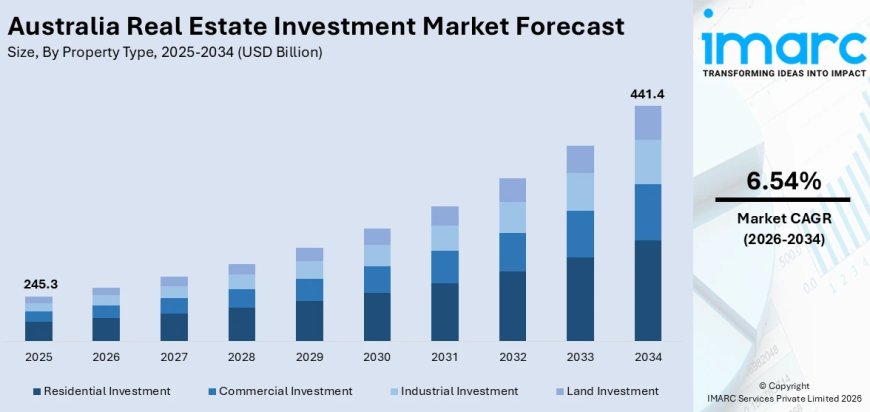
Australia real estate investment market size reached USD 245.3 Billion in 2025. Looking forward, IMARC Group expects the market to reach USD 441.4 Billion by 2034, exhibiting a growth rate (CAGR) of 6.54% during 2026-2034.

Australia Real Estate Investment Market Overview
The Australia real estate investment market is experiencing strong growth, underpinned by robust population expansion driven by record net overseas migration, rapid urbanization across major capital cities, favorable monetary policy settings, sustained infrastructure development, and the emergence of technology-driven property sectors such as data centers and logistics facilities. According to IMARC Group, the Australia real estate investment market size reached USD 245.3 Billion in 2025. Looking forward, IMARC Group expects the market to reach USD 441.4 Billion by 2034, exhibiting a growth rate (CAGR) of 6.54% during 2026-2034.
Australia's real estate investment landscape has demonstrated remarkable resilience, with the housing market staging a significant turnaround in 2025 that defied intense affordability pressures to deliver above-decade-average growth of 7.7% through the year. Regional dwelling values rose 9.7%, outperforming the combined capital cities at 8.2%, with Western Australia leading the nation at 16.1% annual growth, followed by Darwin at 18%, Perth at 13%, and Brisbane at 12%. The Reserve Bank of Australia's (RBA) decision to lower the cash rate by 0.25 percentage points to 4.1% in February 2025 has eased borrowing costs, improved buyer confidence, and further stimulated investment activity across both residential and commercial segments. Australia's population reached approximately 27.1 million as of March 2024, with an increase of 615,300 individuals representing a 2.3% growth rate, creating sustained demand for residential housing, commercial spaces, and supporting infrastructure.
The commercial and industrial real estate sectors are experiencing a structural transformation, with industrial and logistics investment volumes reaching AUD 6.7 billion in 2025 and industrial property investment values projected to surpass office space for the first time. Goodman Group is leading Australian property firms by capitalizing on the growing demand for data centers driven by artificial intelligence advancements, highlighting the shift in real estate investment trends toward technology-driven assets. Transaction volumes across commercial real estate are expected to grow 5-10% in 2026, while the office sector benefits from supply pipeline diminution that is expected to drive vacancy rates lower and support accelerating effective rental growth through 2026-2028. The real estate investment trust (REIT) sector continues to attract institutional and retail capital, with Hong Kong's Link REIT appointing a new head of Australian investment in February 2025, reflecting increasing foreign institutional interest in the country's commercial property market. These dynamics collectively position Australia's real estate investment market for sustained expansion across all property types and distribution channels.
How AI is Reshaping the Future of the Australia Real Estate Investment Market
Artificial intelligence is fundamentally transforming Australia's real estate investment landscape, enabling more accurate property valuations, intelligent portfolio management, predictive market analytics, and enhanced tenant experiences that collectively improve investment returns and reduce risk across all property segments.
- AI-Powered Property Valuation and Market Forecasting: Machine learning algorithms are revolutionizing property valuation methodologies in Australia by analyzing vast datasets encompassing historical transaction records, comparable sales, demographic trends, infrastructure development plans, rental yields, and macroeconomic indicators to generate highly accurate property valuations in real time. These AI systems can process thousands of data points simultaneously, identifying pricing patterns and market anomalies that human analysts might miss. For institutional investors managing large portfolios across Australian capital cities and regional markets, AI-driven valuation tools provide continuous portfolio revaluation that reflects current market conditions rather than periodic manual assessments. Predictive forecasting models leverage machine learning to project property price movements at suburb, corridor, and micro-market levels, enabling investors to identify emerging growth areas before prices escalate and to time their entry and exit decisions with greater precision.
- Intelligent Investment Screening and Due Diligence: AI platforms are streamlining the investment screening and due diligence processes that underpin real estate transactions in Australia. Natural language processing algorithms automatically extract and analyze critical information from lease agreements, planning documents, environmental reports, title searches, and financial statements, reducing the time and cost of due diligence while improving the thoroughness of risk assessment. Machine learning models evaluate investment opportunities against customizable criteria including target returns, risk tolerance, geographic preferences, and sector allocations, automatically ranking and shortlisting properties that match investor parameters. For REITs and institutional investors evaluating hundreds of potential acquisitions annually, AI-powered screening tools significantly improve decision-making speed and quality while reducing reliance on subjective judgment.
- AI-Enhanced Property Management and Tenant Experience: AI-driven property management platforms are transforming commercial and residential property operations across Australia, automating routine management tasks, optimizing energy consumption, predicting maintenance requirements, and enhancing tenant satisfaction. Smart building management systems powered by AI analyze occupancy patterns, weather data, and energy usage to automatically adjust heating, cooling, and lighting systems, reducing operating costs by up to 25% while improving occupant comfort. Predictive maintenance algorithms detect early signs of equipment failure in elevators, HVAC systems, and other building infrastructure, enabling proactive repairs that prevent costly emergency breakdowns and tenant disruptions. AI-powered chatbots and tenant portals handle maintenance requests, lease inquiries, and communication, improving response times and tenant satisfaction scores that directly impact rental retention rates and property values.
- AI for Data Center and Industrial Real Estate Optimization: As data centers emerge as one of Australia's fastest-growing real estate investment categories, driven by AI computing demand itself, artificial intelligence is playing a dual role as both a demand catalyst and an operational optimization tool. AI algorithms optimize data center power usage effectiveness (PUE), cooling system efficiency, and server workload distribution, directly improving the operational economics that determine investment returns. For industrial and logistics properties, AI-powered warehouse management systems optimize space utilization, inventory placement, and fulfillment workflows, increasing the productivity and therefore rental value of distribution facilities. Goodman Group's leadership in capitalizing on AI-driven data center demand exemplifies how AI is simultaneously creating new investment categories and enhancing the operational performance of existing property assets.
- AI-Driven Risk Assessment and Market Intelligence: AI-powered risk assessment tools are enabling Australian real estate investors to make more informed decisions by quantifying and monitoring risks across their portfolios in real time. Machine learning models analyze climate data, flood mapping, bushfire risk zones, and sea-level projections to assess the physical climate risk exposure of individual properties and entire portfolios, an increasingly critical consideration as extreme weather events become more frequent. Economic risk models incorporate interest rate scenarios, employment data, migration patterns, and construction pipeline analysis to forecast market conditions at granular geographic levels. For foreign investors navigating Australia's regulatory environment, including the current ban on foreign purchases of established dwellings effective from April 2025 through March 2027, AI platforms provide automated compliance monitoring and regulatory risk assessment that reduce the likelihood of costly violations.
Request a Business Sample Report for Procurement & Investment Evaluation:
https://www.imarcgroup.com/australia-real-estate-investment-market/requestsample
Australia Real Estate Investment Market Trends
Regional Markets Outperforming Capital Cities
The outperformance of regional property markets relative to traditional capital city strongholds represents one of the most significant structural trends reshaping Australia's real estate investment landscape. Regional dwelling values rose 9.7% in 2025, outperforming the combined capital city average of 8.2%, reflecting a fundamental shift in investor attention toward more affordable, high-growth markets beyond Sydney and Melbourne. Perth and Adelaide have emerged as standout performers, delivering double-digit annual growth rates driven by mining sector strength, favorable affordability ratios, and strong domestic migration inflows from higher-cost eastern seaboard cities. Darwin led all capital cities with 18% growth in 2025, followed by Perth at 13%, Brisbane at 12%, and Adelaide at 9%, while regional Queensland recorded 12.6% growth. This market fragmentation is compelling investors to adopt targeted, micro-market investment strategies rather than relying on broad city-wide or national trend assumptions. The relative affordability of regional and secondary capital markets, combined with improving local economic fundamentals, infrastructure investment, and lifestyle appeal accelerated by remote work adoption, suggests that this regional outperformance trend has structural underpinnings that will persist throughout the forecast period, creating diversified growth opportunities across Australia's real estate investment market.
Technology-Driven Property Sectors Reshaping Investment Allocations
The rapid growth of technology-driven property sectors, particularly data centers, advanced logistics facilities, and cold storage infrastructure, is fundamentally reshaping real estate investment allocations in Australia. Industrial and logistics property investment volumes reached AUD 6.7 billion in 2025, with industrial property investment values projected to surpass office space for the first time, marking a historic shift in Australia's commercial real estate hierarchy. Goodman Group has positioned itself at the forefront of this transformation, capitalizing on the exponential growth in data center demand driven by artificial intelligence computing requirements, cloud services expansion, and digital transformation across Australian businesses. Data centers, cold storage, and advanced manufacturing facilities are emerging as high-growth sub-sectors within industrial real estate, offering investors higher yields, longer lease terms, and stronger tenant covenants compared to traditional office and retail investments. East Coast industrial vacancy rates remained at a tight 3.2%, reflecting the structural undersupply that continues to support rental growth and capital appreciation in the logistics sector. E-commerce expansion is driving demand for larger, more sophisticated warehouse and distribution facilities across major logistics corridors, with tenants seeking modern, technology-enabled facilities that support automated fulfillment operations. This structural shift toward technology-driven property investments is attracting increasing institutional capital allocation and reshaping how Australian real estate portfolios are constructed and managed.
Australia Real Estate Investment Market Summary
The following bullet points provide a quick summary of the key insights from the Australia real estate investment market report:
- Market Size (2025): USD 245.3 Billion
- Market Forecast (2034): USD 441.4 Billion
- CAGR (2026-2034): 6.54%
- Key Growth Drivers: Strong population growth driven by record net overseas migration, favorable monetary policy with the RBA lowering interest rates to 4.1%, rapid urbanization across major capital and regional cities, sustained government and private sector infrastructure development, and the emergence of technology-driven property sectors including data centers and advanced logistics facilities.
- Major Industry Players: Goodman Group, Stockland, Mirvac Group, Dexus, GPT Group, Scentre Group, Charter Hall, Lendlease, Link REIT, Vicinity Centres, National Australian Bank, and Macquarie Asset Management.
Australia Real Estate Investment Market Growth Drivers
Rapid Population Growth and Migration-Driven Housing Demand
Australia's rapid population growth, primarily fueled by high rates of net overseas migration, represents the most fundamental structural driver of the real estate investment market. The nation's population reached approximately 27.1 million as of March 2024, with an annual increase of 615,300 individuals representing a 2.3% growth rate, equivalent to adding the combined populations of Canberra and Hobart within a single year. This population surge has created intense demand across all real estate sectors, with the residential market facing particularly acute pressure as increased competition for housing has elevated property values and rental costs. KPMG Australia projected annual rent growth of approximately 3.5% through 2026 and 2027, estimating that new dwelling completions would need to be approximately 17% higher than current forecasts to normalize rental growth while accommodating expected population expansion. The housing supply deficit is compounding each year as construction activity fails to keep pace with population-driven demand, creating a structural undersupply that supports both property prices and rental yields. This persistent supply-demand imbalance provides a compelling investment thesis for residential real estate, attracting both domestic and international investors seeking exposure to a market with strong demand fundamentals and limited downside risk from oversupply.
Favorable Monetary Policy and Economic Stability
Australia's economic stability and favorable monetary policy settings provide a robust foundation for sustained real estate investment growth. The RBA's decision to lower the cash rate by 0.25 percentage points to 4.1% in February 2025 eased borrowing costs for investors and homebuyers, improved buyer confidence, and stimulated transaction activity across residential and commercial property markets. Australia's diversified economy, spanning mining, agriculture, technology, financial services, and education, provides resilience against sector-specific downturns while maintaining low unemployment and a stable financial system that supports long-term real estate investment. Tax policy instruments, including negative gearing provisions that allow property investment losses to be offset against taxable income and capital gains tax concessions, enhance the after-tax returns available to property investors and encourage capital allocation toward the real estate sector. Government incentive programs, particularly those targeting first home buyers, renewable infrastructure, and regional development, create additional demand catalysts across specific market segments. The combination of economic stability, accommodative monetary policy, favorable tax treatment, and government incentive programs creates an investment environment that attracts both domestic and international capital to Australia's real estate market, supporting sustained price appreciation, rental growth, and transaction volume expansion throughout the forecast period.
Australia Real Estate Investment Market Segments
The Australia real estate investment market report provides a detailed breakup and analysis of the market based on various segments:
Breakup by Property Type: Residential Investment, Commercial Investment (Office Space, Retail Space, Leisure Space, Others), Industrial Investment (Manufacturing Plants, Warehouse/Distribution, Others), and Land Investment.
Residential investment represents the largest property type segment, driven by persistent housing supply shortages, strong population growth through migration, and favorable lending conditions. The national housing market delivered 7.7% growth in 2025, with regional markets outperforming capitals. Commercial investment encompasses office space, which is experiencing supply pipeline diminution that supports rental growth, retail space adapting to omnichannel consumer behavior, leisure properties benefiting from tourism recovery, and specialized commercial facilities. Industrial investment has emerged as the fastest-growing property type, with investment volumes reaching AUD 6.7 billion in 2025 and values projected to surpass office for the first time. The industrial segment includes manufacturing plants, warehouse and distribution centers driven by e-commerce growth, and emerging sub-sectors such as data centers and cold storage facilities. Land investment provides development optionality for investors seeking exposure to future residential, commercial, or industrial projects in growth corridors identified through infrastructure planning and demographic analysis.
Breakup by Distribution Channel: Public REIT, Private REIT, and Private Real Estate Investment.
Public REITs provide liquid, diversified exposure to Australian real estate through exchange-traded securities, offering investors access to institutional-quality property portfolios managed by established operators. Major Australian public REITs including Goodman Group, Stockland, Mirvac, Dexus, and GPT Group collectively manage tens of billions in real estate assets across residential, commercial, and industrial sectors. Private REITs offer similar pooled investment structures without exchange listing, typically targeting institutional investors and high-net-worth individuals seeking longer-term exposure with potentially higher returns and lower volatility. Private real estate investment encompasses direct property ownership by individuals, family offices, syndicates, and private companies, remaining the most prevalent investment channel for Australian property investors who value direct control over asset selection, management, and disposition decisions.
Breakup by Purpose: Sales and Rental.
Sales-oriented investment targets capital appreciation through property acquisition, value enhancement, and disposition, with investors seeking to profit from the price growth that has characterized Australian property markets. Rental-oriented investment focuses on generating ongoing income through tenant leases, with Australian rental markets experiencing sustained tightening due to population growth outpacing new supply. KPMG projected annual rent growth of approximately 3.5% through 2026-2027, with dwelling completions needing to be 17% higher than current forecasts to normalize rental growth. The combination of capital appreciation potential and reliable rental income streams makes Australian real estate attractive across both investment purposes.
Australia Real Estate Investment Market Competitive Landscape
The competitive landscape of the Australia real estate investment market features a diverse ecosystem of institutional investors, real estate investment trusts, property developers, fund managers, and international capital partners competing across residential, commercial, industrial, and land investment segments. Goodman Group has established market leadership in the industrial and logistics sector, capitalizing on AI-driven data center demand and e-commerce logistics growth to deliver strong investor returns. Stockland operates across residential communities, retail town centers, and logistics and business parks, offering diversified property exposure. Mirvac Group competes in residential, office, and industrial development, with a focus on urban transformation projects in major capital cities. Dexus manages a significant office and industrial portfolio, while GPT Group operates across office, retail, and logistics sectors. Scentre Group manages Westfield-branded shopping centers across Australia. Charter Hall has built a substantial funds management platform spanning office, industrial, retail, and social infrastructure investments. Lendlease combines property development, construction, and investment management capabilities across Australian and international markets. Among international entrants, Hong Kong's Link REIT appointed a new head of Australian investment in February 2025, signaling strategic expansion into Australia's commercial property sector. Vicinity Centres manages a major retail property portfolio, while Macquarie Asset Management and National Australian Bank provide real estate investment financing and fund management services. The competitive landscape is expected to intensify as institutional capital allocation to Australian real estate continues to grow and technology-driven property sectors attract new specialized investors.
Latest News and Development in the Australia Real Estate Investment Market
The following are some of the latest news and developments shaping the Australia real estate investment market:
- April 2025: The Australian government implemented a ban on foreign persons, including temporary residents and foreign-owned companies, purchasing established dwellings in Australia, effective through March 2027, as part of broader measures to address housing affordability concerns for domestic buyers.
- February 2025: The Reserve Bank of Australia lowered the cash rate by 0.25 percentage points to 4.1%, easing the burden on mortgage holders, improving buyer confidence, and stimulating investment activity across Australia's residential and commercial real estate sectors.
- February 2025: Hong Kong's Link REIT appointed a new head of Australian investment, indicating its strategic expansion in the country's commercial property sector and reflecting increasing foreign institutional investor interest in key Australian cities including Sydney and Melbourne.
- December 2024: Goodman Group emerged as the leading Australian property firm capitalizing on the growing demand for data centers driven by AI advancements, with its focus on digital infrastructure boosting investor confidence and highlighting the shift in real estate investment trends toward technology-driven assets.
- 2025: Australia's housing market delivered above-decade-average growth of 7.7%, with regional dwelling values rising 9.7% to outperform combined capital cities at 8.2%, and industrial property investment volumes reaching AUD 6.7 billion as the sector was projected to surpass office investment values for the first time.
Note: If you require any specific information not currently covered within the scope of the report, IMARC Group will provide it as part of customization.
Speak to an analyst:
https://www.imarcgroup.com/request?type=report&id=32705&flag=E
What's Your Reaction?