































Australia E-Invoicing Market 2026 | Worth USD 1,854.5 Million by 2034
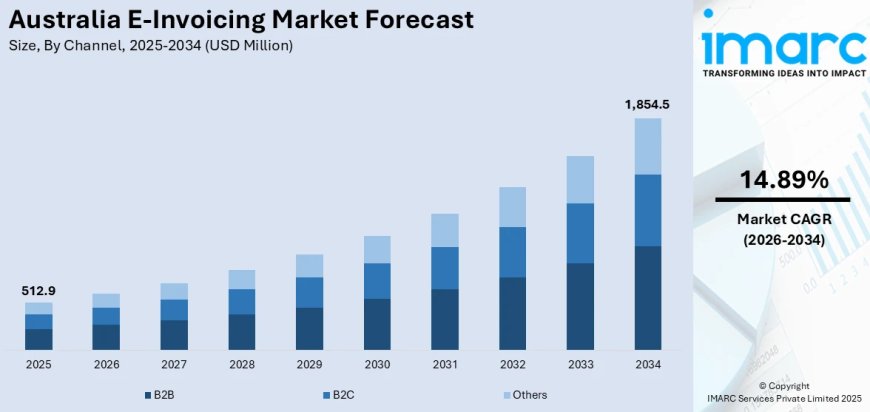
The Australia e-invoicing market size reached USD 512.9 Million in 2025. Looking forward, the market is expected to reach USD 1,854.5 Million by 2034, exhibiting a growth rate (CAGR) of 14.89% during 2026-2034.

Australia E-Invoicing Market Overview
The Australia e-invoicing market is experiencing rapid expansion, fuelled by federal government mandates, nationwide adoption of the Peppol network, and rising demand for automation, cost reduction, and cybersecurity in finance functions. The market size reached USD 512.9 Million in 2025. Looking forward, the market is expected to reach USD 1,854.5 Million by 2034, exhibiting a growth rate (CAGR) of 14.89% during 2026-2034. Mandatory e-invoicing targets for non-corporate Commonwealth entities, ATO-backed Peppol PINT A-NZ standards, and accelerating SME digitisation are positioning Australia as one of the fastest-growing e-invoicing markets in the Asia-Pacific region.
How AI is Reshaping the Future of Australia E-Invoicing Market
• AI-powered invoice capture and extraction engines are automating data entry, coding, and three-way matching with purchase orders and goods receipts, reducing invoice processing costs by up to 70% for Australian enterprises.
• Machine learning-based fraud detection tools are identifying duplicate invoices, supplier spoofing, and anomalous payment patterns, critical in a market where Australia recorded over 47 million data breaches in 2024.
• Generative AI is transforming accounts payable and receivable workflows, with natural-language query interfaces and AI co-pilots that allow finance teams to investigate invoice status, disputes, and ageing without manual reporting.
• AI-driven cash flow forecasting and working capital optimisation tools are leveraging real-time e-invoice data to improve payment timing, dynamic discounting, and supply-chain finance for Australian SMEs and large enterprises.
• AI-enabled compliance engines are continuously monitoring Peppol PINT A-NZ schema changes, GST treatment, and ATO reporting requirements, ensuring Australian taxpayers remain fully compliant as mandates evolve.
Australia E-Invoicing Market Trends
Government-Led Peppol Adoption and B2G Mandates
Australia's e-invoicing market is being shaped decisively by federal government action, with e-invoicing established as the default method for exchanging invoice information across all non-corporate Commonwealth entities (NCEs). Under the ATO's 2025-2026 roadmap, NCEs must achieve at least 30% of invoices received via e-invoicing by July 2026 and full automation of e-invoice processing and issuance by December 2026, with quarterly progress reporting to the Australian Peppol Authority. More than 300 state and territory government organisations and local councils are also participating, with New South Wales, South Australia, ACT, Tasmania, and Victoria enabling receipt. The Peppol PINT A-NZ format has been the only supported standard since 15 May 2025.
SME Digitisation and Cybersecurity-Driven Adoption
More than 1.2 billion invoices are exchanged between Australian businesses each year, with approximately 90% still processed through traditional manual methods, representing a substantial runway for e-invoicing growth. SMEs stand to capture annual savings of up to AUD 40,000 per business through digitisation, with the 2024-2025 federal budget allocating AUD 23.3 million specifically to accelerate SME adoption. Rising cybersecurity threats, highlighted by over 47 million data breaches recorded in Australia in 2024, are driving strong investment in fraud prevention, invoice authentication, and multi-factor authentication protocols. The Australian Cyber Security Centre (ACSC) has issued detailed system safeguard guidelines supporting secure e-invoicing deployment.
Request for a Sample Report: https://www.imarcgroup.com/australia-e-invoicing-market/requestsample
Australia E-Invoicing Market Summary
• Cloud-based e-invoicing deployment is the dominant model in the Australian market, offering lower upfront costs, faster onboarding, and simplified compliance updates for Peppol PINT A-NZ standards.
• SMEs represent the highest-growth segment due to the 2024-2025 federal budget's AUD 23.3 million SME enablement funding and potential annual cost savings of up to AUD 40,000 per business from digitisation.
• B2G e-invoicing is mandatory for all non-corporate Commonwealth entities, while B2B remains voluntary, creating a clear two-speed adoption dynamic across the Australian market.
• More than 1.2 billion invoices are exchanged annually in Australia, with 90% still processed through traditional paper/PDF methods, providing a substantial addressable opportunity for e-invoicing solution providers.
• Key industries driving adoption include retail, logistics, healthcare, professional services, construction, and financial services, with larger enterprises leading early adoption and SMEs now catching up rapidly under federal incentives.
Australia E-Invoicing Market Growth Drivers
Government Mandates, Peppol Network, and ATO Leadership
The Australian Taxation Office (ATO), in its role as Peppol Authority, is actively leading e-invoicing adoption through clear compliance timelines, technical standards, and industry engagement. The mandate requiring all non-corporate Commonwealth entities to adopt Peppol e-invoicing by 2026 is cascading through state and local government tiers and into private-sector supply chains. Federal procurement policy favouring e-invoice-capable suppliers is creating a strong commercial pull on B2B adoption. Continued development of the Peppol PINT A-NZ standard is ensuring interoperability between Australian and New Zealand trading partners, positioning the region as a cohesive digital trade zone.
Cost Savings, Cybersecurity, and AI-Enabled Automation
Businesses are adopting e-invoicing to capture significant operational savings, with SMEs benefiting from up to AUD 40,000 per year in reduced processing, error correction, and payment-delay costs. Rising cybersecurity risks, reinforced by 47 million data breaches in Australia in 2024, are making secure, authenticated Peppol-based invoice exchange a priority over email-based PDF invoicing. Integration of AI, blockchain verification, and multi-factor authentication is enhancing fraud prevention. Cloud ERP and accounting vendors including Xero, MYOB, and Sage are embedding native e-invoicing capabilities, making adoption seamless for Australian SMEs and mid-market enterprises.
Australia E-Invoicing Market Segments
Breakup by Channel: B2B, B2C, B2G, and Others.
Breakup by Deployment Type: Cloud-based and On-premises.
Breakup by Application: Accounts Payable Automation, Accounts Receivable Automation, Tax Compliance & Reporting, Procurement, and Others.
Breakup by Enterprise Size: Small & Medium Enterprises (SMEs) and Large Enterprises.
Breakup by Industry Vertical: Retail & Consumer Goods, BFSI, Healthcare, Logistics & Transportation, Manufacturing, Energy & Utilities, Government & Public Sector, and Others.
Breakup by Region: New South Wales, Victoria, Queensland, Western Australia, South Australia, Tasmania, and Australian Capital Territory & Northern Territory.
Australia E-Invoicing Market Competitive Landscape
The Australia e-invoicing market is highly competitive, comprising global Peppol access point providers, domestic accounting/ERP leaders, and specialist AP/AR automation vendors. Leading accounting and ERP providers with native e-invoicing capabilities include Xero, MYOB, Sage, Intuit QuickBooks, SAP, Oracle NetSuite, and Microsoft Dynamics 365. Specialist e-invoicing, AP automation, and Peppol access point providers include Basware, Tradeshift, Coupa, Taulia, TransferMate, Link4, MessageXchange, Storecove, B2Be, Dataline Software, Ozedi, and Esker. Global tax and compliance platforms such as Avalara, Sovos, Pagero, EDICOM, and Tungsten Automation (formerly Kofax) serve large Australian enterprises. Banks including ANZ, CBA, NAB, and Westpac are also launching value-added e-invoicing and payment integration services for corporate customers.
Recent News & Development
• December 2026 (target): All non-corporate Commonwealth entities must achieve full automation of e-invoice processing and issuance via Peppol PINT A-NZ, with quarterly progress reporting to the Australian Peppol Authority.
• July 2026 (target): All non-corporate Commonwealth entities must reach at least 30% of invoices received via e-invoicing under the Australian Government's Peppol adoption roadmap.
• October 2025: Australia formally established e-invoicing as the default method for exchanging invoice information across federal government procurement, accelerating supplier onboarding to the Peppol network.
• May 2025: Peppol PINT A-NZ became the only supported e-invoicing format in Australia, following an initial preferred-from date of 15 November 2024, standardising digital invoice exchange across the country.
• 2024-2025 Budget: The Australian Government allocated AUD 23.3 million to enhance e-invoicing adoption, with a particular focus on accelerating uptake among small and medium enterprises (SMEs).
Note: If you require any specific information not currently covered within the scope of the report, IMARC Group will provide it as part of customization.
Speak to an analyst:
https://www.imarcgroup.com/request?type=report&id=31758&flag=E
What's Your Reaction?