





























Australia Air Fryer Market | Size, Growth, Trends and Analysis 2026-2034
The Australia air fryer market size reached USD 31.0 Million in 2025. Looking forward, the market is expected to reach USD 64.9 Million by 2034, exhibiting a growth rate (CAGR) of 8.14% during 2026-2034.

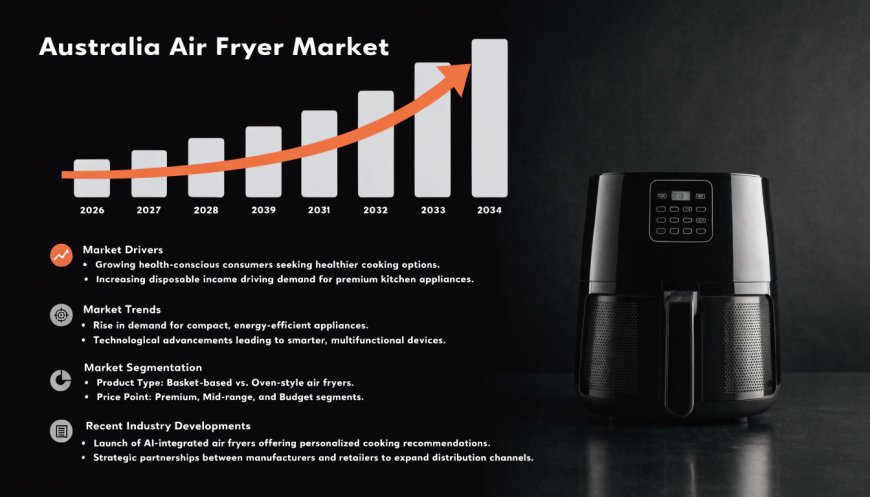
Market Overview
The Australia air fryer market is witnessing strong growth, driven by increasing health consciousness among consumers, a growing preference for convenient and time-saving cooking solutions, and continuous technological innovations that enhance user experience. According to IMARC Group, the market size reached USD 31.0 Million in 2025 and is projected to reach USD 64.9 Million by 2034, exhibiting a compound annual growth rate (CAGR) of 8.14% during 2026‑2034. The market is benefiting from the shift toward low-oil cooking methods, the rising popularity of smart kitchen appliances, and the growing demand for compact, space-saving designs suited to urban living. This market is strategically important to Australia's economy as it supports the nation's evolving culinary culture, drives innovation in the small kitchen appliance sector, and aligns with consumer preferences for healthier, more sustainable lifestyles.
*The Australia air fryer market is poised for sustained expansion, driven by a projected CAGR of 8.14% through 2034, rising health awareness, and the growing demand for versatile, multi-functional kitchen appliances. With approximately two in three Australian households now owning an air fryer and increasing adoption of ready-made meals specifically designed for these devices, the market presents significant opportunities for manufacturers, retailers, and technology partners focused on innovation and convenience.*
Australia Air Fryer Market Summary
The Australia air fryer market encompasses a range of countertop cooking appliances that use rapid air circulation technology to cook food with significantly less oil than traditional deep-frying methods. The ecosystem includes global kitchen appliance manufacturers, local distributors, retailers, and online sales platforms, serving both residential and commercial end-users. Major segments identified in the market include product type (drawer and lid), technology (digital and manual), sales channel (supermarkets/hypermarkets, multi-branded stores, exclusive stores, online, and others), end use (residential and commercial), and region (Australia Capital Territory & New South Wales, Victoria & Tasmania, Queensland, Northern Territory & Southern Australia, and Western Australia).
Porter's Five Forces Analysis – Australia Air Fryer Market
The competitive dynamics of the Australia air fryer market can be analysed using Porter's Five Forces framework.
Bargaining Power of Suppliers – Moderate
The market relies on a mix of global and local suppliers for components such as heating elements, fans, electronic controls, and housing materials. Major manufacturers with established supply chains hold moderate influence due to their scale and sourcing capabilities. However, the presence of multiple component suppliers and the increasing trend toward local assembly and distribution provide manufacturers with alternative sourcing options, balancing supplier power.
Bargaining Power of Buyers – High
Australian consumers have extensive choice among a wide range of air fryer brands, models, and price points available through both physical retail and online channels. The proliferation of e‑commerce platforms has increased price transparency and ease of comparison, giving buyers significant negotiating power. Consumers are also increasingly informed about product features, energy efficiency, and brand reputation, which enables them to make value-driven purchasing decisions.
Threat of New Entrants – Moderate
The threat of new entrants is moderate. While establishing a recognised brand in the small kitchen appliance market requires significant investment in marketing, distribution, and product development, the growing demand for air fryers is attracting new players. Niche opportunities exist for entrants focusing on innovative designs, smart connectivity features, or specialised cooking functions.
Threat of Substitutes – Low
While traditional ovens, stovetops, and deep fryers can serve similar cooking functions, air fryers offer unique advantages in terms of health benefits, speed, and convenience. The ability to achieve crispy results with little to no oil makes air fryers a distinct product category with limited direct substitution.
Competitive Rivalry – Moderate
The market is moderately competitive, featuring a mix of established global brands and emerging local players. Competition centres on product innovation, energy efficiency, design aesthetics, smart features, and price points. The top four companies—including Breville Group Ltd, Wesfarmers Ltd, Newell Australia Pty Ltd, and Woolworths Group Ltd—command a substantial portion of sales, though the market remains dynamic with continuous product launches and marketing campaigns.
Request for Sample Report: https://www.imarcgroup.com/australia-air-fryer-market/requestsample
Market Growth Drivers
Rising Popularity of Quick and Convenient Cooking Solutions
A primary factor propelling the Australia air fryer market is the increasing demand for fast and hassle‑free cooking solutions. With busy work schedules and evolving lifestyle patterns, consumers are looking for appliances that save time in meal preparation without compromising on taste. Air fryers cater perfectly to this need by significantly reducing cooking times compared to traditional ovens or stovetops. Their ability to prepare a wide range of dishes, from snacks to full meals, makes them highly versatile, appealing to both singles and families.
Health-Focused Cooking Fuelling Demand
Australia's increasing focus on healthier diets is profoundly impacting kitchen appliance demand. Air fryers enable consumers to cook meals using very little oil, which is in concert with the rising demand for low‑fat preparation methods. The capability of producing crispy results without deep frying complements dietary objectives aimed at lowering calories. This trend is evident in numerous Australian homes, where air fryers are becoming a standard for people looking for healthier meals.
Technological Innovations Improving User Experience
The incorporation of cutting‑edge technologies into air fryers is revolutionising the cooking experience for Australian consumers. Today's air fryers come with digital controls, pre‑programmed cooking functions, and enhanced safety features, which make them more convenient and effective. Some models also have smart features, enabling users to remotely control the device through mobile apps. Such features appeal to tech‑conscious consumers, where convenience and usability are highly desired.
Space-Saving Models Suiting Urban Homes
In urban Australia, where kitchen space is at a premium, the small and space‑saving models of newer air fryers are especially suited. Manufacturers are producing slim, compact models that fit perfectly into smaller kitchens without sacrificing performance. These space‑saving designs make air fryers the perfect option for apartment dwellers and those with limited counter space.
Expanding Awareness Through Marketing and Branding
Strong marketing strategies and brand promotions are significantly boosting the adoption of air fryers in Australia. Leading kitchen appliance brands and retailers are actively highlighting the benefits of air fryers through digital campaigns, in‑store demonstrations, and collaborations with food influencers. This visibility helps educate consumers about healthier cooking techniques, recipe possibilities, and energy efficiency advantages.
Shifting Consumer Preferences Toward Sustainable Living
Growing environmental consciousness is influencing consumer preferences in the Australian home appliance sector. Air fryers typically consume less energy than conventional ovens, contributing to lower household power usage and reduced carbon footprints. Moreover, by encouraging oil‑free or low‑oil cooking, they support sustainable dietary practices linked to health and wellness. As Australians increasingly prioritise sustainability in their purchasing decisions, air fryers are emerging as a favoured choice in modern kitchens.
Australia Air Fryer Market Segmentation
Segmentation analysis provides a detailed view of the Australia air fryer market by category:
-
Product Type Insights: Drawer, Lid
-
Technology Insights: Digital, Manual
-
Sales Channel Insights: Supermarkets/Hypermarkets, Multi‑Branded Stores, Exclusive Stores, Online, Others
-
End‑Use Insights: Residential, Commercial
-
Regional Insights: Australia Capital Territory & New South Wales, Victoria & Tasmania, Queensland, Northern Territory & Southern Australia, Western Australia
Competitive Landscape
The competitive landscape of the Australia air fryer market is characterised by a mix of established global brands and emerging local players. The market is moderately concentrated, with the top four companies—Breville Group Ltd, Wesfarmers Ltd, Newell Australia Pty Ltd, and Woolworths Group Ltd—commanding a substantial portion of sales. Key players drive the market by expanding product portfolios, investing in digital and smart technologies, and strengthening distribution networks through both physical retail and online channels.
Major brands compete on product innovation, energy efficiency, design aesthetics, smart features, and price points. The market has seen the introduction of models with digital controls, pre‑programmed cooking functions, enhanced safety features, and mobile app connectivity, appealing to tech‑conscious consumers. The competitive environment is also shaped by aggressive marketing campaigns, in‑store demonstrations, and collaborations with food influencers that help educate consumers and build brand loyalty. Detailed profiles of all major companies have been provided in the full report.
Regional Analysis
Regional dynamics within the Australia air fryer market are shaped by population density, urbanisation rates, and consumer purchasing power across states and territories.
-
Australia Capital Territory & New South Wales is a leading market region, driven by Sydney's high population density, concentration of urban households, and strong retail infrastructure. The region benefits from high consumer awareness of health and wellness trends.
-
Victoria & Tasmania represents a significant market, with Melbourne's vibrant culinary culture and growing interest in convenient cooking solutions supporting air fryer adoption.
-
Queensland is a growing market, supported by an expanding population and increasing demand for time‑saving kitchen appliances in both urban and suburban areas.
-
Northern Territory & Southern Australia, while smaller in overall market size, are seeing steady growth driven by increasing retail penetration and rising consumer awareness of healthier cooking alternatives.
-
Western Australia demonstrates consistent demand, with Perth's growing population and expanding retail channels supporting market expansion.
Recent Industry Developments
-
April 2025: Australian creative agency Common Ventures launched a North American campaign for Breville, highlighting the ease and practicality of its latest air fryer. The initiative emphasised the product's user‑friendly design while showcasing Breville's focus on simplifying modern cooking experiences.
-
May 2025: A first‑of‑its‑kind product was introduced by Sydney‑based company Workout Meals. The company debuted a line of ready‑made meals specifically formulated for air fryers. This revolutionary new range features 12 high‑protein, low‑fat selections, all packaged in environmentally friendly materials, tapping into the growing demand for convenient, health‑focused air fryer solutions.
-
2025: According to the Food Safety Information Council, approximately two in three Australian households now own an air fryer, with 54 per cent using it weekly and 38 per cent using it several times a week, reflecting the widespread adoption and deep integration of air fryers into Australian cooking routines.
-
2025: The small cooking appliances market in Australia continued to be driven by consumers' interest in convenient cooking solutions, with air fryers and rice cookers seeing dynamic growth due to consumers' interest in healthier cooking options and international cuisines.
Browse Full Report with TOC & List of Figures for In‑Depth Market Insights: https://www.imarcgroup.com/australia-air-fryer-market
Note: If you need any specific information that is not covered currently within the scope of the report, we will provide the same as a part of customisation.
About Us
IMARC Group is a global management consulting firm that helps the world's most ambitious changemakers to create a lasting impact. The company provides a comprehensive suite of market entry and expansion services. IMARC offerings include thorough market assessment, feasibility studies, company incorporation assistance, factory setup support, regulatory approvals and licensing navigation, branding, marketing and sales strategies, competitive landscape and benchmarking analyses, pricing and cost research, and procurement research.
Contact Us
IMARC Group
134 N 4th St., Brooklyn, NY 11249, USA
Email: sales@imarcgroup.com
Tel No.: (D) +91 120 433 0800
United States: +1-201-971-6302
What's Your Reaction?