




























Australia Agricultural Machinery Market Projected to Reach USD 6.5 Billion by 2034
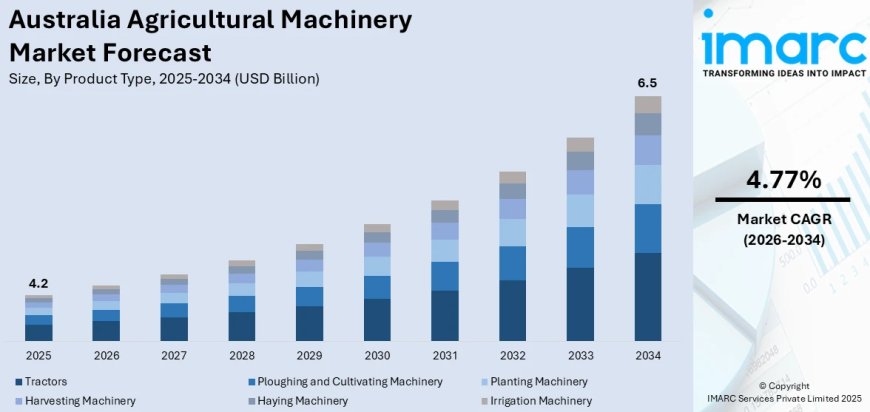
The Australia agricultural machinery market size reached USD 4.2 Billion in 2025 and is projected to reach USD 6.5 Billion by 2034, growing at a CAGR of 4.77% during 2025-2034.

Market Overview
The Australia agricultural machinery market size reached USD 4.2 Billion in 2025 and is projected to reach USD 6.5 Billion by 2034, growing at a CAGR of 4.77% during 2025-2034. The market encompasses a broad range of equipment including tractors, harvesters, planting and fertilizing machinery, haying and forage equipment, and irrigation systems used across Australia's diverse agricultural landscape. These machines serve crop farming, livestock operations, horticulture, and mixed farming enterprises, integrating advanced technologies such as GPS guidance, telematics, autonomous operation, and precision agriculture platforms.
Australia's agricultural machinery sector is being propelled by the ongoing mechanization of farming operations, rising labor costs, increasing adoption of precision agriculture technologies, and strong government support for digital farming infrastructure. The federal government's On Farm Connectivity Program, with AUD 20 million allocated in Round 3, underscores the commitment to bridging the rural digital divide and enabling smart farming. Growing demand for food exports, climate adaptation strategies, and sustainability-focused farming practices are further reinforcing investment in modern agricultural equipment, positioning the market for sustained growth through the forecast period.
Request Industry-Focused Sample with Insights & Forecasts
https://www.imarcgroup.com/australia-agricultural-machinery-market/requestsample
Australia Agricultural Machinery Market Summary
- Tractors represent the leading segment, accounting for approximately 57.85% of the total market share. Their dominance is attributed to versatile applications across tillage, planting, hauling, and material handling in virtually every farming operation.
- Harvesters constitute the second leading segment, driven by Australia's large-scale grain and oilseed production, particularly in Western Australia, New South Wales, and Queensland, where mechanized harvesting is essential for operational efficiency.
- Precision agriculture technology integration is transforming the market, with GPS-guided auto-steer systems, variable rate application technology, and drone-based crop monitoring becoming standard features on new machinery purchases.
- AI-powered smart sprayers are delivering up to 96% reduction in herbicide usage, representing a significant cost saving and environmental benefit that is accelerating adoption of intelligent machinery among Australian farmers.
- John Deere launched the 6M Series 155 tractor in February 2025 specifically for the Australian market, while also unveiling the E-Power fully electric autonomous tractor prototype in May 2025, signaling the industry's direction toward electrification.
- New South Wales and Victoria lead regional demand, collectively accounting for the largest share of machinery sales due to their extensive broadacre cropping, mixed farming operations, and higher farm income levels supporting capital equipment investment.
- The Australian government's On Farm Connectivity Program Round 3 allocated AUD 20 million to improve rural internet infrastructure, directly enabling the adoption of connected and autonomous farming equipment across regional areas.
How AI is Reshaping the Australia Agricultural Machinery Market
Artificial intelligence is fundamentally transforming Australia's agricultural machinery sector, enabling farmers to optimize operations, reduce input costs, and improve yields through data-driven decision-making. From autonomous tractors to intelligent crop management systems, AI is reshaping every aspect of how machinery is designed, operated, and maintained.
AI-Powered Precision Spraying and Weed Detection: Advanced computer vision and machine learning algorithms embedded in smart sprayers can distinguish between crops and weeds in real time, applying herbicides only where needed. This technology has demonstrated up to 96% reduction in chemical usage, delivering substantial cost savings while supporting Australia's sustainable farming objectives.
Autonomous Vehicle Navigation and Operation: AI-driven autonomous tractors and harvesters use sensor fusion combining LiDAR, cameras, and GPS to navigate fields without human intervention. CNH Industrial's T4 Electric Power autonomous tractor concept and John Deere's E-Power prototype represent the next generation of self-driving farm equipment designed for Australian conditions.
Predictive Maintenance and Fleet Management: Machine learning models analyze real-time sensor data from equipment to predict component failures before they occur, reducing unplanned downtime during critical planting and harvesting windows. Telematics platforms enable fleet managers to monitor machinery health, fuel consumption, and utilization rates across multiple farm locations.
AI-Enhanced Yield Mapping and Crop Analytics: Combine harvesters equipped with AI-powered yield monitoring systems generate detailed field performance maps, enabling farmers to identify yield variability and optimize inputs for subsequent seasons. These analytics platforms integrate satellite imagery, soil data, and historical yield records to deliver actionable insights.
Intelligent Soil Analysis and Variable Rate Application: AI algorithms process soil sensor data to create precise nutrient prescription maps, enabling variable rate fertilizer and seed application. This ensures optimal input placement across diverse soil types common in Australian broadacre farming, reducing waste and improving return on investment.
Computer Vision for Livestock Management: AI-powered camera systems integrated into livestock handling equipment can monitor animal health, detect lameness, estimate body condition scores, and automate sorting operations. This technology is particularly relevant for Australia's extensive cattle and sheep operations spanning vast pastoral areas.
AI-Driven Weather and Risk Modeling: Machine learning platforms analyze weather patterns, climate data, and market information to help farmers make informed decisions about planting timing, machinery deployment, and harvest scheduling. These predictive tools are becoming essential for managing climate variability across Australia's diverse agricultural regions.
Key Trends Shaping the Australia Agricultural Machinery Market
- Electrification of Farm Equipment: The transition from diesel to electric-powered machinery is gaining momentum, with manufacturers like John Deere and CNH Industrial unveiling electric tractor prototypes. Battery-electric and hybrid powertrains offer lower operating costs, reduced emissions, and quieter operation suited to peri-urban farming zones.
- Precision Agriculture Becoming Standard: GPS auto-steer, section control, and variable rate technology are transitioning from premium options to standard features on mid-range equipment. Australian farmers are increasingly viewing precision technology as essential for maintaining competitiveness and managing rising input costs.
- Rising Labor Costs Driving Automation: Australia's persistent agricultural labor shortage, exacerbated by remote farm locations and competition from mining and construction sectors, is pushing farmers toward automated and semi-autonomous machinery solutions that reduce dependency on manual labor by up to 30%.
- Growth in Compact and Specialty Equipment: Expanding horticulture, viticulture, and intensive farming sectors are driving demand for compact tractors, specialized harvesters, and orchard-specific equipment. These segments are growing faster than traditional broadacre machinery categories.
- Sustainability and Carbon-Neutral Farming Goals: Australia's agricultural sector is aligning with national emissions reduction targets, driving demand for fuel-efficient machinery, minimum tillage equipment, and electric alternatives. Carbon credit programs are incentivizing farmers to invest in equipment that reduces soil disturbance and fuel consumption.
- Government Digital Infrastructure Investment: The federal On Farm Connectivity Program and state-level initiatives are building the rural broadband and IoT infrastructure necessary for connected machinery, remote diagnostics, and autonomous operations across regional Australia.
- Dealer Network Consolidation and After-Sales Services: The agricultural machinery distribution landscape is consolidating as dealerships invest in larger territories, advanced service capabilities, and digital parts ordering systems. Enhanced after-sales support including remote diagnostics and mobile service units is becoming a key competitive differentiator.
Market Growth Drivers
Expanding Agricultural Output and Mechanization Demand: Australia's agricultural sector continues to expand, driven by strong global demand for wheat, barley, canola, beef, and wool. The need to cultivate larger areas efficiently while managing labor constraints is compelling farmers to invest in higher-capacity, technologically advanced machinery. Government programs supporting farm modernization and rural connectivity are further accelerating equipment upgrades across both broadacre and intensive farming operations.
Technology Innovation and Private Sector Investment: Major manufacturers including John Deere, CNH Industrial, AGCO, Kubota, and CLAAS are investing heavily in R&D for autonomous systems, electrification, and AI-integrated platforms tailored to Australian conditions. CLAAS launched the XERION 12 series in July 2024 with advanced connectivity features, while Kubota expanded its Victorian warehouse operations in September 2024 to strengthen supply chain responsiveness. The convergence of precision agriculture, data analytics, and autonomous machinery is creating a new investment cycle that will sustain market growth through the forecast period to 2034.
Market Segmentation
By Machinery Type:
• Tractors
• Harvesters
• Planting and Fertilizing Equipment
• Haying and Forage Equipment
• Irrigation Equipment
• Others
By Application:
• Crop Farming
• Livestock Management
• Horticulture
• Mixed Farming
By Power Output:
• Below 40 HP
• 40–100 HP
• 101–200 HP
• Above 200 HP
By Region:
• New South Wales
• Victoria
• Queensland
• Western Australia
• South Australia
• Tasmania
• Others
Recent News and Developments
February 2025: John Deere launched the 6M Series 155 tractor specifically configured for Australian farming conditions, featuring enhanced hydraulic capacity and precision-ready technology integration for broadacre and mixed farming operations.
May 2025: John Deere unveiled the E-Power fully electric autonomous tractor prototype, demonstrating zero-emission field operation capabilities and signaling the industry's trajectory toward electrified agricultural equipment.
September 2024: Kubota Australia expanded its warehouse and distribution facility in Victoria to improve parts availability and reduce delivery times across its Australian dealer network, strengthening after-sales support capabilities.
July 2024: CLAAS introduced the XERION 12 series tractor platform featuring advanced telematics, CEMOS auto-optimization, and enhanced connectivity for precision farming applications in large-scale Australian operations.
2024: CNH Industrial showcased the T4 Electric Power autonomous tractor concept, featuring fully electric drivetrain and autonomous navigation technology designed for future commercial deployment in broadacre farming.
2024: The Australian Government announced Round 3 of the On Farm Connectivity Program with AUD 20 million in funding to improve on-farm internet connectivity, enabling adoption of IoT-based machinery monitoring and autonomous operations.
Note: If you require any specific information not currently covered within the scope of the report, IMARC Group will provide it as part of customization.
Speak to an analyst for a customized sample report: https://www.imarcgroup.com/request?type=report&id=24658&flag=E
About Us: IMARC Group is a global management consulting firm that helps the world's most ambitious changemakers to create a lasting impact. The company provides a comprehensive suite of market entry and expansion services. IMARC offerings include thorough market assessment, feasibility studies, company incorporation assistance, factory setup support, regulatory approvals and licensing navigation, branding, marketing, and sales strategies, all backed by a commitment to quality and delivery excellence.
Contact Us
IMARC Group
134 N 4th St. Brooklyn, NY 11249, USA
Email: sales@imarcgroup.com
Tel No: (D) +91 120 433 0800
United States: +1-201-971-6302
What's Your Reaction?