

































India Water Heater Market: Size, Share, Industry Growth and Forecast Report 2026-2034
The water heater market in India size reached USD 1.2 Billion in 2025. Looking forward, IMARC Group expects the market to reach USD 2.2 Billion by 2034, exhibiting a growth rate (CAGR) of 6.30% during 2026-2034.

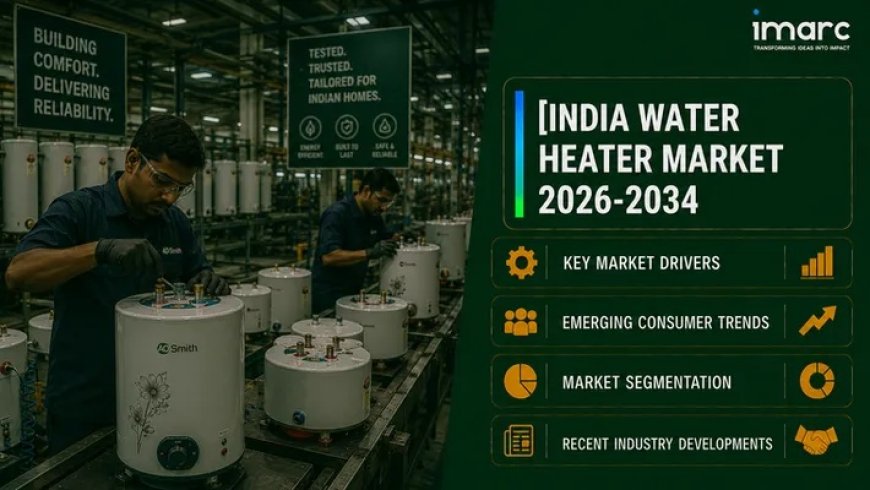
According to IMARC Group’s report titled “India Water Heater Market Size, Share, Trends and Forecast by Product Type, Application and Region, 2026-2034“, the report offers a comprehensive analysis of the industry, including market share, forecast, growth and regional insights.
The water heater market in India size reached USD 1.2 Billion in 2025. Looking forward, IMARC Group expects the market to reach USD 2.2 Billion by 2034, exhibiting a growth rate (CAGR) of 6.30% during 2026-2034. The electronics and semiconductors sector in India is experiencing a rapid structural upgrade, transitioning from standard standalone appliances to highly efficient, connected thermal management solutions. Driven by rapid urban real estate scaling and institutional push toward energy conservation, the manufacturing and distribution of consumer and commercial water heating systems present highly reliable, asset-backed entry points for corporate investors and industrial allocators.
- Renewable Infrastructure Capture: Investing in automated solar thermal assembly lines positions enterprises to capture expanding volume mandates driven by institutional commercial building codes.
- Advanced Product Margin Premiums: Allocating capital toward specialized heat pump architectures and IoT-enabled models unlocks high-margin retail distribution tiers across premium urban centers.
- Supply Chain Localization: Establishing local manufacturing capabilities for key electronic sub-assemblies and corrosion-resistant tanks insulates operating margins from currency fluctuations and import container delays.
The Strategic Market Challenge: Navigating the Water Heater Market in India
A critical operational challenge confronting enterprise leaders within the electronics and semiconductors sector is navigating the complex raw material cost structures while adhering to changing energy compliance parameters. Because materials like high-grade copper heating elements and corrosion-resistant stainless steel sheets constitute between 65% and 75% of total operational expenditure, manufacturers face severe margin compression during global base metal price spikes. This pressure is compounded by the structural mandate to constantly re-engineer consumer units to maintain high star-ratings without escalating retail pricing past mass-market psychological thresholds.
➤ Access Key Market Statistics and Actionable Insights - Request Sample Report
India's Strategic Vision for the Water Heater Market:
-
Macro-Appliance Decarbonization Mandates: National energy strategies are focused on systematically scaling down aggregate grid dependency by transitioning high-load domestic thermal appliances toward solar and heat pump variants.
-
Urban Center Real Estate Formalization: Public housing and smart city blueprints mandate energy-efficient infrastructure deployment, requiring modern residential high-rises to install centralized or highly rated individual water heating systems.
-
Domestic Engineering Capability Targets: State economic initiatives aim to substitute sub-assembly imports with completely localized, component-level manufacturing ecosystems to achieve self-reliance across the appliance sector.
Why Invest in the India Water Heater Market: Key Growth Drivers & ROI
-
Institutional Multi-Modal Infrastructure Support: Targeted expansions of the national electrical grid alongside state-subsidized logistics corridors significantly optimize regional component supply lines, reducing transit overhead for heavy industrial shipments.
-
Evolving Demographic Consumption Trends: Accelerated migration into Tier-2 and Tier-3 urban ecosystems coupled with rising disposable incomes is driving a strong consumption shift from traditional water heating methods toward automated, high-safety electric storage models.
-
Advanced Technological Convergence Upgrades: The systemic corporate integration of smart Wi-Fi controllers, digital diagnostic sensors, and automated schedule-optimization telemetry yields substantial operating savings, reducing household and commercial utility outlays.
India Water Heater Market Trends & Future Outlook:
-
Predictable Growth Trajectory: The domestic market value is structurally positioned to expand at a steady compound annual growth rate (CAGR) of 6.30% between 2026 and 2034, ensuring long-term volume stability for industrial capital allocations.
-
Surging Smart Device Adoption: The rapid consumer shift toward IoT-powered appliances enables users to streamline power consumption patterns, fueling double-digit demand acceleration for automated appliances.
-
Proliferation of Solar and Heat Pump Systems: High-volume commercial installations across the hospitality, healthcare, and educational verticals are systematically driving down reliance on conventional fossil-fuel or direct electric options.
-
Accelerating Replacement Cycles: Decreasing product lifecycles combined with consumer preference for compact, corrosion-resistant, and aesthetically modern wall units are stimulating reliable re-purchasing patterns across metropolitan centers.
Regulatory Landscape & Policy Catalysts in India:
-
Bureau of Energy Efficiency (BEE) Star Rating Mandates: According to the Ministry of Power, the continuous tightening of mandatory energy efficiency scales compels electronic manufacturers to systematically optimize heating element thermal transfers.
-
Ministry of New and Renewable Energy (MNRE) Subsidies: According to the Ministry of New and Renewable Energy, dedicated capital subsidies continue to support the structural deployment of massive solar thermal water heating configurations across general and special category regions.
-
Energy Conservation Building Code (ECBC) Compliance: According to the Bureau of Energy Efficiency, strict institutional construction parameters mandate that a specific baseline percentage of hot water requirements in commercial buildings be fulfilled via solar or waste-heat recovery designs.
-
Production Linked Incentive (PLI) Spillover Frameworks: According to the Ministry of Electronics and Information Technology (MeitY), domestic fiscal support targeting localized semiconductor and component production directly lowers local input costs for smart appliance developers.
➤ Explore the Exact Chapters and Data Scope - Get Full Brochure
India Water Heater Market Segmentation:
The market report offers a comprehensive analysis of the segments, highlighting those with the largest India water heater market share. It includes forecasts for the period 2026-2034 and historical data from 2020-2025 for the following segments.
Product Type Insights:
- Electric Water Heater
- Solar Water Heater
- Gas Water Heater
- Heat Pump Water Heater
Application Insights:
- Residential
- Commercial/Industrial
Regional Insights:
- North India
- South India
- East India
- West India
Note: If you need specific information that is not currently within the scope of the report, we can provide it to you as a part of the customization.
By the IMARC Group, the Top Competitive Landscape & their Positioning:
Covering an in-depth analysis of the competitive landscape, market structure, key player positioning, competitive dashboards, top winning strategies, and detailed profiles of all major industry participants you will gain access to all these exclusive insights within the full research report.
➤ Shape the Data to Answer Your Specific Questions - Request Customization
Frequently Asked Questions (FAQs)
Q1: What is the current value and projected growth of the India Water Heater Market?
A1: According to IMARC Group, the India water heater market size reached USD 1.2 Billion in 2025. Looking forward, the market is projected to reach USD 2.2 Billion by 2034, exhibiting a structured compound annual growth rate (CAGR) of 6.30% during the 2026–2034 forecast period.
Q2: Which core product type classifications define the primary industrial output streams?
A2: The extensive product portfolio is distinctly categorized into Electric Water Heaters, Solar Water Heaters, Gas Water Heaters, and Heat Pump Water Heaters. Electric models command the leading historical volume share, while solar thermal and high-performance heat pumps represent the fastest-growing structural categories.
Q3: How is market consumption structured across the primary application sectors?
A3: The structural application framework is bifurcated into Residential and Commercial/Industrial sectors. The residential segment commands primary dominance over total industry revenue due to rapid urbanization, while the commercial sector is expanding rapidly backed by massive hospitality and healthcare infrastructure expansions.
Q4: Which distribution channel leads consumer access across the domestic marketplace?
A4: The commercial fulfillment pipeline maps across Offline and Online channels. Offline distribution channels, including traditional multi-brand appliance showrooms, wholesale hardware distributor partnerships, and exclusive brand stores, retain the vast majority of volume footprint due to consumer preferences for physical verification.
Q5: Which regional geographic block exhibits the highest concentration of market consumption?
A5: The domestic operational framework maps across North India, South India, East India, and West India. North India holds the top position with a commanding 31.2% market share, heavily anchored by severe seasonal winter drops and dense real estate concentrations across Delhi-NCR, Punjab, and Uttar Pradesh.
Strategic Insight & Verdict:
The structural realignment of India’s electrical appliance framework presents an exceptional window for high-volume corporate capital deployment. As residential real estate developments and institutional hospitality networks permanently pivot away from legacy, low-efficiency components toward smart, scale-resistant, and eco-certified thermal architectures, we at IMARC Group have observed that the highest financial returns will favor investors who secure control over advanced tankless technologies and build direct integration loops with corporate construction lines. Moving forward, the strategic positioning of technology and material capital must prioritize smart IoT integration and localized anti-corrosion engineering to capture dominant long-term equity across the expanding domestic market.
Verified Data Source: India Water Heater Market Report by IMARC Group
Written by: Gourav (Digital Market Research Strategist @ IMARC Group)
View my full professional profile and connect with me at [https://www.linkedin.com/in/gourav-shah-005425345] for exclusive market research insights and B2B growth strategies.
What's Your Reaction?