























Indian Textile and Apparel Market Size, Share, Key Trends and Growth Report 2026-2034
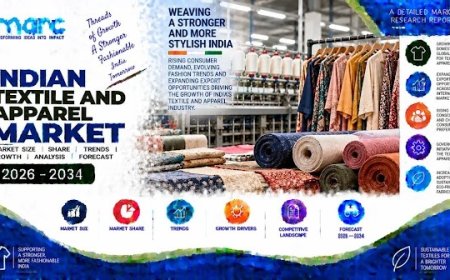
The textile and apparel industry in india reached USD 248.70 Billion in 2025 to USD 277.01 Billion in 2026 and is projected to reach USD 656.31 Billion by 2034, growing at a CAGR of 11.38% during 2026-2034.

According to IMARC Group’s report titled “Indian Textile and Apparel Market Size, Share, Trends and Forecast by Raw Material, Application, Product Type, and State, 2026-2034“, the report offers a comprehensive analysis of the industry, including market share, forecast, growth and regional insights.
Market Outlook
The textile and apparel industry in india reached USD 248.70 Billion in 2025 to USD 277.01 Billion in 2026 and is projected to reach USD 656.31 Billion by 2034, growing at a CAGR of 11.38% during 2026-2034.
What are the Key Developments and Emerging Shifts in the Indian Textile and Apparel Market?
PM MITRA Textile Parks and Integrated Cluster Infrastructure
The government's establishment of PM Mega Integrated Textile Region and Apparel (PM MITRA) Parks across seven locations is a transformative development. With an outlay of Rs. 4,445 crore up to 2027-28, these parks are creating integrated textile clusters that combine spinning, weaving, processing, dyeing, and garmenting at single locations. This dramatically reduces production delays, lowers logistics costs, and improves supply chain efficiency, moving the industry toward globally competitive production hubs.
Transition Toward Sustainable and Eco-Friendly Fabrics
Leading manufacturers are increasingly pivoting toward sustainability by utilizing organic cotton, recycled polyester, and biodegradable fabrics with lower carbon footprints. Driven by rising environmental concerns and global ethical sourcing requirements, top textile companies are investing heavily in water conservation, recycling technologies, and renewable energy to reduce their environmental footprint while capitalizing on the booming demand for sustainable fashion.
What Factors are Driving Growth in the Indian Textile and Apparel Market?
Rising Domestic Consumption and Middle-Class Expansion
The rapid expansion of the Indian middle class is fundamentally driving domestic consumption. By 2030, India is expected to add around 75 million middle-class households and 25 million affluent households, together accounting for 56% of total households. This immense growth in disposable income is heavily increasing consumer spending on branded clothing, fashion, and lifestyle products across urban and semi-urban retail ecosystems.
Growing Export Demand for Indian Textiles
Strong export demand continues to boost production volumes, capacity utilization, and investments across the manufacturing value chain. In 2024-25, India's textile and apparel exports reached approximately US$ 37.0 billion, recording nearly 6% growth compared to the previous year. Robust demand from major international markets encourages manufacturers to expand their operations and solidify India's position as a premier garment export hub.
How will the Indian Textile and Apparel Market Evolve in the Coming Years?
The Indian textile and apparel market is positioned for robust, highly organized expansion through 2034, structurally supported by massive government infrastructure investments and booming domestic retail. As the market transitions, the shift toward sustainable, recycled textiles and fully integrated mega-parks will define the next phase of industrial growth. Manufacturers who strategically invest in technology adoption, ESG compliance, and omnichannel branded retail will remain uniquely positioned to capture dominant market share across both domestic consumption and high-value export markets over the forecast period.
Request Sample Report – TOC, Charts & Key Insights: https://www.imarcgroup.com/indian-textiles-apparel-market/requestsample
By the IMARC Group, the Top Competitive Landscape & their Positioning:
Covering an in-depth analysis of the competitive landscape, market structure, key player positioning, competitive dashboards, top winning strategies, and detailed profiles of all major industry participants you will gain access to all these exclusive insights within the full research report.
- Aditya Birla Group
- Arvind Limited
- Welspun
- Trident Group
- RUPA & COMPANY LIMITED
Indian Textile And Apparel Market Segmentation:
The market report offers a comprehensive analysis of the segments, highlighting those with the largest Indian textile and apparel market share. It includes forecasts for the period 2026-2034 and historical data from 2020-2025 for the following segments.
Raw Material Insights:
- Natural Fibres
- Man-Made Fibres (with a market share of 44.0% of the total market in 2025)
Natural fibres dominate with a market share of 56% of the total market in 2025.
Application Insights:
- Clothing Textiles
- Technical Textiles (with a market share of 18.6% of the total market in 2025)
- Fashion Textiles (with a market share of 16.9% of the total market in 2025.
- Home-Decor Textiles (with a market share of 14.8% of the total market in 2025)
- Other Textiles (with a market share of 9.7% of the total market in 2025)
Clothing textiles leads with a share of 40% of the total market in 2025.
Product Type Insights:
- Yarn
- Fabric
- Fibre
- Others
Fabric exhibits a clear dominance with a 38% share of the total market in 2025.
State Insights:
- Maharashtra
- Uttar Pradesh (with a market share of 16.4% of the total market in 2025)
- Tamil Nadu (with a market share of 18.7% of the total market in 2025)
- Gujarat (with a market share of 17.2% of the total market in 2025)
- Karnataka (with a market share of 12.1% of the total market in 2025)
- Others (with a market share of 15.6% of the total market in 2025)
Maharashtra leads with a share of 20% of the total market in 2025.
Note: If you need specific information that is not currently within the scope of the report, we can provide it to you as a part of the customization.
Request Report Customization: https://www.imarcgroup.com/request?type=report&id=1082&flag=E
Frequently Asked Questions (FAQs)
Q1: What is the current value and projected growth of the Indian Textile And Apparel Market?
A1: According to IMARC Group, the Indian textile and apparel market size reached USD 248.70 Billion in 2025. Looking forward, the market is projected to reach USD 656.31 Billion by 2034, exhibiting a structured compound annual growth rate (CAGR) of 11.38% during the 2026-2034 forecast period.
Q2: Which primary raw material segment commands the largest share in India?
A2: The extensive industrial input matrix is distinctly categorized into Natural Fibres and Man-made Fibres. Natural fibres command clear dominance with a 56.0% market share of the total industry in 2025, heavily propelled by India’s position as a premier global cultivator of high-grade raw cotton.
Q3: How is market demand structured across key downstream application categories?
A3: The structural application framework spans Clothing Textiles, Technical Textiles, Fashion Textiles, Home-Decor Textiles, and Other Textiles. Clothing textiles represent the leading market segment, capturing a 40.0% application share due to rising consumer disposable incomes and rapid retail brand formalization.
Q4: What product type classifications define the primary industrial output streams?
A4: The industry production portfolio is distinctly categorized into Yarn, Fabric, Fibre, and Others. The yarn and fabric segments command major historical volume shares, supporting both massive domestic garment cutting lines and continuous export shipping schedules.
Q5: Which regional state exhibits the highest concentration of production asset installations?
A5: The domestic operational framework maps across Maharashtra, Uttar Pradesh, Tamil Nadu, Gujarat, Karnataka, and Others. Maharashtra retains the top position with a 20.0% revenue share, anchored by proximity to major maritime shipping lanes, deep financial capital access, and advanced milling corridors.
Strategic Insight & Verdict:
The structural consolidation of India’s fiber-to-retail infrastructure presents an exceptional window for high-volume corporate capital alignment. As international purchasing networks permanently shift sourcing volumes away from highly volatile single-country supply channels, we at IMARC Group have observed that the highest financial yields will favor investors who secure positions inside integrated mega textile parks and deploy advanced, automated synthetic manufacturing assets. Moving forward, the strategic positioning of retail and manufacturing capital must prioritize vertical supply integration and strict technical compliance parameters to capture dominant long-term equity across the expanding global apparel economy.
What's Your Reaction?