
























Carbon Detection Spectrometer: Why the Portable LIBS Spectrometer LIS-02 Gets This Right
Ask any metallurgist what makes steel grading genuinely difficult, and carbon almost always comes up first. It's a small percentage on a spec sheet, but it drives hardness, weldability, and mechanical performance in ways that can't be guessed at. This is exactly why a reliable carbon detection spectrometer matters so much in quality control — and why not every portable analyzer is actually built to deliver on that requirement.

Carbon Detection Spectrometer: Why the Portable LIBS
Spectrometer LIS-02 Gets This Right
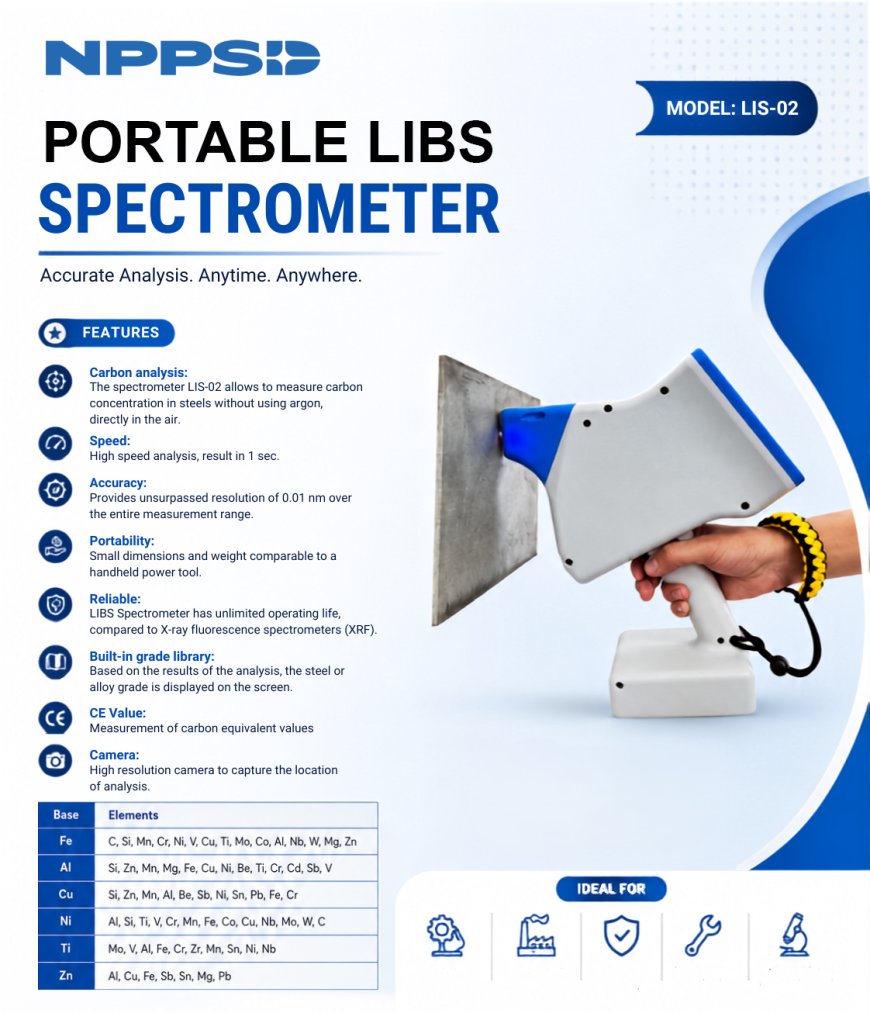
At NPP Strukturnaya Diagnostika Pvt. Ltd. (NPPSD), we manufacture the Portable LIBS Spectrometer LIS-02, and carbon detection is one of the specific reasons customers choose it over other portable options already on the market. This article looks at why carbon measurement is harder than it sounds, and how the LIS-02 approaches it.
Why Carbon Is the Hard Part of Elemental Analysis
Most metals contain a fairly wide range of elements that are relatively straightforward to detect with common analytical technologies. Carbon is the outlier. It's a light element, and light elements are notoriously difficult for several widely used portable analysis methods to measure accurately.
XRF-based analyzers, in particular, are well documented as unreliable for direct carbon detection. This isn't a minor technical footnote — it means a facility relying on XRF alone for steel grading is often working with an incomplete picture, one that may confirm several elements correctly while leaving the single most consequential number unverified.
For low-carbon stainless grades especially, where the difference between one grade and another can hinge on a fraction of a percentage point of carbon, that gap becomes a genuine quality risk rather than a theoretical limitation.
How the LIS-02 Approaches Carbon Detection Differently
The LIS-02 uses laser-induced breakdown spectroscopy, a fundamentally different working principle than XRF. Instead of relying on X-ray fluorescence, it fires a pulsed laser at the sample surface, creating a brief plasma that excites the atoms present — carbon included — and reads the light each element emits as it cools.
Because this process excites carbon atoms directly, the LIS-02 delivers accurate carbon analysis as a standard part of its reading, not as an added feature bolted onto a technology that wasn't built for it. It also does this directly in open air, without requiring an argon environment that some other systems need to stabilize carbon readings.
Where Accurate Carbon Detection Actually Matters
Steel grading and certification depend heavily on confirmed carbon content, since even closely related grades can behave very differently under heat treatment or mechanical stress if carbon levels are off.
Stainless steel identification, particularly distinguishing low-carbon grades like 304L or 316L from their standard counterparts, is one of the more demanding tests for any carbon detection spectrometer — and one of the clearest places where XRF-based tools show their limits.
Aerospace and automotive alloy verification often involves light element composition, including carbon, silicon, and magnesium, where small variances affect mechanical performance in ways that matter under real operating stress.
Scrap sorting and recycling also benefits, since accurate carbon reading helps sort mixed scrap by grade more precisely, directly affecting melt chemistry planning and material value.
What Accurate Carbon Detection Changes for a Quality Team
When carbon detection is reliable, a quality team stops needing a follow-up lab test just to fill in the gap a portable analyzer left behind. That matters practically — it means a single handheld reading can serve as the actual grade confirmation, rather than a partial check that still needs verification elsewhere before anyone can sign off with confidence.
It also changes what a facility can say during a supplier audit. Being able to show a single, complete elemental reading — carbon included — is a stronger answer than explaining that carbon gets checked separately, later, by a different method.
Getting Reliable Readings in Practice
Accurate carbon detection from any instrument still depends on correct technique — clean sample surfaces, consistent measurement distance, and enough readings per spot to smooth out minor surface variation. This is why NPPSD builds certification-based training into the LIS-02 relationship, helping operators understand not just how to take a reading, but how to get one they can trust for a carbon-critical decision.
Choosing a Carbon Detection Spectrometer That Actually Delivers
If carbon accuracy is central to your grading process — and for most steel, aerospace, and automotive applications, it is — the technology behind your analyzer matters more than the marketing around it. The Portable LIBS Spectrometer LIS-02 was built specifically to close the carbon detection gap that other portable methods leave open, giving your quality team a complete, trustworthy reading in about a second.
Want to see the LIS-02's carbon detection in action? Contact NPPSD at sales@nppsd.co.in or call (+91) 9289924641 for a live demo and a direct comparison against whatever method you're currently using.
Frequently Asked Questions
1. Why is carbon detection difficult for many portable analyzers? Carbon is a light element, and technologies like XRF are widely known to struggle with reliably detecting light elements, which leaves a gap in grading accuracy for carbon-sensitive applications.
2. How does the LIS-02 measure carbon accurately? The LIS-02 uses laser-induced breakdown spectroscopy, which directly excites carbon atoms in the sample and reads their emitted light, delivering accurate carbon analysis without needing an argon environment.
3. Why does carbon accuracy matter for stainless steel grading? Low-carbon grades like 304L and 316L differ from standard grades by relatively small carbon variations, making accurate carbon detection essential for correctly distinguishing between them.
4. Can a carbon detection spectrometer replace lab testing for grade confirmation? For most routine grading needs, yes. A reliable carbon reading from the LIS-02 can serve as the actual grade confirmation, reducing dependence on a separate lab test to fill detection gaps.
5. Does operator technique affect carbon detection accuracy? Yes. Clean sample surfaces, consistent measurement distance, and proper reading technique all affect result reliability, which is why NPPSD includes certification-based training with the LIS-02.
What's Your Reaction?